.png)
AI Marketing Automation Tools: 13 Best Software to Automate Your Creative and Bidding
.png)

.png)

The leading enterprise AI marketing tools are Persado (creative message optimization) and Improvado (unified multi-channel analytics). For mid-market and SMB teams, the top choices are Jasper for scaled content creation, HubSpot Breeze AI for CRM automation, and Seventh Sense for predictive email send-time optimization.
Snapshot
Most marketing teams are running more tools than ever and still spending too much time on manual work. The best AI marketing automation tools in 2026 are not the ones with the longest feature lists — they are the ones that fit how your team actually operates, connect to your existing data, and reduce the execution tasks that currently consume the most time.
Introduction
AI marketing automation tools have shifted from being optional productivity aids to structural components of how modern marketing teams operate. The volume of channels, audience segments, and campaign variables that teams now manage simultaneously cannot be handled efficiently through manual execution alone.
The market for AI marketing tools is saturated and poorly differentiated at the surface level. Most platforms claim to automate campaigns, personalize content, and optimize spend. The practical question is which tools actually fit the workflow, integrate with existing systems, and produce measurable performance improvement rather than adding operational complexity.
This matters most for two types of organizations: C-level executives in APAC managing multiple brand programs across diverse markets, and SME or SMB decision-makers in the USA and Australia who need performance gains without the cost structure of enterprise tooling.
How Were These Tools Selected?
Tools are evaluated on operational capability rather than market share — specifically on integration depth with major ad platforms, AI capability per function, implementation complexity, total cost of ownership, and accessibility for lean teams. First-party audience data — behavioral and purchase data collected directly from customers through platforms like HubSpot CRM, Salesforce Data Cloud, or Tealium CDP — is the baseline requirement; tools without it optimize toward incomplete signals.
AI Tools for Creative Automation
Jasper is one of the strongest tools for high-volume content production, supporting generation across more than 25 languages with integrations into major CMS and ad platforms. The key discipline is treating it as a drafting accelerator, not a final-output tool — teams that skip editorial review see quality drift quickly.
Persado operates at the enterprise end of AI creative, specializing in message optimization through language testing at scale. It is particularly strong for financial services, retail, and subscription brands where message framing has a measurable impact on conversion. Implementation typically requires six to eight weeks and custom pricing, making it less accessible for SMB teams.
Buffer Remix solves one specific problem: repurposing a blog post or video into LinkedIn, Instagram, and X formats without manual reformatting. For lean teams managing multiple channels, this removes a predictable weekly time drain.
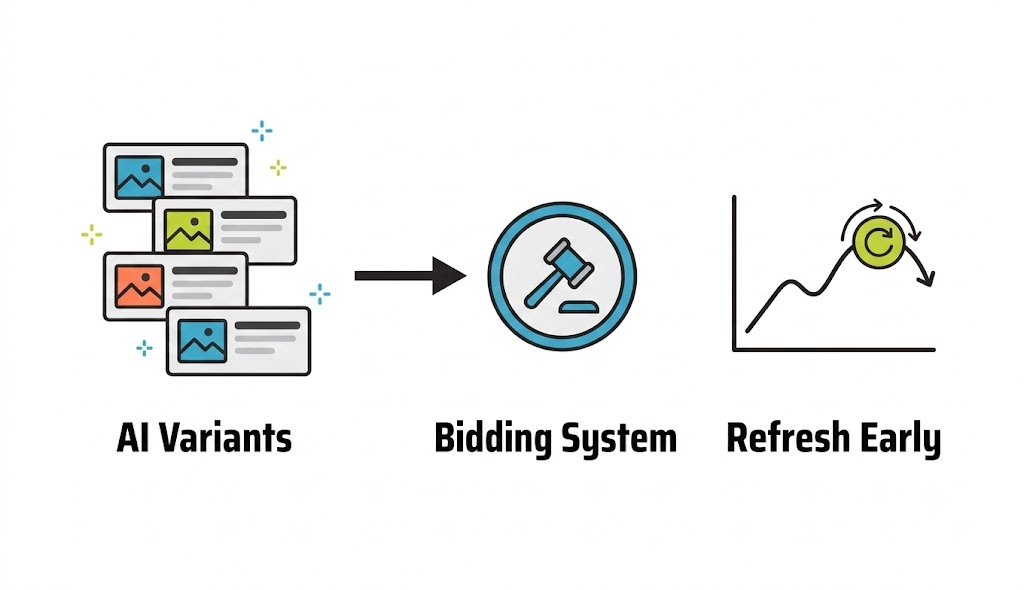
Increasingly, creative and bidding tools work together, allowing AI-generated ad variations to be pushed directly into platforms like Meta Advantage+ and Google Performance Max for automated testing and optimization. The teams getting the most from this connection are those that treat creative as an input to the bidding system — not as a finished product — and refresh variants before performance visibly drops rather than after.
AI Tools for Bidding and Campaign Optimization
Google Performance Max and Meta Advantage+ are the most widely used AI-driven bidding environments. Both use machine learning to manage placement, audience, creative, and bid decisions across their respective ecosystems simultaneously. The performance advantage is real, but so is the transparency trade-off: advertisers relinquish granular control in exchange for algorithmic optimization.
The practical implication is that these platforms perform best when they have enough data to learn from. Performance Max and Meta Advantage+ need a consistent flow of real purchase or lead conversion data — ideally 30 to 50 completed sales or qualified leads per campaign per month — to optimize accurately. Page views and clicks do not provide enough signal. When campaigns are only tracking surface-level activity, the AI learns to find users who click, not users who buy.
The most reliable setup sends conversion data directly from the brand's own server to the ad platform — bypassing browser restrictions that increasingly block standard tracking — using tools like Google's Server-Side Tag Manager or Meta's Conversions API. Teams without this in place are feeding the system incomplete information. The most consistent pattern seen across accounts is that data quality, not budget, determines whether automated bidding outperforms manual.
Optmyzr sits above Google and Meta campaigns, restoring some of the control and transparency that fully automated platforms remove. It is most useful for agencies and mid-market advertisers managing multiple accounts who need structured oversight without giving up automation efficiency.
AI Tools for Analytics and Attribution
Improvado AI Agent pulls data from ad platforms, CRMs, and analytics tools into one place where teams can request reports in plain English — no SQL required. For APAC teams managing campaigns across multiple markets, it aggregates regional data silos across Southeast Asia, Australia, and Japan while supporting local data residency requirements. Per Improvado's case data, teams reduce manual reporting time by up to 90% — though this reflects mature, multi-source integrations rather than minimal setups.
Atlas AI provides attribution modeling specifically for data-focused B2B and performance teams. It offers a more accessible entry point than enterprise multi-touch attribution platforms, with pricing starting at $39 per month. The constraint is model sophistication: it performs well for direct-response attribution but is less suited to long, complex B2B purchase journeys with multiple offline touchpoints. For teams moving off spreadsheet-based reporting for the first time, it provides a meaningful step up without the implementation overhead of enterprise platforms.
AI Tools for Email and Lifecycle Automation
HubSpot Breeze AI adds AI across CRM workflows, email automation, and lead scoring without requiring additional tool integration for teams already in HubSpot's ecosystem. Pricing is per AI-assisted outcome, such as a generated blog draft, a categorized lead, or an automated email response, at $0.50 to $1.00 each, making costs predictable at lower volumes.
Klaviyo forecasts customer lifetime value, identifies churn risk, and automates winback sequences based on purchase behavior. It performs strongest for e-commerce brands with transaction history — teams without it lose most of the predictive functionality.
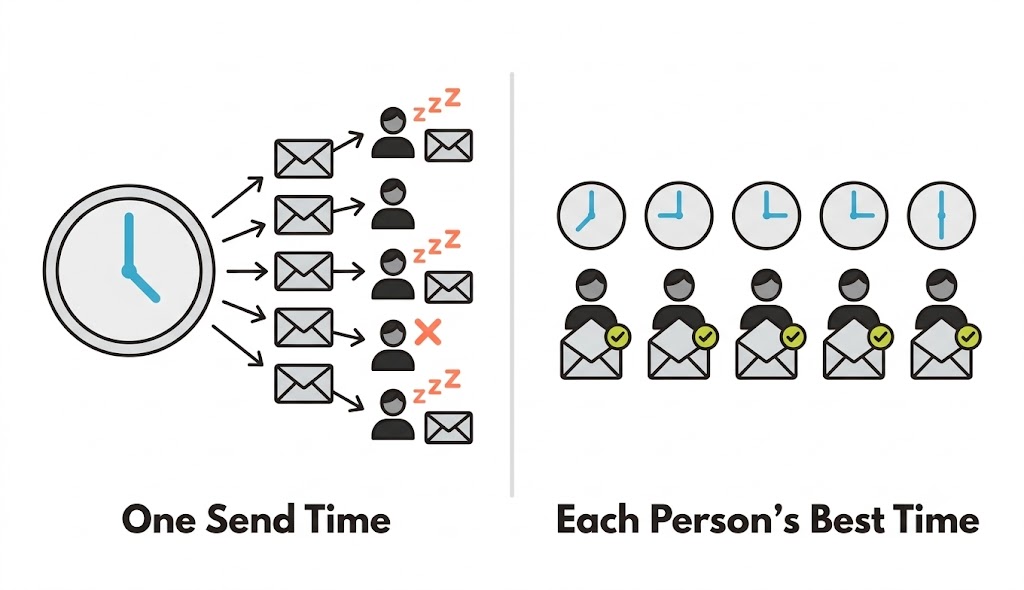
Seventh Sense addresses a specific and measurable email problem: send-time optimization at the individual recipient level. Rather than scheduling a broadcast to an entire list at one time, Seventh Sense analyzes each recipient's historical engagement patterns and delivers emails when that individual is statistically most likely to open. Pricing ranges from $64 to $450 per month, and implementation takes approximately two weeks, making it accessible for SMB teams. It works best for lists with at least three to six months of engagement history — newer lists do not yet have enough behavioral data for the optimization to be meaningful.
AI Tools for Workflow Automation
Zapier remains the most widely used workflow automation tool for SMB and mid-market teams. It connects more than 6,000 applications and enables multi-step automation triggers without code. Its limitation at enterprise scale is complexity: workflows that need to behave differently based on conditions — for example, routing a lead differently depending on where it came from, or recovering gracefully when a connected platform goes offline — require a more structured environment than Zapier provides.
n8n provides a more flexible workflow automation environment for teams with technical resources who need greater control over automation logic and custom integrations. It runs on self-hosted infrastructure — meaning data stays on the organization's own servers rather than passing through a third-party cloud. This matters for businesses operating across APAC markets where data residency laws require customer data to remain within specific geographic boundaries, including Australia, Singapore, and Japan.
Tool Comparison by Operational Tier
What Are Realistic Performance Benchmarks?
Benchmarks vary by industry, audience quality, and implementation depth. All figures reflect optimized conditions and should be treated as directional.
Creative automation. Zebracat AI's 2025 analysis found AI-generated creatives produce 47% better CTRs than traditionally produced ads. In practice, 20 to 35% is more typical for teams in early calibration — the upper range reflects mature programs with structured testing and regular brand voice refinement.
Bid optimization. AISofto's 2025 study found organizations using AI-driven optimization report an average 32% reduction in customer acquisition costs. Performance Max and Meta Advantage+ with strong conversion signals typically achieve 15 to 35% lower CPA versus manual campaigns. Weak signals or low conversion volume frequently produce the opposite.
Email performance. AI send-time optimization produces open rate improvements of 10 to 29%. Verified email's synthesis of 15 billion tracked emails found top-quartile B2B programs using AI personalization achieve 50%+ open rates and 10%+ CTR. New lists or infrequent senders see smaller gains.
Analytics efficiency. Teams using unified AI analytics platforms report 60 to 90% reductions in manual reporting time, depending on how many data sources are integrated.
Implementation costs. Per Improvado's total cost of ownership data: SMB teams typically spend $600 to $5,000 annually with 8 to 20 setup hours; mid-market $12,000 to $60,000 with 40 to 120 hours; enterprise $100,000 to $500,000+ with 200 to 500+ hours.
While these internal vendor benchmarks represent optimized setups, real-world gains depend heavily on factors such as data quality, integration maturity, and workflow setup.
When Should You Scale AI Tool Investment Versus Pause?
The decision to scale AI marketing tools should follow operational readiness, not vendor timelines.
When to Scale Investment
Proceed with expanding AI tool investment when the following conditions are in place:
- Conversion tracking is clean, consistent, and connected to the AI system receiving signals
- The team has editorial or analytical capacity to review and calibrate AI outputs
- Integration between tools is stable and data is flowing without manual intervention
- Early results show directional improvement over a four to eight-week baseline period
When to Pause and Restructure
Hold back on scaling when any of the following are present:
- AI-generated outputs require more correction time than manual production would have taken
- Platform-reported performance diverges significantly from CRM revenue or backend data
- Integration failures are causing data gaps that feed incorrect signals into optimization systems
- Cost per outcome is rising without corresponding revenue improvement
Adding more tools before fixing data infrastructure amplifies the underlying problem rather than correcting it.
What Limitations Affect AI Marketing Tools in Real Conditions?
No AI marketing tool eliminates structural performance constraints.
Signal loss from privacy restrictions. In plain terms, the data your ad platforms use to make decisions is getting less complete every year. Browser-side tracking limitations and consent management requirements reduce the accuracy of data that AI bidding and personalization systems rely on. The practical fix is sending conversion data directly from the brand's own server to ad platforms — using Google's Server-Side Tag Manager or Meta's Conversions API — bypassing browser restrictions. Teams still relying on standard pixel tracking are working with a shrinking data set.
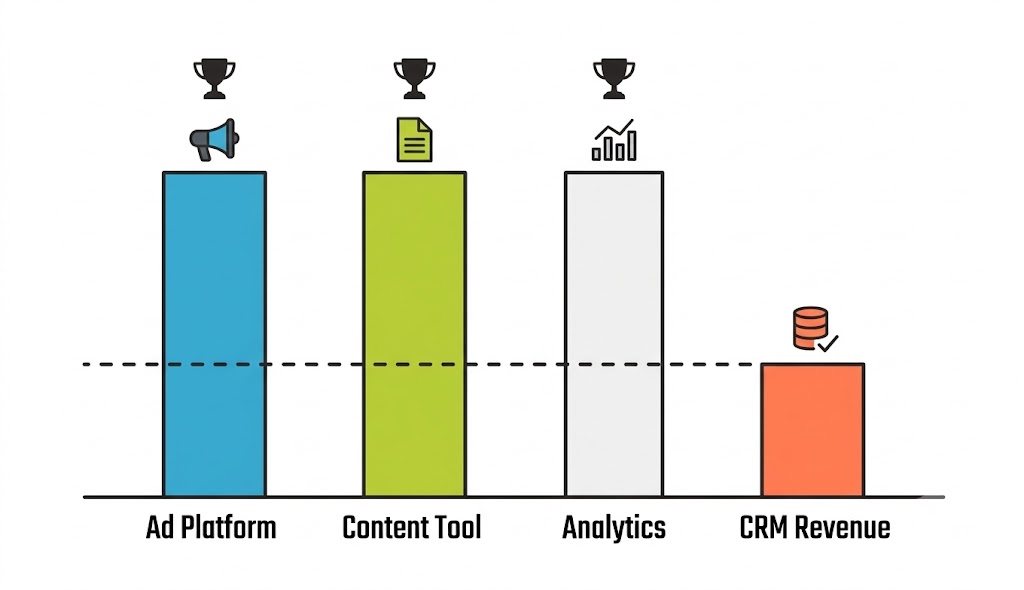
Attribution fragmentation. In plain terms: every platform claims more credit than it deserves. A content tool reports engagement. An ad platform reports conversions. A CRM records actual revenue. These numbers rarely agree, and the gap between what an ad platform reports and what actually closed in the CRM is one of the most consistently underestimated risks in AI-driven campaign management. The safest approach is to treat platform-reported ROAS as directional and validate against backend revenue data before making budget decisions.
Brand voice degradation. In plain terms: AI writing tools drift without supervision. Without regular review and prompt refinement, the tone, vocabulary, and positioning of AI-generated content gradually moves away from what the brand actually sounds like. Teams that configure brand voice guidelines once and revisit them infrequently see the sharpest quality drop — typically noticeable within six to eight weeks of initial deployment.
How Should Businesses Choose the Right AI Marketing Tools?
The best tool selection depends on operational maturity rather than feature checklists. For SMB and mid-market teams, usability, onboarding speed, and integration with existing platforms matter more than enterprise customization depth. Enterprise teams — particularly those in APAC — should prioritize integration depth, data governance, multi-market reporting, and compliance with regional data localization requirements including Australia's Privacy Act, Singapore's PDPA, and Japan's APPI.
The tool is not the strategy. Selecting tools before the data foundation is ready produces the most common and most avoidable implementation failures.
Conclusion
The strongest AI marketing automation stacks are not defined by the number of tools or the sophistication of any single platform. Performance depends on how effectively creative production, bid management, audience signals, and analytics connect into a system that learns continuously. For C-level executives and SME decision-makers, the practical question is not which platform has the most features — it is which tools fit the current operational reality, integrate with existing infrastructure, and can be measured against commercial outcomes rather than platform-reported metrics.
Frequently Asked Questions
What is the difference between AI marketing tools and traditional marketing automation?
Traditional automation executes predefined rules. AI tools learn from data patterns, predict outcomes, and adjust decisions in real time without manual updates.
Do AI bidding tools work without strong conversion data?
Not effectively. Platforms like Performance Max and Meta Advantage+ require 30 to 40 primary bottom-of-funnel conversions per campaign per month. Weak signal quality produces optimization toward the wrong outcomes.
How long does it take to see results?
Efficiency improvements are visible within two to four weeks. Performance improvements in bidding, email, and creative typically take four to eight weeks against a baseline.
What is the biggest risk when implementing AI marketing tools?
Fragmented data infrastructure. AI tools that optimize against incomplete data amplify the underlying problem. Fixing data foundations before scaling is the single most important sequencing decision.
Related Content
Read These Next
B2C Marketing Automation: 7 Retail Workflows That Drive Immediate Impulse Sales