Conversion Rate Optimization for SaaS: How to Turn Free Trials Into Paying Customers



What is the Average SaaS Free Trial Conversion Rate?
According to ChartMogul's SaaS Conversion Report, a good free-to-paid conversion rate for freemium products is 3% to 5%, while top-performing products achieve 8% to 12%. Products using credit card-required free trials typically convert 25% to 35%, with best-in-class products exceeding 50%.
Introduction
Most SaaS businesses spend significantly more on acquiring trial users than on converting them. That imbalance is expensive. A trial that ends without a conversion represents not just a lost customer but the full cost of acquisition, onboarding, and infrastructure that supported the free period.
The mechanics of free-to-paid conversion are well understood. What fails most often is execution: unclear onboarding, misaligned trial structures, and fragmented data that makes it impossible to identify where users drop off before they pay. According to ChartMogul's 2026 SaaS Conversion Report, based on 200 B2B software products, the median free-to-paid conversion rate is 8%, but conversion rates vary by more than 10x between the bottom and top 20% of products. That range reflects how much execution quality matters relative to product quality alone.
AI-driven onboarding platforms like Userflow or Chameleon, predictive activation scoring via HubSpot CRM, and in-product behavioral analytics engines like Amplitude or Mixpanel that track user events and trigger personalized guidance based on behavior have made it possible for smaller teams to operate conversion programs that previously required dedicated growth engineering. The tools exist. The gap is whether the system connecting traffic, activation, and conversion is structured correctly.
What This Guide Covers
This guide explains how to improve free trial to paid conversion in SaaS, covering the key levers, realistic benchmarks, and where conversion programs typically break down.
It covers:
- What drives free-to-paid conversion in SaaS
- How trial structure affects conversion rates
- The role of activation and time to value
- How onboarding sequences influence paid conversion
- Realistic benchmarks by trial type and business model
- Common failure modes and what to account for
- When to scale conversion investment
What Actually Drives Free-to-Paid Conversion?
Free-to-paid conversion in SaaS is determined by three factors working together: how quickly users reach a meaningful product moment, how well the onboarding sequence guides them toward that moment, and whether the trial structure creates sufficient motivation to upgrade before it ends.
No single factor produces strong conversion in isolation. A well-designed onboarding sequence cannot compensate for a product that takes too long to demonstrate value. A compelling upgrade prompt cannot convert a user who never became active during the trial. An excellent product experience will not convert users who receive no communication guiding them toward the paid plan.
The most common framing of conversion optimization focuses on individual tactics: better email sequences, improved upgrade CTAs, and stronger pricing pages. These matter, but conversion performance emerges from how these components work together across the trial lifecycle, not from any single element.
How Does Trial Structure Affect Conversion Rates?
Trial structure has a larger effect on conversion rates than most SaaS teams account for when choosing between free trial, freemium, or credit-card-required models. The differences are substantial.
According to ChartMogul's 2026 SaaS Conversion Report, which surveyed 200 B2B software products:
The most striking finding is the effect of requiring a credit card. Products with credit card required trials see conversion rates more than five times higher than those without.
However, the same report notes that credit card requirements reduce signup rates by approximately 50%, meaning the higher conversion rate applies to a smaller pool of users. The overall number of paying customers may or may not improve, depending on the product and audience.
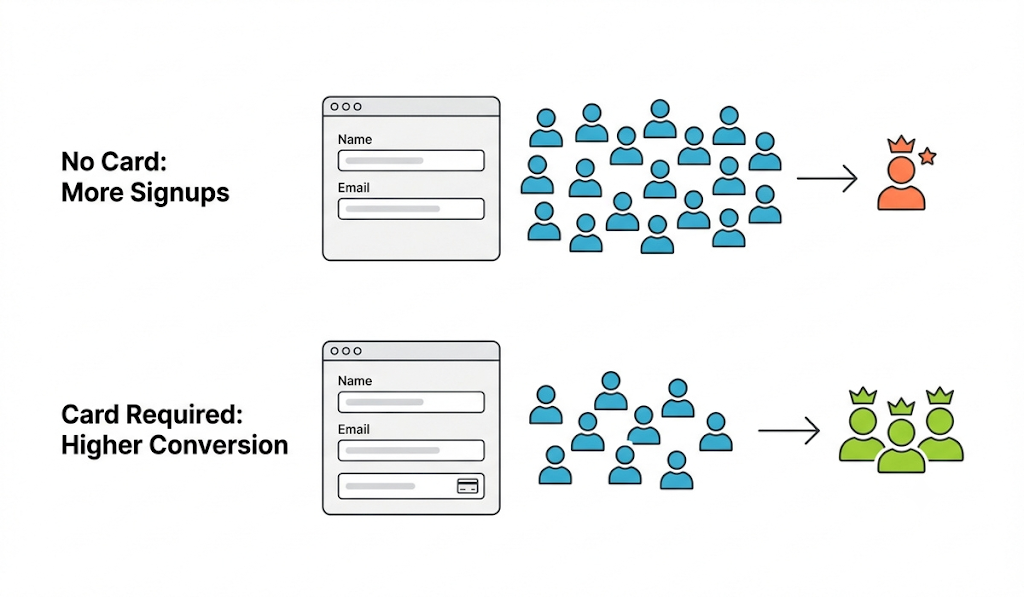
For most B2B SaaS products priced below $250 per month, free trials without a credit card requirement represent the most common structure, with good conversion defined as 4 to 6% and great as 10 to 15%. These benchmarks should be evaluated against actual product data, not treated as universal targets.
What Is Activation and Why Does It Predict Conversion?
Activation is the point at which a trial user experiences sufficient value to form a genuine reason to continue using the product. It is the most predictive variable for free-to-paid conversion and the most commonly underinvested element of the trial experience.
Activation is not defined by time spent in the product or pages visited. It is defined by the specific product moment that correlates with long-term retention for a given product. For a project management tool, activation might be creating a first project with teammates. For an analytics platform, it might be generating a first report from real data. Identifying the activation event specific to a product is the foundational step in conversion optimization.
The ChartMogul report found that 62% of products use a 14-day trial as their primary structure. A 14-day window is not long enough for users who reach activation late in the trial to meaningfully evaluate the product and make a purchase decision. Products that front-load activation, by guiding users toward the core value moment within the first two to three days, consistently outperform those that rely on users to discover value independently.
Time to activation is the single metric most worth optimizing before investing in email sequences, pricing page improvements, or upgrade prompt placement. Reducing time to activation by 48 hours often produces a larger conversion lift than any communication-layer optimization.
How Does Onboarding Influence Paid Conversion?
Onboarding is the sequence of product experiences, automated messages, and human touchpoints that guides a trial user from signup to activation and toward a purchase decision. It is the primary lever for improving conversion rates after trial structure is set.
Effective onboarding sequences share three characteristics. They are personalized to the user's stated or inferred use case. They are paced to the activation timeline, delivering the most important guidance before the trial closes rather than spreading communication evenly. And they respond to user behavior, accelerating sequences for engaged users and re-engaging users who go quiet early.
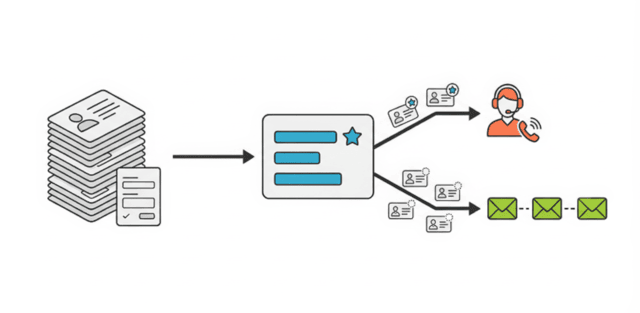
The ChartMogul data shows 80% of free trial products have human touchpoints when an enterprise user enters the trial. A hybrid model, where automated onboarding handles volume and sales or customer success intervenes for high-intent accounts, outperforms either purely automated or purely human approaches.
Onboarding sequences tied to activation milestones—defined as high-value, multi-step actions that confirm a user has successfully experienced the product's core value—produce stronger conversion than time-based drips. A message sent because a user completed a key action carries more relevance than one sent because seven days have elapsed since signup.
How Do These Factors Work as a System?
Free trial conversion is not a single decision or campaign. It is a system where traffic quality, trial structure, activation speed, onboarding sequence, and upgrade prompt timing interact to produce a conversion rate that reflects how well those components are connected.
Acquisition channels determine who enters the trial and with what intent. High-intent search traffic converts at higher rates than broad awareness traffic. Trial structure determines what the user can access and how long they have. Onboarding and activation determine whether the user experiences enough value to decide to pay. The upgrade prompt and pricing page determine whether a motivated user can complete the conversion without friction.
B2B conversion optimization should address both end users and buyers, since the person using the product during the trial is often different from the person who approves the purchase. Onboarding should help users experience value quickly, while automated email campaigns should highlight ROI and business benefits for decision-makers.
Improvements at any single stage create downstream effects. Reducing trial length without improving activation produces more expired trials. Improving onboarding without addressing traffic quality produces better-nurtured users who were never likely to convert. The sequence of optimization matters as much as the optimizations themselves. Activation is the right starting point for most products.
What Are Realistic Benchmarks for SaaS Free Trial Conversion?
Conversion benchmarks vary significantly by trial type, price point, market segment, and activation design. The figures below are drawn from ChartMogul's 2026 SaaS Conversion Report and should be treated as directional reference points, not universal targets.
A conversion rate below 4% for a free trial without a credit card requirement is a signal that something is structurally broken, most often in activation speed or onboarding clarity. A rate above 15% typically reflects strong activation design, high-intent traffic, or both.
The most reliable indicator of whether a conversion rate is good or poor is not the absolute percentage but whether it is improving over time with deliberate optimization. A rate that is stable or declining despite active optimization effort usually indicates a structural issue in activation or product value delivery, not a communication problem.
What Causes Free Trial Conversion to Underperform?
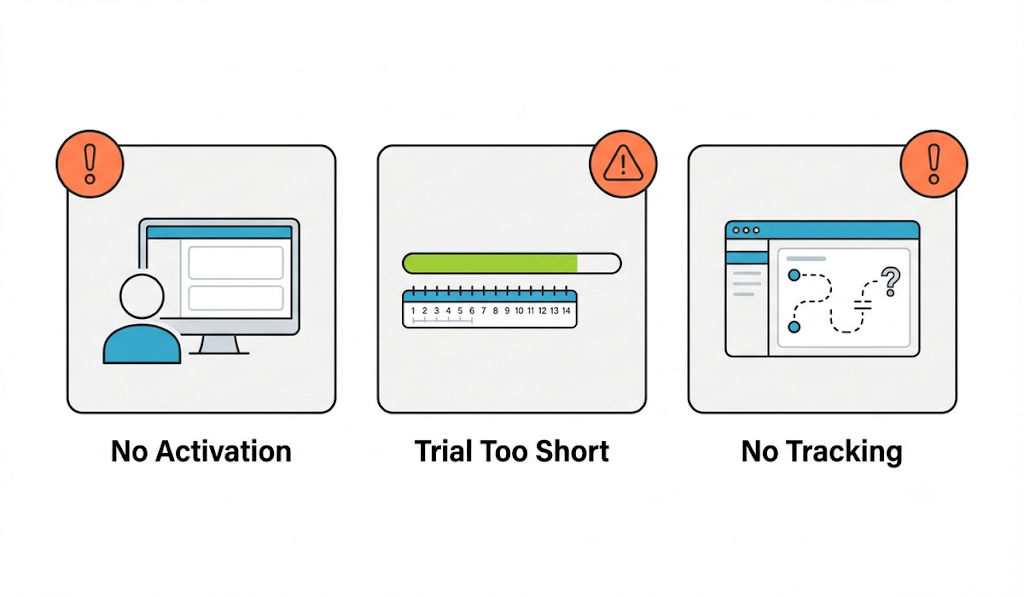
Most underperformance in free trial conversion traces back to activation gaps, structural mismatches, or measurement problems rather than to upgrade prompts or pricing pages.
Activation failure is the most common cause. Users who do not reach the core product value moment have no genuine motivation to pay. No email sequence can substitute for the experience of the product working as intended.
Structural mismatch occurs when trial length, feature access, or upgrade trigger does not match the complexity of the product or the buyer's decision timeline. A 14-day trial for a product that requires two weeks of setup before the value is visible is structurally misaligned.
Measurement fragmentation makes it impossible to identify where users drop off. Without behavioral event tracking connected to a CRM like Salesforce or a product analytics tool like June.so, conversion optimization becomes guesswork. The most common gap is failing to track which users reach activation versus which users churn from the trial without engaging with the core product.
Attribution gaps compound this. Because standard last-touch attribution models default to tracking the final click, platform-reported analytics frequently over-credit the final touchpoint before conversion, making the last email in an onboarding sequence appear more influential than the in-product activation event that preceded it.
When Should You Scale Conversion Optimization Investment?
Conversion optimization investment should scale when the foundational elements are in place: activation is defined and measurable, onboarding sequences are running and connected to behavioral triggers, and conversion data is being tracked at the individual user level.
Scaling before these conditions are met produces more optimization activity without producing more conversions, because the underlying system does not have the data quality or activation clarity needed to improve through testing.
The most common scaling mistake is investing in more email sequences or upgrade prompt variants before resolving activation gaps. Testing messaging around a product that users have not yet found value in produces consistent results: no statistically significant improvement in conversion, and confidence intervals wide enough to validate any conclusion the team wants to reach.
Conclusion
Free trial to paid conversion in SaaS is a system problem before it is a messaging problem. Activation speed, trial structure, onboarding sequence design, and measurement infrastructure interact to produce a conversion rate that reflects how well those components are connected.
The ChartMogul 2026 benchmark data from 200 B2B software products shows a median conversion rate of 8%, with a 10x gap between top and bottom performers. That gap is not explained by product quality. It is explained by how deliberately each component of the conversion system has been designed and measured.
For most SaaS products, the highest-leverage starting point is identifying and reducing time to activation. Everything else in the conversion system becomes more effective when users reliably reach the product value moment before the trial ends.
FAQs
What is a good free trial conversion rate for SaaS?
Per ChartMogul's 2026 report, good is 4 to 6% for a free trial without a credit card requirement and great is 10 to 15%, varying by segment and trial structure.
What is the difference between activation and conversion?
Activation is when a trial user experiences meaningful product value. Conversion is when they pay. A user can activate and still not convert if pricing or upgrade friction gets in the way.
Why do credit card required trials convert at higher rates?
They pre-qualify users at signup — ChartMogul's 2026 data shows 25 to 35% good conversion for credit card required trials versus 4 to 6% without, though signup volume drops by around 50%.
What causes low free trial conversion rates?
Slow activation, a mismatch between trial length and product complexity, and no behavioral tracking to identify where users drop off before converting.
How do you measure whether conversion optimization is working?
Track conversion rate by cohort and cross-reference platform-reported figures with CRM data to account for attribution gaps.
Related Content
Read These Next
Conversion Rate Optimization for Lead Generation: 7 Tactics That Fill Your Pipeline Faster