.png)

What is Programmatic Advertising? - The Complete 2026 Guide to Ad Automation
.png)

.png)

SNAPSHOT
Programmatic advertising is the automated buying and selling of digital ad space using software, algorithms, and audience data. Instead of manual negotiations and insertion orders, technology handles the transaction in real time — matching the right ad to the right user across channels including web, mobile, connected TV, and digital out-of-home.
Introduction
Digital advertising used to require people to manage every transaction. Relationship calls, proposal documents, negotiated insertion orders, and manual trafficking created a process that was slow, opaque, and difficult to scale. Programmatic advertising replaced most of that with software.
Today, programmatic is how most digital media is bought and sold. Global programmatic ad spending is projected to reach $273.7 billion in 2026, with more than 91% of digital display ads now transacted programmatically. Across APAC markets — including Australia, Singapore, and Japan — adoption has accelerated as fragmented media consumption across devices and streaming platforms has made manual buying impractical at scale.
The operating environment has grown more complex at the same time. Third-party cookie deprecation has reduced user-level tracking visibility. AI-driven campaign automation has shifted optimisation decisions from media planners to platform algorithms. Attribution across fragmented customer journeys has become harder to verify. These changes mean that understanding how programmatic actually works — as a system, not just a channel — has become a prerequisite for informed media investment.
Performance depends less on individual campaign settings and more on how efficiently each component of the system interacts: audience data, inventory access, bidding logic, creative relevance, and conversion tracking.
What This Guide Covers
This guide explains how programmatic advertising works across the full buying and selling ecosystem and how to approach it for measurable performance.
It covers:
- What programmatic advertising is and how it differs from traditional media buying
- How the real-time bidding process works end to end
- The four deal types and when each applies
- Targeting methods and what drives performance
- Realistic cost and return benchmarks by channel
- Where the system breaks down in real-world conditions
- How AI and privacy changes affect campaign performance in 2026
What Is Programmatic Advertising?
Programmatic advertising is the automated process of buying and selling digital ad space in real time using software, algorithms, and audience data. Instead of negotiating placements with individual publishers, advertisers define targeting criteria and budgets, and the system finds and purchases matching inventory across exchanges — in milliseconds.
Unlike traditional media buying, programmatic:
- executes transactions in real time without manual negotiation
- uses audience data to match ads to users rather than placing ads on fixed sites
- adjusts bids dynamically based on predicted conversion probability
- operates across multiple channels and inventory sources through a single platform
This makes programmatic both a buying method and a performance optimisation system. Every impression, bid, and placement generates data that feeds back into the model and informs subsequent decisions.
How Does Programmatic Advertising Work?
Programmatic advertising works through an automated auction that occurs every time a user loads a page with available ad inventory. The entire process — from ad request to ad delivery — completes in under 200 milliseconds.
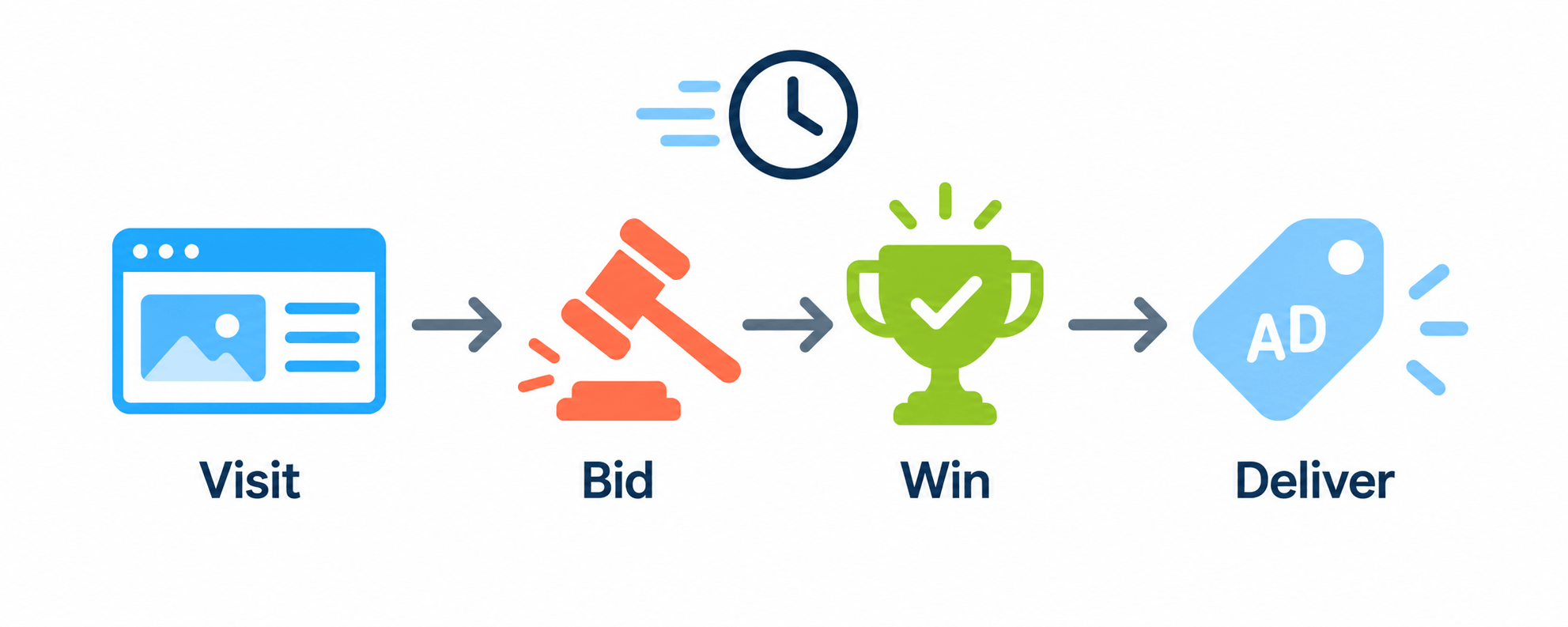
When a user visits a website or opens an app, the publisher's system sends an ad request to an ad exchange. That request includes contextual data about the placement and, where permitted, anonymised signals about the user — browsing behaviour, location, device type, and inferred interests. The ad exchange distributes this request to connected advertiser platforms, which evaluate whether the impression matches their targeting criteria and submit bids. The highest eligible bid wins, and the ad is served to the user before the page finishes loading.
The process repeats for every ad impression, across every publisher, simultaneously.
What makes this more than a simple price auction is the intelligence layer underneath it. Advertiser platforms draw on first-party data, modelled audiences, and real-time conversion signals to assess the value of each impression — not just whether a user technically matches the targeting parameters, but how likely they are to convert based on prior outcomes. Bid prices adjust continuously. The system learns from results and shifts spend toward the audiences, times, and placements that generate measurable performance.
Step-by-step flow:
- User visits a publisher site or app
- Publisher's platform sends an ad request to the ad exchange
- Ad exchange distributes the request to connected advertiser platforms
- Advertiser platforms evaluate the impression and submit bids
- Highest eligible bid wins the auction
- Winning ad is delivered to the user's screen
- Outcome data (view, click, conversion) feeds back into the bidding model
What Are the Key Components of the Programmatic Ecosystem?
The programmatic ecosystem is built on four interconnected platform types. Performance depends on how well each component functions and how they interact with each other.
Demand-Side Platforms (DSPs) are the advertiser's interface with the ecosystem. Marketers use a DSP to define campaign objectives, set targeting parameters, manage bids, and access inventory across exchanges. The choice of DSP determines which inventory sources are accessible, what data signals are available, and how much transparency the buyer receives into placement performance. Major DSPs include The Trade Desk, Google Display & Video 360 (DV360), and Amazon DSP.
Supply-Side Platforms (SSPs) serve the publisher side. An SSP connects a publisher's available inventory to multiple exchanges and DSPs simultaneously, running yield optimisation to maximise revenue per impression. Publishers use SSPs to set price floors, manage demand partners, and control buyer access to their inventory. The SSP and DSP do not communicate directly — the ad exchange sits between them.
Ad Exchanges are the neutral marketplaces where transactions clear. They receive bid requests from SSPs, distribute them to DSPs, run the auction logic, and settle the transaction. Major exchanges include Google Ad Exchange, OpenX, Magnite, and Xandr.
Data Management Platforms (DMPs) and Clean Rooms enable audience segmentation and data activation. A DMP collects first- and third-party signals and pushes audience segments to the DSP to inform targeting. As third-party cookie availability continues to decline, clean room environments — where advertiser and publisher first-party data can be matched without raw data transfer — are becoming the more sustainable infrastructure for audience-level buying.
These components do not operate independently. Campaign quality reflects the weakest link in the chain. Strong audience data underperforms if it reaches poor-quality inventory. Premium inventory produces limited results if creative is weak or conversion tracking is broken. Attribution built on third-party signals becomes unreliable as those signals disappear.
What Are the Four Types of Programmatic Deals?
Not all programmatic inventory is purchased through open auctions. Deal structures vary by exclusivity, pricing control, and inventory quality — and the right choice depends on campaign objectives.
Open Auction (Real-Time Bidding / RTB) is the default mechanism for most programmatic spend. Any eligible advertiser can bid on available inventory, and pricing is set dynamically by competition. RTB offers the broadest reach and lowest average CPM but provides the least control over placement quality. Brand safety and contextual relevance require active management through inclusion and exclusion lists.
Private Marketplace (PMP) is an invite-only auction where a publisher makes premium inventory available to a select group of advertisers at or above a price floor. PMPs offer higher transparency and brand safety than open RTB. They are typically used when the content environment matters — brand awareness on quality editorial, for example. CPMs run higher than open auction, but audience quality and viewability rates often justify the premium.
Preferred Deals give a specific advertiser first look at publisher inventory at a pre-agreed fixed price before it enters any auction. The advertiser can accept or pass on each impression. This model provides pricing predictability and priority access without the volume commitment of a direct deal.
Programmatic Guaranteed mirrors a traditional direct media buy but executes through programmatic technology. A fixed volume of impressions is reserved at an agreed CPM. No auction occurs. This is appropriate for campaigns where securing specific, high-value placements matters more than price efficiency — major product launches, brand tentpole events, or campaigns requiring assured delivery on specific premium publishers.
For most SME and mid-market advertisers, open RTB and PMPs represent the practical starting point. Programmatic Guaranteed typically requires the budget scale and publisher relationships to justify the volume commitment.
What Targeting Methods Does Programmatic Support?
Programmatic's primary value is precision, the ability to reach a defined audience rather than a defined placement. Targeting methods vary in signal quality, privacy compliance, and how they perform as third-party data continues to decline.
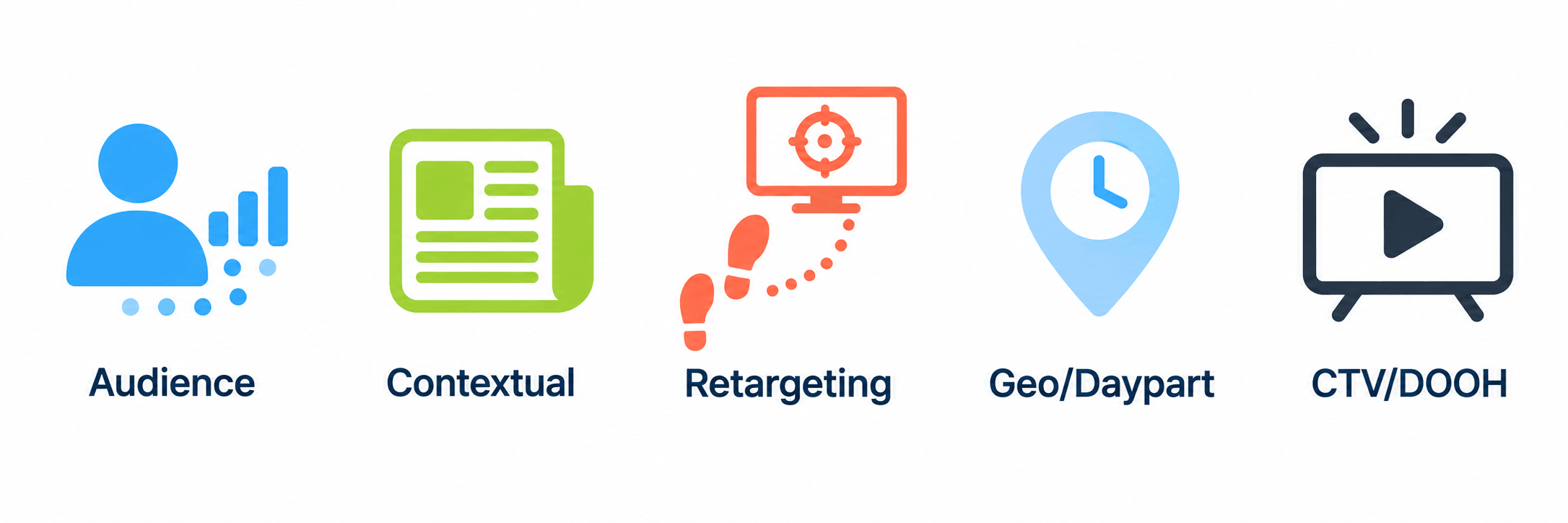
- Audience-based targeting uses behavioural signals — browsing history, purchase intent, category affinity — to identify users likely to be relevant to a campaign. This draws on first-party CRM data pushed to a DSP, second-party data partnerships, or third-party audience segments purchased through a DMP. First-party data consistently produces the strongest performance when the seed audience is sufficiently large, recent, and behaviourally relevant. Third-party segments are broader, less current, and increasingly constrained by privacy regulation.
- Contextual targeting places ads based on the content of the page rather than data about the user. A financial services brand targets business news. A consumer electronics brand targets technology review content. Contextual has become a more prominent strategy as third-party signals have declined — it requires no individual user tracking and aligns naturally with privacy-first environments. Modern contextual tools use natural language processing to assess page-level relevance with significantly more precision than keyword matching alone.
- Retargeting reaches users who have previously visited a site or completed a defined action. It consistently delivers the strongest conversion rates in a programmatic mix — retargeting campaigns typically generate two to three times higher click-through rates than equivalent prospecting campaigns. Audience pools are smaller, and frequency management is essential to prevent oversaturation.
- Geographic, device, and daypart targeting narrow delivery based on location, device, and time. Daypart targeting refers to controlling ad delivery during specific hours of the day or days of the week when audience engagement or conversion likelihood is highest. These parameters are particularly relevant for businesses with physical locations, time-sensitive offers, or strong device-usage patterns in their category.
- Connected TV (CTV) and digital out-of-home (DOOH) have expanded programmatic into non-screen and streaming environments. CTV is growing rapidly as a programmatic channel across Australia and APAC, with audience-level targeting now available through streaming publishers at a meaningful scale. In our recent campaign audits, CTV inventory has commonly produced stronger completion rates and lower frequency fatigue than equivalent pre-roll inventory in highly saturated retargeting environments.
What Does Programmatic Advertising Cost?
Programmatic pricing is not fixed. It varies by inventory type, audience quality, deal structure, vertical, and region. Cost ranges help set realistic expectations before committing to the budget.
Costs are typically expressed as CPM (cost per thousand impressions). Open auction display CPMs generally fall between $0.50 and $5 across most consumer verticals. B2B audiences, financial services, and high-intent segments routinely transact at $8 to $20 CPM or higher. Private marketplace deals carry a 30% to 100% premium over open auction rates for equivalent placement quality.
Video CPMs are substantially higher than display. Pre-roll video inventory on premium publishers typically ranges from $15 to $35 CPM. Connected TV inventory, which commands the strongest engagement rates, commonly clears at $25 to $50 CPM across APAC and US markets.
The more useful measure for performance campaigns is Cost Per Acquisition (CPA) relative to customer value. A $25 CPM that produces a $40 CPA on a product with a $300 average order value is an efficient media buy. A $1 CPM display buy that generates no measurable conversion is expensive regardless of the unit price.
Return on Ad Spend (ROAS) benchmarks vary significantly by vertical and funnel stage. E-commerce campaigns with strong first-party data and structured retargeting commonly deliver 3x to 7x ROAS on direct-response objectives. Brand awareness campaigns are not meaningfully measured by ROAS — the relevant metrics are reach, frequency, and downstream impact on branded search or consideration lift.
Minimum effective budgets depend on the market and the objective. Programmatic platforms require sufficient impression volume for machine learning to stabilise bidding after the learning phase. For SMEs, this generally means a minimum of $3,000 to $5,000 per month per active campaign line to generate enough data for meaningful optimisation. Smaller budgets produce impressions but unreliable performance signals.
Where Does Programmatic Break Down?
Programmatic performs well when signals are clean, data is accurate, and attribution reflects actual behaviour. Several structural limitations affect how the system operates in practice.
Signal loss is the most significant constraint in the current environment. Third-party cookies, which historically underpinned cross-site tracking and attribution, are restricted or deprecated across most major browsers. Campaigns relying on third-party audience segments reach users who are less accurately profiled than the data implies. Modelled conversions — which platforms use to fill attribution gaps — introduce assumptions that can overstate performance, particularly for longer sales cycles or campaigns with low conversion volume.
Ad fraud is a real cost. Estimates of fraudulent traffic in the open web programmatic market typically range from 10% to 25% of served impressions, depending on the verification methodology. Invalid traffic — bots, non-human crawlers, stuffed ad frames — inflates impression counts without producing genuine user exposure. Third-party verification through providers such as IAS, DoubleVerify, Oracle Moat, or MOAT is not optional at a meaningful programmatic scale.
Platform bias affects how performance is reported. DSPs and ad exchanges have structural incentives to attribute conversions to their own inventory and report results favourably. Last-touch attribution overweights the final impression before conversion and undervalues upper-funnel channels. Multi-touch models address this but require cross-platform data integration that most mid-market advertisers have not yet implemented. Marketing Mix Modelling (MMM) and incrementality testing provide more reliable performance measurement in privacy-constrained environments, without dependence on user-level tracking.
Inventory quality varies significantly in the open exchange. The same ad can appear on premium editorial, low-quality made-for-advertising (MFA) sites, or adjacent to brand-unsafe content. Allowlists, blocklists, and contextual safety tools reduce exposure but require active maintenance. Buying through curated PMPs reduces quality risk at the cost of reach and scale. Commonly observed in the Australian market, MFA inventory frequently enters open exchange buys through low-cost scale optimisation strategies that prioritise CPM efficiency over placement quality.
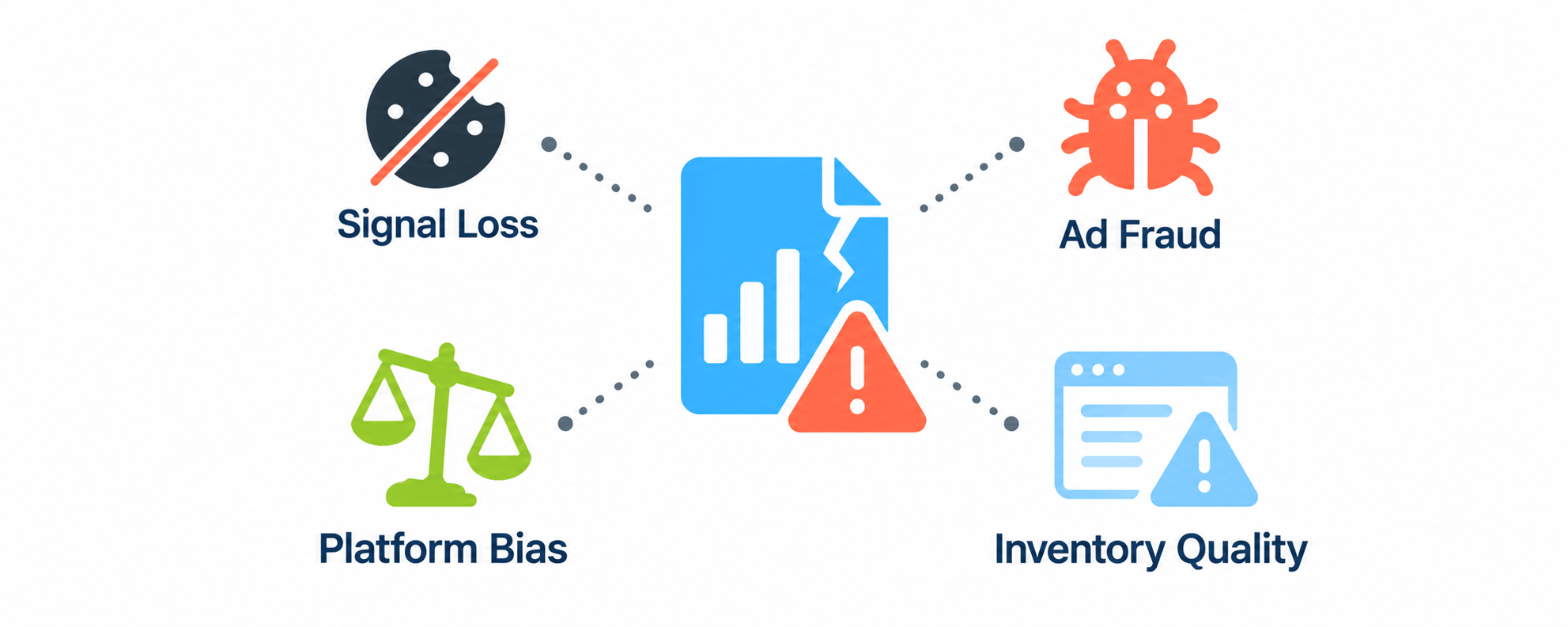
Common programmatic failure points:
How Should Organisations Approach Programmatic in 2026?
Programmatic readiness depends on whether the conditions that make the channel effective are in place. Adding spend to a broken measurement environment or undefined audience strategy produces inconsistent results regardless of budget size.
Conversion tracking must be functional and complete. Without accurate conversion signals returning to the DSP, automated bidding has nothing to optimise toward. Campaigns running with broken pixel tracking, incomplete server-side event setups, or misattributed conversions consistently underperform — not because the channel fails, but because the platform cannot learn from missing inputs. Server-side tagging and Customer Data Platform (CDP) integration improve signal reliability where client-side tracking is constrained.
First-party data quality determines targeting ceiling. Advertisers with clean CRM data — customer lists, purchase history, segmented email audiences — can build seed audiences, create lookalike segments, and suppress existing customers from acquisition campaigns. Advertisers without structured first-party data depend more heavily on third-party segments that are declining in both accuracy and availability.
Creative must be built for each format. Display, video pre-roll, native, and CTV placements have different technical requirements and user expectations. Campaigns that repurpose a single static asset across all inventory types without adaptation consistently underperform campaigns built with format-specific creative.
Reporting infrastructure determines how quickly the team can act. Programmatic generates high data volume — impressions, clicks, view-through events, frequency exposure, placement-level performance. Without a clear process for reviewing and acting on this data within reasonable timeframes, the optimisation advantage over manual buying is lost.
AI automation shifts — but does not eliminate — the media buyer's role. Platforms increasingly handle bid adjustments, audience expansion, and creative rotation automatically. The practical work shifts toward signal quality: ensuring conversion events fire accurately, that the data feeding the model is clean, and that exclusion lists and brand safety parameters are actively maintained. Algorithmic performance is only as reliable as the inputs it receives.
For SMEs accessing programmatic through a managed service or agency, the same conditions apply. The organisation provides clean first-party data, a functional tracking setup, and clearly defined performance objectives. The platform and its operators handle execution — but they cannot compensate for missing or unreliable inputs at the foundation.
Conclusion
Programmatic advertising is a system where inventory access, audience data, bidding logic, creative, and conversion tracking interact to determine whether spend produces measurable outcomes. Performance depends on how each component functions — and how reliably they connect.
In 2026, AI-driven optimisation and privacy constraints have reduced manual control at the campaign level while increasing dependence on data quality and measurement infrastructure. Platforms can automate bids, expand audiences, and rotate creatives — but they cannot compensate for broken tracking, low-quality audience data, or a mismatch between the ad and the user's actual intent.
For executives and decision-makers, the most useful question is not whether to use programmatic — at meaningful digital spend levels, it is almost certainly already part of the media mix. The more relevant question is whether the infrastructure supporting it — tracking, data, measurement — is capable of producing the signals the system needs to perform.
Programmatic works when the inputs are clean. Getting those inputs right is where the investment actually begins.
FAQs
What is the difference between programmatic advertising and display advertising?
Display refers to the ad format; programmatic refers to the buying method. Display inventory can be purchased programmatically or through direct deals.
What is the difference between a DSP and an ad network?
A DSP gives advertisers direct access to inventory across exchanges with full visibility into placement and performance. Ad networks aggregate and resell inventory with less transparency into where ads run or at what margin.
Does programmatic advertising work for B2B businesses?
Yes, when combined with intent data or account-based targeting. B2B audiences are smaller, which pushes CPMs higher, but targeting by job function and company size makes programmatic viable where other channels lack precision.
What should SMEs prioritise when starting with programmatic?
Fix conversion tracking first, then build first-party audience lists. Start with retargeting before prospecting — the audience pools are smaller but conversion rates are significantly higher, generating reliable performance data faster.
How does programmatic handle privacy regulations?
Reputable DSPs and SSPs build consent management into their bid stream logic. Advertisers remain responsible for ensuring first-party data is collected with appropriate consent under applicable frameworks — including Australia’s Privacy Act and Australian Privacy Principles (APPs), GDPR in Europe, CPRA in California, and other evolving APAC and US state-level privacy regulations.
How do I know if a programmatic campaign is performing well?
For direct response, measure CPA relative to customer value and Return on Ad Spend (ROAS) relative to margin targets. Consistent conversion volume at a stable or improving CPA is the clearest signal of a healthy campaign.
Related Content
Read These Next
Personalization in Marketing Automation: The Ultimate Playbook for Engagement