.png)
B2B Conversion Rate Optimization Strategy for Complex Sales Funnels
.png)

.png)

In 2026, a B2B CRO sales funnel is a machine-readable technical architecture that converts high-intent buyers through AI-mediated discovery and automated qualification. It prioritizes Interaction to Next Paint (INP) for user trust and Generative Engine Optimization (GEO) for visibility in AI overviews, replacing traditional manual lead nurturing with Agentic AI systems.
Key Takeaways
- Successful funnels treat each stage as a distinct technical objective: Awareness requires formatting for AI citations, Evaluation depends on deep expertise (E-E-A-T), and Purchase focuses on removing technical friction.
- Improving Interaction to Next Paint (INP) ensures mobile sites feel instant, which is more critical for building trust than aesthetic design.
- Organizations are pivoting toward zero-party data for voluntary data sharing by customers, to comply with strict privacy laws like GDPR and the EEA.
- Agentic AI and prospecting agents can independently research leads, update CRM records, and route high-intent buyers to sales staff in seconds.
- Using interaction-based triggers ensures buyers are not interrupted prematurely, leading to higher-quality leads and better conversion outcomes.
- To maintain organic visibility in AI-mediated search in 2026, brands should adopt Generative Engine Optimization (GEO) to increase the likelihood that their content is included in AI-generated summaries.
Aligning B2B Funnel Stages with Modern Search Intent
Success in 2026 requires matching website content to the specific technical intent of the visitor at each step of the journey. A complex B2B sales funnel moves prospects through three main phases to reach a final agreement.
- Awareness Stage and Informational Intent: Visitors search for basic answers using beginner learning queries. Optimization focuses on Answer Engine Optimization (AEO), a technical method of formatting content so artificial intelligence search tools can recognize and cite the website as a direct, correct source of information.
- Evaluation Stage and Comparison Intent: Buyers compare different software or service providers. High Experience, Expertise, Authoritativeness, and Trustworthiness (E-E-A-T) signals are used to establish credibility. These signals are standards search engines use to judge if a website is trustworthy based on real-world knowledge and established authority.
- Purchase Stage and Transactional Intent: Buyers navigate procurement flows and multi-stakeholder approval barriers. The objective is to satisfy transactional intent by reducing technical friction in the final sign-up or checkout process.
This alignment provides the right information at the exact moment a buyer needs it to progress.
Traditional SEO vs. GEO: How Search Visibility is Changing
Traditional SEO focuses on helping pages rank in search results and earn clicks. GEO focuses on helping content become clear, credible, and structured enough to be cited or summarized by AI search tools. Both matter, but GEO is increasingly important when buyers get answers from AI-generated summaries before they ever visit a website.
Before a funnel can personalize, qualify, or route buyers effectively, it has to earn the visitor’s trust at the point of interaction. Technical health is the first domino in CRO because every later conversion moment depends on the site responding quickly, forms loading smoothly, and buyers feeling confident enough to continue.
In long B2B cycles, a lagging page or broken interaction does more than reduce convenience; it weakens credibility before the sales conversation begins.
That is why the first optimization priority is not creative messaging or visual redesign. It is the technical foundation that makes every later tactic—data collection, AI personalization, routing, and buying committee enablement—work reliably.
Effective Tactics for Optimizing B2B Sales Cycles
Improving performance in long B2B cycles involves combining technical speed with smart data collection and artificial intelligence.
Tactic 1: Streamlining Data Collection and Page Experience
High-performing sales cycles focus on technical health and gathering information directly from visitors. Before a funnel can personalize or qualify buyers, the experience must feel fast, credible, and easy to complete. By making websites faster and forms easier to use, organizations can turn more browsers into qualified leads without causing user frustration.
Technical Trust and Consent-Based Data Collection
The first conversion barrier in a complex B2B funnel is often not the offer itself. It is the quality of the interaction. Slow response times, long forms, and unclear data requests can make buyers hesitate before they ever reach sales.
- Interaction to Next Paint (INP)
Improving Interaction to Next Paint (INP), a metric that measures how long it takes for a site to respond after a click, ensures mobile websites feel instant. The speed of page responsiveness influences overall user experience, thereby affecting the decision-making of a purchase.
- Zero-Party Data Collection
Smart, multi-step forms collect Zero-Party Data, information that a customer shares directly and intentionally with a brand. This is a pivot away from traditional tracking due to strict privacy laws like GDPR and EEA regulations, which require clear user consent for data tracking. Organizations now ask for information directly to stay compliant and ensure data accuracy.
- Differential Privacy and Aggregated Tracking
In 2026, B2B teams must also account for the shift toward Differential Privacy, a measurement approach that protects individual identities by adding statistical noise or using aggregated data patterns instead of exposing user-level behavior. This means marketers can still identify broad conversion trends, but they cannot rely as heavily on precise third-party tracking at the individual level.
- Lead Form Simplification
Reducing the number of steps helps more people finish forms. Removing unnecessary fields decreases the effort required by a visitor during the final purchase stage.
Implementation Guide
Pro-Tip: Prioritize technical speed before making design changes. A fast site that responds instantly to user input builds more trust than a beautiful site that lags. Use simple, interactive forms early in the funnel to gather data that makes later stages feel more personal and less like a sales pitch.
Case Study: involve.me
Site involve.me used its AI funnel builder and interactive forms to collect data directly from users. The problem was low engagement with traditional landing page forms. By using interactive surveys to gather better user insights, the process resulted in an 80% response rate for onboarding surveys.
Tactic 2: Leveraging AI for Personalized Engagement and Routing
Automation tools and smart assistants help move leads through the sales process with less manual work. In long B2B cycles, the value of AI is not only speed; it is relevance. These systems ensure that every visitor receives information that matches their intent and that sales teams talk to the right people at the right time.
Real-Time Personalization and Sales Handoff
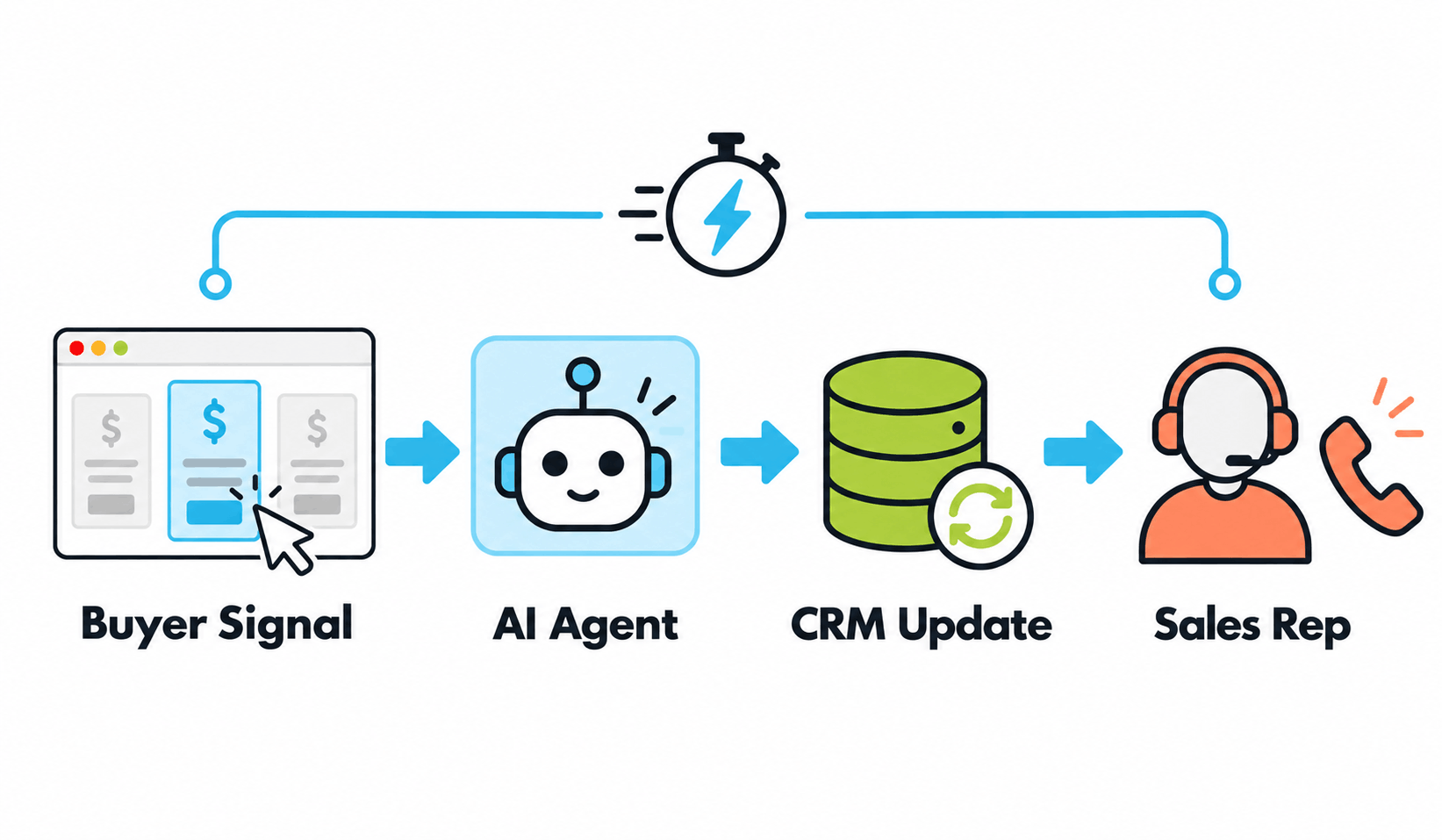
AI works best when it connects visitor behavior, CRM data, and sales routing into one continuous process. Instead of treating personalization and sales follow-up as separate activities, B2B teams should use AI to interpret buyer signals and trigger the next best action.
- Personalized Content Generation
Agentic AI, advanced artificial intelligence that can act independently to complete multi-step goals, keeps visitors interested by creating dynamic pages. These pages change based on user history to increase relevance and satisfy specific intent.
- Pipeline Automation
Prospecting Agents autonomously research contacts and perform personalized outreach. These are AI tools designed to find potential customers and start sales conversations automatically. These tools also use Customer Relationship Management (CRM) software, a system that stores all information about customer interactions—to find the best time to contact a lead.
- Automated Lead Routing
Speeding up the routing process ensures sales staff can speak to interested people while they are still on the site. This process reduces the time a lead stays cold and improves pipeline velocity.
Implementation Guide
Pro-Tip: Connect AI agents directly to the primary CRM to ensure data stays updated in real time. Personalization works best when the AI knows exactly what a prospect did five minutes ago. Routing leads within seconds rather than hours prevents high-intent buyers from moving to a competitor.
Case Study: World of Wonder
World of Wonder used Unbounce AI and Smart Traffic to personalize the visitor journey. The brand faced low engagement on static landing pages. By automatically routing visitors to content that matched specific needs through AI optimization, the process improved relevance and resulted in a 20% increase in conversions.
Tactic 3: Optimizing for Behavioral Timing and Psychological Triggers
The timing of website interactions determines lead quality. In complex B2B sales, buyers often need time to research, compare, and build internal confidence before they are ready to speak with sales. Using specific actions to trigger messages ensures that visitors are not interrupted too early, leading to higher trust and better conversion outcomes.
Intent-Based Triggering and Buyer Momentum
Behavioral timing helps the funnel respond to what the buyer is actually doing, not just where they are on the page. A visitor who has read multiple case studies, returned to a pricing page, or used a calculator is showing stronger intent than a first-time visitor reading a basic guide.
- Interaction-Based Trigger Timing
Interaction-Based Trigger Timing, showing offers only after a visitor performs a specific action like clicking through multiple pages, leads to higher quality leads. This method ensures that buyers are not interrupted prematurely during the research phase.
- End-to-End Resolution Agents
Deploying End-to-End Resolution Agents handles nuanced requests with less manual intervention. These are AI customer service tools that can solve a user's problem from the first question to the final solution. These agents build trust and maintain momentum in the sales funnel.
Implementation Guide
Pro-Tip: Use behavioral data to set custom triggers for different visitor types. A returning visitor should see a different call to action than a first-time learner. Aligning the timing of an offer with the depth of research prevents frustration and helps move leads through the evaluation stage faster.
Case Study: Broomberg
Broomberg tested the timing of lead capture tools to improve lead quality. The problem was that early pop-ups captured low-quality leads that rarely converted into sales. By using delayed triggers based on specific user behavior, the quality of leads improved, ensuring the sales team focused on qualified prospects.
Tactic 4: Facilitating Consensus in Large Buying Committees
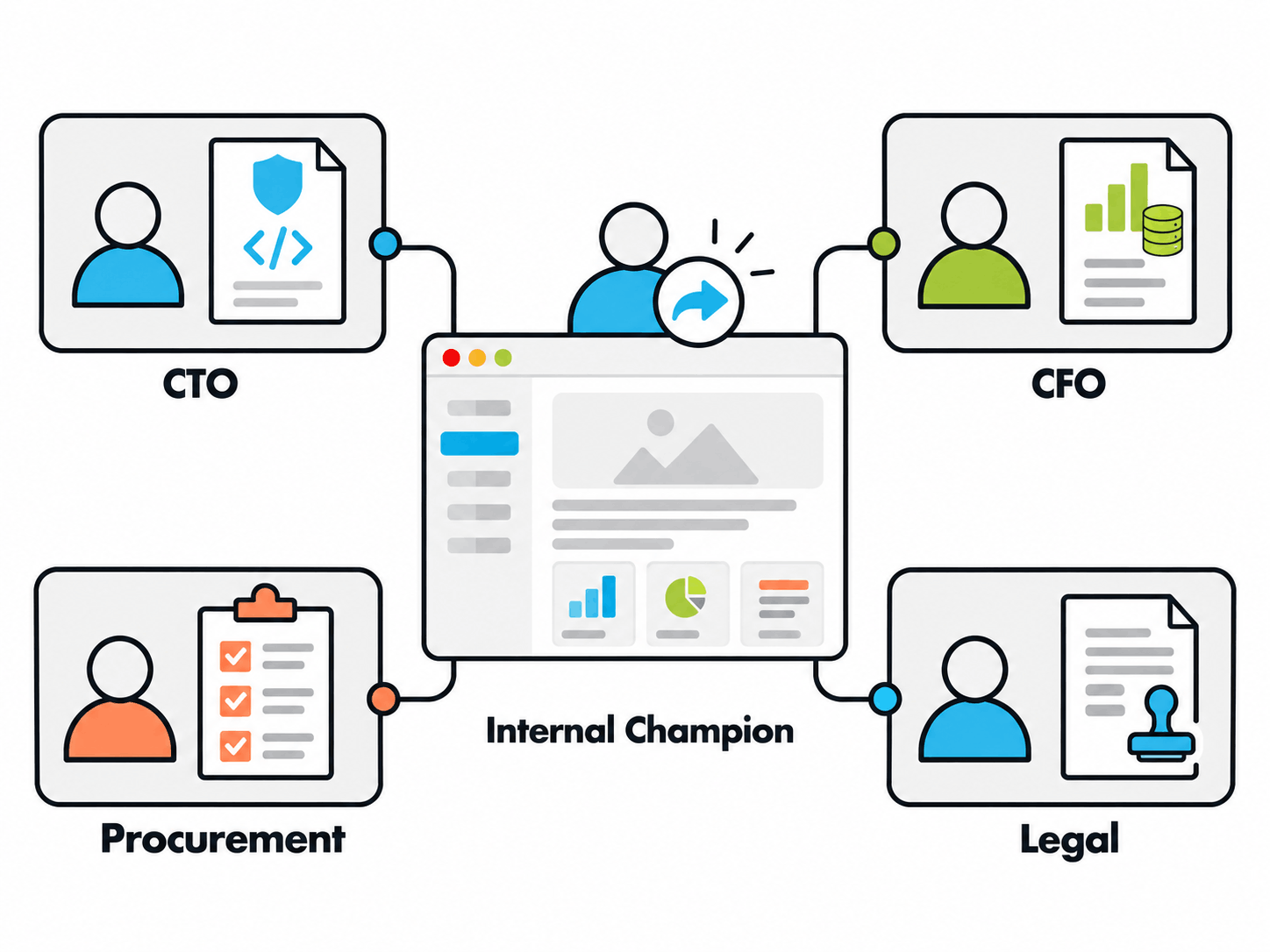
In complex B2B sales, conversion rarely depends on one person. It depends on a buying committee made up of stakeholders from IT, Finance, Operations, Procurement, Legal, and executive leadership. A strong CRO strategy must therefore do more than persuade the first visitor. It must equip that visitor with materials that help the broader buying committee reach consensus.
Multi-Stakeholder Conversion Path
Traditional funnels fail because they assume the person browsing has the sole authority to buy. A complex sales funnel must act as a resource hub that your primary contact can use to sell internally to IT, Finance, and Operations.
- Committee-Ready Dashboards
Instead of a generic "thank you" page, high-intent visitors should be directed to a personalized portal. This portal summarizes the value proposition in formats tailored for different roles (e.g., a technical whitepaper for the CTO and a 1-page ROI summary for the CFO).
- Shareable ROI Calculators
Interactive tools that allow a visitor to input their company's specific data and generate a custom "Business Case" PDF. This empowers your champion to present a professional, data-backed pitch to their board without manual intervention from your sales team.
- Consensus-Driven CTAs
Beyond "Book a Demo," include calls-to-action like "Invite your Team" or "Send to Procurement." This moves the conversion from a private interaction to a collaborative group event.
Implementation Guide
Pro-Tip: Use Zero-Party Data collected early in the funnel to identify the visitor's role. If the visitor identifies as "Technical," prioritize security documentation. If they identify as "Management," prioritize case studies and ROI.
Effective B2B Conversion Strategy Summary
Integrating technical stability with modern intent mapping ensures that a website remains discoverable for both humans and machines.
Future Constraints and Risks for B2B Growth
B2B growth in 2026 faces barriers from technical debt and shifts in search behavior. Success requires managing system complexity and adapting to AI crawlers to prevent revenue loss from zero-click searches and evolving search engine models.
- Technical Debt and System Complexity
Technical debt in 2026 has expanded beyond old code to include unmanaged system complexity. This includes messy automation logic and vibe-coding debt, where AI agents are built on outdated or partial metadata. This complexity acts as a core structural constraint that slows down enterprise performance.
When systems are too complex, it becomes difficult to launch new AI initiatives or make site changes, causing companies to fall behind agile competitors.
- Existential AI Disruption to Traditional Models
Analysis by SaaS Capital in 2026 warns that traditional software models face existential threats from rapid AI growth. Many B2B tools built on old subscription models are becoming obsolete as AI-native solutions perform the same tasks with more automation and lower costs.
Companies that rely on manual workflows are at high risk of being replaced by agentic systems that can solve problems end-to-end without human help.
- Search Visibility Shifts in the AI Era
The way buyers find information is changing due to Zero-Click Searches, which are instances where a search engine or AI provides a full answer directly on the results page, removing the need to click a link. A 2026 AI Traffic Report from upGrowth flags that this can lead to a significant drop in website traffic.
To maintain organic visibility in AI-mediated search, brands should adopt Generative Engine Optimization (GEO), the process of optimizing content specifically to be included in AI-generated summaries and overviews. Content must also be formatted for AI Crawlers, which are automated bots that scan the web to gather data for large language models.
If a website blocks these crawlers or fails to provide structured data, it will not be cited by AI search tools, leading to a total loss of organic visibility and brand authority.
Final Thoughts
To maintain a competitive edge in 2026, B2B organizations must transition from static pages to interactive, AI-optimized environments. Priority should be placed on technical stability and intent mapping to satisfy both human buyers and AI crawlers.
Next Steps:
- Prioritize INP improvements to ensure the site responds instantly to user clicks.
- Use multi-step, interactive forms to collect zero-party data without frustrating the user.
- Format content specifically for AI search tools to earn citations in automated summaries.
- Connect prospecting and resolution agents directly to the primary CRM for real-time lead management.
- Regularly audit automation logic and metadata to prevent "vibe-coding debt" from slowing down system performance.
Frequently Asked Questions (FAQs)
What is zero-party data?
Zero-party data is information that a customer shares directly and intentionally with a brand. This shift helps companies stay compliant with privacy laws like GDPR and EEA while ensuring data accuracy.
How does Agentic AI improve the sales process?
These advanced tools act independently to complete multi-step goals, such as creating dynamic pages based on user history or researching and contacting potential customers automatically.
What are zero-click searches?
Zero-click searches occur when an AI or search engine provides a full answer directly on the results page. This removes the need for a user to click a link, making it harder for websites to get traffic.
Why should I delay my "Call to Action" pop-ups?
Showing offers too early can capture low-quality leads. Waiting until a visitor performs specific actions ensures you don't interrupt their research, which builds higher trust.
Read These Next
%20Mobile.png)
Conversion Rate Optimization (CRO) - The Complete Guide for 2026