.png)
High Converting Landing Page: The 5 Anatomy Secrets of Million-Dollar Pages
.png)

.png)

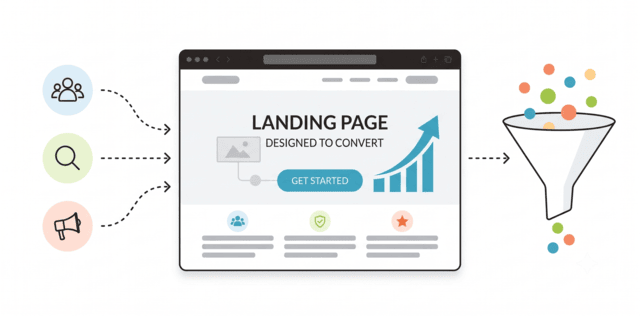
In 2026, a high-converting landing page is a focused webpage designed to drive a specific action, such as a purchase or sign-up. It uses AI, customer behavior data, and ongoing testing to personalize the experience, match user intent, and improve conversions and return on ad spend (ROAS).
Key Takeaways
- Traditional content management systems create operational bottlenecks and developer dependencies, limiting marketing teams to only a few page variations.
- High-converting pages align post-click layouts with specific ad targeting metrics, location, and buyer intent rather than using generic homepages.
- Providing tailored educational layers and AI-driven conversational assistants before the pricing stage builds consumer confidence and overcomes choice paralysis.
- Tracking behavior through platforms such as Hotjar, Microsoft Clarity, or Crazy Egg can reveal cursor patterns, repeated clicks, and scroll-depth drop-offs. These signals help teams prioritize hypotheses for controlled experimentation rather than proving that a specific design element caused the behavior.
- Engineering shorter, device-specific checkout paths can reduce mobile friction and improve completion rates. In the Road Scholar case study, the redesigned mobile path reportedly doubled conversion rates; this should be presented as a company-specific outcome rather than a result every organization should expect.
- Using specialized automation models trained on unique brand voices under Human in the Loop (HITL) oversight, rapidly scales production-ready wireframes.
Why Traditional Content Management Systems Limit Conversion Rates
In 2026, traditional content management systems (software applications used to create, edit, and manage digital website content) restrict conversion rates due to rigid customization, isolated testing backlogs, and deep development dependencies that limit corporate marketing teams to running only two or three basic page variations per ad group.
Combining legacy tool limitations with the modern benefits of a flexible digital ecosystem highlights how upgrading web infrastructure transforms campaign performance:
- Modern landing-page stacks combine page-building platforms such as Unbounce or Instapage with experimentation systems such as Optimizely Web Experimentation, VWO, or Adobe Target. These tools may also connect to Webflow Enterprise or a headless CMS, allowing authorized marketing teams to launch approved variants while engineering teams retain deployment controls, performance standards, and rollback procedures.
- Marketing teams can use pre-approved templates to deploy and change customized landing pages in minutes for active flash sales or new campaigns.
- Optimizing the existing ad budget within a single flexible ecosystem lowers the overall cost-per-click (the amount an advertiser pays for every user click).
Because relying on engineers to manually code these pages is slow and expensive, it creates an operational bottleneck that leaves a backlog of untested pages.
How AI Uses Customer Data to Increase Web Conversions
In 2026, AI can use customer data to create more relevant product recommendations, answer common questions, and help visitors understand complex purchasing options. These experiences may improve conversion rates when they are based on accurate data, tested carefully, and reviewed by human teams.
AI-powered personalization typically connects several systems:
- Tools such as Google Analytics 4 or Segment collect first-party behavior data, including page visits, clicks, and product interactions.
- Cloud data warehouses such as Snowflake or Google BigQuery securely combine this information with approved product, CRM, and transaction data.
- Platforms such as Salesforce Data Cloud or Adobe Experience Platform use the connected data to support personalized recommendations and guided shopping experiences.
Automated product advisors can ask visitors a few simple questions, recommend an appropriate option, and explain why it may suit their needs. For example, a skincare landing page might ask about skin type and concerns before displaying a suggested product and a short explanation. Visitors should also have a clear way to contact a human representative when the system cannot answer confidently.
Companies should measure these tools through recommendation accuracy, customer satisfaction, assisted-conversion rates, and controlled A/B tests (a controlled experimentation framework where two or more web page variations are shown to users at random to see which yields higher conversions). The results will vary depending on the quality of the data, the product category, and the design of the experience.
First-party and zero-party data should be collected with clear user consent and managed according to applicable privacy requirements, including the GDPR. Consent-management platforms such as OneTrust or Cookiebot can record visitor choices, while Google Consent Mode v2 can pass those consent signals to supported Google services.
By combining approved customer data with clear explanations and human support, companies can create useful recommendation experiences without making unrealistic promises about conversion performance.
5 Anatomy Secrets of Million-Dollar Pages
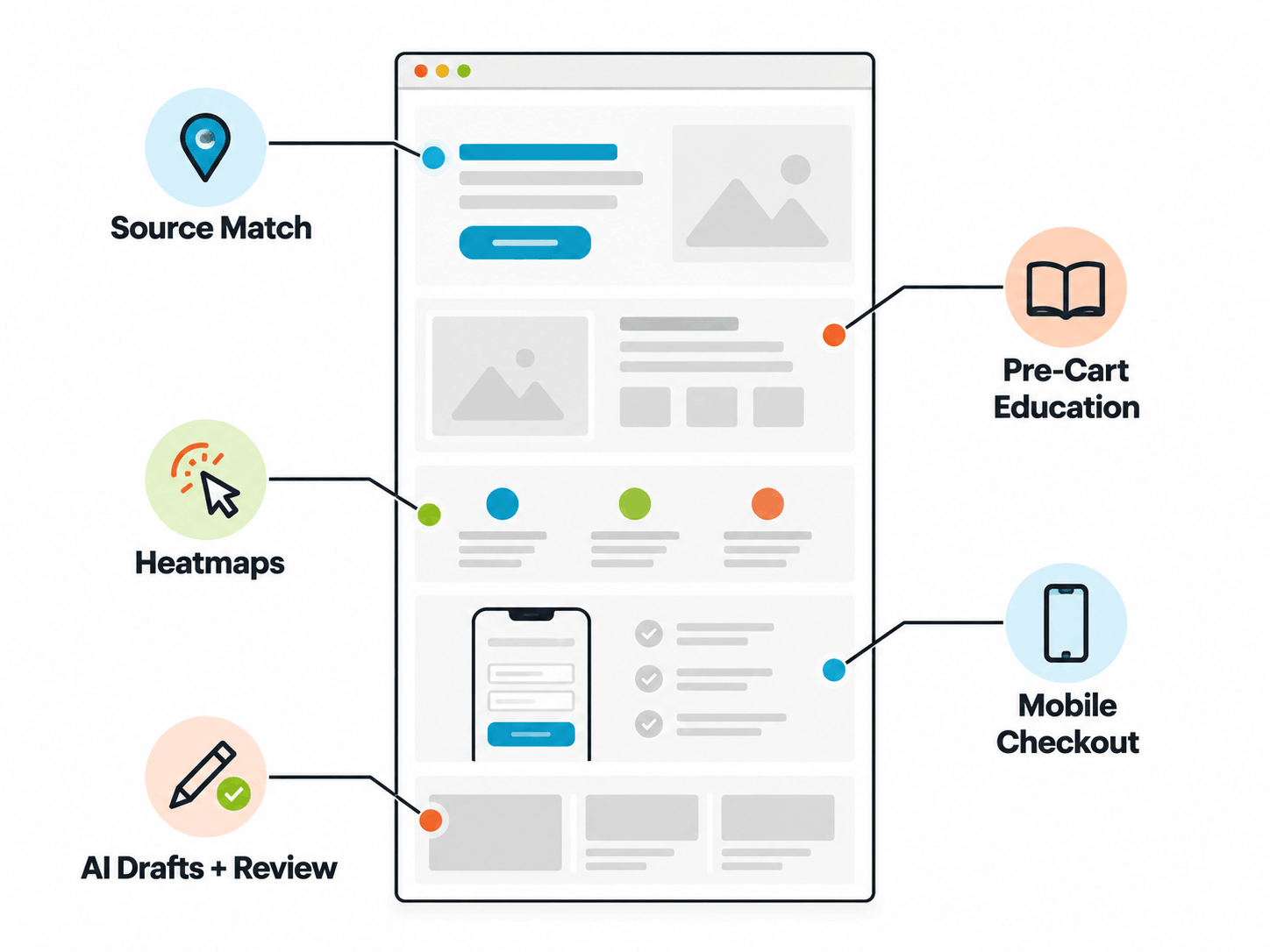
High-converting landing pages succeed by matching content to the visitor's source, providing helpful information before purchase, analyzing user behavior, optimizing the mobile checkout experience, and using data-driven design improvements to reduce friction and increase conversions.
Anatomy Secret 1: Traffic Source Personalization
Traffic source personalization matches post-click page layouts with specific ad targeting metrics, including geographical location and buyer intent. Replacing generic homepage traffic with targeted destinations resolves optimization limits and increases return on ad spend.
- Aligning Layouts with Ad Targeting Rules: Website sales drop when companies send tailored ad traffic to a generic corporate homepage. High-performing pages must match the exact targeting rules of the ad, including user location and buyer intent.
- Configuring Simple Content Flows: Premium conversion platforms adapt text content and page layouts to tell unique stories for specific regional targets. Tailoring content structure to geographical audiences promotes relevant and seamless consumer journeys.
Case Study: HelloFresh
HelloFresh struggled with low conversion rates from generic homepages. Marketers built location-specific post-click pages tailored exactly to ad targeting and buying intent. This seamless matching process cut landing page production time by 33% and drove a 30% increase in conversion rates.
Anatomy Secret 2: Pre-Cart Product Education
Pre-cart product education delivers targeted explanations on emerging or complex offerings before sending visitors to a pricing page. It coordinates data-driven AI recommendation matchmakers to decode product features, maximizing user confidence and trust.
- Informing Visitors Prior to the Pricing Step: Selling an emerging or complex product requires giving buyers extra educational facts before sending them to a pricing screen. Custom educational layers provide explanations tailored to the user's current stage in the buying journey.
- Deploying Intelligent Matchmaker Advisors: Advanced setups utilize automated data assistants and conversational AI chatbots to decode features, answer questions completely, and increase shopping confidence.
Case Study: Noli
Online shoppers at Noli faced choice paralysis trying to find personalized skincare. The brand deployed an AI recommendation engine trained on over one million skin data points and scientific datasets to decode complex product features. This automated education gave 86% of users an excellent product match.
Anatomy Secret 3: Behavioral Heatmapping
Behavior analytics platforms such as Hotjar, Microsoft Clarity, or Crazy Egg visualize where visitors click, move, hesitate, repeatedly tap, and stop scrolling. These observations can expose possible friction points, but they should be treated as inputs for testable hypotheses rather than proof that a particular component caused abandonment.
- Analysts can segment heatmaps and session recordings by device, campaign, location, or landing-page version to identify patterns that deserve further investigation.
- Teams can then validate proposed changes through randomized experiments in platforms such as Optimizely, VWO, or Adobe Target. A winning test may reduce cost per conversion, but the size and direction of the result depend on traffic quality, sample size, offer strength, industry, and the original page baseline.
Case Study: Verizon Digital Media Services
Running only two or three web experiences per ad group severely limited audience optimization for Verizon. Analysts tracked visitor mouse movements and scroll depth via heatmaps to identify underperforming layout elements for A/B testing.
This contributed to a 53% reduction in cost per conversion.
Anatomy Secret 4: Simplified Buying Paths for Phones
Simplified mobile buying paths reduce unnecessary fields, preserve session state, support autofill, and adapt payment and navigation controls to smaller screens. These changes can lower abandonment and improve completion rates, although the result will vary according to the audience, transaction complexity, page speed, and starting conversion rate.
- Mobile teams should test shorter forms, address autocomplete, digital-wallet options, persistent cart data, larger touch targets, and clear progress indicators rather than merely shrinking the desktop checkout design.
- Preventing device switching can remove a major source of friction, particularly for visitors who would otherwise need to restart the transaction on a desktop computer or contact a support center.
Case Study: Road Scholar
Road Scholar discovered that lagging mobile conversions forced older users to switch devices mid-purchase. The e-commerce team engineered a separate, shorter, and highly fine-tuned mobile checkout funnel that kept visitors inside the mobile viewport. This optimization reportedly helped double mobile conversion rates for the brand.
Anatomy Secret 5: Brand-Trained AI Layout Generation
Brand-trained AI layout generation uses customized automation models trained on core brand guidelines and psychology frameworks to instantly output production-ready web wireframes alongside human creative oversight. Integrating Human in the Loop oversight keeps human creators focused on emotionally appealing work.
- Moving Beyond Generic AI Output Limitations: Standard, open-source artificial intelligence copywriting tools fail to deliver high-quality layouts or appropriate brand context. Professional operations rely on specialized AI models trained on unique brand voices, conversion frameworks, and psychological habits.
- Deploying Human in the Loop (HITL) Integration: Implementing a Human in the Loop (HITL) integration model, a procedural framework that embeds mandatory human validation and creative editing steps directly within automated AI workflows, ensures that automated quality control systems audit text for accuracy while human creators focus on the emotional, brand-defining creative work that requires deep human understanding.
Case Study: Robinson Club
Robinson Club needed to scale multilingual competitor benchmarking and landing page production. They systematically trained an AI writer on unique brand voice rules, purpose-built page frameworks, and behavioral psychology principles. The brand reported that structured brand training reduced initial design drafting from days to seconds.
However, this acceleration applies to first-draft generation and does not eliminate the need for human quality assurance, usability review, or final production checks.
Summary of the Top 5 Secrets of Million Dollar Pages
How to Optimize Landing Page Performance
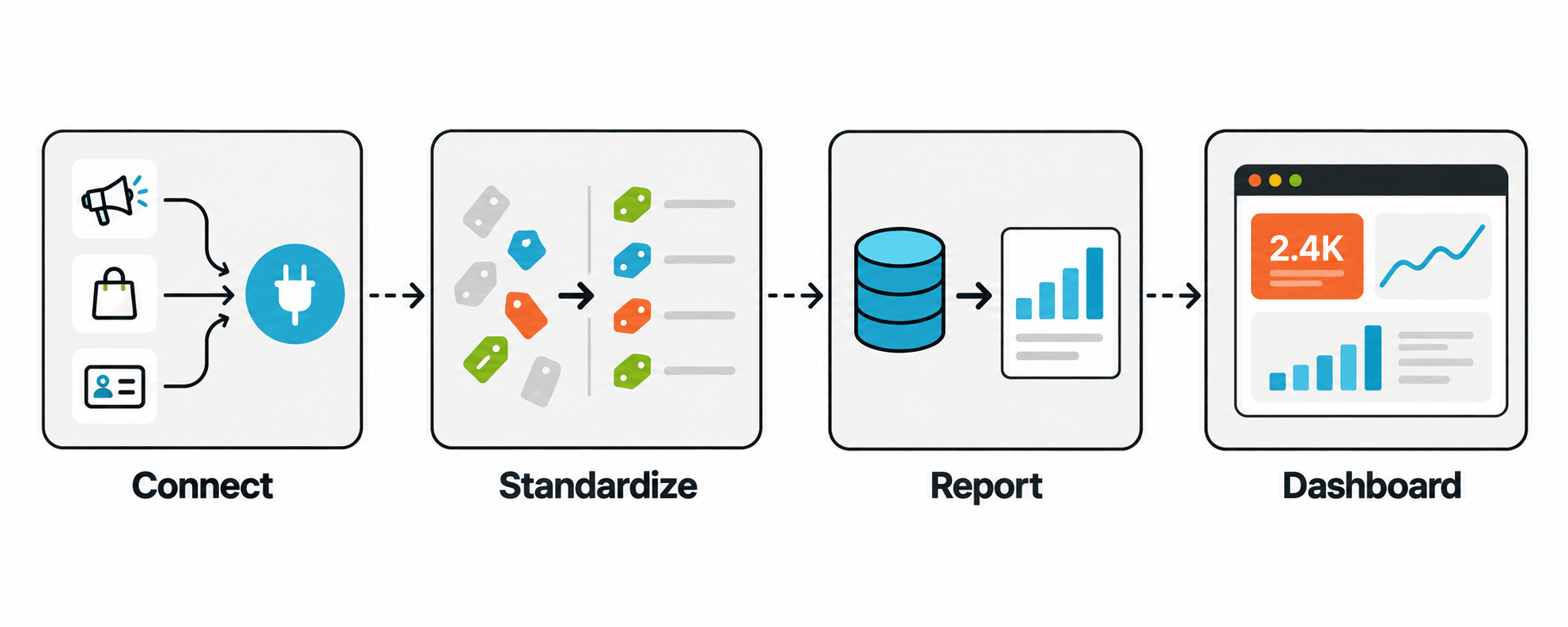
Optimizing landing page performance requires consolidating fragmented corporate data systems into a centralized data warehouse using out-of-the-box data connectors to limit manual tracking and accelerate the production of actionable business insights.
- Step 1: Connect Fragmented Data Streams: Use managed ELT connectors such as Fivetran or Airbyte Cloud to move events and records from Google Analytics 4, Google Ads, Meta Ads, HubSpot, Salesforce, and commerce platforms into Snowflake, Google BigQuery, or a Databricks SQL warehouse.
- Step 2: Standardize and Synchronize the Data: Use governed transformation models in dbt Cloud to standardize campaign names, customer identifiers, attribution fields, and conversion definitions. Identity-resolution tools in Segment or a comparable customer data platform can help connect interactions across approved channels.
- Step 3: Connect the Warehouse to Business Intelligence: Route governed datasets into enterprise business-intelligence pipelines such as Microsoft Power BI Desktop and Power BI Service, Tableau Cloud with Tableau Pulse, or Looker Studio, backed by secure Snowflake or Google BigQuery cloud data warehouses.
- Step 4: Launch Governed Performance Dashboards: Build dashboards around documented definitions for conversion rate, cost per acquisition, revenue per visitor, mobile completion rate, and experiment lift. Describe the reporting as “near-real-time” unless the architecture includes an actual streaming pipeline; otherwise, state the refresh interval clearly.
How to Prevent Operational Risks in Website Management
Preventing operational website risks requires maintaining flexible backup data frameworks to route incoming lead records during unexpected system outages, planning hyper-fast database migrations to minimize transactional downtime, and providing structured training to overcome employee AI adoption resistance.
Deploy Temporary CRM Infrastructure to Survive Outages
- During a CRM outage, teams can use Zapier Agents, formerly Zapier Central, or Make.com to route authenticated form submissions into a temporary staging system such as Airtable, a protected Google Sheet, or a dedicated HubSpot staging object.
The workflow should include webhook authentication, retry logic, duplicate-prevention keys, failure alerts, access controls, and a documented process for reconciling the staged records after the primary CRM returns. Avoid routing sensitive lead data through an unmanaged generic email inbox.
- Automatically routing incoming leads from generic email inboxes into structured project management rows limits disruption across marketing and sales pipelines.
Reduce Transactional Downtime During System Migrations
- Web teams protect digital communities from losing access to live online marketplaces by utilizing managed cloud databases that simplify replication of data.
- Restricting major backend information updates and server transitions to fifteen minutes or less preserves conversion momentum and ongoing revenue.
Eliminate Tool Friction Through Structured AI Learning Programs
- Launching advanced automated layout tools requires creating clear organizational frameworks to address workplace adoption anxiety and uncertainty.
- Management teams reduce employee friction by distributing specialized prompt engineering libraries, establishing rock-solid instructions, and tracking query growth performance metrics.
How to Future-Proof Landing Pages through Conversion Intelligence and Agentic Frameworks
Future-proofing landing pages involves shifting from static dashboard reports to streaming actionable analytics, integrating context-aware autonomous AI agents with natural language search fields, and making validation testing non-negotiable for all feature deployments.
Progress From Static Dashboards to Actionable Analytics
To future-proof analytics, teams must stream user event data straight to a customer data platform configured with predictive scoring models, establishing a pipeline that surfaces conversion shifts as they occur.
- Shifting to predictive analytics gives marketing groups the immediate insights needed to execute real-time, automated layout changes on active pages.
- This dynamic processing framework instantly unifies historical customer touchpoints, lifetime value metrics, and behavioral patterns without manual generation.
Integrate Autonomous AI Agents and Natural Language Fields
Instead of requiring every visitor to complete a long contact form, some landing pages can offer a clearly labeled request box such as, “Tell us what you are trying to accomplish.”
After the visitor submits the request, a back-end workflow can:
- Identify the visitor’s intent.
- Retrieve information only from approved product, policy, or account sources.
- Ask for missing structured information when necessary.
- Answer routine questions or create a qualified lead in Salesforce or HubSpot.
- Route low-confidence, sensitive, or high-value requests to a human representative.
The orchestration layer may use a workflow framework such as LangGraph or an enterprise agent service such as Salesforce Agentforce API. The interface should include an accessible label, explicit consent language, data-retention controls, input validation, and a warning not to submit sensitive personal information.
- This creates a fewer-step experience in which visitors can describe their needs in ordinary language without navigating several disconnected form fields or support pages.
- Routine, low-risk requests may receive an immediate automated response, while uncertain, regulated, or commercially sensitive requests should trigger a human handoff.
Institute Mandatory Testing Into the Organizational Culture
Engineering teams can require an approved experiment configuration before a major layout change receives full production traffic. Feature flags and experimentation controls in LaunchDarkly, Optimizely, or VWO can support gradual rollouts, holdout groups, and rapid rollback.
Each test should define its primary success metric, sample-size requirements, test duration, and guardrail metrics—such as error rate, page speed, refund rate, or lead quality—before launch. This process reduces the risk of opinion-led design changes, but it does not guarantee that every experiment will improve performance.
Final Thoughts
To optimize landing page performance and future-proof digital conversions, organizations should execute the following actionable steps:
- Deploy plug-and-play connectors to link websites, ad platforms, and CRM systems into a single cloud-based data warehouse.
- Utilize behavioral heatmapping to trace user navigation habits and identify underperforming elements.
- Train AI layout and text generators on specific brand voices while maintaining human validation for emotional creative work.
- Update engineering pipelines to lock down live layout publishing permissions unless the deployment script includes an active, randomized A/B split-test.
Frequently Asked Questions (FAQs)
What is a high-converting landing page in 2026?
In 2026, it is defined as a highly personalized post-click destination designed to guide visitors toward a single transactional goal. It utilizes pre-approved templates, behavioral heatmaps, and brand-trained AI workflows to optimize conversion rates and ad spend.
How does behavioral heatmapping improve website conversions?
Platforms such as Hotjar, Microsoft Clarity, and Crazy Egg can show where visitors click, scroll, hesitate, or repeatedly interact with a page. These patterns help teams identify possible friction and develop testing hypotheses. Heatmap observations should be validated through controlled experiments because behavioral visualization alone does not establish causation.
How can companies safely integrate AI layout generation?
Organizations can train or configure AI systems using approved brand guidelines, component libraries, accessibility standards, and conversion frameworks. Human in the Loop review should remain mandatory for factual claims, legal language, brand alignment, and production approval. Governance can also be structured around the NIST AI Risk Management Framework 1.0, supported by role-based access, audit logs, documented data sources, and escalation procedures.
Related Content
Read These Next
Landing Page Optimization Checklist: 11 Proven Ways to Increase Conversions