Conversion Rate Optimization Checklist: Your Complete Audit Guide




To improve conversion rates in 2026, you must first identify funnel bottlenecks through behavioral data, then systematically resolve them by optimizing site speed (LCP < 2.0s), reducing form friction, and applying psychological triggers like the Conversion Sequence Heuristic. By combining technical stability with a mobile-first "Thumb Zone" design and an integrated AI growth stack, brands can consistently hit the 3%–7% benchmark.
Key Takeaways
- Success begins with site speed and stability, specifically maintaining an LCP under 2.0 seconds and a CLS below 0.1.
- Using the conversion sequence formula helps marketers prioritize user motivation and value while reducing anxiety and friction.
- Accessibility is a conversion driver; adhering to Web Content Accessibility Guidelines (WCAG) standards ensures a site is usable for everyone, regardless of their physical or cognitive abilities.
- Reducing data entry fields and mapping "Thumb Zones" for mobile users are essential tactics to prevent user drop-offs during the final conversion steps.
- Small shifts in language, such as using first-person CTAs (e.g., "Start my free trial"), can significantly boost click-through rates.
Why is Your Conversion Rate Low?
Low conversion rates result from irrelevant traffic, friction, or a weak core offer. Diagnosing these conversion bottlenecks (specific points in a funnel where users drop off) allows for precision optimization of the conversion path (the sequence of steps a user takes to complete a goal).
Before site fixes are implemented, the root causes of underperformance must be identified. Most conversion issues originate from three specific areas:
- Irrelevant Traffic
If SEO or advertisements attract users who do not need the product, the conversion rate will remain low regardless of site quality.
- Friction in the Customer Experience (CX)
Technical bugs, slow loading, or confusing navigation create Friction (any element that prevents a user from moving smoothly through a process), prompting immediate abandonment.
- Weak Core Offer
If the price-to-value ratio is suboptimal or the product lacks Social Proof (the psychological phenomenon where people mirror the actions of others to reflect correct behavior), optimization efforts will only provide a temporary boost.
CRO Checklist: How to Identify Website Conversion Bottlenecks
1. Map the Conversion Funnel
Start by mapping every step between the first visit and the final conversion. For e-commerce, this may include product page views, cart additions, checkout starts, payment attempts, confirmation pages, and post-purchase actions.
For B2B, it may include landing page visits, form starts, form completions, calendar bookings, sales follow-ups, and demo attendance.
2. Find the Highest Drop-Off Points
Use funnel analytics to identify where the largest percentage of users abandon the process. A bottleneck is not always the page with the lowest conversion rate; it is the point where fixing the experience can produce the greatest business impact.
3. Segment the Data
Review bottlenecks by device, browser, traffic source, campaign, geography, new versus returning visitors, and customer intent. A page may perform well overall while failing badly for mobile users, paid traffic, or Safari users on a specific browser version.
4. Review Behavior Data
Use heatmaps, scroll maps, click maps, session recordings, form analytics, and predictive eye-tracking tools to see where users hesitate, rage-click, abandon fields, or miss key CTAs.
Predictive eye-tracking tools use AI to estimate where users are likely to look first, which areas they may ignore, and whether CTAs, headlines, or trust signals are visually prominent enough. These tools are useful during audits, especially before enough live traffic exists for statistically reliable heatmaps.
5. Prioritize Bottlenecks
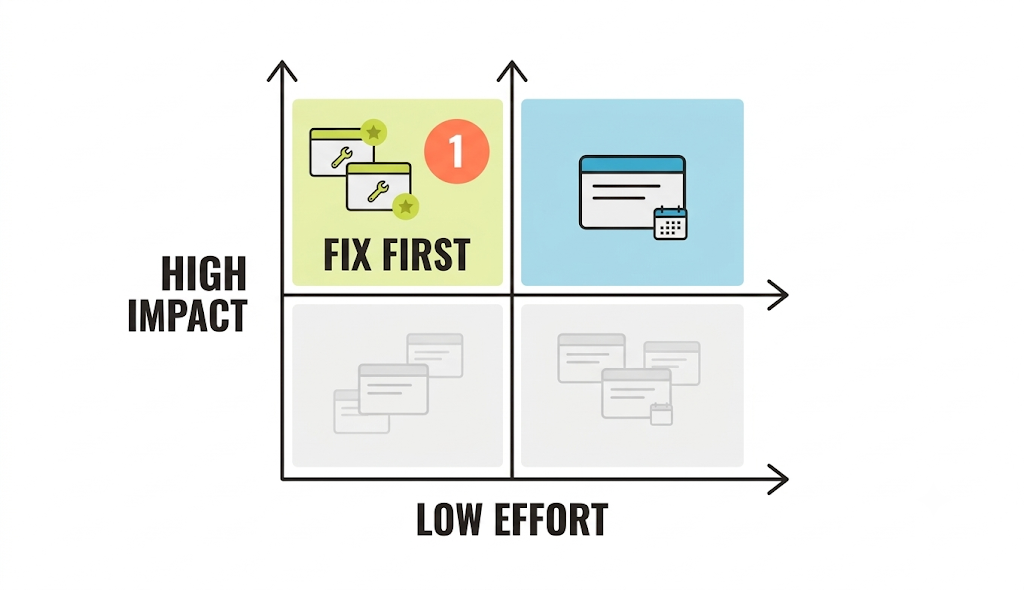
Rank issues by conversion impact, traffic volume, implementation effort, and confidence level. Fix high-impact, low-effort issues first before moving into deeper redesign or experimentation work.
CRO Checklist: Steps to Fix Website Conversion Bottlenecks
1. Technical Performance and Core Web Vitals
Site speed is the foundation of digital trust. If a page fails to load quickly, the psychological momentum of the visitor is lost.
- Audit Core Web Vitals: Utilize these standardized metrics used by search engines to measure real-world user experience and ranking eligibility.
- Optimize Largest Contentful Paint (LCP): Ensure the time required for the largest visible element on a page (such as a hero image or headline) to fully render is under 2.0 seconds.
- Stabilize Cumulative Layout Shift (CLS): Maintain a score below 0.1 to ensure visual stability, preventing elements from jumping and causing accidental clicks as the page loads.
- Refine Interaction to Next Paint (INP): Minimize the delay between a user action (like a button click) and the visual update to under 200ms to ensure the interface feels instantaneous.
For 2026 audits, test performance and conversion flows across current stable browser versions, including Chrome, Safari, Edge, and Firefox, with special attention to mobile Safari and Chrome for Android.
Also, verify that analytics, consent, checkout, and personalization scripts work correctly under modern privacy controls, cookie restrictions, consent mode implementations, and server-side tracking setups.
Teams should also review API reliability for payment processors, CRM handoffs, form submissions, email validation, fraud detection, consent management platforms, and analytics events. A fast page can still lose conversions if the checkout API fails, the lead form does not sync to the CRM, or the confirmation event is not recorded.
2. The Conversion Sequence Heuristic
The Conversion Sequence Heuristic from MECLABS is a prioritization model that helps marketers evaluate which forces are helping or hurting a user’s decision to convert.
The formula is expressed as:
C = 4M + 3V + 2(I-F)-2A
- Conversion Probability (C): The likelihood that a visitor completes the desired action.
- Align with Motivation (M): Ensure headlines and imagery match the internal drive or specific need that brought the visitor to the page.
- Clarify the Value Proposition (V): Explicitly state the unique combination of benefits that answer why this specific offer should be chosen over every other available option.
- Strengthen the Incentive (I): The extra reason to act now, such as a trial, guarantee, bonus, discount, or free shipping.
- Remove Friction (F): Identify psychological or physical resistance in the process, such as redundant steps or unnecessary navigation.
- Resolve Anxiety (A): Neutralize psychological doubt regarding data security or product quality by placing security badges and clear return policies near the final action.
Because motivation and value carry the heaviest weight in the model, CRO often begins by confirming whether the page matches visitor intent and clearly communicates the value of the offer.
Case Study: Kareo Marketing
Kareo Marketing implemented Unbounce to optimize its Landing Pages (standalone goal-oriented pages). Facing developer bottlenecks and low conversion, the team conducted A/B Testing to simplify forms.
This process led to a 30% increase in recruitment and $1.56 million in revenue by reducing systemic friction.
3. Accessibility and Inclusive Architecture
Accessibility ensures that a website is usable by individuals with varying physical and cognitive abilities, adhering to WCAG (Web Content Accessibility Guidelines) standards.
- Validate Contrast Ratios: Ensure the difference in luminance between text and its background is high enough for readability for users with visual impairments.
- Populate Alt Text: Description tags embedded in the code of an image allow Screen Readers (software that reads text on a screen for blind users) to provide context.
- Ensure Keyboard Navigation: Verify the entire conversion path can be navigated using only the keyboard to assist users who cannot use a mouse.
4. High-Utility Form Optimization
Forms are the final hurdle in the conversion process. Optimizing them requires a focus on Cognitive Ease, or the mental comfort a user experiences when processing information.
- Implement Progressive Disclosure: Utilize this design technique to show only essential information initially, revealing complex options only as the user progresses.
- Deploy Inline Validation: Provide immediate feedback (green checkmarks or error alerts) as a user completes each field rather than waiting for the final "Submit" click.
- Minimize Data Entry: Remove every field that is not strictly necessary for the initial conversion to reduce the interaction cost.
Case Study: PayU
A recent PayU analysis utilized VWO for Form Analytics (tracking user field interactions) to address checkout drop-offs. The audit identified excessive fields as a source of friction. By removing the email field, PayU achieved a 6% increase in checkout rate through simplified data entry.
5. Mobile UX and Touch Ergonomics
With mobile devices accounting for the majority of global traffic, the Viewport (the visible area of a web page on a device) must be optimized for physical interaction.
- Map the Thumb Zone: Place primary CTAs (Call to Action buttons) within the most comfortable area for a user to touch when holding a device with one hand.
- Enlarge Touch Targets: Ensure all interactive elements are at least 44x44 pixels to prevent "fat-finger" errors and accidental clicks.
- Audit Navigation Systems: Verify that menu structures are easily expandable and do not obscure critical conversion elements on small screens.
Case Study: Intertop
Intertop in 2025 applied an Evolutionary Site Redesign (ESR), a gradual redesign approach where teams improve the site through small, tested changes instead of launching one large redesign all at once. By resolving mobile navigation issues and search bugs, the brand achieved a 55.4% conversion increase during its first year of iterative testing.
6. Conversion Copywriting & Framing
The language used on a page must leverage Heuristics, or mental shortcuts, to guide the user toward a decision.
- Incorporate Social Proof: Feature verified reviews or testimonials to leverage the psychological phenomenon where individuals mirror the behavior of others.
- Apply Loss Aversion Framing: Structure offers to highlight what is lost by not acting, as the pain of losing is psychologically twice as powerful as the pleasure of gaining.
- Adopt First-Person CTA Language: Utilize phrasing like "Start my free trial" instead of "Start your free trial" to trigger psychological ownership, which can help increase clicks.
Case Study: Going
Going used A/B Testing (comparing two webpage versions) to refine its CTA (Call to Action). Previously struggling with measurability, the brand tested "Trial for free" against "Sign up for free". This minor adjustment resulted in a 104% month-over-month increase in the webpage’s conversion rate.
Large percentage gains are more common when the original baseline is low, the audience is highly motivated, or the previous CTA created unnecessary hesitation.
7. Trust Integrity and Technical Security
Small technical failures signal a lack of professionalism and destroy user confidence.
- Confirm SSL Status: Ensure a valid SSL Certificate (which enables an encrypted connection) is active so browsers display the HTTPS (Hypertext Transfer Protocol Secure) prefix.
- Monitor for 404 Errors: Regularly audit for broken links, specifically on checkout and confirmation pages, to prevent immediate path abandonment.
- Utilize Contextual Bandits: Employ this machine-learning approach where an AI automatically routes traffic to the best-performing version of a page in real-time.
Summary of CRO Audit Checklist
To succeed in 2026, brands must move beyond keyword matching to Contextual Authority. This requires a "Technical-First, Human-Centered" approach where site speed and accessibility satisfy AI crawlers, while psychological triggers and mobile ergonomics drive final user conversions.
Post-Conversion CRO
CRO does not end when a visitor submits a form or completes a purchase. In 2026, high-performing teams also audit the immediate post-conversion experience because this is where retention, referrals, upsells, and customer confidence begin.
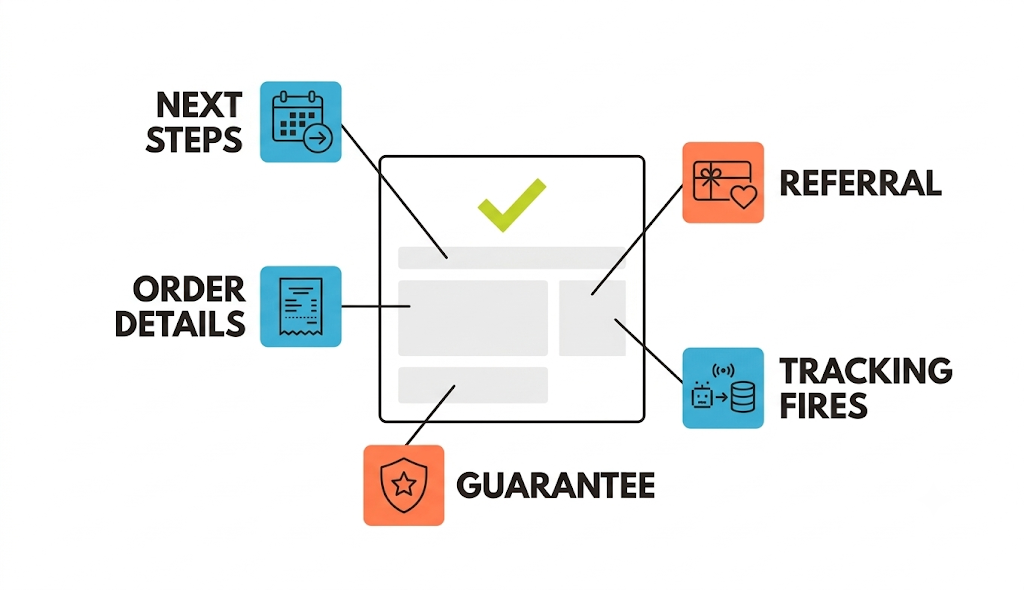
Audit the Thank You page for:
- Confirmation clarity: Tell users exactly what happened and what comes next.
- Next-step guidance: Provide calendar links, onboarding instructions, account setup steps, delivery expectations, or sales follow-up timelines.
- Secondary conversions: Offer newsletter signups, referral prompts, product recommendations, app downloads, or community invitations where appropriate.
- Tracking accuracy: Confirm that conversion events, CRM handoffs, ad platform pixels, and server-side events fire correctly.
- Trust reinforcement: Use the page to reduce buyer’s remorse with guarantees, support links, order details, or helpful resources.
Build a High-Performance Marketing Growth Stack
A marketing growth stack is an integrated ecosystem of software designed to optimize the customer journey through data-backed experimentation. In 2026, high-performance stacks prioritize AI-driven experimentation (automated real-time testing), Behavioral Intelligence (the study of how users interact with digital interfaces), and Customer Relationship Management (CRM) (centralized databases for tracking long-term customer value).
Growth Stack Optimization Framework
In 2026 audits, many teams also use synthetic users, which are AI-generated user simulations that test navigation paths, form flows, product discovery, and checkout experiences before live visitors encounter those issues. These tools do not replace real user data, but they help teams spot likely usability problems earlier.
Strategic Utility of the Growth Stack
- Deployment of Contextual Bandits
Modern stacks utilize Contextual Bandits, an AI testing method that gradually sends more traffic to the better-performing page version while still learning from other variants. Unlike a traditional A/B test, this approach can reduce the amount of traffic sent to weaker experiences.
- Funnel Analysis Integration
By connecting behavioral tools to a CRM, teams can conduct Funnel Analysis, a method of tracking the specific steps a user takes toward a conversion, to identify exactly where the highest percentage of users drop off.
- AI-Driven Insights
Tools like VWO Copilot or Zapier Agents use generative AI to analyze thousands of hours of user data, flagging anomalies and suggesting specific optimizations that a human auditor might overlook.
Final Thoughts
To begin improving conversion rates, organizations should take the following immediate steps:
- Use performance tools to ensure LCP is under 2.0 seconds and all broken 404 links are resolved.
- Conduct a form audit to remove unnecessary fields and implement inline validation for real-time feedback.
- Review the checkout process to ensure SSL certificates are active and security badges are placed near final action buttons to lower user anxiety.
- Use A/B testing or "Evolutionary Site Redesign" to make small, data-backed changes to headlines and CTA language.
Frequently Asked Questions (FAQs)
What are Core Web Vitals and why do they matter for conversions?
Core Web Vitals are standardized metrics that measure how users experience a page's speed, responsiveness, and visual stability. If a page loads slowly or elements jump around, visitors lose momentum and often leave before taking action.
How does the Conversion Sequence Heuristic work?
It is a mathematical model used to predict the likelihood of a conversion. It places the highest value on matching the user's Motivation and clearly explaining the Value Proposition, while subtracting points for Friction and Anxiety.
What is the "Thumb Zone" in mobile design?
The Thumb Zone is the most comfortable area for a user to touch when holding their phone with one hand. Placing primary action buttons in this area prevents "fat-finger" errors and makes the site easier to use.
Read These Next
How to Build Automated Growth Hacking Tools in 2026