.png)


Growth Hacking Tools: The 10 Essential Platforms for High-Speed Scaling
.png)

.png)

High-speed scaling in 2026 relies on automated, low-code software stacks and AI-driven data analytics to rapidly optimize user acquisition funnels. Because traditional ad costs are at historic highs, modern growth hacking focuses on continuous conversion rate optimization (CRO) and cross-functional, agile experimentation to scale revenue without expanding marketing budgets.
Key Takeaways
- Growth hacking combines rapid experimentation, data analysis, and creative marketing to achieve high-speed business scaling.
- Rising traditional ad costs in 2026 mean companies must utilize low-code tools and AI to optimize conversion rates without expanding budgets.
- A successful growth stack relies on clear tracking and rapid experimentation across ten essential digital platforms to eliminate guesswork.
- Tools should be carefully chosen based on a company's specific revenue stage and active funnel bottlenecks rather than blindly copying competitors.
- Growth platforms must remain accessible across marketing, product, and engineering teams to avoid operational silos.
Why Automated Software Stacks Matter for High-Speed Testing
Overcoming the Constraints of Traditional Media
Salesforce Tenth Edition State of Marketing reports that 69% of marketers struggle with acquiring new customers. Paid channels on traditional networks are saturated and expensive, meaning companies cannot rely solely on big ad budgets to achieve growth. Out-optimizing competitors through continuous conversion rate optimization lowers acquisition costs and boosts returns on investment without requiring additional budget.
Low-Code and AI Platforms as Force Multipliers
Modern growth professionals use low-code tools and automation to move faster without relying on engineering support. These platforms help marketers build workflows, segment users, launch landing pages, and test onboarding experiences independently.
AI has also evolved from a content tool into an operational layer within the growth stack. In 2026, common use cases include churn prediction, personalization, lead scoring, support routing, and retrieval-augmented generation workflows. Behind many of these systems are vector databases and LLM ops tools that help teams retrieve customer insights and manage AI outputs.
During our stack integrations, we have found that AI performs best when built on clean data. Poor tracking, inconsistent CRM fields, or missing consent logic can undermine even the most advanced automation.
Speed of Iteration
Agile testing teams operate like scientific labs. They form specific hypotheses, run controlled tests, and use performance data to guide decisions. This rapid iteration allows companies to capture early insights, learn from failed experiments, and scale winning strategies immediately.
Top 10 Experimentation and Conversion Rate Optimization Platforms
1. Optimizely
Optimizely is a software platform utilized to run controlled digital experiments, including A/B testing and multivariate testing. The tool removes guesswork by delivering clear data about which page elements, headlines, or layout flows drive conversions.
In 2026, setting up experiments with modern testing software is highly efficient, allowing teams to maintain a continuous loop of testing, analyzing results, and implementing improvements.
2. Google Analytics 4
Google Analytics 4 remains a foundational analytics platform for monitoring website traffic, acquisition channels, and user behavior. By 2026, however, it functions best as a baseline measurement layer rather than a standalone growth intelligence system. Its effectiveness depends on proper implementation of server-side tagging, consent mode, privacy-safe event collection, and integrations with platforms such as BigQuery, HubSpot, Amplitude, and Mixpanel.
GA4 provides visibility into channel performance and audience trends, while specialized analytics tools support deeper cohort analysis and lifecycle insights.
Growth teams should also account for attribution limitations, cookie deprecation, and GDPR/CCPA compliance requirements when designing their measurement strategy.
3. Mixpanel
Mixpanel is an event analytics platform that helps teams observe how users interact with a digital product after acquisition. The software enables growth professionals to define key performance indicators, calculate conversion rates, and perform cohort analyses across activation, retention, and monetization events.
When deployed carefully, Mixpanel is especially useful for identifying the behaviors that separate retained users from casual visitors. It is most effective when paired with a disciplined event taxonomy and server-side tracking for critical events, helping teams avoid making retention decisions based on incomplete browser-side data.
4. Amplitude
Amplitude serves as a behavioral analytics tool built to establish detailed tracking funnels and monitor event logs across the customer journey. The software tracks user events to reveal where prospective customers get stuck, abandon onboarding, or fail to reach value moments inside a product lifecycle.
For 2026 growth teams, Amplitude is most valuable when connected to a modern data pipeline rather than treated as another isolated dashboard. Server-side tagging, warehouse syncs, and consent-aware identity resolution can make the platform more reliable as browser cookies and device-level identifiers become less dependable.
5. HubSpot
HubSpot operates as a comprehensive platform for marketing automation, customer relationship management, lead nurturing, and revenue operations. The system allows businesses to build triggers and workflows that deploy automated, personalized messages based on specific customer behaviors.
For example, onboarding emails can be triggered when a user signs up but does not complete registration. HubSpot can also help teams manage consent preferences, GDPR/CCPA requirements, lifecycle stages, and customer communications from a single platform.
The most effective workflows are tied to specific funnel actions and customer behaviors rather than broad, generic lead-nurturing campaigns.
6. Mailchimp
Mailchimp is a customer engagement tool focused on email automation and lifecycle marketing. Marketers deploy this software to set up automated workflows that deliver tailored messages, product updates, and personalized recommendations to active users. This automated approach ensures consistent engagement without requiring manual intervention for every broadcast.
7. Zapier
Zapier is a low-code integration platform that connects marketing applications, databases, CRMs, and communication tools to automate operational workflows without extensive engineering support.
For example, a website form submission can be routed to HubSpot, Slack, Airtable, or a sales queue for immediate follow-up. Multi-step workflows help reduce lead leakage by automating enrichment, assignment, logging, and routing processes.
However, automation does not replace process design. If lead stages, ownership rules, or data fields are poorly structured, Zapier will simply accelerate the movement of inaccurate data.
8. Airtable
Airtable serves as a low-code database that growth teams connect to Webflow via Webhooks or Zapier to log experiment variations. Growth teams use it to segment users intelligently, track experimentation frameworks, and coordinate historical testing data.
It allows teams to organize complex data points and execute strategic tasks efficiently.
9. Webflow
Webflow is a low-code website design and development platform that lets teams construct custom websites and landing pages rapidly. Instead of waiting multiple weeks for an engineering department to code a sandbox area, a growth professional can use this tool to deploy a quick testing variant independently.
This capability significantly accelerates the speed at which conversion rate optimization experiments can be pushed live.
10. Ahrefs
Ahrefs is a specialized search engine optimization software platform used to build a durable foundation of organic search traffic. Growth marketers use the platform to perform keyword research, identify long-tail search queries, and uncover emerging user questions.
By targeting specific keyword niches, a business can rank high-quality content and capture valuable users that larger competitors might completely overlook.
Growth Platform Summary
Framework for Evaluating and Selecting a Growth Stack
Step-by-Step Strategic Framework
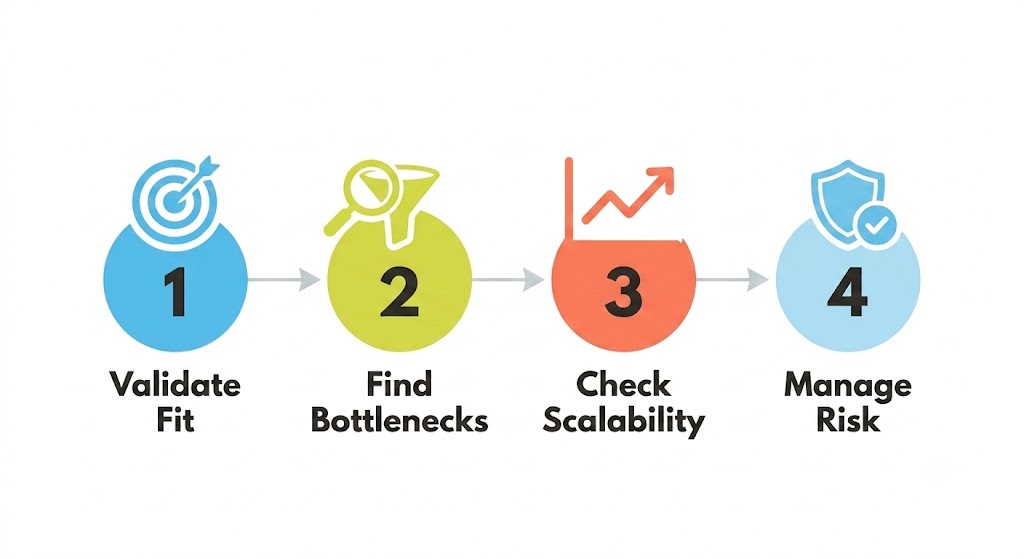
- Prioritize Product-Market Fit Validation
Software infrastructure should not be heavily funded before confirming product-market fit, as driving traffic to an unproven product results in resource waste.
- Identify Active Funnel Bottlenecks
Growth professionals must map existing operational metrics to locate the exact constraints within the funnel before choosing specific platform integrations.
- Evaluate Long-Term Scalability
Stacks must favor tools that support automation and compounding returns, allowing systems to scale 10x without requiring a 10x increase in manual effort.
- Support Controlled Risk-Taking
Software settings must accommodate rapid experimentation workflows where deployment failure is treated as analytical feedback rather than an operational loss.
Tool Stack Allocation Matrix by Revenue Stage
Common Pitfalls to Avoid
- Skipping Data Tracking
Neglecting to set up precise measurement systems on active applications creates a reliance on guesswork, which defeats the scientific goal of rapid testing. In 2026, this also means avoiding fragile tracking setups that depend only on browser-side cookies. Growth teams should prioritize server-side tagging, clear event naming conventions, consent-aware tracking, and documented analytics ownership.
- Ignoring Privacy and Compliance Requirements
Growth teams can no longer treat compliance as a legal afterthought. GDPR, CCPA, cookie deprecation, consent banners, suppression rules, and customer data retention policies all affect how campaigns are measured and automated. Platforms such as HubSpot, GA4, Amplitude, and Mixpanel should be configured with privacy constraints in mind from the beginning.
- Treating AI as a Standalone Growth Strategy
AI platforms can accelerate analysis, personalization, and campaign production, but they do not fix weak positioning, poor data quality, or unclear funnel ownership. Teams using AI-assisted workflows should connect them to approved customer data, monitored prompts, vector databases where appropriate, and LLM ops processes that prevent hallucinated or noncompliant outputs.
Final Thoughts
To implement a high-speed scaling strategy, the following strategic next steps should be taken:
- Validate product-market fit before allocating heavy funding toward software infrastructure.
- Map existing operational metrics to locate the exact constraints and bottlenecks within the active funnel.
- Restrict tool deployment to two or three core platforms that directly target the primary bottleneck.
- Establish precise tracking systems using clean event taxonomies, server-side tagging, and consent-aware analytics.
- Configure privacy and compliance controls early, especially for GDPR, CCPA, consent management, CRM permissions, and lifecycle automation.
- Use AI platforms where they strengthen an existing workflow, such as churn prediction, lead scoring, customer insight retrieval, or personalization.
- Share growth stack access across marketing, product, and engineering departments to eliminate communication delays and silos.
Frequently Asked Questions (FAQs)
What is growth hacking in 2026?
It is a mainstream, mission-critical business strategy that pairs rapid experimentation with data analysis to help companies of all sizes scale quickly.
Why are low-code tools important for growth teams?
Low-code platforms act as force multipliers, letting marketers build workflows, segment users, and deploy landing pages rapidly without waiting for engineering support.
How many tools should a business deploy at once?
To prevent diluted focus and data confusion, deployment should be restricted to two or three core tools that target the primary bottleneck.
Read These Next
B2B Marketing Attribution: A Complete Guide for Modern B2B Teams