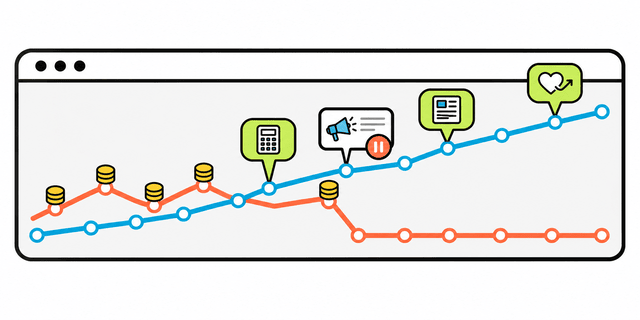
Organic Growth Strategy: Scale Sustainably Without Burning Cash on Ads



An Organic Growth Strategy is a system of helpful tools and repeating cycles designed to improve a business’s value-to-cost ratio (LTV:CAC) by relying less on expensive daily ad spending.
The goal is to maintain a low burn multiple, keeping operating expenses tight as revenue scales. This approach builds owned digital assets that continue to work long after a standard ad campaign would have ended.
Key Takeaways
This summary provides a strategic overview of how organic assets and retention-focused experience drive long-term business valuation.
- Brands must shift from keyword-mapped content to utility-based assets like tools and calculators to provide value that AI-driven searches cannot replicate.
- Organic growth succeeds by prioritizing self-sustaining loops where existing user actions naturally acquire new customers.
- Success requires identifying when ad spend hits diminishing returns, marked by stagnant conversions and rising costs, then transitioning to assets that protect margins.
- With 25% of consumers abandoning brands after one negative interaction, growth depends on high-quality, personalized experiences that secure long-term customer loyalty.
Overview
Modern brand growth requires building systems that attract customers naturally through helpful tools and data-driven value.
While organic growth takes longer to establish, it creates a massive competitive advantage and fosters communities that pull in new customers.
What Does Organic Growth Mean in Business Today?
Organic growth is the natural progression in a company’s size and revenue using its own internal resources. It is important to distinguish between the effort (what you do) and the outcome (the growth itself).
- Traffic-Led vs. Community-Led: Moving from simply getting clicks from strangers to building a loyal group of users who bring others into the fold.
- Organic vs. Inbound Marketing: Clarifying that Inbound is the method (creating content to pull people in), while Organic is the measurable financial result of those efforts.
- The Reality of Timing: Addressing the timeline gap—why organic results take months to manifest but offer higher stability than ads.
Why Your Current Organic Reach is Declining (and How to Reverse It)
The decade-old strategy of high-volume, keyword-mapped content is failing due to two technical shifts: Search Generative Experience (SGE) and zero-click searches. AI-integrated search engines now provide direct answers, eliminating the need for users to click through to source websites.
To stay visible, businesses must pivot from information-based content to utility-based assets. This requires:
- Smart Automation: Creating large groups of high-quality landing pages using organized data sets.
- Product-Led Growth (PLG): Letting the product itself do the talking by offering lite versions or free tools that keep users inside your ecosystem.
- Self-sustaining Growth Loops: Building systems where one new user naturally helps acquire the next.
Understanding the Efficiency Gap: Compound SEO vs. Linear Content
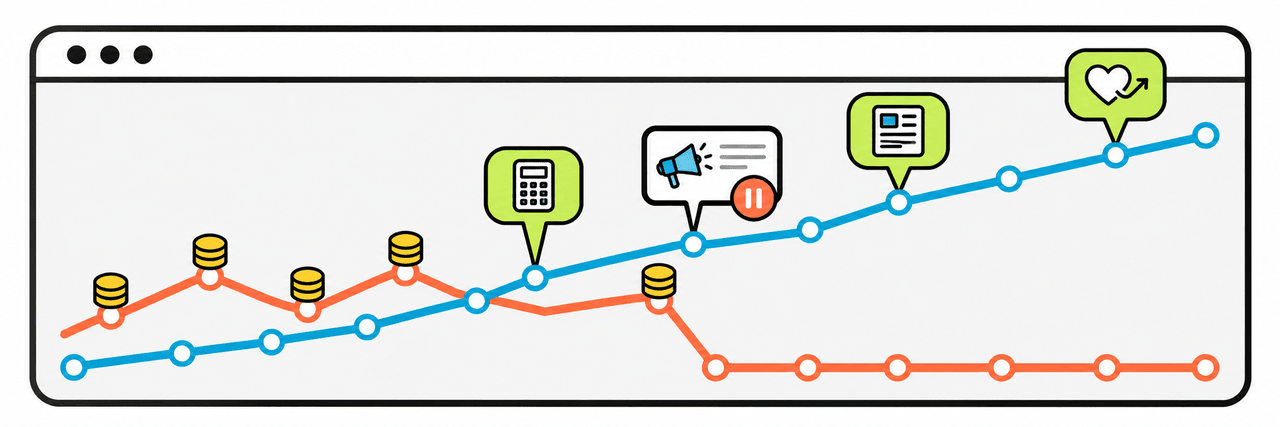
Modern organic growth is non-linear, where the value builds on itself over time. This table highlights why structured, utility-based assets are more effective for decision-making than basic content.
The Core Pillars of Sustainable Organic Growth
A reliable growth plan is built on three main ideas: how you reach people, how you keep them, and whether the numbers actually make sense for your budget.
1. Self-sustaining Growth Loops
Building systems where one user naturally leads to the next (e.g., a "refer-a-friend" feature or a collaborative tool).
Unlike linear funnels, a growth loop is a closed system where user actions lead to new acquisitions.
- Viral Loops: Users invite others to collaborate (e.g., Slack, Figma).
- Content Loops: User-generated content is indexed by search engines to attract new users (e.g., Pinterest, Stack Overflow).
- Social Distribution: Interest-based algorithms drive reach. Reports show that while Facebook showed over 50% new content to users in October 2025, TikTok remains the primary driver of reach in 2026, with engagement rising to 49%.
Ultimately, brands must determine the main platforms their audiences interact on to determine the approach that aligns best with their target customer’s digital behavior.
2. LTV:CAC Ratio
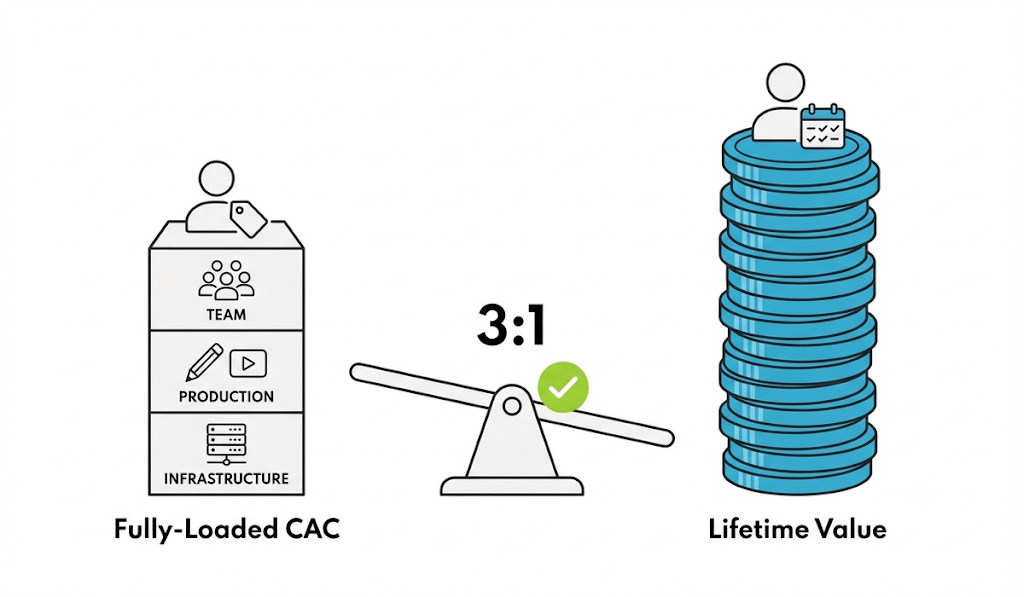
Ensuring a customer eventually brings in at least three times what it cost to find them. This sustainability is measured by the relationship between the cost of acquisition (CAC) and the customer lifetime value (LTV).
- Fully-loaded CAC: In organic marketing, this includes headcount, production, and infrastructure costs.
- Efficiency Benchmarks: Profitable ratio varies by industry and infrastructure; however, a standard ratio lies at 3:1.
Data from a report by Genesys Growth in 2026 confirms that a 3:1 LTV:CAC ratio remains the survival benchmark. However, their analysis reveals that companies relying purely on paid channels saw a 222% year-over-year increase in CAC in 2022, making this ratio harder to maintain without organic support.
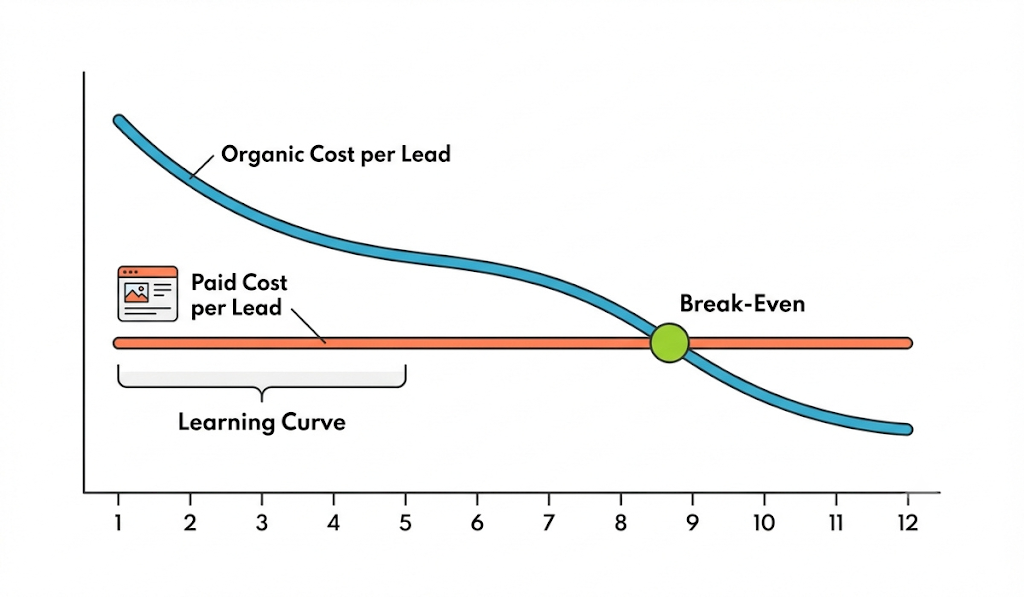
By building evergreen content, the cost to acquire a lead eventually drops as it generates traffic long after the initial production cost is paid. This demonstrates one of organic growth’s long-term values.
3. AI-Ready Infrastructure
Making sure your website is easy for both humans and AI scrapers to read and understand.
A summarized key pillar approach focuses on:
- Infrastructure: Technical considerations such as Core Web Vitals and schema markup to ensure machine-readability.
- Authority: Building a backlink profile through original research and proprietary data rather than link-buying.
- Retention: Using organic channels (email, community) to lower churn, which effectively increases the LTV without increasing the acquisition spend.
Why Most Brands Struggle with Customer Retention
Modern data shows that the biggest threat to your growth isn't a lack of ads, but a failure in customer experience. If your organic assets don't provide immediate value, your acquisition costs increase as users abandon your brand.
- The Cost of a Single Mistake: A report from Agility PR in 2025 reveals that retaining consumers means consistent interaction and recognition of long-term value, with nearly 25% willingly abandoning a brand after just one negative experience. This highlights why organic utility assets (which solve problems immediately) are far more valuable than ads that lead to a high-friction sales process.
- The Personalization Gap: A study by VML in 2025 found that 45% of consumers believe most brands fail at personalization. This failure creates a massive opportunity for organic growth: by building owned channels (like tools or member portals), you capture first-hand data on user needs, allowing for the deep personalization that paid ads cannot replicate.
By focusing on the quality of the interaction rather than the volume of the ads, you protect your LTV:CAC ratio. Every user retained through a high-utility organic asset is a user you don't have to acquire through expensive retargeting ads.
How to Identify the Paid Media Ceiling
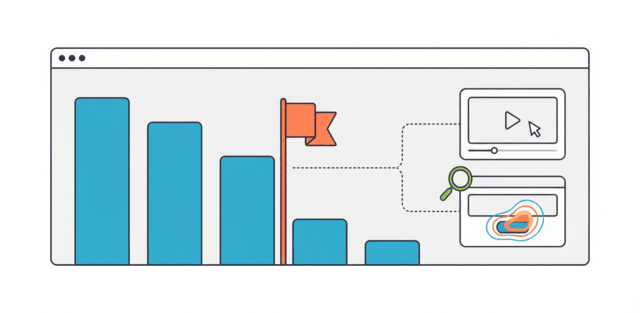
The paid media ceiling is the point of diminishing returns where increasing your ad budget no longer produces a proportional increase in profit.
When a brand struggles with inconsistent customer experiences or a lack of personalization, hitting this ceiling often means that expensive ad traffic is being directed toward a flawed user journey. In these cases, spending more on acquisition only accelerates the rate at which potential customers disengage.
How to recognize you have hit the ceiling:
- Stagnant Conversion Volume: Your total number of new customers remains flat despite consistent increases in monthly ad spend.
- Rising Acquisition Costs: Your Customer Acquisition Cost (CAC) is steadily climbing, eventually approaching or exceeding the initial profit generated from a new sale.
- Audience Saturation: Your ads are being shown to the same people repeatedly (high frequency), leading to "ad fatigue" and a sharp drop in engagement rates.
- Platform Volatility: Your profitability is overly sensitive to algorithm changes or price hikes in the ad auction, making your growth unpredictable.
Transitioning to an organic strategy protects your profit margins by shifting the focus from the sheer volume of ads to the quality of the interaction.
By building high-value assets, you ensure that the traffic you attract is met with a meaningful experience that encourages long-term retention.
Organic vs. Paid: Choosing the Right Strategy for Your Budget
The primary difference between organic growth and paid acquisition is the compounding nature of the investment.
Paid acquisition is a linear expense; when the budget stops, traffic stops, creating a dependency on external platforms.
While ads facilitate rapid scaling, organic strategies provide sustainability and a competitive moat.
Paid ads facilitate rapid scaling, but organic strategies facilitate sustainability. Relying solely on PPC leads to margin compression as competitors bid up the cost of keywords. An organic strategy functions as a hedge against this inflation.
Initial organic efforts may render ineffective for 6–12 months during the technical learning curve, but once the break-even point is reached, cost-per-lead typically drops significantly below PPC averages.
Summary
Sustainable organic growth requires a structured approach that combines growth loops, customer retention, LTV:CAC efficiency, and AI-ready infrastructure. Rather than relying heavily on paid acquisition, businesses can build useful digital assets, improve customer experiences, and create systems that attract and retain customers over time.
As search behavior evolves and advertising costs rise, utility-based content, owned channels, and data-driven personalization become increasingly important. A well-built organic growth engine can reduce acquisition costs over time, strengthen brand loyalty, and create a more stable foundation for long-term business growth.
FAQs
1. Is organic growth actually cheaper than paid advertising?
While organic growth has no variable ad spend, it is not zero-cost. It requires significant investment in operational expenditure from individuals running the organic assets. However, it becomes more efficient in the long run once it creates a system for user acquisition that can continue even if the marketing budget is temporarily reduced.
2. What is the "paid media ceiling" and how do I know if I’ve hit it?
The ceiling is the point where spending more money on ads stops bringing in more customers at a reasonable price. You’ve hit it if your ad bills are going up, but your sales are staying the same, or if the cost to get a single new customer is becoming higher than the profit that customer brings in.
4. What is the difference between "old" SEO and "new" SEO in organic growth?
"Old" SEO was about writing articles to rank for specific words. "New" organic growth is about building utility. For instance, instead of just writing an article about how to calculate taxes, you build a tax calculator tool. The tool is more useful, stays relevant longer, and is much harder for an AI or a competitor to replicate.
Related Content
Read These Next
Conversion Rate Optimization for Lead Generation: 7 Tactics That Fill Your Pipeline Faster