.png)


AI Media Buying: How Algorithms Are Outperforming Human Media Buyers in 2026
.png)

.png)

AI media buying outperforms human buyers by processing millions of real-time signals—such as intent, device, and context—to adjust bids and budget in milliseconds. While humans excel at strategy and creative direction, algorithms provide superior execution consistency and scale in fragmented programmatic and social auctions. Human oversight remains critical because AI systems still depend on accurate goals, clean data, and commercial judgment.
Snapshot
AI media buying uses machine learning algorithms to automate bid management, audience targeting, budget allocation, and creative delivery across programmatic, search, and paid social channels. Algorithms now outperform human buyers on moment-to-moment execution - processing signals, adjusting bids, and optimizing delivery faster than any manual process. Human oversight remains essential for strategy, measurement, creative direction, and interpreting performance data that platforms routinely misreport.
Introduction
AI media buying is no longer a feature layer sitting on top of traditional campaign management. It is the operating infrastructure through which programmatic, paid search, and paid social now function. Programmatic advertising refers to the automated buying and selling of digital ad inventory through real-time auctions. Bidding, targeting, budget distribution, and creative selection are increasingly automated by default across every major platform - Google, Meta, The Trade Desk, Amazon, LinkedIn, and TikTok, among them.
The shift has been significant and fast. According to AI Digital’s 2025 Global Digital Advertising Outlook Report, digital advertising is projected to account for more than 70 percent of global ad revenue by 2025, with more than 90 percent of digital display impressions in the US trading programmatically. The volume and speed at which these transactions occur - millions of real-time bid decisions per second - make algorithmic buying not just efficient but structurally necessary at scale.
What has changed in the current environment is how much control platforms now expect advertisers to hand over. Smart Bidding on Google, Meta Advantage+, and programmatic DSP automation have expanded their scope considerably. A DSP (Demand-Side Platform) is software that allows advertisers to buy digital ad inventory automatically across multiple exchanges. The algorithms are improving at execution. The tradeoff is transparency, as delivery becomes more automated, the visibility into what is actually driving performance declines.
This issue has become more pronounced in the 2026 privacy landscape. Google’s Privacy Sandbox rollout, third-party cookie deprecation, iOS tracking restrictions, and stricter consent requirements have significantly reduced observable user-level data across the open web. Attribution across fragmented customer journeys is increasingly modeled rather than directly observed, which is why AI-driven probabilistic modeling has become operationally necessary. First-Party Data (1PD), server-side tracking, Conversions API (CAPI) integrations, and LTV (Lifetime Value) modeling are now critical infrastructure for maintaining targeting accuracy and measurement reliability in cookieless environments.
Platform-reported results also systematically overstate actual returns
What This Guide Covers
This guide explains how AI media buying works across programmatic, search, and paid social channels and the conditions under which algorithmic buying outperforms - and underperforms - human decision-making.
- What AI media buying is and how it works as a system
- Where algorithms outperform human buyers and why
- How AI bidding works in paid search
- How AI delivery works in paid social
- Where AI media buying breaks down in practice
- What human oversight still controls and why it matters
- How to measure AI media buying performance accurately
Quick Comparison: AI vs Human Media Buying
1. What Is AI Media Buying and How Does It Work as a System?
AI media buying refers to the use of machine learning algorithms to automate the decisions traditionally made by human media buyers - which impressions to bid on, how much to pay, which audiences to target, and how to allocate budget across placements and channels. The algorithm makes these decisions in real time, processing far more signals than any human could evaluate simultaneously.
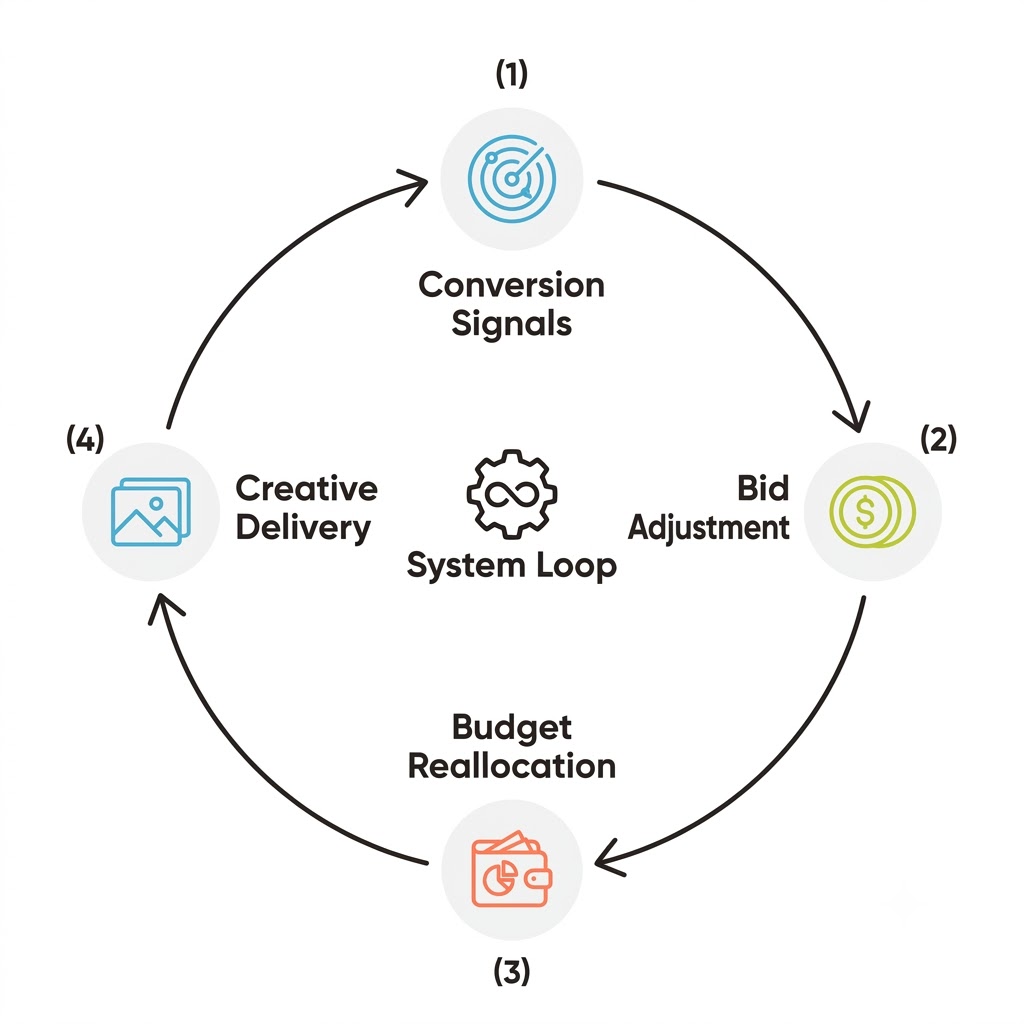
The system works through a feedback loop. Algorithms ingest conversion signals - purchases, form fills, page views, video completions - and use that data to model which users, placements, and times are most likely to generate the desired outcome. Bids are adjusted in real time at the auction level. Budget is reallocated dynamically toward signals that are converting. Creative variants are tested and served based on predicted engagement.
The components interact. A change in conversion signal quality affects bidding accuracy. A drop in creative performance reduces the data the algorithm has to work with. A misconfigured campaign objective sends the system optimizing toward the wrong outcome. This is why performance is a system, not a setting - the algorithm performs only as well as the inputs it receives and the objective it has been given.
In 2026, those inputs increasingly rely on First-Party Data (1PD), server-side event tracking, Conversions API (CAPI) integrations, and modeled attribution systems because observable third-party behavioral signals continue to decline under Privacy Sandbox frameworks and broader cookieless tracking restrictions. AI systems are now required to infer intent from incomplete data environments rather than rely on deterministic tracking alone. Higher-quality inputs such as offline conversions, LTV (Lifetime Value) modeling, and margin-based signals increasingly determine how effectively AI systems optimize budget allocation and long-term profitability.
2. Where Do Algorithms Outperform Human Media Buyers?
Algorithms outperform human buyers on execution speed, signal processing volume, and consistency of optimization. These are structural advantages that cannot be replicated manually, regardless of how experienced the media buyer is.
The performance gap is clearest in real-time bidding environments. In a programmatic auction, the algorithm evaluates hundreds of audience, contextual, and behavioral signals within milliseconds to determine the bid price. A human buyer setting manual bids is making decisions hours or days after the fact, based on aggregated data rather than individual impression signals. According to The MTM Agency, AI consistently outperforms humans at moment-to-moment execution - reacting to signals, bids, and behavioral patterns at a level no human can replicate.
The areas where algorithms have the clearest advantage include:
- Bid-level optimization: adjusting spend in real time based on conversion probability for each individual auction
- Audience expansion: identifying user segments that convert based on observed behavioral patterns, including segments a human buyer would not have defined manually
- Budget pacing: distributing spend across dayparts, placements, and channels to maximize conversion volume within budget constraints
- Creative selection: testing multiple ad variants simultaneously and shifting delivery toward higher-performing combinations faster than manual rotation allows
The performance advantage compounds over time as the algorithm accumulates conversion data. Campaigns with sufficient signal volume improve consistently in the early weeks as the algorithm refines its model. This is why performance benchmarks from the first week of a campaign are unreliable as a measure of long-term potential.
3. How Does AI Bidding Work in Paid Search?
In paid search, AI bidding has effectively replaced manual CPC management for most advertisers. Google's Smart Bidding strategies - Target CPA, Target ROAS, Maximize Conversions, and Maximize Conversion Value - use machine learning to set bids at the individual auction level based on a wide range of contextual signals.
The signals the algorithm uses go beyond what manual bidding can incorporate. Device type, location, time of day, search query, audience list membership, landing page quality, and historical conversion patterns are all factored into the bid decision for every single auction. This is why Smart Bidding on a well-configured account consistently outperforms manual bidding on cost per conversion over time.
The shift has changed where strategy lives in paid search. Account structures are simpler - fewer campaigns, broader match types, and less granular ad group segmentation. But the quality of conversion signals fed into the system has become the primary competitive variable. As The MTM Agency notes, feeding high-quality conversion data - including offline conversions and margin-based signals where possible - has become a competitive advantage in search.
Decision clarity:
- Use Target CPA bidding when the priority is controlling cost per acquisition, and conversion volume is sufficient for the algorithm to optimize
- Use Target ROAS when revenue value per conversion varies, and the system needs to weight higher-value conversions more heavily
- Use Maximize Conversions during campaign launch phases to build signal volume before switching to a constrained bidding strategy
- Avoid manual CPC as a long-term strategy in competitive markets - it removes the algorithm's ability to respond to real-time auction signals
The risk in paid search AI buying is passive acceptance of platform recommendations. Google's suggestions are designed to drive platform performance metrics, not necessarily business profitability. Human oversight remains essential to ensure bidding strategies align with margin, stock levels, seasonality, and customer lifetime value rather than platform-reported ROAS alone.
4. How Does AI Delivery Work in Paid Social?
Paid social has become the clearest example of AI-first media buying. Audience definitions are now broader by design, delivery is automated, and creative has replaced targeting as the primary signal the algorithm uses to identify relevance and find converting users.
Meta's Advantage+ campaign structure, TikTok's Smart Performance Campaigns, and similar AI-driven formats on LinkedIn and Pinterest automate audience selection, placement, and budget allocation within a single campaign objective. The advertiser defines the conversion goal and creative assets. The algorithm handles the rest. This represents a significant expansion of machine control compared to manual campaign structures from just a few years ago.
The change has practical implications for how campaigns are built. The biggest mistake advertisers make is treating creative volume as creative variety. AI-driven delivery does not need multiple versions of the same ad with minor copy tweaks. It needs meaningfully different creative angles, hooks, and value propositions that give the algorithm genuine variance to test. Without that variance, the system has insufficient signal to differentiate and optimize.
Benchmark context: Meta Advantage+ campaigns require a minimum of 50 optimization events per ad set per week to exit the learning phase. Campaigns below this threshold continue learning indefinitely, which means bid efficiency and delivery stability are both lower. Budget and audience size must be sufficient to generate this volume - running too many simultaneous ad sets against a small audience is the most common cause of extended learning phases.
The limitation in paid social AI delivery is transparency. As automation expands, visibility into which specific audience segments, placements, and creative combinations are driving performance shrinks. Advertisers see aggregate ROAS but not the granular breakdown that would inform strategic decisions. First-party data - email lists, CRM records, pixel events - has become the most important input for maintaining targeting relevance as third-party signal quality declines.
5. Where Does AI Media Buying Break Down in Practice?
AI media buying has clear performance advantages, but it breaks down under specific conditions that are common in real-world campaigns. Understanding these failure modes is as important as understanding the benefits.
The most common breakdown is an insufficient conversion signal. Algorithms require a minimum data volume to optimize - typically 30 to 50 conversions per week per campaign or ad set. Below this threshold, the system is effectively guessing.
Other conditions where AI buying underperforms:
- Misconfigured objectives: if the algorithm is optimizing for link clicks rather than purchases, it will find the cheapest clicks regardless of purchase intent - the system is performing correctly against the wrong goal
- Poor creative input: on paid social in particular, the algorithm can only work with what it is given - weak creative limits performance regardless of how well the bidding system functions
- Attribution gaps: In the 2026 post-cookie environment, Privacy Sandbox limitations, iOS tracking restrictions, third-party cookie deprecation, and cross-device customer journeys mean the algorithm is working with incomplete conversion data. Modeled conversions are increasingly necessary, but they are still less reliable than fully observed attribution.
- Audience saturation: as the algorithm exhausts high-intent segments, it expands to broader audiences that convert at lower rates - CPA rises not because the system is failing, but because efficient demand has been consumed
- Platform reporting bias: all major platforms over-attribute conversions to their own channel; ROAS figures in platform dashboards should be treated as directional rather than definitive
6. What Does Human Oversight Still Control - and Why Does It Matter?
As algorithms take over execution, the human role in media buying has not shrunk - it has moved. The tasks that require human judgment are now upstream: strategy, objective setting, creative direction, measurement design, and commercial interpretation of performance data.
The MTM Agency frames this shift clearly: the modern performance marketer's role is to orchestrate the inputs the machine needs to function, not to make the moment-to-moment decisions the machine now handles better. When performance stalls, the issue is rarely a bid adjustment. More often it is a poorly defined objective, conflicting conversion signals, or creative that lacks the variety the algorithm needs to differentiate.
The areas where human judgment remains essential:
- Objective definition: the algorithm optimizes toward whatever goal it is given - defining the right goal requires commercial understanding that the platform cannot provide
- Conversion signal quality: deciding which actions to track, how to weight them, and how to pass offline or margin-based data back into the platform is a human decision with direct algorithmic consequences
- Creative strategy: AI can test and select creative variants, but it cannot develop the narratives, positioning, or customer insights that make those variants worth testing
- Market context: algorithms cannot account for competitive moves, product launches, supply constraints, regulatory changes, or brand events - human oversight is required to adjust campaign parameters when external context changes
- Budget allocation across channels: AI optimizes within channels efficiently, but the decision about how much to invest in paid search versus paid social versus programmatic requires a cross-channel view the algorithm does not have
The practical implication for C-level decision makers is that AI media buying reduces the cost of execution without reducing the need for strategic investment. Teams that cut strategic oversight in response to automation gains tend to see performance erode within months as the algorithm begins optimizing toward metrics that no longer reflect business reality.
7. How Do You Measure AI Media Buying Performance Accurately?
Measuring AI media buying performance accurately requires more than reading platform dashboards. All major platforms - Google, Meta, LinkedIn, The Trade Desk - report performance using attribution models that systematically over-credit their own channel. In an environment where AI is also generating modeled conversions to fill gaps left by privacy restrictions, the gap between platform-reported and actual performance can be substantial.
A reliable measurement approach requires multiple data sources that can be triangulated against each other. No single source is definitive. The goal is to identify consistent directional signals across sources, not to find one number that captures the complete picture.
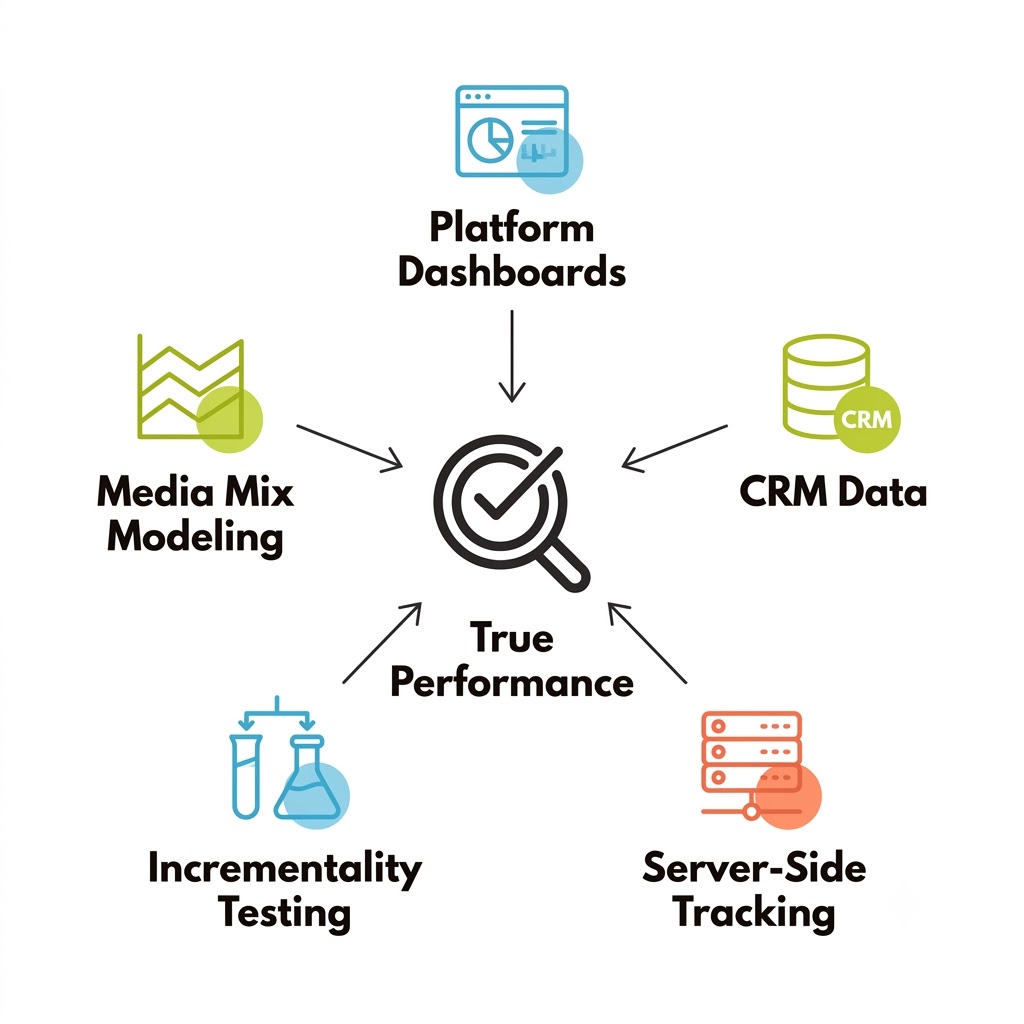
Benchmark context: Platform-reported ROAS typically overstates actual ROAS by 20 to 60 percent, depending on channel, attribution window, and the proportion of modeled conversions in the data. Businesses running incrementality tests consistently find that a portion of platform-attributed conversions would have occurred without the ad - the size of this incremental gap varies by channel, audience, and campaign type, but is rarely zero.
Scaling decisions should never be based on platform-reported ROAS alone. Cross-reference against CRM data before significantly increasing the budget. Run incrementality tests before drawing conclusions about channel contribution. Treat platform data as a directional input, not a business outcome.
Conclusion
AI media buying has fundamentally changed the execution layer of digital advertising. Algorithms now outperform human buyers on bid management, audience optimization, and budget pacing - not because the technology is perfect, but because the speed and signal volume required for competitive performance in real-time auctions is beyond what manual processes can match.
What has not changed is the requirement for a clear strategy, accurate measurement, and human judgment about what the algorithm is being asked to optimize toward. The businesses generating consistent returns from AI media buying are not those who have handed over the most control - they are those who have become more precise about the inputs the algorithm receives, the objectives it is given, and the standards against which its performance is evaluated.
AI will continue to improve at execution. Competitive advantage will increasingly come from the quality of strategy, creative, and measurement infrastructure built around it - not from the algorithm itself, which every advertiser with sufficient budget can access equally.
FAQs
What is AI media buying?
AI media buying uses machine learning algorithms to automate bid management, audience targeting, budget allocation, and creative delivery across paid search, paid social, and programmatic channels.
Do AI algorithms really outperform human media buyers?
On execution tasks - real-time bidding, signal processing, budget pacing - yes, consistently. On strategy, objective setting, creative direction, and commercial interpretation of performance data, human judgment remains essential.
What is the minimum budget needed for AI media buying to work effectively?
The practical threshold is conversion volume rather than spend alone. AI bidding systems require approximately 30 to 50 conversion events per week per campaign to optimize effectively.
How accurate is platform-reported ROAS for AI campaigns?
Platform-reported ROAS systematically overstates actual returns due to attribution window choices, last-click or platform-modeled attribution, and the inclusion of modeled conversions. Cross-referencing platform data against CRM and backend revenue data typically reveals a gap of 20 to 60 percent.
What happens when AI media buying underperforms?
The most common causes are insufficient conversion signal volume, a misconfigured campaign objective, weak creative input, or audience saturation. The fix is rarely a bid adjustment - it is identifying which input to the algorithm is wrong or missing and correcting it at the source.
Should businesses use AI media buying or manual media buying in 2026?
AI-driven buying is the default and correct approach for most paid search, paid social, and programmatic campaigns in 2026. Manual bidding is appropriate in specific, narrow situations - very low conversion volume campaigns, highly controlled brand safety environments, or testing phases where algorithmic expansion needs to be constrained.
Read These Next
AI Marketing Automation: How to 10x Your Output with Machine Learning