.png)

B2B Programmatic Advertising: How to Target Enterprise Decision Makers with Precision
.png)

.png)

How Do You Target Enterprise Decision-Makers with B2B Programmatic Advertising?
Target enterprise decision-makers by layering account-level firmographic data (industry, revenue, company size), technographic signals (current IT stack and installed software), and third-party intent data from providers like Bombora or G2. Use IP-to-company resolution tools to identify anonymous account visitors, and identity networks such as LiveRamp or UID2 to maintain cross-channel reach as cookies deprecate. Campaigns must track account progression via CRM integrations (Salesforce Data Cloud, HubSpot Operations Hub) rather than relying on individual cookie-based conversions.
Introduction
B2B programmatic advertising works differently from consumer campaigns. The purchase decision is usually made by a group of people, not one individual. The final conversion — a signed contract, a qualified sales meeting — happens offline, often months after someone first encountered an ad. And the various touchpoints that shape that decision are spread across a long research period that mostly wraps up before any sales conversation even begins.
The tools for reaching business buyers have evolved significantly. In 2026, most of B2B display budgets flow through programmatic platforms, as per industry research. What is clear is that automated media buying has become the default, driven by the targeting precision it offers over broad, placement-based campaigns. At the same time, measurement has become more difficult.
Third-party cookie deprecation, modelled attribution, and iOS tracking restrictions have reduced the reliable data signals available to ad platforms. Buying committee members move across devices and channels in ways that no single platform can track completely.
For C-level executives and decision-makers at SMEs and mid-market businesses across APAC, the US, and Australia, the practical value of B2B programmatic is not reach at scale — it is the ability to concentrate spend on specific accounts, roles, and buying stages with a level of precision that manual buying cannot match.
The challenge is building the measurement infrastructure to verify that spend is actually reaching and influencing the right people.
What This Guide Covers
This guide explains how B2B programmatic advertising works as an operational system and how to approach it for measurable pipeline outcomes. It covers:
- How B2B programmatic differs structurally from consumer programmatic
- Which targeting methods actually reach enterprise decision-makers
- How account-based marketing changes the measurement model
- Which platforms are best suited to different B2B budgets and objectives
- What realistic performance benchmarks look like across funnel stages
- Where B2B programmatic breaks down in practice
- How to evaluate readiness and scale spend responsibly
How Is B2B Programmatic Different from Consumer Programmatic?
B2B programmatic targets accounts and buying committees rather than individual consumer profiles. In B2B advertising, the final sale often happens months after someone first sees an ad. Multiple people are involved in the decision, and many of the important conversations — procurement reviews, legal sign-offs, security audits — happen entirely offline. These offline steps are a core reason why B2B sales cycles commonly run six to eighteen months, and why standard last-click attribution cannot reliably measure commercial impact.
In consumer programmatic, a single user sees an ad, clicks, and converts within a traceable window — the platform observes the full journey. In B2B, a CFO sees a LinkedIn ad, a VP of Engineering reads a whitepaper served through a display campaign, a procurement manager researches independently via organic search, and the deal closes six months later in a sales conversation. Each touchpoint influences the outcome. None of them connects cleanly in a platform dashboard.
This structural difference has direct implications for how campaigns should be built, measured, and evaluated. B2B programmatic requires account-level targeting — reaching multiple roles within a defined company rather than optimising for individual user conversions. It requires attribution windows that span the full sales cycle rather than defaulting to 30-day or 90-day click windows. And it requires CRM integration to connect ad exposure to pipeline outcomes, rather than relying on platform-reported figures that have no visibility into offline revenue.
The buying committee reality compounds this. Research from Gartner and 6sense consistently puts the average B2B buying committee at six to thirteen stakeholders for mid-market and enterprise deals. A campaign that reaches only one contact at a target account leaves the rest of the committee uninfluenced — and media spend that fails to reach the economic buyer or technical evaluator rarely contributes meaningfully to deal progression, regardless of impression volume.
What Targeting Methods Actually Reach Enterprise Decision-Makers?
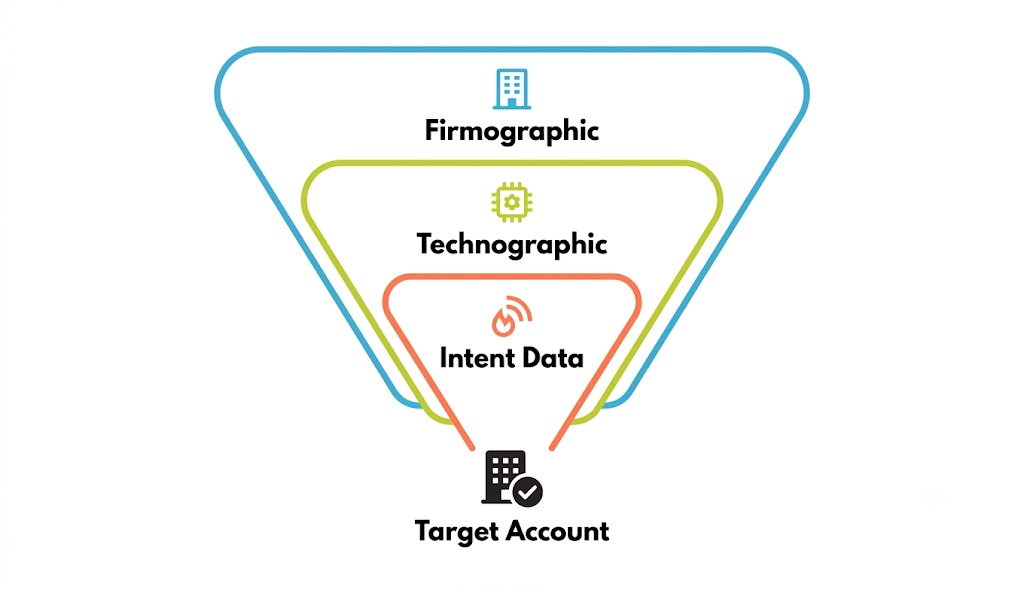
The most effective B2B programmatic targeting combines firmographic, technographic, and intent signals at the account level. No single method is sufficient on its own.
Firmographic targeting uses company attributes — industry, company size, revenue range, geography, and job function — to identify which organisations match the ideal customer profile (ICP) and which roles within those organisations are part of the buying decision. This is the foundational layer and the minimum viable approach for any B2B programmatic campaign.
Technographic targeting identifies accounts based on the technology stack they currently use. A cybersecurity vendor targeting companies running legacy infrastructure, or a SaaS platform targeting teams using a competitor's product, can use technographic signals to filter for accounts where the solution is most relevant.
Intent data identifies accounts that are actively researching a category, product, or topic — typically through content consumption signals collected across B2B publisher networks. When multiple employees at an account are reading content related to your product category, that signals buying activity. Intent data allows campaigns to prioritise accounts that are actively in-market rather than reaching the entire ICP indiscriminately.
Identity resolution and IP geolocation are increasingly important as third-party cookies disappear. IP-to-company mapping tools (such as Clearbit, Demandbase Identify, or 6sense's graph) match anonymous web visits to specific company accounts, allowing B2B teams to identify which organisations are engaging even without a form fill or login. Modern identity networks such as LiveRamp and ID5, as well as the IAB Tech Lab's UID2 (Unified ID 2.0) standard, provide privacy-compliant alternatives to cookie-based tracking for cross-site identification.
Account-level retargeting operates differently from individual retargeting in consumer campaigns. An account where three employees have visited the pricing page in the past thirty days represents a different signal than a single anonymous visit. Account-level retargeting — serving ads to any known contact at that company — is more reliable than individual-user pixel tracking in environments where iOS opt-out rates frequently reach 60% or higher on B2B audience segments.
The system works through layering: firmographic targeting identifies the right accounts, intent data prioritises which of those are active, and retargeting re-engages accounts that have already shown interest. Reaching the economic buyer, the technical evaluator, and the end user with role-appropriate messaging — simultaneously, within the same account — is what separates account-based programmatic from a standard display campaign with a job title filter applied.
How Does Account-Based Marketing Change the Measurement Model?
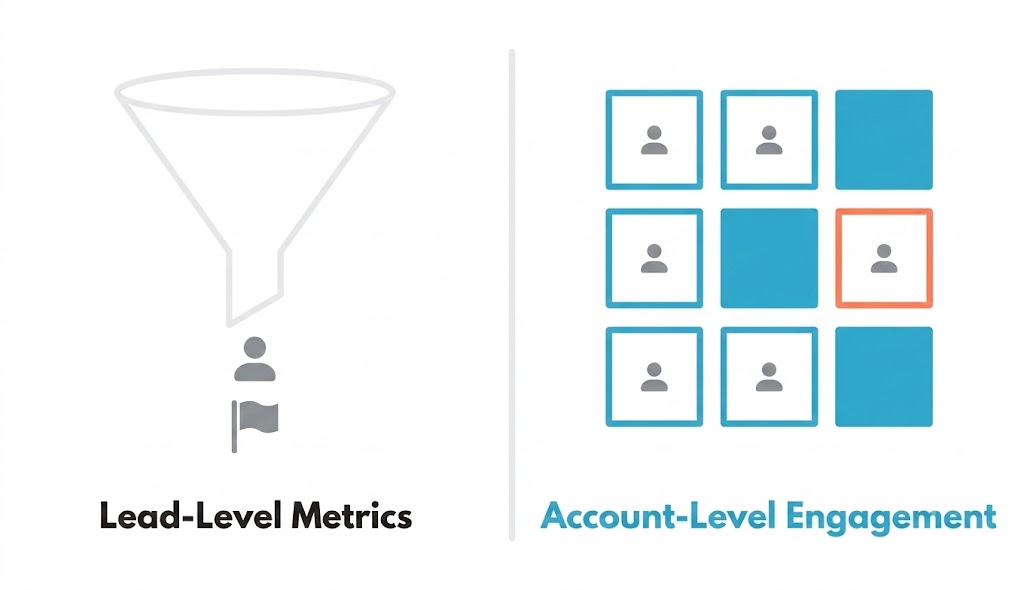
ABM shifts the unit of measurement from the individual lead to the account. This changes what success looks like at every stage of the campaign.
In a standard programmatic campaign, success is measured by cost per lead, click-through rate, and platform-reported return on ad spend (ROAS). In an ABM programmatic campaign, those metrics are largely irrelevant. A low cost per lead means nothing if the leads are not from target accounts. High click-through rates on awareness creative do not confirm that the buying committee is being reached. Platform ROAS cannot capture the offline sales conversation that actually converted.
The metrics that matter in B2B programmatic are account-level. The relevant questions are: what percentage of target accounts have been exposed to the campaign? How many have visited the website in the past thirty days? How many have progressed to a sales conversation? How much pipeline has been generated from accounts that were active in the programmatic campaign during the evaluation period?
Connecting those answers requires CRM integration. Campaign exposure data from the demand-side platform (DSP) — the technology that automates the buying of digital ad inventory across multiple publishers in real time — needs to be matched against the account list in Salesforce (including Salesforce Data Cloud for enterprise-level data unification) or HubSpot (Operations Hub for advanced integrations) to identify which target accounts are being reached, which are engaging, and which are progressing through the pipeline.
Stable account-level engagement means at least two to three separate touchpoints per account per month across the campaign period — for example, a website visit, a content asset download, and an ad impression from a named contact. Accounts meeting this threshold are meaningfully more likely to progress to a sales conversation than those with a single impression.
For SMEs and mid-market businesses without enterprise ABM infrastructure, a simpler version of this model is achievable. Define a target account list. Run LinkedIn or StackAdapt campaigns against that list. Track which accounts from the list visit the website using a tool like Clearbit or Demandbase Identify. Manually cross-reference those visits against CRM records monthly. This is a lower-fidelity approach, but it connects media activity to pipeline outcomes in a way that platform dashboards alone cannot.
Which Platforms Perform Best for B2B Programmatic?
Platform selection depends on budget size, technical maturity, CRM integration requirements, and whether the primary objective is demand generation or account-based marketing. Rather than re-explaining the targeting concepts covered above, this section focuses on how each platform executes against those targeting types — and which business situations each is best suited to.
LinkedIn Campaign Manager is the default starting point for most B2B advertisers. Its targeting draws on verified professional profile data — job title, seniority, company size, industry — rather than inferred audience signals. This precision comes at a cost: CPMs are substantially higher than programmatic display (typically $30 to $80 or more, depending on audience and objective). The trade-off is justified when deal values are large enough to absorb it. LinkedIn is most effective for reaching decision-makers who are not yet in active buying mode — building familiarity and credibility before intent is expressed. Note that the $5,000 to $10,000 monthly minimum is directional: a target account list (TAL) of 50 enterprise accounts requires far less budget to achieve meaningful frequency than a TAL of 5,000 mid-market accounts, where spend would need to scale proportionally.
StackAdapt is well-suited to mid-market B2B advertisers who need multi-channel programmatic access — native, display, video, connected TV (CTV), and programmatic audio — without enterprise-level complexity. Architecturally, StackAdapt integrates intent data natively and executes account-level targeting across its programmatic supply, making it a practical extension layer for LinkedIn-anchored campaigns. For teams spending between $50,000 and $250,000 annually on B2B programmatic, it provides a strong middle ground. Its CTV capabilities are also worth noting for reaching executives in a lean-back context, complementing the professional environment of LinkedIn.
The Trade Desk suits enterprise advertisers with large budgets, experienced programmatic teams, and the need for global cross-channel scale. Its Koa AI system handles audience scoring and bid optimisation across 200-plus data integrations. The platform typically requires a minimum annual spend of $250,000 or more before its full capabilities are accessible, and demands significant operational expertise. For lean internal teams, managed service access through an agency partner reduces the burden.
6sense and Demandbase are purpose-built for account-based B2B programmatic. Both combine intent data, account identification, display advertising, and CRM integration in a single platform. The key architectural difference from general DSPs is that intent scoring and account identification happen inside the platform before bidding begins — the DSP does not just buy impressions, it actively prioritises which accounts to pursue. Both require annual contract commitments and meaningful minimum budgets, making them more appropriate for established B2B marketing teams than for SMEs testing programmatic for the first time.
Programmatic audio and digital out-of-home (DOOH) are underused formats for reaching C-suite audiences. Executive podcast advertising, served programmatically through platforms like StackAdapt or specific audio DSPs, reaches senior decision-makers in contexts where display and social ads cannot. DOOH placements in major tech hubs — office districts, airport lounges, conference venues — allow B2B advertisers to build brand familiarity with hard-to-reach executive segments at relatively low CPMs. In managing enterprise campaigns, we consistently find these formats outperform display on executive audience segments when brand recall is the objective.
For most SMEs and mid-market businesses entering B2B programmatic, the practical path is LinkedIn for precision audience reach, combined with StackAdapt for multi-channel extension, with CRM integration as the non-negotiable prerequisite for measuring pipeline outcomes.
What Do Realistic B2B Programmatic Benchmarks Look Like?
B2B programmatic benchmarks vary significantly by platform, audience quality, funnel stage, contract size, and vertical. The table below provides directional ranges rather than universal targets.
Conversion rates in particular vary significantly by average contract value (ACV): a $10,000 ACV velocity deal can move from lead to close in weeks, while a $500,000 enterprise deal may require twelve months of multi-stakeholder evaluation.
The figures below are most applicable to mid-market deals in the $30,000 to $150,000 ACV range.
*LinkedIn's $5,000–$10,000 minimum is directional. A TAL of 50 enterprise accounts requires significantly less budget for meaningful frequency than a TAL of 5,000 mid-market accounts.
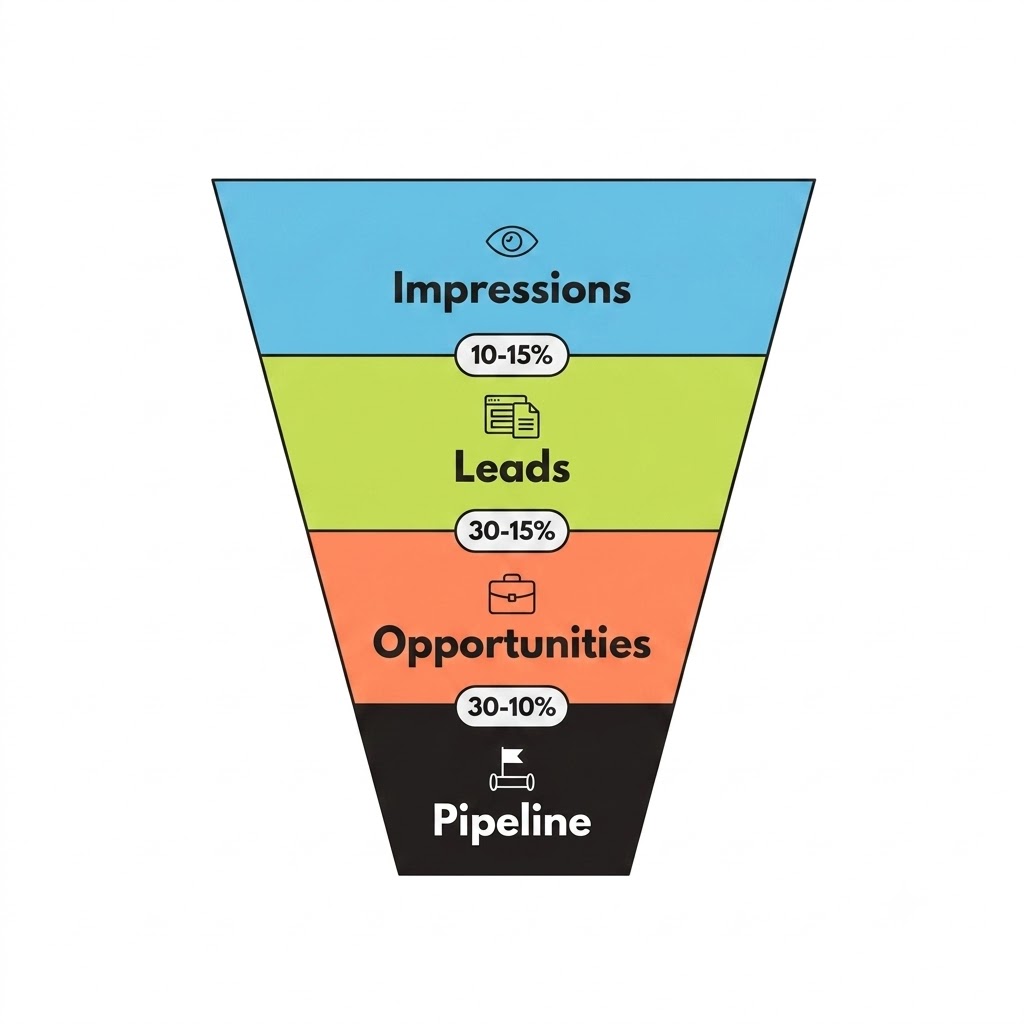
Cost per opportunity is the more reliable early indicator of B2B programmatic efficiency. The median B2B conversion rate from lead to sales-qualified opportunity is commonly cited around 15% — but this varies significantly by source and deal complexity.
Content syndication and gated asset leads typically convert at 5% to 10%. Inbound search leads convert at 20% to 30%. For programmatic display and LinkedIn, a 10% to 15% lead-to-opportunity rate on well-qualified audiences is a reasonable directional expectation for mid-market ACV deals.
Pipeline influence is how most mature B2B programmes measure programmatic ROI. A campaign that touches 70% of target accounts and influences 30% of pipeline generated from those accounts within a defined period represents a meaningful commercial contribution — even if no single impression can be credited with closing a deal.
Where Does B2B Programmatic Break Down in Practice?
B2B programmatic fails in predictable ways, and most failures trace back to measurement infrastructure rather than channel performance.
Attribution windows that are too short are one of the most common structural errors. A B2B sales cycle of six to twelve months means that 30-day or 90-day attribution windows miss most of the commercial impact of upper-funnel programmatic campaigns. A campaign impression that contributed to a deal closing nine months later will never appear in a standard platform report. This causes upper-funnel programmatic to be systematically undervalued and cut before it has time to influence the pipeline.
Optimising for the wrong conversion event is equally damaging. Programmatic platforms optimise toward whatever conversion event they can observe. If the campaign objective is set to form fills or content downloads, the algorithm will find users who fill out forms and download content — not necessarily users who represent a genuine pipeline. Passing sales-qualified opportunity events or CRM stage progressions back to the DSP produces a significantly better optimisation signal than top-of-funnel form submissions. Both Salesforce Data Cloud and HubSpot Operations Hub support the native CRM event integrations required to enable this.
Signal loss from privacy restrictions affects B2B programmatic in the same way it affects consumer programmatic, but the impact is amplified because B2B audiences are smaller. iOS opt-outs and cookie deprecation affect a meaningfully larger share of the observable audience. Modern B2B systems address this through IP-to-company mapping graphs, data clean rooms (where first-party data can be matched against publisher or platform data without exposing raw records), and identity networks like LiveRamp and ID5. The IAB Tech Lab's UID2 standard provides a privacy-compliant, interoperable identifier that is increasingly supported across DSPs. First-party CRM data — customer lists, website visitors identified through IP resolution tools, engaged contacts — becomes the most reliable targeting foundation as third-party signal quality declines.
Platform bias in attribution is a structural limitation that does not disappear regardless of how well the campaign is configured. DSPs and ad platforms have financial incentives to attribute conversions to their own inventory. LinkedIn, The Trade Desk, and 6sense all report performance using their own attribution logic, which consistently over-credits their channel relative to what CRM and revenue data show. Cross-referencing platform data against CRM pipeline records monthly, and applying a calibration factor to platform-reported results, is the operational minimum for accurate budget decisions.
Creative irrelevance is underestimated as a failure mode in B2B programmatic. The same display banner served to a CFO, a VP of Engineering, and a procurement manager, but addresses none of their individual concerns. Role-specific creative — messaging that speaks to the economic buyer's ROI concerns, the technical evaluator's integration requirements, or the end user's workflow impact — consistently outperforms generic brand creative at equivalent impression volume. Running undifferentiated creative across all roles is one of the most common reasons B2B programmatic programmes generate impressions without progressing the pipeline.
When Should You Scale B2B Programmatic Spend?
Scale when account-level engagement is stable (two to three separate monthly touchpoints per account across web visits, ad exposures, and content interactions), CRM integration is functioning, and pipeline data shows that target accounts are progressing. Scale based on pipeline signals rather than platform-reported metrics.
Before increasing spend, confirm three things: conversion tracking is accurately passing sales-qualified events to the DSP, the target account list is defined and connected to CRM tracking, and the attribution window is long enough to capture the full buying cycle for the segment being targeted. Without these conditions, additional spend reaches the right accounts without producing measurable evidence of influence.
Pause or restructure campaigns when:
- Platform-reported results diverge significantly from CRM pipeline data over a sustained period
- Target account engagement is high, but no accounts are progressing to sales conversations
- Frequency exposure is rising without a corresponding increase in account-level engagement
- CPL is declining, but cost per opportunity is rising — a signal that lead quality is deteriorating
B2B programmatic is not a channel that produces results on a monthly optimisation cycle. Three to six months of consistent exposure against a defined account list, combined with aligned sales follow-up on accounts showing engagement signals, is the minimum window for evaluating whether the channel is contributing to the pipeline.
Conclusion
B2B programmatic advertising works when the campaign structure reflects how B2B purchasing actually happens: committee-level decisions, long evaluation cycles involving procurement reviews and legal sign-offs, and offline conversion events that platform attribution cannot observe directly. Impression volume and platform-reported ROAS are insufficient measures of whether the channel is contributing to commercial outcomes.
The campaigns that generate consistent B2B pipeline reach the right accounts at the right buying stage, serve role-appropriate messaging to multiple stakeholders simultaneously, and connect ad exposure to CRM pipeline records through integrated measurement rather than relying on last-click attribution. Getting those inputs right — account list quality, CRM integration, attribution window, and creative differentiation by role — is where B2B programmatic performance is actually determined, before any budget is committed to the auction.
FAQ
What is B2B programmatic advertising?
B2B programmatic advertising automates digital media buying to reach business decision-makers and buying committees using firmographic, technographic, and intent data, with the goal of generating pipeline and revenue rather than direct consumer conversions.
Which platform is best for B2B programmatic targeting?
LinkedIn is the most precise for job title and account targeting. StackAdapt suits mid-market multi-channel ABM across display, native, video, CTV, and audio. 6sense and Demandbase are the strongest options for organisations running full account-based marketing programmes with CRM integration requirements.
How do you measure B2B programmatic performance?
Measure account engagement rate, pipeline generated, pipeline influenced, and cost per sales-qualified opportunity — not cost per lead or platform ROAS, which cannot capture the offline conversion events where B2B revenue is generated.
How much budget does B2B programmatic require?
LinkedIn campaigns typically require $5,000 to $10,000 per month to build meaningful frequency, though the right level depends heavily on target account list size. StackAdapt ABM programmes typically require $8,000 to $15,000 per month. Platform minimums for 6sense and Demandbase start from $30,000 to $40,000 annually before ad spend.
Why does B2B programmatic produce impressions without pipeline?
The most common causes are optimising toward the wrong conversion event, attribution windows too short for the sales cycle, undifferentiated creative served across all buying roles, and the absence of CRM integration to connect ad exposure to account progression.
How does cookie deprecation affect B2B programmatic?
B2B audiences are smaller than consumer audiences, so privacy restrictions affect a larger share of the observable pool. Modern solutions include IP-to-company mapping graphs, data clean rooms, and identity networks such as LiveRamp and ID5. The IAB Tech Lab's UID2 standard provides a widely adopted privacy-compliant alternative to cookie-based identification.
Read These Next
B2B Marketing Attribution: A Complete Guide for Modern B2B Teams