.png)
E-commerce Marketing Automation: How to Increase Sales on Autopilot in 2026
.png)

.png)

E-commerce marketing automation is a data-driven system that triggers responsive marketing actions based on real-time customer behavior. By deploying tailored workflows — such as cart recovery, browse abandonment, and replenishment triggers — it captures high-intent revenue and maximizes customer lifetime value (LTV) without scaling ad spend. When implemented correctly, automation increases revenue from existing traffic and customers while improving operational efficiency across acquisition, conversion, and retention.
Introduction
E-commerce growth has become increasingly dependent on operational efficiency rather than traffic volume alone.
Customer acquisition costs continue to fluctuate across paid channels, privacy restrictions have reduced attribution visibility, and customer journeys now span multiple devices, platforms, and touchpoints before purchase. At the same time, AI-driven automation has expanded beyond email marketing into product recommendations, predictive segmentation, customer retention, and lifecycle marketing — all of which depend on first-party data: behavioral and transactional information collected directly from customers through owned channels like your website, email, and purchase history, rather than inferred from third-party sources.
This shift matters because most e-commerce businesses already generate significant customer activity that never converts into revenue. Visitors abandon carts, browse products without purchasing, and complete one purchase without returning. Marketing automation helps recover and nurture those opportunities systematically.
The goal is not simply to automate marketing tasks. The goal is to create a connected system that increases customer value across the entire lifecycle.
What This Guide Covers
This guide explains how e-commerce marketing automation increases sales and where it creates measurable business value.
It covers:
- How e-commerce marketing automation works
- Which workflows generate the most revenue
- How automation supports customer retention
- Realistic e-commerce performance benchmarks
- The relationship between AI and automation
- Common limitations and implementation challenges
- When automation is worth scaling
What Is E-commerce Marketing Automation?
E-commerce marketing automation is the use of software, customer data, and behavioral triggers to automatically deliver marketing actions based on customer activity.
These actions can include abandoned cart reminders, product recommendations, post-purchase follow-ups, loyalty campaigns, replenishment reminders, and customer retention workflows. Platforms like Klaviyo and Attentive handle execution across email and SMS channels, while infrastructure like Shopify Plus, Adobe Commerce, and WooCommerce provide the underlying customer data that those tools act on.
The difference between automation and traditional campaigns is responsiveness. Traditional campaigns operate on schedules. Automation responds to customer behavior as it occurs.
This allows e-commerce businesses to engage customers at moments when purchase intent is highest.
Why Does E-commerce Marketing Automation Increase Sales?
Marketing automation increases sales through structural economic compounding — not just by adding more touchpoints.
The core mechanic is straightforward: the same customer base and traffic volume generate progressively more revenue as behavioral signals are captured and acted on systematically. A customer who abandons a cart is worth more with a recovery workflow than without one. A customer who purchases once is worth more with a retention sequence than without one. These incremental gains compound across the entire customer lifecycle without requiring proportional increases in acquisition spend.
What makes this particularly valuable in practice is that the compounding effect accelerates as the system matures. Early-stage automation programs typically see the biggest lift from cart recovery alone. As more workflows are added — browse abandonment, post-purchase, replenishment — each layer captures revenue that would otherwise go unaddressed. Businesses that have built out full lifecycle automation consistently find that their revenue per customer increases without a corresponding increase in traffic, which is the clearest sign the system is working as intended.
This is why automation ROI tends to improve over time rather than plateau. Each workflow added to a mature system creates another revenue recovery layer on top of what already exists.
Which E-commerce Automation Workflows Generate the Most Revenue?
Not all workflows contribute equally to business outcomes. Certain workflows consistently outperform others because they engage customers closer to purchasing decisions.
Abandoned cart recovery remains one of the highest-performing automation categories because it targets customers who have already demonstrated purchase intent.
However, mature e-commerce businesses often generate greater long-term value through retention and repeat-purchase automation than through cart recovery alone.
How Does E-commerce Marketing Automation Improve Customer Retention?
Customer retention automation helps businesses generate more revenue from existing customers.
Acquiring new customers is typically more expensive than retaining existing ones. As acquisition costs increase across digital advertising channels, retention becomes increasingly important to profitability.
Automation supports retention through:
- Post-purchase education
- Product usage reminders
- Loyalty programs
- Replenishment notifications
- Personalized recommendations powered by tools like Nosto, which uses AI to surface relevant products based on individual browsing and purchase history
These activities keep customers engaged after the initial purchase and increase the likelihood of repeat transactions.
For many e-commerce brands, customer lifetime value improves more significantly through retention workflows than through acquisition optimization alone.
How Does AI Improve E-commerce Marketing Automation?
AI acts as an optimization layer within automation systems.
Traditional automation follows predefined rules. AI helps determine which customers should receive which messages, products, and offers based on predictive behavior patterns. Predictive segmentation — the practice of grouping customers based on AI-modeled likelihood of future actions like churn or repeat purchase, rather than past behavior alone — allows platforms to act before intent is expressed rather than after.
Modern e-commerce platforms increasingly use AI for:
In practice, the biggest performance gains from AI tend to come not from the models themselves but from the quality of data feeding them. Brands running Nosto for product recommendations, for example, see better results meaningfully when their product catalog is clean, their purchase history is complete, and their customer profiles are unified — versus brands that activate AI features on top of fragmented data. The technology is a multiplier, not a fix.
How Does E-commerce Marketing Automation Work as a System?
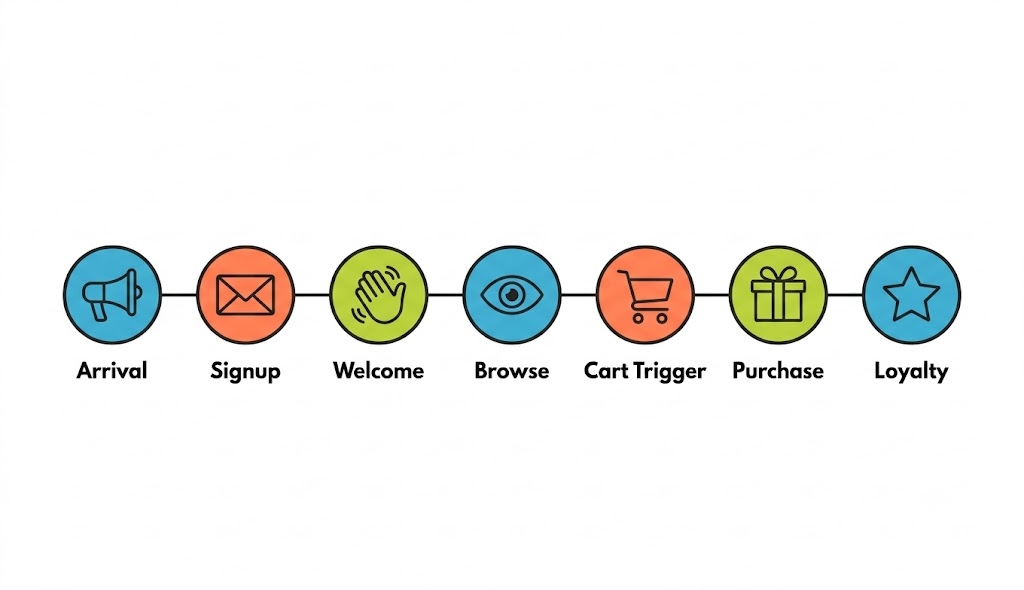
Automation performs best when viewed as part of a larger e-commerce ecosystem. Traffic generation, customer acquisition, conversion optimization, retention, and reporting all influence one another.
A typical system operates in sequence:
- A customer arrives through paid advertising or organic search
- Automation captures an email signup or behavioral event via a first-party data pipeline — such as Twilio Segment, which unifies customer data across touchpoints into a single profile
- A welcome workflow introduces products and sets purchase expectations
- Browse behavior triggers personalized product recommendations
- Cart abandonment triggers recovery messaging via email or SMS
- Purchase completion triggers post-purchase onboarding and retention workflows
- Repeat purchase behavior feeds loyalty and VIP sequences that increase lifetime value
Each workflow supports the next stage of the customer journey. The effectiveness of any individual workflow depends on how well the broader system functions. Weak customer data, inaccurate tracking, or poor segmentation reduce performance across the entire automation program — not just at the affected stage.
What Do Realistic E-commerce Automation Benchmarks Look Like?
Performance varies significantly by industry, product category, pricing structure, and customer behavior. The ranges below should be viewed as directional benchmarks rather than universal targets.
Strong performance depends on customer experience quality, offer relevance, and operational consistency rather than automation alone. Benchmarks should always be evaluated within the context of average order value, margin structure, and customer lifecycle length.
What Limitations Affect E-commerce Marketing Automation Performance?
Marketing automation does not eliminate the structural challenges affecting e-commerce performance. Key limitations include:
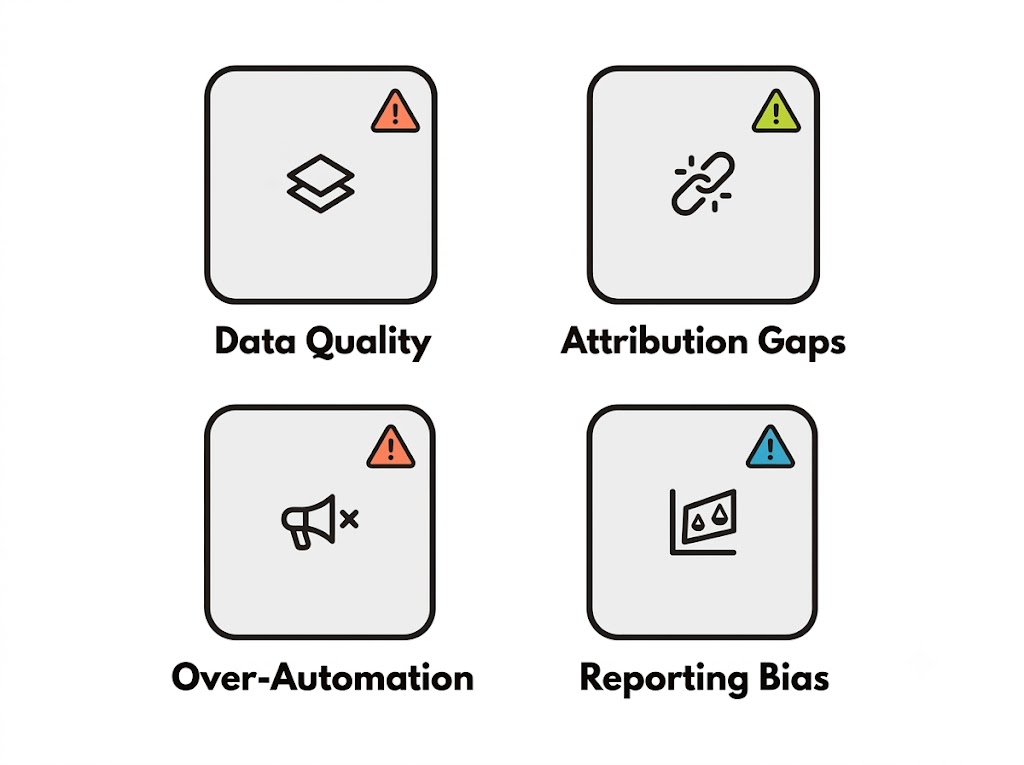
Data Quality Problems
Automation relies on accurate customer data. Incomplete profiles, duplicate records, and poor tracking reduce personalization effectiveness.
The 2026 Privacy Shift: Advanced signal loss from tracking restrictions — including Apple's Link Tracking Protection and third-party cookie deprecation — has reduced the reliability of behavioral data collected passively. Modern automation increasingly depends on zero-party data: preferences explicitly shared by the customer through quizzes, preference centers, or onboarding forms. Tools like HubSpot support structured zero-party data collection that feeds directly into segmentation and personalization logic, improving accuracy without relying on inferred signals.
Attribution Challenges
Privacy restrictions and cross-device shopping behavior make perfect attribution increasingly difficult. Many automation platforms rely partly on modeled conversions rather than directly observed outcomes.
Over-Automation
Excessive automation can create repetitive customer experiences. Too many messages or poorly timed workflows reduce engagement and increase unsubscribe rates. The strongest programs audit workflow frequency regularly and suppress over-messaged segments.
Platform Reporting Bias
Automation platforms often attribute value using their own measurement methodologies. Businesses should compare platform-reported outcomes against revenue data and customer retention metrics whenever possible.
When Should E-commerce Businesses Scale Marketing Automation?
Automation should be expanded when operational foundations are already functioning effectively.
The most common mistake is scaling automation before the underlying data is reliable. Brands that expand workflows on top of inconsistent tracking or fragmented customer profiles end up amplifying the wrong signals — sending the right message to the wrong segment, or triggering workflows based on incomplete purchase history. The automation runs, but it does not compound.
Scaling ineffective automation simply increases inefficiency. The strongest results occur when automation supports an already functioning customer acquisition and retention strategy.
Conclusion
E-commerce marketing automation creates value by improving how businesses capture, convert, retain, and re-engage customers throughout the buying journey.
The strongest automation programs operate as connected systems rather than isolated workflows. Customer behavior, acquisition channels, retention efforts, AI-driven optimization, and reporting infrastructure all influence outcomes together.
As customer journeys become more fragmented and acquisition costs remain volatile, automation is increasingly becoming part of the operational foundation of e-commerce growth. Businesses that focus on data quality, customer experience, and lifecycle optimization generally generate more sustainable long-term results than those relying on acquisition alone.
Frequently Asked Questions
What is e-commerce marketing automation? E-commerce marketing automation uses customer data and behavioral triggers to automatically send messages, recommendations, and campaigns that support conversion, retention, and repeat purchases.
Which e-commerce automation workflow generates the most revenue? Abandoned cart recovery is often one of the highest-performing workflows, though retention and repeat-purchase campaigns frequently generate greater long-term customer value.
Is e-commerce marketing automation only for large businesses? No. Small and mid-sized e-commerce businesses often benefit significantly from automation because it improves efficiency and customer follow-up without requiring additional staff.
How does AI improve e-commerce marketing automation? AI helps optimize recommendations, audience segmentation, content selection, and customer retention by analyzing behavioral patterns and predicting future actions.
When should an e-commerce business invest in marketing automation? Automation becomes most valuable when customer volume, marketing complexity, and retention opportunities exceed what can be managed effectively through manual processes.
Related Content
Read These Next
What is Retention Marketing? - The 2026 Guide to Customer-First Growth