.png)
.webp)
Benefits of Paid Advertising: 7 Reasons Why It's the Fastest Way to Scale
.png)

.png)

Paid advertising is a digital marketing strategy where placements are purchased on search engines and social media to drive immediate traffic. The seven core benefits include speed, targeting precision, scalability, real-time data, cross-channel amplification, competitive visibility, and budget control. Unlike organic channels, paid media allows for instant market entry but requires continuous spend to maintain results.
Introduction
Paid advertising works faster than any other marketing channel. A campaign can generate traffic within hours, test five messages in a week, and scale spend based on what converts. For businesses that need revenue before organic channels mature — or that are launching a product, entering a new market, or running a time-sensitive promotion — there is no direct alternative through inbound channels, though aggressive outbound sales or viral social content can serve similar short-term functions in specific contexts.
What is less often discussed is that these advantages operate within a shifting environment. Privacy restrictions have reduced the precision of third-party targeting. AI-driven platforms now automate delivery in ways that improve efficiency but reduce transparency. And attribution gaps (the difference between conversions a platform reports and what can be verified against actual revenue) mean that platform-reported results frequently overstate actual ROI. According to Dilate Digital, paid advertising has become a necessity rather than an option in competitive digital markets — but sustained performance depends on accurate tracking, strong creative, and realistic expectations.
This guide breaks down each core benefit of paid advertising, how it works, where it holds, and where it breaks down.
What This Guide Covers
This guide explains the seven core benefits of paid advertising and the conditions under which each benefit actually delivers.
It covers:
- The speed advantage of paid advertising over other channels
- How targeting precision reduces wasted spend
- How scalability works and when it plateaus
- Why real-time data is both an advantage and a limitation
- How paid advertising amplifies other marketing channels
- How paid ads create competitive visibility in crowded markets
- How budget control and flexibility support smarter decisions
Quick Comparison: Paid Advertising vs Organic Across 7 Dimensions
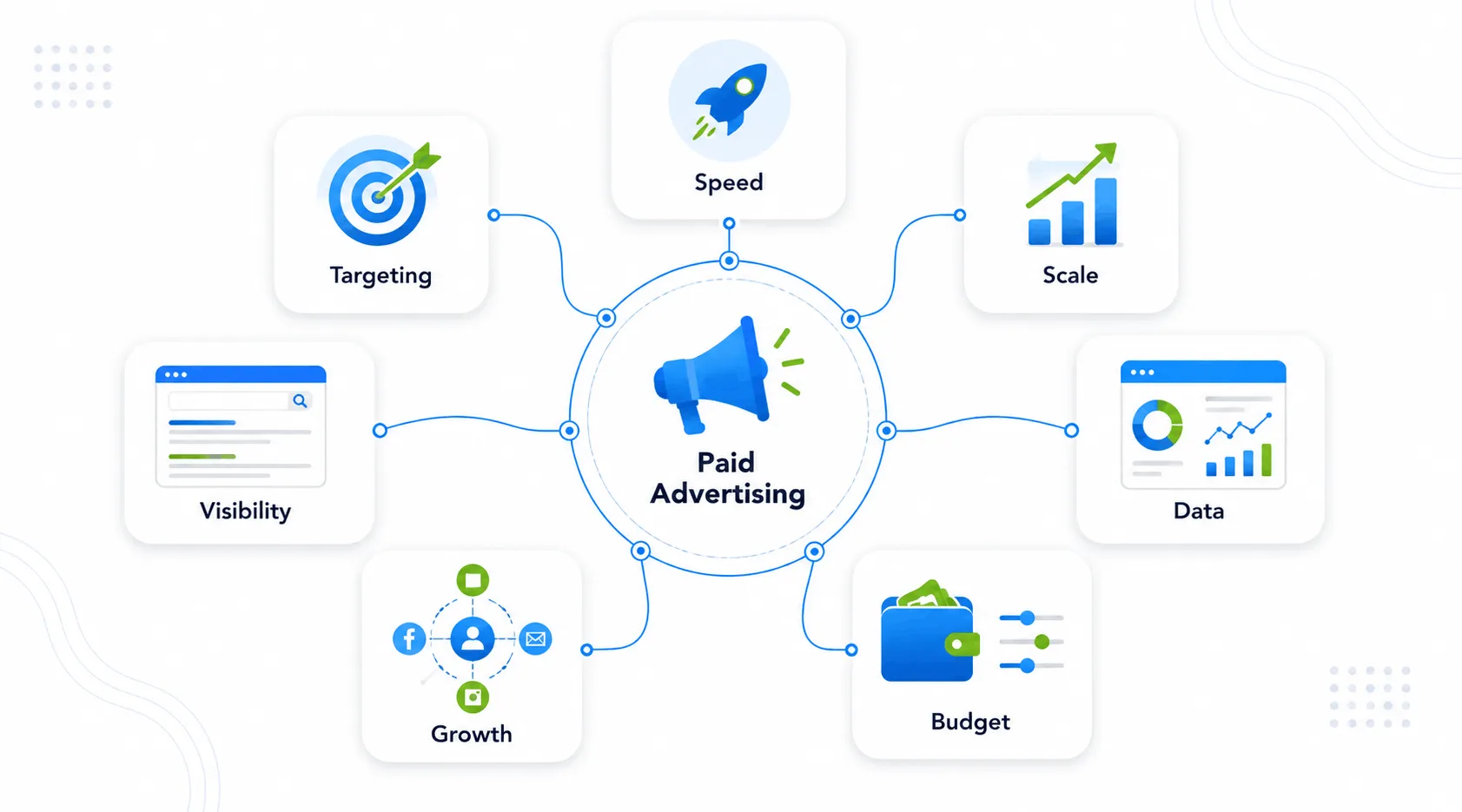
The 7 Core Benefits of Paid Advertising
1. Speed — Results Within Hours, Not Months
Paid advertising generates traffic and conversions faster than any other digital marketing channel. Unlike SEO or content marketing, there is no ranking process, no algorithm to satisfy over months, and no audience to build gradually. Once a campaign goes live, ads appear immediately and traffic begins flowing.
How it works: Advertisers purchase placements on search engines, social platforms, or display networks. Ads appear based on targeting criteria and bid levels. When users match the targeting parameters, ads are served and traffic is delivered in real time.
Where it holds: Speed is most valuable for product launches, seasonal promotions, market entry, and situations where revenue is needed before organic channels can scale. A well-structured paid search campaign can generate its first conversions within 24 to 48 hours of launch.
Where it breaks down: Speed requires continuous spend. Paid advertising produces no residual — traffic and visibility reset to zero when campaigns stop. Businesses that rely entirely on paid for traffic have no compounding asset, which increases long-term acquisition costs compared to channels that build over time.
Benchmark context: Meaningful optimisation data — typically defined as reaching 30 to 50 conversion events, which gives automated bidding systems enough signal to exit the learning phase and reach statistical reliability — accumulates within two to four weeks of consistent spend, depending on traffic volume and conversion rate.
2. Targeting Precision — Reach the Right Audience Before They Find You
Paid advertising allows campaigns to reach specific audiences based on search intent, demographics, interests, behaviors, and past interactions with the brand. This precision reduces wasted impressions and improves the relevance of traffic, which directly affects conversion rates and cost per acquisition.
How it works: Different channels use different targeting mechanisms. Search ads target users based on what they are actively searching for. Social ads target users based on who they are. Retargeting re-engages users who have already visited the site or interacted with the brand. Each method serves a different funnel stage.
Key targeting mechanisms:
- Search intent — keywords that signal active buying behavior
- Demographic and interest targeting — audience attributes on social platforms
- Behavioral retargeting — re-engaging users who already know the brand
- Lookalike audiences — reaching new users who resemble existing customers
Where it holds: Targeting precision is most effective when first-party data is clean and conversion signals are strong. Campaigns with well-defined audiences, validated offers, and accurate tracking consistently outperform broad campaigns with the same budget.
Where it breaks down: Privacy restrictions — including iOS signal loss, GDPR enforcement in the EU and UK, and CCPA in California — have reduced the quality of third-party audience data across all platforms. AI-driven systems like Meta Advantage+ and Google Performance Max now automate targeting, which improves delivery efficiency but reduces visibility into which specific segments are performing. Performance increasingly depends on creative quality and first-party data rather than manual audience configuration.
3. Scalability — Increase Spend to Increase Conversions
Paid advertising scales directly with budget. A campaign generating a 4x ROAS at $10,000 per month can theoretically be scaled by increasing spend, making it one of the most direct growth levers available to a business that has validated its offer and conversion funnel.
How it works: AI-driven bidding systems on Google, Meta, and LinkedIn optimise delivery based on conversion data. As campaigns accumulate signals, the algorithm improves at identifying which users convert — which means performance often improves in the first few weeks before plateauing as audiences saturate.
Where it holds: Scalability works best when campaigns have sufficient conversion volume for automated systems to optimise effectively. Businesses with higher average order values or lifetime customer values can sustain paid scaling at higher CPAs, giving them more room to grow before margins compress.
Where it breaks down: Scaling beyond high-intent audiences increases CPA because broader segments convert at lower rates. CPA typically rises with scale — not because the campaign is underperforming, but because the most efficient audience segments have been exhausted. Creative fatigue compounds this at scale: in 2026, where AI platforms handle bidding automatically, creative quality has become the primary lever for performance. As spend increases and audiences are reached more frequently, ad fatigue sets in and conversion rates decline — not from audience exhaustion alone, but from the same creative losing effectiveness. Campaigns that scale without a systematic creative refresh cadence will see CPA rise faster than the audience saturation data alone would predict. Scaling decisions should be based on stable performance data over two to three weeks, not short-term platform-reported spikes.
Decision clarity:
- Scale when CPA stays within target margins and conversion rate holds steady across two to three weeks
- Pause or reduce spend when CPA consistently exceeds margins or conversion rate declines without a clear external cause
- Validate platform ROAS against backend revenue data before significantly increasing budget
4. Real-Time Data — Test Fast, Iterate Faster
Paid advertising provides real-time performance data — impressions, clicks, conversions, cost per acquisition — at a granularity and speed that no other marketing channel matches. This allows rapid testing of creative, messaging, and audience combinations, compressing the iteration cycle from months to weeks or days.
How it works: Ad platforms provide live dashboards showing campaign performance as it happens. Advertisers can run A/B tests on headlines, images, calls to action, and landing pages simultaneously, then reallocate budget toward what works without waiting for organic feedback loops. Accurate data collection requires proper tracking infrastructure — server-side tagging via Google Tag Manager (server-side) or platform Conversion APIs (CAPI), such as Meta's Conversions API or Google's Enhanced Conversions, ensures conversion signals reach ad platforms even when browser-based tracking is blocked by privacy restrictions.
Where it holds: The testing advantage is most valuable early in a campaign when offer and messaging are still being validated. High-converting paid keywords and messages provide a validated signal for SEO investment — paid data identifies what earns revenue before committing to long-term organic content production.
Where it breaks down: Real-time data is only as accurate as the tracking infrastructure behind it. Privacy changes — browser restrictions, iOS signal loss, and third-party cookie deprecation — mean a growing share of attributed conversions is now modelled rather than directly observed. Platform dashboards tend to over-attribute conversions to paid touchpoints, meaning reported ROAS frequently differs from what CRM and revenue data shows. Real-time data supports directional decisions but should not drive major budget changes without cross-referencing external sources.
Benchmark context: In some platforms, estimates suggest 40% to 60% of reported conversions are now modelled rather than directly tracked. This gap should be accounted for when evaluating campaign performance.
5. Cross-Channel Amplification — Paid Makes Everything Else Work Better
Paid advertising does not operate in isolation. It interacts with SEO, content, email, and social channels in ways that improve overall marketing efficiency when the system is managed as a whole rather than in silos.
How it works: Paid search campaigns identify which queries and messages convert, providing validated demand signals for organic content investment. Retargeting campaigns re-engage users who discovered the brand through organic search or content but did not immediately convert. First-party data collected from paid campaigns improves targeting precision across other channels.
Practical workflow:
- Use paid search data to identify high-converting queries, then build SEO content around those terms
- Promote high-performing organic content through paid social to extend reach cost-efficiently
- Use retargeting to re-engage users who found the brand through organic search but did not convert
- Feed CRM and first-party behavioral data back into paid audience targeting
Where it holds: The amplification benefit is strongest for businesses that track the full customer journey across channels. Users who encounter a brand through organic search before seeing a paid ad convert at higher rates, reducing the effective CPA of paid campaigns over time.
Where it breaks down: Cross-channel amplification requires integrated tracking infrastructure to measure. Without server-side tracking, CRM integration, and consistent UTM attribution, the interactions between channels are invisible — and budget decisions default to optimising each channel independently, which consistently underperforms a systems-level approach.
6. Competitive Visibility — Appear at the Top Immediately
Paid advertising allows businesses to appear above organic search results, in social feeds, and across display networks immediately — regardless of domain authority, content volume, or brand recognition. This gives smaller businesses access to the same placements as established competitors.
How it works: Search ads appear above organic results for targeted keywords. Social ads appear in feeds alongside organic content. Display ads reach users across publisher networks. In all cases, paid placement bypasses the time required to earn organic visibility, which can take months or years in competitive verticals.
Where it holds: Competitive visibility through paid advertising is most valuable in markets where organic positions are dominated by established players. A new entrant can appear on the first page of Google for high-intent queries on day one of a campaign, which is structurally impossible through organic search alone.
Where it breaks down: Competitive visibility through paid search is subject to auction dynamics. In highly competitive categories — financial services, SaaS, legal, insurance — CPCs can be high enough to make paid acquisition unviable for businesses with thinner margins. Rising competition consistently increases the cost of maintaining visibility over time, which is one reason businesses invest in organic as a long-term hedge against paid cost inflation.
Benchmark context: CPC in competitive B2B markets can range from $5 to $50+ depending on keyword and platform. In some financial and legal categories, CPCs exceed $100 per click for high-intent queries.
7. Budget Control — Start Small, Scale What Works
Paid advertising allows full control over how much is spent, where it is spent, and when campaigns run. Unlike traditional media channels with fixed commitments, paid digital campaigns can be started, paused, adjusted, and scaled in real time based on performance data.
How it works: Advertisers set daily or campaign-level budgets, choose bidding strategies, and can pause or reallocate spend at any point. Automated bidding systems handle real-time allocation within the budget parameters set, optimising for the defined conversion goal.
Where it holds: Budget flexibility is most valuable for businesses testing new offers, entering new markets, or validating messaging before committing to larger spend. Starting with a small test budget — enough to generate statistically meaningful conversion data — before scaling reduces the risk of allocating large budgets to unvalidated campaigns.
Where it breaks down: Budget control does not eliminate budget dependency. Campaigns require ongoing spend to maintain visibility, which means the total cost of paid advertising compounds over time. Small businesses that start paid campaigns without a clear path to profitability at scale can find themselves dependent on spend that delivers diminishing returns as audiences saturate and CPCs rise. Budget control is a feature of the channel, not a protection against structural cost increases.
Conclusion
Paid advertising's seven core benefits — speed, targeting, scalability, real-time data, cross-channel amplification, competitive visibility, and budget control — are genuine advantages that no other marketing channel provides with the same speed and measurability.
What makes the difference between campaigns that scale and those that plateau is not access to these benefits, but how well the system around them is built. Accurate tracking, strong creative, validated offers, and cross-channel integration determine whether the speed and flexibility of paid advertising compound into sustainable growth or produce diminishing returns.
The businesses generating the most consistent returns from paid advertising are not necessarily spending more. They are measuring more accurately, testing more systematically, and treating paid as one part of a larger acquisition system rather than the only engine driving it.
FAQs
What are the main benefits of paid advertising? Speed of results, precise targeting, direct scalability with budget, real-time performance data, cross-channel amplification, immediate competitive visibility, and full budget control.
How quickly does paid advertising produce results? A well-structured paid search campaign can generate its first conversions within 24 to 48 hours. Meaningful optimisation data — typically 30 to 50 conversion events — requires two to four weeks of consistent spend.
Is paid advertising worth it for small businesses? It depends on margins and average customer value. Start with a defined test budget, validate CPA against margins, and scale only after confirming profitability at the test level.
What is a good ROAS for paid advertising? Most well-optimised paid search campaigns generate ROAS between 3x and 6x. Below 2x consistently usually indicates a structural issue. What counts as good ROAS depends on margins — a 3x ROAS on a 70% margin business performs very differently than on a 20% margin business.
Why does paid advertising stop working when you pause spend? Because traffic is purchased rather than earned. Unlike SEO, paid advertising produces no residual — visibility and traffic cease when campaigns stop running.
Read These Next
AI Marketing Automation: How to 10x Your Output with Machine Learning