Content Performance Marketing: How to Create Content That Actually Converts




Quick Answer
Content performance marketing is a strategy focused on creating content that drives measurable business actions by aligning content with the user's stage in the marketing funnel (TOF, MOF, BOF) and with search intent. Instead of publishing content randomly, companies plan content based on goals, audience stage, and conversion metrics to increase the chance of turning traffic into leads or sales.
Introduction
Many companies publish blog posts, videos, or social media content regularly but see little effect on leads, sales, or other meaningful results. Content alone does not guarantee conversion. In many cases, the problem is not quality, but the lack of a strategy that connects content to the customer journey and to specific business goals.
This guide explains how content performance marketing works when the goal is conversion instead of only traffic. It introduces the funnel model (TOF, MOF, BOF), explains why search intent matters, and shows a structured framework companies use to plan content that can lead to measurable results. Content marketing generates 3x more leads than outbound marketing at 62% lower cost—but only when content is mapped to funnel stage and buyer intent.
What This Guide Covers
- What conversion-focused content means
- How TOF / MOF / BOF content works
- Why matching search intent matters
- The framework used to plan content
- Why content often gets traffic but not conversions
- How companies track content performance
- The 7-step framework for creating content that converts
- Why content strategy often fails
- How companies track conversion performance
What Does It Mean for Content to Convert?
Content that converts is content that leads to a defined business action such as a sign-up, lead submission, demo request, or purchase. A conversion does not always mean a sale. Companies often track both micro conversions and macro conversions depending on the goal.
Common conversions include:
- Email sign-ups
- Form submissions
- Demo requests
- Downloads
- Purchases
A micro conversion is a small action that shows interest, such as subscribing to a newsletter.
A macro conversion is a final action, such as becoming a customer.
For content to convert, it must have a clear purpose. Content created without a goal may generate traffic but still fail to produce results. Companies usually connect content to objectives such as lead generation, education, or sales support.
Content also has limits. Conversion depends on factors outside the content itself, including:
- Product fit
- Pricing
- Trust
- User experience
- Timing
Because of this, content performance marketing focuses on planning content as part of a system rather than expecting one article to produce results. A good blog-to-lead conversion rate is 1–2% for B2B; rates below 0.3% typically indicate poor audience-content alignment or inadequate CTAs.
What Is TOF, MOF, and BOF Content?
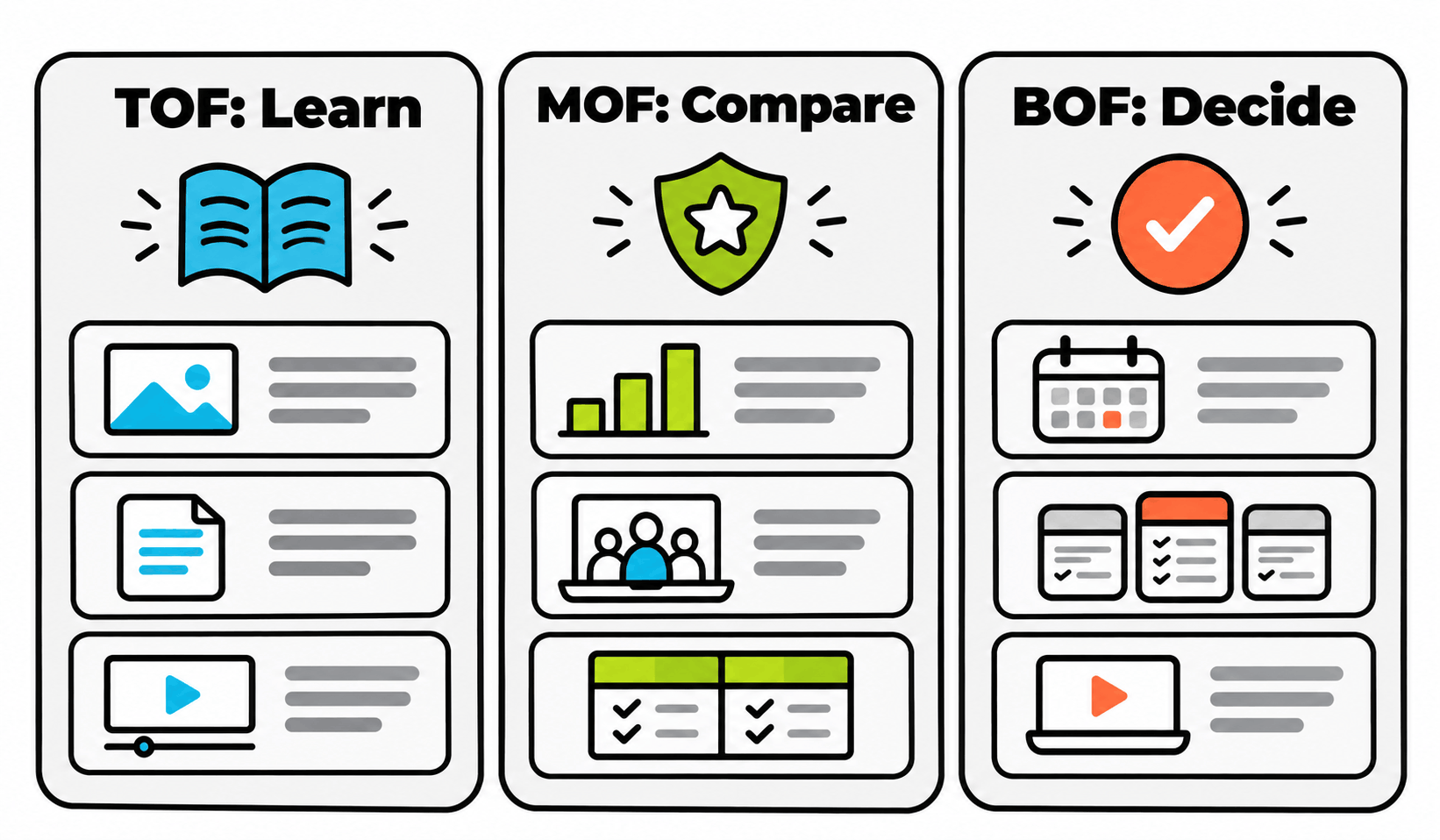
Content performance marketing often uses the marketing funnel to organize content based on the user’s stage in the decision process. The funnel is commonly divided into TOF (Top of Funnel), MOF (Middle of Funnel), and BOF (Bottom of Funnel). Each stage has a different goal, user intent, and type of content. Organizations using content marketing funnels generate more qualified prospects and achieve higher conversion rates than those creating content without strategic alignment.
At the TOF stage, users are learning about a problem, so content should focus on education. At the MOF stage, users compare solutions, so content should build trust. At the BOF stage, users are ready to act, so content should make the decision easier.
💡 Pro tip: In many campaigns, BOF content can convert 3–5× higher than TOF, but TOF content is necessary to fill the funnel. Bottom-of-funnel commercial keywords routinely outperform awareness content on conversion rate by a wide margin. HubSpot’s inbound data shows that inbound-led companies generate 54% more leads at 61% lower cost than outbound-only approaches, reinforcing the value of full-funnel content planning.
Tracking also changes by stage:
- TOF: time on page, shares, newsletter sign-ups
- MOF: downloads, webinar registrations, gated content
- BOF: trial starts, contact forms, revenue, ROAS
The funnel is only a model, but it helps companies plan content with a clear role instead of publishing randomly.
Why Matching Search Intent Matters
Content converts more often when it matches search intent, which describes what the user expects to find when searching. If the content does not match intent, users may leave even if the topic is correct.
Common search intent types include:
- Informational — learning about a topic
- Commercial — comparing options
- Transactional — ready to buy
- Navigational — looking for a specific brand
Search intent usually matches funnel stages:
Content that ignores intent often fails to convert. For example, showing a pricing page to a TOF user may cause them to leave, while showing a beginner guide to a BOF user may slow the decision.
The Content Marketing Institute B2B Report 2025 shows that companies aligning content with both funnel stage and intent report higher conversion rates than those publishing general content. Semrush’s content marketing research also confirms that bottom-of-funnel comparison content — such as ‘Product A vs. Product B’ — consistently outperforms awareness content on conversion rate by a significant margin.
Matching intent also makes performance easier to measure, because each type of content can have a different goal and metric.
The 7-Step Framework for Creating Content That Converts
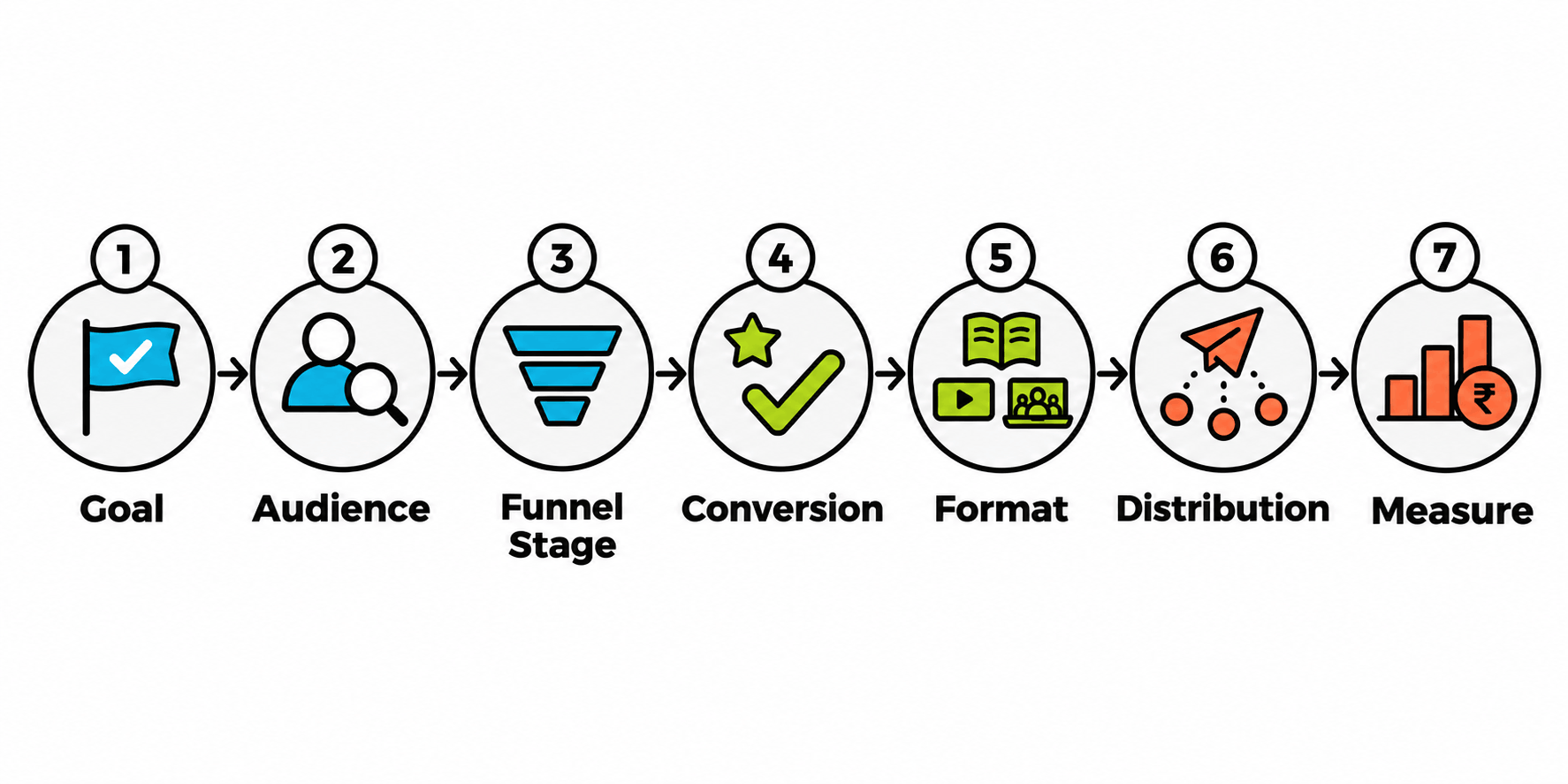
Content that converts is usually created through a structured process where goals, audience, funnel stage, and metrics are defined before publishing. Instead of writing topics randomly, companies plan content using a workflow that connects traffic to leads, pipeline, and revenue.
Step 1 — Define the goal
Decide what the content should achieve. Goals may include traffic, leads, micro conversions, or macro conversions such as sales. Without a clear goal, performance cannot be measured.
Step 2 — Define the audience
Identify who the content is for, including their problem, awareness level, and intent. Content that targets the wrong audience rarely converts.
Step 3 — Map the funnel stage
Decide whether the content is TOF, MOF, or BOF. Each stage requires a different message and different expectations for conversion rate.
Step 4 — Define the conversion type
Choose what counts as success:
- Micro conversion — newsletter sign-up, download, page visit
- Marketing Qualified Lead (MQL) — lead form submission
- Sales Qualified Lead (SQL) — demo request, qualified call
- Macro conversion — purchase, contract signed
- Return on Ad Spend (ROAS) — revenue generated per dollar of content-driven ad spend
Step 5 — Choose content format
Different stages require different formats:
- TOF → guides, blogs, videos
- MOF → comparisons, webinars, case studies
- BOF → demos, pricing pages, consultations
Step 6 — Distribute through the right channel
Content may be distributed through SEO, email, paid ads, social media, or retargeting.
Step 7 — Measure performance using business metrics
Track results using tools such as Google Analytics (GA4), HubSpot, Salesforce, Google Ads, or Meta Ads. Metrics should match the goal — not only traffic.
💡 Pro tip: In many campaigns, BOF content converts at a much higher rate than TOF, but TOF content is required to build enough audience for BOF to work. HubSpot’s inbound data shows that companies using full-funnel content strategies generate 54% more leads at 61% lower cost than outbound-only approaches.
This framework is flexible, but skipping steps often leads to content that gets views without producing results.
How to Track TOF, MOF, and BOF Content Performance
Content performance marketing requires tracking different metrics at different funnel stages. Measuring all content using the same metric often leads to incorrect conclusions.
- At the TOF stage, the goal is attention, so engagement metrics are normal
- At the MOF stage, the goal is trust, so MQL → SQL conversion rate becomes important
- At the BOF stage, the goal is conversion, so pipeline, revenue, and ROAS matter more than traffic
Tracking becomes more accurate when content data is connected to CRM systems like HubSpot or Salesforce. The Content Marketing Institute B2B Report 2025 shows that companies tracking content using both marketing data and sales data report better ROI than those measuring only traffic.
However, tracking is not perfect. Users may read several pieces of content before converting, and some actions happen offline, which makes attribution incomplete.
Why Content Strategy Often Fails
Content strategy often fails because content is created without a clear connection to the funnel, the audience, or the conversion goal. Publishing frequently does not guarantee results if the content is not aligned with search intent, funnel stage, and business metrics.
Common reasons content fails:
- No defined goal
- Wrong audience
- No funnel mapping
- Missing call-to-action
- Wrong success metric
- Expecting fast results
Another common problem is measuring only traffic. High traffic does not always mean high conversion, especially for TOF content, which is designed for awareness.
AI and Content Competition in 2026
Modern content performance is also affected by competition. Content volume demands have increased 300% since 2020, and 75% of content professionals say AI has increased the volume they produce (Canto and Ascend2, November 2025). Google processed 15% more content in 2024 than 2023, which makes it harder for each individual piece to get attention.
AI tools have increased content production even further. 67% of marketing teams now use AI for content creation, up from 38% in 2024 (MarketingProfs B2B Benchmarking Report, 2025). This means strategy and funnel alignment matter more than volume. 31.4% of marketers report the biggest performance decline in organic search and SEO, ahead of traffic drop-offs and email losses, driven largely by content saturation and zero-click search environments.
Because of this, content performance marketing focuses on planning and intent alignment, not only publishing volume.
Final Thoughts
Content performance marketing works best when content is treated as part of a system instead of individual posts. Conversion depends on how well goals, funnel stages, search intent, and measurement are connected, not only on how well the content is written.
Results are never guaranteed. Conversion depends on the product, the audience, timing, and the overall marketing process. When content is planned using clear goals, correct funnel mapping, and realistic metrics, it becomes easier to understand what works and what needs to change.
FAQs
What is a micro vs macro conversion?
Micro conversion: a small action that shows interest, such as a newsletter sign-up or download. Macro conversion: a final action such as a qualified lead, SQL, or purchase.
How do you measure content performance?
Use different metrics per stage: traffic for Top of the Funnel, leads and MQLs for Middle of the Funnel, and pipeline, revenue, or ROAS for Bottom of the Funnel. Tools include GA4, HubSpot, Salesforce, and your ad platforms.
Why does content get traffic but not conversions?
Common reasons include wrong intent, weak funnel mapping, missing CTA, or tracking only traffic instead of business results.
Does AI make content strategy harder?
Content volume demands have increased 300% since 2020 as AI makes production easier for everyone. This raises the bar for differentiation — strategy, funnel alignment, and unique insight matter more than ever.
Related Content
Read These Next
A/B Testing for Conversion Rate Optimization: How to Run Experiments That Increase Your Revenue