Paid Performance Marketing: The Ultimate Guide to Scalable Paid Media




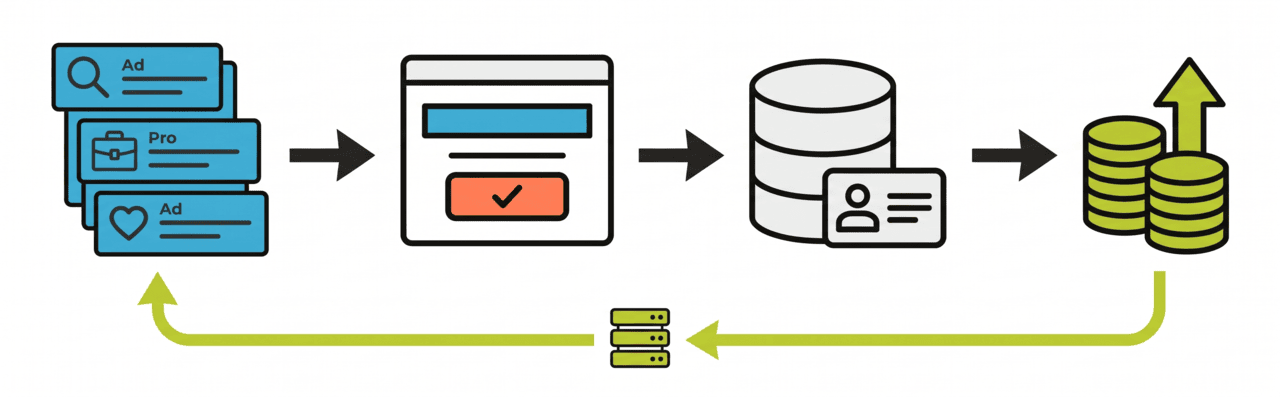
Paid performance marketing is a data-driven advertising strategy focusing on measurable business outcomes like leads and revenue over brand impressions. In 2026, scalability requires a closed-loop system connecting ad platforms (Google Ads, Meta Ads, LinkedIn Ads) to a CRM (HubSpot, Salesforce) using server-side tracking (CAPI) to mitigate privacy-related data loss.
Platforms like Google Ads, LinkedIn Ads, and Meta Ads allow marketers to track cost, conversions, and return on spend, but scalable paid media requires reliable tracking, stable conversion rates, and consistent funnel performance across multiple channels.
Recent marketing reports show that over 70% of marketers are now targeting Millennials and Gen Z as digital-first audiences, while CPC inflation has accelerated across nearly every industry between 2024 and 2026, making performance harder to measure. Because of this, successful paid media depends not only on ads, but on how well analytics, tracking, and CRM systems work together to evaluate real business results.
What This Guide Covers
- What paid performance marketing means
- What scalable paid media means
- How paid campaigns work in practice
- Why campaigns fail to scale
- What metrics actually matter
- How companies build scalable paid media systems
- What metrics matter in paid performance marketing
- Step-by-step scaling framework
- Tracking limits and privacy changes
- 2026 benchmarks and CAC ranges
- Why paid performance marketing fails today
What Is Paid Performance Marketing?
Paid performance marketing is advertising where campaigns are measured using real outcomes such as leads, opportunities, pipeline, or revenue instead of impressions alone. Companies run ads on platforms like Google Ads, LinkedIn Ads, and Meta Ads and connect them to analytics and CRM tools to track whether campaigns produce business results.
In performance marketing, every campaign is linked to a measurable action. Common metrics include:
- CPC (cost per click) — the amount paid for each ad click. The cross-industry average Google Ads CPC reached $2.96–$4.22 in 2026, up 12% year-over-year.
- CPA (cost per acquisition) — the cost required to generate one conversion. The average CPA for Google Search campaigns is $49 across industries.
- ROAS (return on ad spend) — revenue divided by advertising cost
- CAC (customer acquisition cost) — total cost to acquire one customer
- Pipeline value — total revenue potential from generated leads
Tools such as GA4, HubSpot, and Salesforce are used to connect advertising data with sales results.
Gartner research shows that the average B2B buying group involves 6–10 decision-makers, interacting with multiple marketing touchpoints before making a decision. This means ad platform data alone does not show the full impact of campaigns. A user may click a Google ad, see a LinkedIn ad, return later through search, and only convert after speaking with sales.
Performance marketing focuses on measurable impact, not only visibility. A campaign may generate clicks or leads but still fail if targeting is wrong, the landing page converts poorly, or the sales process does not close deals. Results depend on the full funnel, not only the ad.
What Does Scalable Paid Media Mean?
Scalable paid media means increasing advertising spend while keeping performance stable, so higher budgets continue to produce leads or revenue at an acceptable cost. Scaling is not the same as spending more money. A campaign is scalable only if conversion rate, CAC, and ROAS stay within profitable limits as the budget grows.
For campaigns to scale, several conditions must remain stable:
- Consistent conversion rate
- Large enough audience
- Profitable unit economics
- Reliable tracking
- Working funnel
For example, a Google Ads or LinkedIn Ads campaign may perform well at low spend, but scaling requires enough search volume or targeting size to support higher budgets. CPC increased for 87% of industries in 2025 (WordStream), and CPCs are projected to rise a further 5–9% year-on-year in 2026, particularly in B2B and SaaS sectors.
Scaling also has limits. Larger budgets can cause audience saturation, higher CPC, and lower conversion rates because ads reach less qualified users. Demand in the market may also be limited, which means performance cannot grow indefinitely. Because of this, not every campaign can scale, even if early results look strong.
How Paid Media Works in Practice
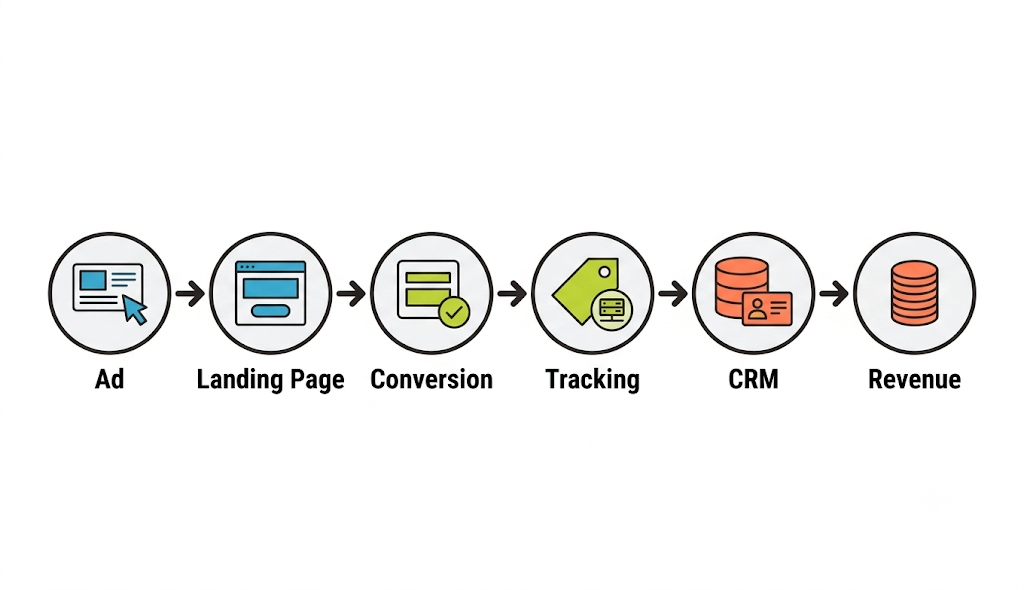
Paid media works as a system where ads, landing pages, tracking tools, and CRM data are connected so companies can measure how advertising leads to revenue.
Typical paid media flow: Ad → Landing page → Conversion → Tracking → CRM → Revenue
Each part of the system has a role:
- Ad platforms — Google Ads, LinkedIn Ads, Meta Ads
- Landing pages — convert visitors into leads
- Tracking tools — GA4, pixels, tags, Conversions API (CAPI)
- CRM — HubSpot, Salesforce
- Sales process — closes deals
Different channels serve different purposes:
Modern ad platforms rely heavily on automated bidding and conversion signals. AI-powered bidding now drives 78% of all Google Ads spend in 2026. Because of privacy changes, browser-side tracking is often incomplete, which is why many companies now use CRM data, server-side tracking (CAPI), or offline conversion imports to measure real results.
Ads alone do not create performance. Results depend on how well the entire system works together.
Why Paid Campaigns Don’t Always Scale
Paid campaigns do not always scale because performance changes when the budget increases. A campaign that works at small spend may become inefficient at higher spend because CAC rises, conversion rates drop, or the available audience becomes too small.
Common reasons campaigns fail to scale:
- Wrong targeting
- Weak landing page
- Poor tracking
- Low demand
- Weak funnel
- Product-market fit issues
Customer acquisition cost usually increases as ads reach less qualified users, and conversion rates often fall when traffic expands beyond the best audience. Global digital ad spend is projected to reach $765 billion in 2025 (eMarketer), meaning more companies are competing for the same audiences and driving up costs for everyone.
Scaling problems can often be improved by:
- Expanding targeting gradually
- Improving conversion rate before increasing spend
- Fixing tracking and attribution
- Adding new channels
- Improving landing pages
- Measuring pipeline instead of leads
Scalable paid media requires a stable system, not only a good ad.
What Metrics Matter in Paid Performance Marketing
In paid performance marketing, ad platform metrics and business metrics are not the same. Platforms report clicks, conversions, and cost per lead, but companies usually evaluate performance using pipeline, customer acquisition cost, and revenue stored in analytics or CRM systems.
Common metrics include:
- CPC (cost per click) — cost paid for each ad click
- CPL (cost per lead) — cost to generate a lead
- CPA (cost per acquisition) — cost per conversion
- ROAS (return on ad spend) — revenue divided by ad spend
- CAC (customer acquisition cost) — total cost to acquire one customer
- Pipeline value — total potential revenue from leads
- Blended CAC — total marketing cost across all channels divided by customers
Blended CAC has become more important because buyers often interact with multiple touchpoints before converting. Marketing reports show that most conversions involve several channels, which means ad platform data alone does not show real performance (HubSpot, 2025).
Channel performance also differs:
Because attribution is fragmented, most companies compare ad platform data with CRM or revenue data instead of relying on one report.
Step-by-Step: How Companies Build Scalable Paid Media
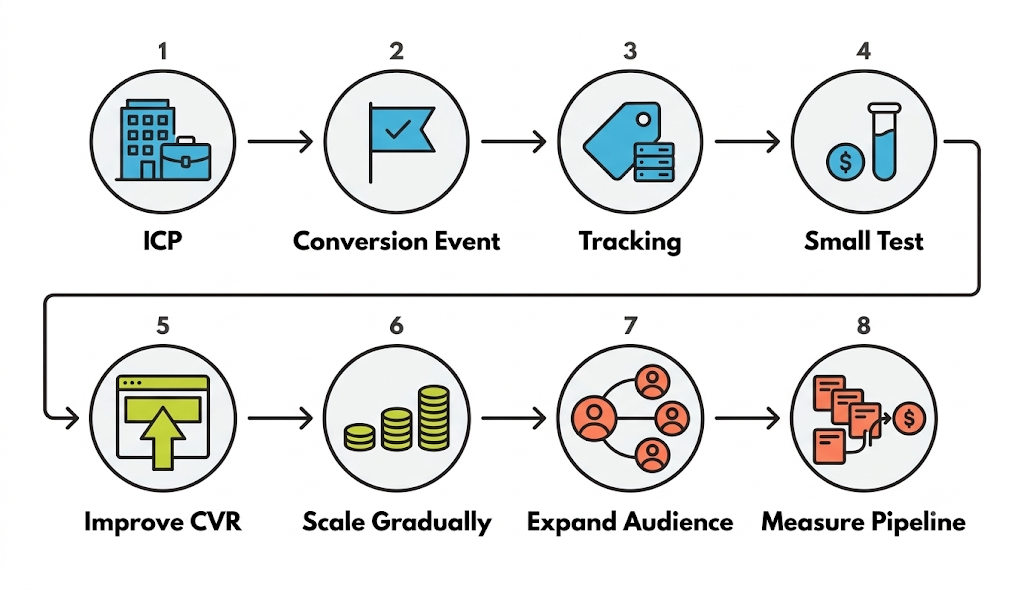
Scalable paid media is built through a structured process where targeting, tracking, conversion, and CRM data are stable before budget increases. Companies that scale successfully usually test campaigns at small spend, confirm that conversions produce a real pipeline, and then increase budget gradually.
Typical workflow:
- Define the ideal customer profile
Use CRM data to identify industries, company size, roles, or keywords that convert best. - Define the real conversion event
Use qualified leads, demo requests, or purchases instead of clicks. - Set up tracking before scaling
Connect Google Ads, LinkedIn Ads, Meta Ads, analytics, and CRM. Because browser tracking is less reliable, many teams now use server-side tracking, Conversion API (CAPI), or Offline Conversion Imports to send data directly to ad platforms. - Test campaigns on a small budget
Confirm that leads become opportunities or revenue. - Improve conversion rate first
Landing page improvements often reduce CAC more than increasing spend. - Scale gradually
Budgets are usually increased in small steps so bidding algorithms stay stable. - Expand the audience slowly
Scaling requires broader targeting, more keywords, or additional channels. - Measure pipeline, not only leads
Compare ad platform data with CRM results to confirm real business impact.
Modern ad platforms rely heavily on automated bidding, which means accurate conversion data is required before scaling. Without reliable signals, campaigns may optimize for clicks instead of revenue.
Why Paid Performance Marketing Fails Today
Paid campaigns often fail to scale because performance changes when the budget increases. A campaign that works at small spend may become inefficient at higher spend because CAC rises, conversion rates drop, or the available audience becomes too small.
Common reasons campaigns fail:
- Wrong targeting
- Weak landing page
- Poor tracking
- Low demand
- Limited audience
- Weak funnel
- Product-market fit issues
Tracking accuracy is also lower than before. Privacy updates, cookie restrictions, and Google’s Privacy Sandbox reduce the amount of data ad platforms receive, which makes optimization less precise. Because of this, browser-side pixels may miss part of the conversions, and campaign reports may not match CRM results.
Another issue is dark social, where traffic comes from private sharing in email, messaging apps, or direct links and cannot be tracked correctly. This makes attribution incomplete even when campaigns are working.
Competition is also increasing. Marketing reports show that more companies are investing in paid media, which raises cost per click and makes scaling harder than in previous years (State of Marketing Report, 2025).
Ways to improve scaling:
- Use server-side tracking or CAPI
- Expand targeting gradually
- Improve landing page conversion
- Add new channels
- Compare CRM and ad data
- Focus on blended CAC instead of CPL
Scaling requires a stable system, not only a larger budget.
Final Thoughts
Paid performance marketing works best when it is treated as a system instead of only advertising. Results depend on how well targeting, landing pages, tracking, CRM data, and the sales process work together.
Scaling requires:
- Stable conversion rate
- Acceptable CAC
- Enough demand
- Reliable tracking
- Strong funnel
Because privacy limits, automation, and competition are increasing, campaign reports should be used as guidance instead of the exact truth. When tracking, conversion, and economics are stable, paid media can be scaled predictably, but without these conditions, increasing the budget often reduces performance.
FAQs
What is scalable paid media?
Scalable paid media is increasing budget while keeping CAC and conversion rate stable.
Why do campaigns fail to scale?
Campaigns fail due to a limited audience, poor tracking, a weak funnel, or high costs.
What metric matters most today?
Metrics that matter most today are blended CAC and pipeline, not only CPL.
Is ad platform data enough?
No. Most companies need analytics and CRM data to evaluate real performance.
Related Content
Read These Next
A/B Testing for Conversion Rate Optimization: How to Run Experiments That Increase Your Revenue