.png)


Growth Hacking Framework: The Step-by-Step System for Rapid Scaling
.png)

.png)

The 2026 Growth Hacking Framework is an AI-native scaling system built on continuous, automated testing across the customer journey. By combining autonomous prospecting agents with Generative Engine Optimization (GEO), the framework replaces traditional marketing tricks with a data-driven testing engine designed to keep the LTV: CAC ratio above 3:1.
Key Takeaways
- Modern growth hacking replaces single viral loops with a continuous, unified engine running small experiments across the entire customer journey.
- Due to rising customer acquisition costs (CAC) in 2026, companies often prioritize financial efficiency and target a lifetime value to CAC (LTV: CAC) ratio of 3:1 or higher.
- Growth teams leverage autonomous prospecting agents to handle manual lead generation, allowing human teams to focus on strategy and creative testing.
- Organic visibility relies on formatting content with structured data so AI search tools can easily find and cite the brand in zero-click summaries.
- Successful scaling requires eliminating data silos and managing technical debt caused by undisciplined AI vibe-coding.
Foundational Pillars of the Growth Hacking Framework
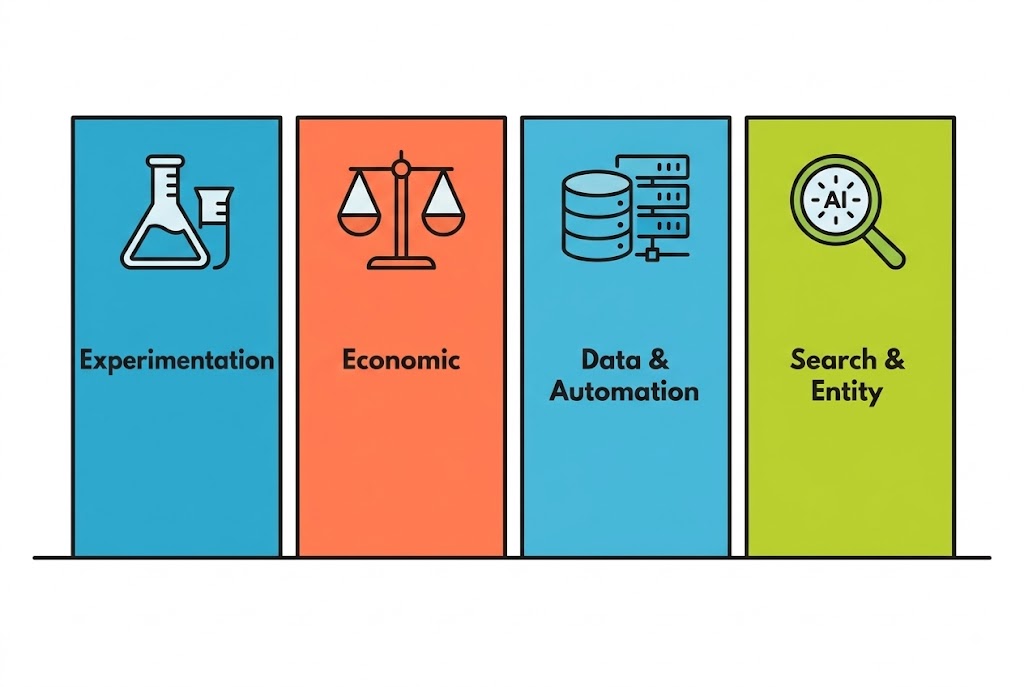
The 2026 growth hacking model rests on four connected operating layers: experimentation, economics, automation, and search visibility.
1. Experimentation Layer
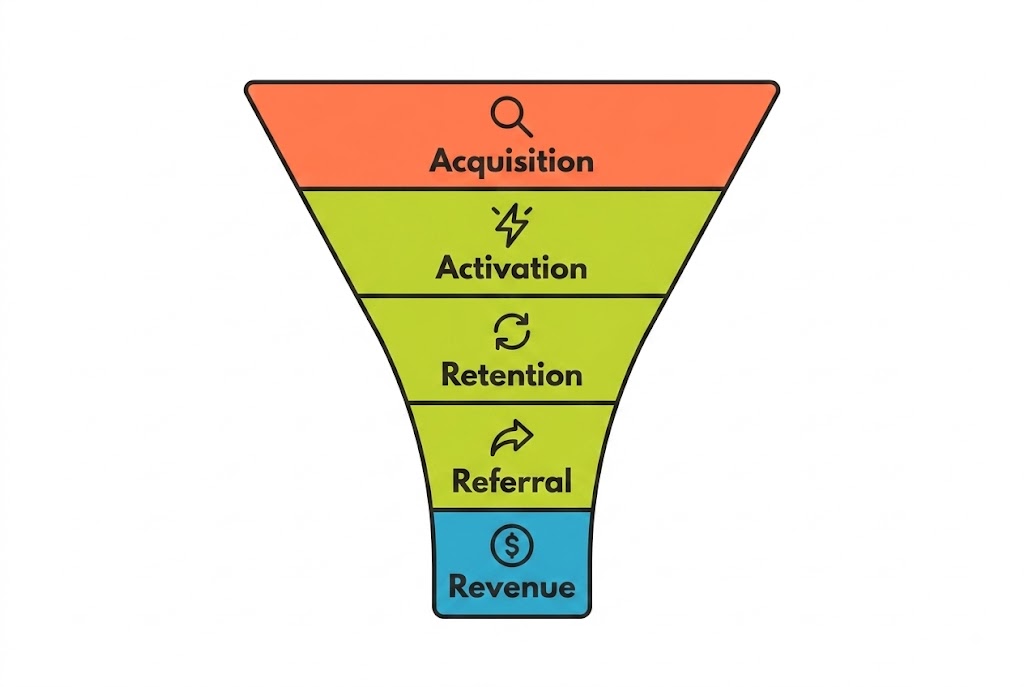
Modern growth hacking is a structured testing discipline. Instead of searching for one viral loop or one acquisition hack, growth teams run continuous experiments across the AARRR funnel: Acquisition, Activation, Retention, Referral, and Revenue.
In the traditional Dave McClure Pirate Metrics model, AARRR served as a simple way to diagnose where users entered, converted, returned, referred others, and generated revenue. In the 2026 AI-native version, each stage becomes an experimentation surface connected to product analytics, CRM data, automated outreach, and AI-generated content systems.
2. Economic Layer
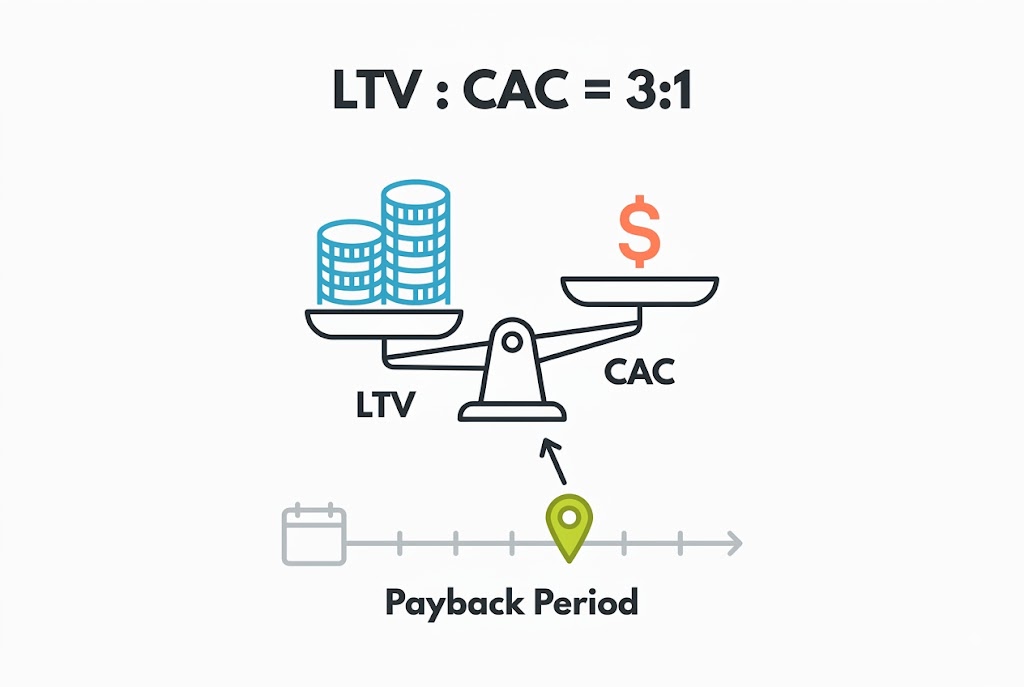
Capital efficiency is the financial constraint that prevents growth teams from scaling broken channels. The LTV:CAC ratio compares customer lifetime value with customer acquisition cost, while the payback period measures how quickly acquisition spend is recovered.
A 3:1 LTV:CAC ratio is a common benchmark, especially in B2B SaaS, but it should not be treated as universal. Healthy ratios vary by category, margin profile, sales cycle length, and retention curve. A product-led SaaS company, a local service business, and an enterprise software company will not share the same acquisition economics.
3. Data and Automation Layer
AI-native workflow automation depends on a centralized data foundation. Customer, product, marketing, and sales data must be accessible from systems such as Snowflake, Databricks, or BigQuery, which are CRM and product analytics platforms.
Without a reliable data layer, AI agents will act on incomplete information. That leads to duplicated outreach, irrelevant personalization, inaccurate lead scoring, and automation that damages trust instead of improving efficiency.
4. Search and Entity Layer
GEO and AEO require brands to make their entities machine-readable. This includes using JSON-LD, Organization Schema, Product Schema, Review Schema, FAQPage Schema.org, and SameAs properties to connect brand profiles, product pages, reviews, and authoritative third-party references.
For AI systems, topical authority is strengthened by entity consistency. A brand that clearly connects its organization, products, founders, reviews, pricing, documentation, and social profiles is easier for retrieval systems to understand and cite.
The 2026 Growth Hacking Framework: Five Steps to Scalable Growth
The modern growth hacking system moves from mapping user behavior to optimizing for autonomous search engines to improve durable visibility and reduce dependency on paid acquisition.
Step 1: Diagnose the AI-Native AARRR Funnel
The AI-native AARRR funnel is a measurement system for identifying where growth efficiency breaks down across Acquisition, Activation, Retention, Referral, and Revenue.
Growth teams should begin by mapping each stage to a measurable user behavior. Acquisition should track qualified traffic and qualified account entry, not just visits. Activation should track time to value, onboarding completion, first successful workflow, or first meaningful product outcome.
Retention should track repeated usage, expansion signals, and cohort-level engagement. Referral should track user-driven sharing, partner introductions, reviews, and community amplification. Revenue should track conversion, expansion, payback period, and LTV:CAC.
In our execution of this framework, the highest-leverage insight usually appears between Activation and Retention. A company can increase acquisition volume and still lose money if users fail to reach the first valuable outcome quickly enough.
How to Win
- Define one primary conversion event for each AARRR stage.
- Measure Time to Value for new users, trials, demos, or qualified leads.
- Identify the largest drop-off between two adjacent funnel stages.
- Prioritize experiments that improve Activation and Retention before increasing paid acquisition.
- Compare funnel performance by channel, segment, persona, and acquisition source.
Step 2: Implement a High-Velocity Experimentation Cycle
Growth is a result of the number of tests a team runs every week. To scale, a company creates a Hypothesis (an educated guess about a change), launches an A/B Test (comparing the original version to the new version), and uses data to pick the winner.
Rapid testing requires Cross-Functional Teams. These are small, independent groups consisting of a developer, a designer, and a marketer who have the authority to launch tests without waiting for management approval. This speed allows the business to find winning strategies months before competitors do.
How to Win
Use the ICE Framework to rank ideas. Assign a score of 1 to 10 for Impact (how much it helps), Confidence (how sure the team is that it will work), and Ease (how fast it is to build). Only launch the highest-scoring tests first.
Step 3: Deploy AI-Native Prospecting Agents with MCP Infrastructure
Model Context Protocol (MCP) is a standard that allows LLM agents to securely connect with external tools, databases, and business systems. For growth teams, MCP gives AI agents governed access to the context they need, including CRM records, account status, product usage, prior outreach, support history, enrichment data, and approved messaging rules.
An MCP server should not function as a novelty layer. It should serve as the controlled interface between an LLM agent and the company’s operational data.
MCP Deployment Protocol
- Select the agent orchestration layer.
Choose whether the team will run agents through LangChain, CrewAI, AutoGPT-style workflows, HubSpot Breeze, or a custom internal orchestration layer. - Define the agent’s job boundary.
Specify whether the agent can research accounts, enrich records, draft messages, update CRM fields, create tasks, or trigger outbound sequences. - Connect the centralized data foundation.
Route approved data from Snowflake, Databricks, BigQuery, the CRM, and product analytics into a governed access layer. - Configure the MCP server.
Expose only the tools, APIs, and data tables the agent needs. Separate read permissions from write permissions. - Add authentication and permission controls.
Require OAuth, API keys, role-based permissions, and audit logs before the agent can interact with production systems. - Create approved action templates.
Give the agent structured workflows for enrichment, lead scoring, segmentation, email drafting, CRM updates, and handoff to sales. - Test in a sandbox environment.
Run the agent against historical accounts before allowing it to act on live prospects. - Add human approval gates.
Require human review for sensitive actions such as sending outbound emails, changing lifecycle stages, or updating revenue forecasts. - Monitor quality and drift.
Track hallucinated fields, duplicate messages, incorrect personalization, unsubscribe rates, reply sentiment, and pipeline impact. - Scale only after proving lift.
Expand the workflow only when the agent improves speed, quality, or conversion without increasing brand risk.
How to Win
Use MCP to give agents controlled context, not unlimited autonomy. The best-performing growth teams use AI agents to accelerate research, enrichment, prioritization, and message drafting while keeping strategy, positioning, and sensitive customer interactions under human supervision.
Step 4: Monitor Economic Benchmarks and Payback Periods
Profitable scaling requires keeping the cost of getting a customer (CAC) much lower than the total money that customer brings in (LTV). Healthy 2026 benchmarks for B2B SaaS companies target an LTV/CAC Ratio of 3:1 or higher (SaaS Hero, 2026).
A business must also track the Payback Period, which is the number of months it takes to earn back the money spent to get one customer. If it takes more than 12 months to break even on a customer, the business may face cash flow problems during rapid expansion.
How to Win
Aim for a Payback Period of 12 months or less. Shorter windows allow a company to take the profit from one customer and immediately reinvest it into finding the next one, creating a faster growth cycle.
Step 5: Build a GEO and AEO Content System
Generative Engine Optimization (GEO) is the process of making brand information retrievable, interpretable, and citable by AI search systems. Answer Engine Optimization (AEO) is the process of formatting content so AI systems can extract concise, accurate answers.
AI engines prioritize Structured Data and clear, direct answers. Using specific code to label facts, prices, and reviews helps AI agents understand the webpage. Because "Zero-Click" searches—where a user gets an answer without clicking a link—now represent over 65% of all queries, being the cited source in an AI summary is the new standard for visibility.
AEO and GEO Execution Protocol
- Create machine-readable definitions.
Use explicit copula verbs so definitions are easy for retrieval systems to parse. For example: “Generative Engine Optimization is…,” “Answer Engine Optimization is…,” and “Product Schema is…” - Build a glossary or resource library.
Publish concise pages for high-intent industry terms, product concepts, comparison queries, buyer objections, and frequently asked questions. - Use JSON-LD structured data.
Implement Schema.org markup in JSON-LD format rather than relying only on visible page copy. - Add Organization Schema.
Define the company name, logo, URL, founding details, contact points, social profiles, and SameAs properties. - Use Product Schema where relevant.
Mark up product names, descriptions, pricing, use cases, category, availability, and core differentiators. - Use Review Schema carefully.
Mark up legitimate customer reviews, ratings, and testimonials where they comply with platform and search guidelines. - Use FAQPage Schema for answer-ready pages.
Add direct, factual answers to common buyer questions so AI systems can extract clear responses. - Connect entities with SameAs properties.
Link the brand to authoritative profiles such as LinkedIn, Crunchbase, GitHub, YouTube, G2, Capterra, or relevant industry directories. - Write extractable answer blocks.
Place one-sentence answers near the top of each page, then support them with deeper explanation, examples, data, and proof points. - Track AI visibility separately from website traffic.
Monitor brand citations, AI overview appearances, referral quality, assisted conversions, and zero-click visibility.
The strategic point is that more discovery now happens inside answer surfaces, summaries, and AI assistants, where users may not click through to the original website.
How to Win
Treat GEO as an entity-building discipline, not a keyword tactic. The objective is to make the brand, product, reviews, expertise, and proof points easy for retrieval systems to verify and cite.
Managing Common Challenges during Rapid Scaling
- Controlling Technical Debt:
Technical debt is the future cost of fixing messy systems, broken computer code, or rushed automation. In 2026, technical debt has become a primary structural barrier to business performance due to vibe-coding, which is the practice of using AI to generate code rapidly without strict engineering discipline. This rapid creation leaves companies with unmanaged system complexity and confused AI agents operating on outdated data.
- Eliminating Data Silos
Data silos are separate pockets of information trapped inside single departments or software tools. When sales, marketing, and product data remain disconnected, AI engines cannot see the complete picture of customer behavior. Scaling successfully requires building a centralized database layer so that all autonomous tools can access the same accurate customer records.
- Prioritizing Strategy Over Tools
True scaling means focusing on solving real customer problems instead of simply purchasing the newest software subscriptions. Accumulating too many separate platforms creates tool fatigue, wastes capital, and adds unnecessary complexity to business operations. Software must only be adopted if it directly supports the core experimentation framework.
The Future of Scalable Growth
- Experience-Led Growth
Experience-led growth is an expansion strategy driven by tailoring the digital journey to every single user. Instead of showing the same website, application, or ad to every person, platforms use Real-Time Machine Learning, a type of AI that learns from user data instantly, to change layouts, offers, and content based on live customer actions.
- Multi-Agent Frameworks for Advanced Operations
Future expansion will rely heavily on Multi-Agent Frameworks, which are software networks where multiple specialized AI programs work together as a team to solve complex workflows.
For example, one internal agent might analyze product usage drops while a second agent automatically creates customized retention campaigns to win those users back.
- Zero-Click Analytics for Performance Tracking
Growth teams must adopt Zero-Click Analytics Platforms, which are specialized software tools designed to track how often a brand name is cited by AI search assistants when users do not click through to a website. Because search behavior has shifted away from links, success will be measured by visibility inside AI models rather than traditional website visits.
- Resilient Experimentation Systems
Long-term scaling relies on a permanent company culture of continuous testing rather than temporary marketing tricks or a single viral loophole. Businesses achieve sustainable market dominance by maintaining cross-functional teams that treat every operational challenge as a data-backed experiment.
Final Thoughts
To successfully implement this framework, organizations can take the following immediate steps:
- Track Time to Value to identify and remove activation friction.
- Use the ICE Framework to prioritize high-impact, high-confidence, low-complexity experiments.
- Build a centralized data foundation using systems such as Snowflake, Databricks, BigQuery, a CRM, and product analytics.
- Deploy AI agents through controlled orchestration layers such as LangChain, CrewAI, AutoGPT-style workflows, or HubSpot Breeze, with MCP servers governing access to business systems.
- Integrate JSON-LD structured data, Schema.org markup, Organization Schema, Product Schema, Review Schema, FAQPage Schema, and SameAs properties to support GEO and AEO visibility.
- Maintain a payback period target that fits the company’s category, margin structure, and cash flow constraints.
Frequently Asked Questions (FAQs)
What is Generative Engine Optimization (GEO)?
GEO is the practice of formatting website content using structured data so AI assistants like ChatGPT and Perplexity can easily find and cite the brand.
Why is the Activation stage so critical in 2026?
A slow or confusing first user experience wastes upfront acquisition costs, making activation the most vital stage for long-term growth.
What is the risk of "vibe-coding"?
Vibe-coding uses AI to write code quickly without strict engineering discipline, which creates messy technical debt, system complexity, and confused AI agents.
How should teams prioritize their growth ideas?
Teams can use the ICE framework to score ideas from 1 to 10 based on Impact, Confidence, and Ease, launching the highest-scoring tests first.
Read These Next
Marketing Automation Workflow: How to Design High-Converting Sequences from Scratch