.png)
Growth Hacking Techniques: 12 Creative Tactics to Double User Bases
.png)

.png)

Modern growth hacking is a data-driven methodology that scales user bases by deploying autonomous AI agents, intent-based automation, and Generative Engine Optimization (GEO). By replacing manual workflows with agentic systems, companies systematically remove conversion friction and optimize digital content to secure direct citations within AI search engines.
Key Takeaways
- Growth hacking transitions sequentially from high-frequency small experiments to automated workflows and permanent acquisition engines.
- Long-term expansion requires centralizing verified workflows into a unified configuration to eliminate system fragmentation and technical debt.
- Deploying autonomous AI agents and monitoring intent signals reduces manual prospecting bottlenecks and accelerates sales cycles.
- Modern discovery optimization relies on Generative Engine Optimization (GEO) to structure content so it gets cited by AI platforms like ChatGPT and Gemini.
- Utilizing behavioral mapping to fix website bugs and engineering viral referral loops provide highly cost-effective paths to user growth.
- Backend Governance: Future scaling requires managing complex digital infrastructure, including AI agent metadata and data models, to prevent growth from stalling.
12 Creative Tactics to Maximize Conversion Efficiency
Deploying targeted automation, engineering behavioral adaptations, and optimizing search discovery allows companies to build scalable acquisition infrastructure. These combined methods systematically accelerate conversion paths to achieve high-volume growth without proportional resource expansion.
1. Deploy AI agents for sales research and outreach
AI agents perform autonomous research and personalized outreach by integrating directly with CRM data. This technical approach removes manual prospecting bottlenecks and speeds up the sales cycle, but it should not be treated as a fully hands-off system. Agents can hallucinate company details, reuse stale CRM fields, exceed API rate limits, or drift from approved messaging prompts if governance is weak.
In our testing of agentic workflows, the biggest issue was not speed; it was accuracy. Even after connecting agents to source systems through API tracking, the tools could still hallucinate details, misread account context, or turn partial data into confident-sounding claims.
This makes human review essential before AI-generated sales messages, templates, or presentation materials reach prospects.
The strongest advantage was time savings. Agents helped accelerate first drafts of outreach templates, campaign variations, sales enablement materials, and presentation decks. That gave the team more time to focus on deployment, performance monitoring, and optimization opportunities instead of spending hours building every asset from scratch.
Case Study: Sandler
Sandler used the HubSpot Breeze Prospecting Agent to solve low lead engagement. This AI tool autonomously researched contacts and sent personalized notes based on current CRM data. The process removed slow manual research tasks. As a result, the company saw four times more sales leads and 25% better engagement.
2. Automate sales messages based on company interest signals
Intent-based automation triggers sales sequences only when target companies show active interest signals. This strategy relies on monitoring technical data points like web visits, hiring trends, or news mentions. Messages reach prospects at the exact moment the company is looking for a solution. This makes outreach feel helpful instead of annoying, which leads to more booked meetings.
Tracking “dark social” signals means monitoring brand or category mentions that happen outside public search and social feeds, such as private Slack communities, Discord servers, WhatsApp groups, closed LinkedIn groups, niche newsletters, and invite-only founder forums.
Case Study: Oyster
Oyster implemented intent-based campaigns with automated messaging segmentations to find companies ready to hire. The strategy saved approximately 40 hours per month for each sales representative, allocating more time toward direct engagement with qualified prospects
3. Scale outreach across LinkedIn and email using social tools
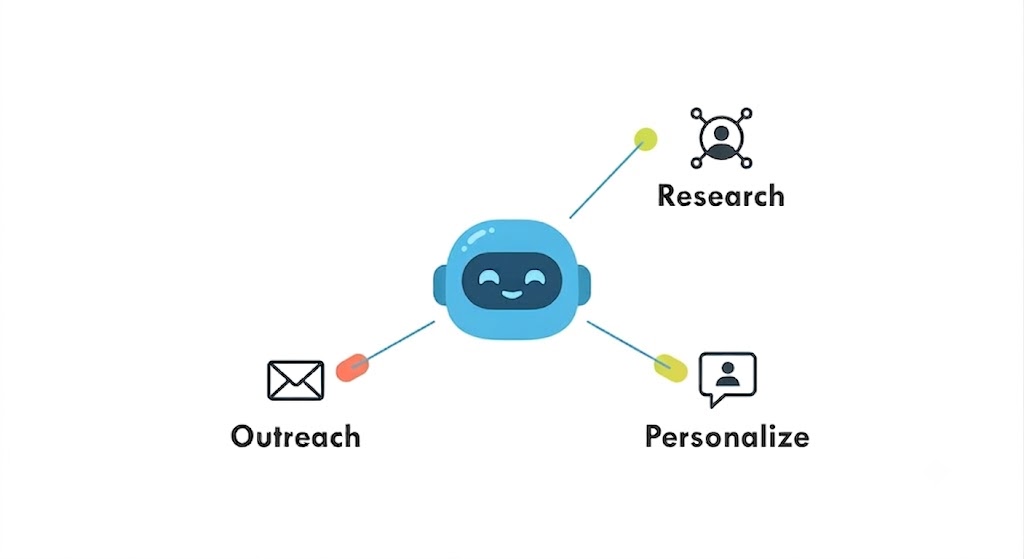
Multi-channel social automation coordinates LinkedIn and email outreach to build a unified contact system. This technique uses specialized social tools to batch process connections and follow-ups across different sites. Reaching people on different platforms makes the brand more likely to get a reply. It ensures the message gets seen even if a prospect is not checking their email.
Keeping automated actions slightly below the maximum limits of social sites keeps accounts safe while still reaching thousands of new people every week.
Case Study: Nytro Marketing
Nytro Marketing automated lead extraction across LinkedIn, sending prospects personalized email outreach to the company’s events. By coordinating their email and LinkedIn channels, the agency obtained 11,000 LinkedIn leads, improving their outreach to be more scalable and efficient while keeping the messages highly targeted for better response rates.
4. Optimize digital content for AI search and answer engines
Generative Engine Optimization (GEO) designs content to be picked up as a source by AI platforms like ChatGPT and Gemini. This requires structuring data into clear, direct answers that machines can easily understand.
Technical Markdown execution for GEO includes:
- Leading each major section with a concise, 40–50-word declarative answer, use descriptive H2 and H3 headings
- Defining the entity being discussed, and following with supporting bullets, examples, FAQs, and schema-friendly summaries.
- Adding an “atomic” variant for snippet optimization: one question, one direct answer, one supporting example, and one clear entity relationship per section.
Case Study: GreenBananaSEO
GreenBananaSEO implemented Answer Engine Optimization for a professional firm client to keep brand visibility high in AI search results. By tailoring technical content for generative platforms, they solved the problem of falling organic traffic, delivering ROI by placing brand facts directly into AI-generated answers for natural user search.
5. Distribute content automatically into niche communities
Automated content distribution pushes articles and videos into specific online communities and social channels. This tactic treats distribution as a core service to make sure every piece of work reaches a large audience. It prevents high-quality content from being wasted by sitting on a site no one visits. This builds a strong presence in niche groups where the best customers spend time.
Creating a "distribution-first" plan ensures content is designed for specific community standards, which makes people more likely to share it.
Case Study: Foundation
Foundation in 2021 used SparkToro to automate content distribution across niche communities. While this was not a 2026 autonomous workflow, it demonstrated the same principle modern teams now automate: using audience intelligence to identify where high-intent buyers already gather.
The agency solved the problem of time-heavy research by making distribution a main service. This automated process built 50% more qualified leads than their traditional marketing campaigns.
6. Use audience research to find effective micro-influencers
Audience research tools identify niche sources like newsletters and podcasts that hold strong influence over a specific group. This technical data replaces the old way of just picking people with the most followers. It focuses on finding sources that the target audience actually trusts. This leads to higher conversion rates and lower costs for every new user found.
Looking for "hidden" influence in places like industry Slack groups or small newsletters can find better leads than big, expensive social media stars.
Case Study: AlgoRhythm
AlgoRhythm London utilized SparkToro for automated audience research. They tested ad performance by distributing one creative campaign across two audience segments: AlgoRhythm’s existing audience group and SparkToro’s identified profiles. After two weeks, the SparkToro campaign gained 42% higher click-through rate for its ads compared to the client’s.
By finding niche newsletters and podcasts with high affinity, AlgoRhythm cut the cost of finding new supporters, leading to higher engagement and more social shares than using traditional, expensive ad networks.
7. Partner with content creators to reach new age groups
Creator partnerships combine data insights with the creative work of social influencers to modernize a brand. This strategy uses the trust a creator has already built to enter new markets. It is a vital way to reach younger people who often ignore standard commercials. This keeps a legacy brand feeling fresh and relevant to new generations of users.
Putting creator videos directly into paid ads combines the trust of a real person with the power of targeted computer ads.
Case Study: Anne Klein
Anne Klein leveraged data-led creator partnerships and paid media distribution in social and search channels with Darkroom. By integrating the creator’s existing community base and heightened paid campaigns, the brand reached younger shoppers, leading to a 28% increase in new customers and a 34% boost in brand visibility across search and social sites.
8. Run frequent A/B tests to increase website conversion
High-frequency experimentation involves running hundreds of A/B tests every year to make the website better. This requires a technical platform that lets teams change things quickly without needing a computer coder. Constant testing takes away the guesswork and shows what really makes people click. This leads to a website that gets better and better at finding users every day.
Building a culture where losing tests are seen as valuable lessons helps the team find big wins much faster than companies that fear failure.
Case Study: L’Oréal
L’Oréal runs up to 200 rapid experiments yearly with personalized UX designs, from A/B testing website features to identify purchase friction, to using custom metrics with automated reporting tools for less manual dev work.
This process helped align the customer journeys with target audience segments, personalizing outreach.
9. Use behavioral mapping to reduce user friction
Behavioral mapping uses heatmaps and session recordings to see exactly where people get stuck on a website. This identifies the "friction points" that cause people to leave before buying.
Fixing these problems in real-time makes the website much easier to use. This simple change can quickly increase the number of people who finish their sign-up or purchase.
Pro tip: Watch ten random session recordings before reviewing the dashboard. The recordings will not replace analytics, but they often reveal friction patterns, broken navigation paths, and confusing form fields that spreadsheets hide.
Case Study: Materials Market
Materials Market used Hotjar heatmaps and recordings to identify the friction of users leaving their site. After determining user interaction, the team found and fixed navigation bugs. This simple process tripled the number of purchases on the site within just one month.
10. Create referral programs that reward people for invites
Viral referral loops are systems built into a product that give users rewards for inviting friends. This turns every current user into a person who finds new users for the brand. It is one of the cheapest ways to grow because the product does the marketing work. This creates a cycle where growth happens on its own without needing big ad budgets.
Making sure the reward is given immediately to both the person who invites and the new friend keeps the excitement high and the growth moving.
Case Study: Dropbox
Dropbox created a referral program that gave people extra storage space for inviting friends. This solved the problem of high ad costs by building growth right into the product. The program led to a massive 3900% increase in users over 15 months with organic distribution.
Dropbox’s referral program predates the current AI-growth stack, but it remains one of the clearest examples of automated acquisition logic. The system turned each user action into a repeatable growth loop by rewarding both the inviter and the new user.
11. Use low-code tools to automate internal office tasks
Low-code automation lets regular staff build workflows that handle boring tasks like data entry or sending emails. This makes the whole company work faster and more accurately. An efficient office lets the business handle a much larger user base without getting overwhelmed. It also saves money by not needing expensive custom software for every small task.
In practice, low-code tools like n8n usually connect systems through REST APIs, Webhooks, scheduled syncs, and prebuilt app connectors, so every workflow should be documented with its trigger, data source, destination, and owner.
Keeping all these small automations in one central list helps the company stay organized and prevents technical problems as the business gets bigger.
Case Study: Huel
Huel used n8n to develop an AI team that centralized employee systems to help workers automate manual tasks. This saved about 1,000 hours of labor in only nine months. This process also saved the company over £100,000 in software costs during the very first year.
12. Prioritize sales leads using predictive scoring systems
Predictive lead scoring uses AI to rank leads by how likely they are to buy. This makes sure sales teams only spend time on the best opportunities. It uses past data and current signals to find "hot leads" that need a call right away. This makes the sales process much more efficient and helps the company grow revenue faster.
Combining basic company facts with recent interest signals creates a score that changes in real-time as a prospect's behavior changes.
Case Study: Noble
Noble built a 10% conversion system by using Apollo’s data to score leads. The system ranks leads so sales teams know who to call first. This replaced messy, old data with fresh information. It ensured the team only focused on high-value targets, which led to much better sales results.
Summary of top-performing platforms by growth tactic
Why Backend Governance Matters Before Scaling
Growth hacking in 2026 depends on more than launching automations; it requires controlling how data moves between CRMs, enrichment tools, analytics platforms, and AI agents. Without that layer, automated growth can create duplicate records, inaccurate lead scores, hallucinated outreach, and disconnected reporting.
In our testing of agentic workflows, the highest-risk failures usually came from weak data boundaries rather than weak prompts. When an AI agent pulls from stale CRM fields, incomplete company records, or unverified notes, it may generate confident but incorrect outreach. Teams can reduce this risk by using verified data pipelines, strict CRM permissions, and retrieval layers built on vector databases or graph databases such as Pinecone and Neo4j.
Backend governance also includes orchestration. Snowflake data models, dbt transformations, Airflow jobs, Salesforce objects, and AI agent metadata should be documented in one central configuration so teams can audit what each workflow does, where it gets data, and when it is allowed to act.
How the Growth Hacking Process Moves from Testing to Rapid Scale
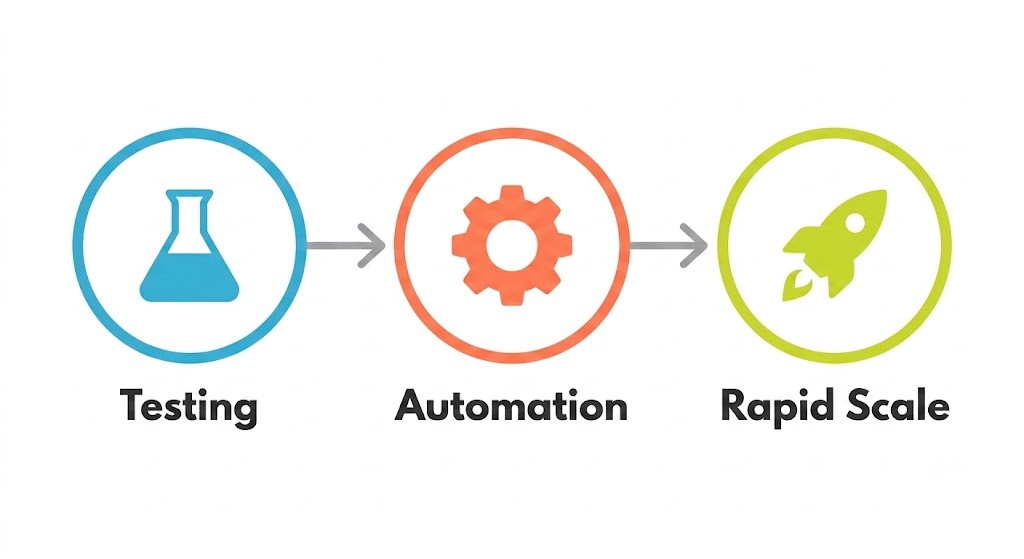
Step 1: Testing with high-frequency small experiments
Run small, frequent experiments to gather real-world user data without risking large budgets. High-frequency testing identifies exactly what triggers customer conversion, ensuring every digital experience is backed by performance metrics before full deployment.
Step 2: Replacing repetitive manual tasks with automated systems
Convert winning experiments into automated workflows to eliminate human operational bottlenecks. Handing over repetitive tasks like contact research and initial outreach to specialized software prevents employee burnout and ensures data accuracy across systems.
Step 3: Building automated engines for user acquisition
Turn successful automated sequences into permanent user acquisition engines that run continuously across marketing channels. This step establishes a predictable, firm data foundation that scales endlessly to expand a user base without requiring additional headcount.
Operational optimization relies on locking every verified automated workflow into a unified central configuration, preventing system fragmentation and technical debt before broader scaling begins.
Future Trends For Growth Hacking Creative Optimization
- The rise of agentic workflows
Growth hacking is moving from basic automated tools to AI systems that act as independent team members. These agents make their own decisions to optimize user acquisition and engagement in real-time.
- Managing technical debt in 2026
Organizations must fix messy and complex digital systems to ensure creative optimizations remain effective. If underlying systems are too complicated, growth will likely stall.
- Complexity beyond software code
Technical debt now includes unmanaged complexity in AI agent metadata, Snowflake data models, and Salesforce environments. Optimizing these back-end systems is essential for supporting long-term user growth.
- AI-Human Integrated Workflows
Long-term success depends on combining human creativity with autonomous systems that learn from data and run without constant manual input.
Final Thoughts
To successfully implement these growth hacking methodologies, organizations should take the following immediate actions:
- Run small, budget-friendly A/B tests to gather real-world performance metrics and identify customer triggers.
- Convert winning manual tasks into automated software sequences to eliminate human operational bottlenecks.
- Maintain a unified master list of all internal low-code automations to control technical debt and system complexity.
- Structure digital assets into direct answer formats to secure visibility within modern AI search assistants.
Frequently Asked Questions (FAQs)
What is Generative Engine Optimization (GEO)?
GEO involves designing and structuring digital content into clear, direct answers so AI platforms can easily read, understand, and cite the brand as a source in generative search results.
How does behavioral mapping improve website conversions?
It uses tools like heatmaps and session recordings to observe exactly where users experience friction or encounter bugs, allowing teams to fix issues in real-time and increase purchases.
What is the benefit of a viral referral loop?
It builds reward incentives directly into a product, encouraging existing users to invite friends and creating a self-sustaining growth cycle that minimizes traditional advertising costs.
Read These Next
AI Marketing Automation: How to 10x Your Output with Machine Learning