.png)
How to Do Pay Per Click Advertising: The 10-Step Checklist for High-Converting Campaigns
.png)

.png)

To improve PPC conversion in 2026, advertisers must shift from keyword-matching to intent-based modeling powered by first-party data and AI-driven bidding strategies like Target ROAS. Success is defined by Full-Funnel Alignment, where personalized ad creatives serve as primary targeting signals, leading to high-performance landing pages with sub-two-second load speeds and mobile-first optimization.
Key Takeaways
- Success comes from prioritizing why a user is searching rather than just the specific words they use.
- High-performing campaigns rely on information collected directly from customers to improve targeting accuracy.
- Modern systems use smart bidding and behavior modeling to find the best customers and manage costs.
- Conversions happen when the ad message perfectly matches what the user is looking for and what they see on the website.
- Regularly removing irrelevant search terms and coordinating with organic search results prevents unnecessary spending.
Key Principles for Improving PPC Conversion in 2026
PPC performance improves when campaigns align intent signals, data accuracy, and user experience.
- Prioritize intent over keywords using behavioral targeting
- Use first-party data (data collected directly from users) for better accuracy
- Optimize for AI-driven delivery systems that automate bidding and targeting
- Ensure landing page alignment with ad messaging
- Continuously refine campaigns using performance data
The 10-Step Checklist for High-Converting PPC Campaigns
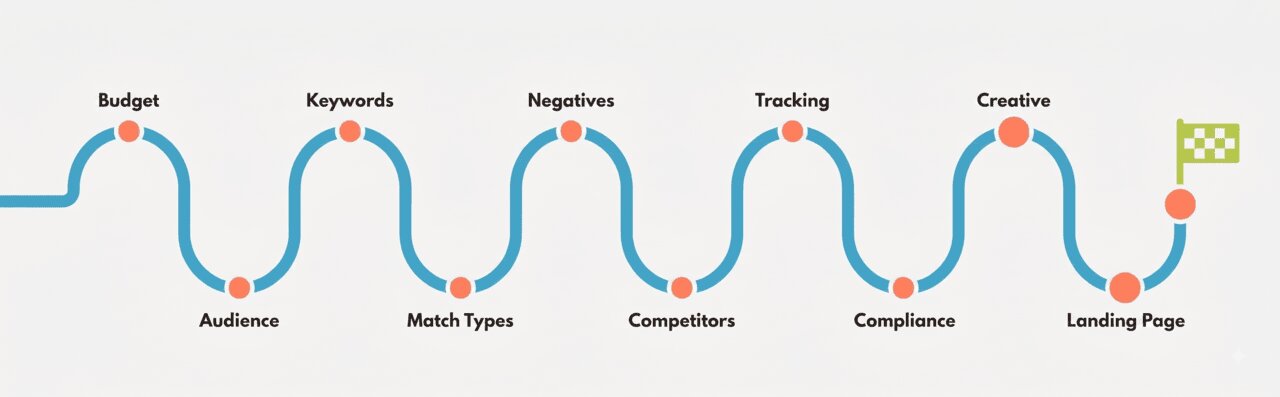
This checklist outlines the core components of high-converting PPC campaigns, including budgeting, audience targeting, keyword strategy, creative optimization, and measurement. Each step focuses on improving efficiency, reducing wasted spend, and aligning campaigns with user intent and AI-driven delivery systems.
Step 1: Establish Financial Foundations and Bidding Parameters
This step ensures campaigns operate within sustainable budgets while maximizing return on ad spend.
Budgets define reach, while bidding strategies determine how efficiently that budget converts. Rising CPC (cost per click, the amount paid per ad click) levels require tighter control over spend.
Key actions:
- Set defined daily and monthly budgets
- Select bidding strategy:
- Maximize Conversions: automated bidding focused on generating conversions
- Target ROAS (Return on Ad Spend): bidding based on revenue goals
- Allow a learning phase (algorithm training period) for optimization
Step 2: Define Audience Personas and Digital Twinning
This step improves targeting by focusing on behavior and intent rather than demographics. Audience personas represent ideal customers based on behavioral, transactional, and engagement data. Digital twinning takes this further by using AI-generated models to simulate how high-value customers behave before they convert.
For example, an e-commerce brand might upload CRM data from repeat buyers, match those records to ad platform signals, and build a lookalike or predictive audience model based on shared behaviors such as product category interest and email engagement. Instead of targeting “women ages 25–44,” the campaign targets users who behave like the brand’s best customers.
Key actions:
- Build personas using behavioral and transactional data
- Use first-party data (CRM, email lists)
- Match CRM, email, and purchase data to build lookalike or predictive audiences
- Use tools such as Google Performance Max and Meta Advantage+ to expand from seed audiences into high-intent users
- Segment first-party data by value, recency, and product interest instead of relying only on demographics
Step 3: Conduct Intent-Driven Keyword Research
This step identifies keywords based on user intent, improving conversion likelihood.
Search intent refers to the underlying goal behind a query.
Key actions:
- Combine short-tail and long-tail keywords
- Target high-intent queries
- Include natural language queries for AI systems
Step 4: Map Match Types to AI-Driven Search Patterns
This step balances automation with control in keyword targeting.
Match types define how closely a keyword must match a search query. AI-driven search expands reach beyond exact matches.
Key actions:
- Use Broad Match for discovery
- Maintain Exact Match for precision
- Monitor AI-generated query expansion
Step 5: Implement Aggressive Negative Keyword Pruning
This step removes irrelevant traffic to improve efficiency.
Negative keywords are terms that prevent ads from appearing for unwanted searches.
Key actions:
- Build exclusion lists (e.g., “free,” “DIY”)
- Review search term reports regularly
- Continuously refine targeting
Step 6: Perform Strategic Competitor and Auction Analysis
This step identifies opportunities by analyzing competitor performance.
Auction Insights is a reporting tool that compares ad performance against competitors.
Key actions:
- Track Impression Share (percentage of total impressions captured)
- Analyze Top of Page Rate (frequency of top ad placement)
- Benchmark against competitors
Step 7: Configure Privacy-First Measurement and Attribution
This step ensures accurate tracking in a privacy-focused environment where browser cookies, platform restrictions, and consent requirements reduce the reliability of traditional tracking.
A modern PPC measurement setup should connect Google Analytics 4, platform conversion APIs, Enhanced Conversions, and Server-Side Google Tag Manager. This gives ad platforms cleaner conversion signals while reducing dependence on third-party cookies.
Key actions:
- Implement GA4 as the primary analytics layer
- Use Server-Side GTM to improve data control and tracking reliability
- Enable Enhanced Conversions for Google Ads where consent and policy requirements are met
- Connect Meta Conversions API for Meta campaigns
- Use Multi-Touch Attribution to evaluate assist interactions, not just last-click conversions
Step 8: Ensure Ad Compliance and Platform Policy Adherence
This step prevents disruptions by maintaining compliance with platform rules.
Ad compliance includes adherence to privacy laws, copyright rules, and platform-specific guidelines.
Key actions:
- Follow platform policies (Google, Meta, Amazon)
- Monitor AI-generated content for violations
- Use platform controls for content moderation
Step 9: Optimize Creative Assets and AI-Generated Ad Copy
This step improves engagement by treating creative assets as both messaging and targeting inputs. In a privacy-first 2026 environment, ad platforms have fewer third-party audience signals, which means creatives do more of the work. The images, videos, hooks, offers, headlines, and formats you upload help algorithms understand who is likely to respond.
Optimize for Video and Social Search
PPC in 2026 is not limited to text-based Google Search. Users increasingly search inside TikTok, YouTube, Instagram, Amazon, and retail media platforms. Campaigns should account for visual discovery, short-form video search behavior, and creator-style ad formats.
Key actions:
- Build creative variations for different intent stages: problem-aware, comparison, offer-driven, and ready-to-buy
- Upload diverse asset types into Google Performance Max, including short-form video, product images, lifestyle images, and benefit-led copy
- Use Meta Advantage+ creative features to test image and video variations
- Repurpose top-performing search keywords into video ad concepts
- Diversify creative assets so algorithms can match different messages, visuals, and formats to different audience behaviors.
Meta Advantage+ creative helps advertisers stretch each asset further by adapting images and videos into multiple formats and variations.
Step 10: Refine Landing Pages for Speed and AI Discoverability
This step converts clicks into measurable outcomes. Landing page speed should be treated as a conversion factor, not just a technical SEO metric.
In 2026, mobile users, AI crawlers, and automated ad systems reward pages that are fast, structured, and easy to interpret. A page that technically loads in under two seconds may still feel slow if the main content, form, or product module appears late.
Key actions:
- Treat a two-second load time as the minimum acceptable benchmark (aim for sub-1-second perceived load on mobile)
- Maintain strong Core Web Vitals performance
- Optimize for mobile devices
- Align messaging with ad intent
- Implement structured data
How PPC Integrates with SEO and the Total Search Ecosystem
PPC performance improves when aligned with SEO and cross-channel data. Integration reduces wasted spend, strengthens visibility, and improves overall search efficiency.
Core Concepts
- Keyword Cannibalization: overlap between paid ads and organic rankings that can lead to unnecessary spend
- Omnichannel Data: unified data across platforms (Google, Meta, Amazon) for better decision-making
- Paid-to-Organic Spillover: paid campaigns increasing organic search demand and brand awareness
- Retail Data Integration: syncing product feeds, inventory, pricing, promotions, customer data, and campaign performance across platforms so ads reflect what users can actually buy.
Key Integration Strategies
- Coordinate keyword targeting: reduce bids where organic rankings are strong; support gaps with PPC
- Centralize data: use unified reporting for better attribution and optimization
- Align messaging: maintain consistent headlines and offers across paid and organic
- Use PPC insights for SEO: apply high-performing keywords to content strategy
Integrated PPC and SEO strategies improve efficiency, reduce duplication, and create compounding gains across both paid and organic search performance.
PPC Campaign Management and Optimization Routine
Sustained performance requires consistent monitoring and optimization across regular schedules.
Daily:
- Monitor spend and pacing
- Check for tracking or technical errors
Weekly:
- Review keyword performance
- Analyze ad variations
- Update negative keywords
Monthly:
- Refresh creative angles across formats, including static images, short-form video, testimonials, product demos, and comparison ads
- Retire fatigued assets and replace them with new hooks, offers, or audience-specific messages
- Evaluate trends and performance shifts
- Address ad fatigue (declining engagement due to repetition)
Common Pitfalls We See in 2026
Even well-structured PPC campaigns fail when teams over-rely on automation without feeding it the right signals. In our audits, the most common performance issues usually come from poor data quality, weak creative variety, and landing pages that do not match the user’s intent.
1. Launching Performance Max without enough asset diversity
Campaigns often underperform when advertisers upload only a few headlines and generic images. Performance Max works best when asset groups include distinct messages, audience signals, product feeds, and video assets.
2. Using broad match without strong negative keyword controls
Broad match can discover valuable queries, but it can also waste money if search term reports and exclusion lists are ignored.
3. Treating Meta Advantage+ as “set-and-forget”
Advantage+ can optimize delivery, but performance still depends on offer quality, creative diversity, conversion data, and post-click experience.
4. Tracking only platform-reported conversions
Platform dashboards can overstate or understate value depending on attribution windows. Cross-check results in GA4, CRM data, and backend revenue reports.
5. Sending high-intent clicks to generic pages
A transactional search ad should not lead to a broad homepage. The landing page should match the query, offer, audience stage, and ad promise.
6. Ignoring server-side tracking until performance drops
Server-Side GTM, Enhanced Conversions, and conversion APIs should be implemented before signal loss becomes a reporting problem.
Final Thoughts
To begin optimizing your PPC performance, readers should take the following actionable steps:
- Implement server-side tracking and enhanced conversions to ensure data accuracy in a privacy-first environment.
- Move toward automated strategies like Target ROAS, allowing for a necessary learning phase for algorithmic optimization.
- Conduct a weekly review of search term reports to update negative keyword exclusion lists.
- Ensure all landing pages load in under two seconds and are fully optimized for mobile users.
- Identify where organic rankings are strong to reduce redundant PPC spend and reallocate those funds to fill visibility gaps.
Frequently Asked Questions (FAQ)
What is a good PPC conversion rate in 2026?
There is no universal “good” PPC conversion rate in 2026. A 2% conversion rate may be strong in a high-consideration B2B or legal campaign, while ecommerce, branded search, lead generation, and remarketing campaigns can produce very different benchmarks.
Conversion rate should be evaluated by industry, funnel stage, offer type, device, traffic source, and revenue quality rather than against a single generic range.
How can PPC cost per click (CPC) be reduced?
Reducing CPC involves improving Quality Score (a metric based on relevance and user experience), refining targeting, using negative keywords, and focusing on high-intent search queries.
Is PPC still effective with AI-driven search?
PPC remains effective but requires adaptation. Performance depends on intent alignment, data quality, and integration with AI-driven targeting and bidding systems.
What drives PPC success most?
Alignment between user intent, ad messaging, and landing page experience is the primary driver of PPC performance and conversion efficiency.
Read These Next
Marketing Automation Workflow: How to Design High-Converting Sequences from Scratch