.png)


International Expansion Strategies: 5 Proven Frameworks for Global Market Entry
.png)

.png)

In 2026, a successful international expansion strategy requires a data-first, asset-light entry model that aligns capital flexibility with verified regional demand. Organizations must validate local customer metrics via low-cost digital channels or localized partnerships—such as e-commerce testing or regional wholesale showrooms—before committing capital to permanent physical infrastructure.
Key Takeaways
- Modern market entry relies on low-cost infrastructure, live metrics for proof of demand, and on-site product tailoring to minimize upfront financial risks.
- Businesses can select from five distinct frameworks, ranging from risk-reduced wholesale distribution to master franchise partnerships and direct executive relocation.
- Successful international expansion requires parallel digital and physical validation, such as testing regional e-commerce metrics before establishing permanent brick-and-mortar assets.
- Streamlining administrative overhead through automated multi-currency platforms protects profit margins from volatile exchange rates and legacy banking delays.
- Companies must actively avoid common pitfalls like entering stagnant retail networks, building complete products before validating local demand, and ignoring regional environmental regulations.
What Are the Core Components of a Global Market Entry Plan?
A modern market entry plan uses low-cost infrastructure expansion, proof of demand via live metrics, and on-site product tailoring. These components ensure a business confirms local customer interest before spending large corporate budgets.
- Low-Cost Infrastructure Expansion
This component expands sales channels using existing third-party logistics and retail networks. Brands utilize local showrooms, spaces where bulk retail buyers place product orders, to access independent boutiques. It avoids heavy upfront real estate spending.
Companies also sign multi-year contracts with master franchise groups (third-party local business operators who buy regional store rights).
For example, a brand enters the United States wholesale market through a New York showroom partnership. Concurrently, the same brand scales across the Middle East by opening franchise storefronts in major retail hubs.
- Proof of Demand via Live Metrics
This component uses quantitative digital performance data to verify active consumer interest. It reduces geographic guesswork before physical launch. Companies track organic international web orders to identify existing regional demand.
Firms also deploy a minimum viable product (MVP)—a basic, functional product version used to gather real-time consumer feedback.
For instance, excellent online performance serves as the primary justification for opening a physical store. Digital teams use extensive online A/B testing (controlled web experiments comparing two feature versions) to refine user interfaces based on empirical data.
- On-Site Product Tailoring
This component involves moving executive leadership directly to the destination market. This on-the-ground presence helps analyze local competitors.
Relocated leaders interview local buyers directly to achieve product-market fit (the point where a product closely aligns with regional needs). This live field research reveals critical variations in regional document requirements, legal compliance rules, and consumer styling preferences.
For example, a chief executive officer temporarily relocates to a foreign business hub to observe consumer habits firsthand. The business then creates interactive digital mockups (visual product models) to validate messaging before financing a complete product suite.
How to Choose a Global Market Entry Model
Selecting the correct international market entry model requires aligning available internal financing and corporate data with localized regional demand and macroeconomic volatility. Organizations choose between risk-reduced, indirect wholesale models or high-exposure omnichannel launches based on capital flexibility and prior e-commerce validation.
Quick Summary Matrix of Global Entry Frameworks
The five proven frameworks detailed below provide distinct operational paths for executing a successful international expansion strategy.
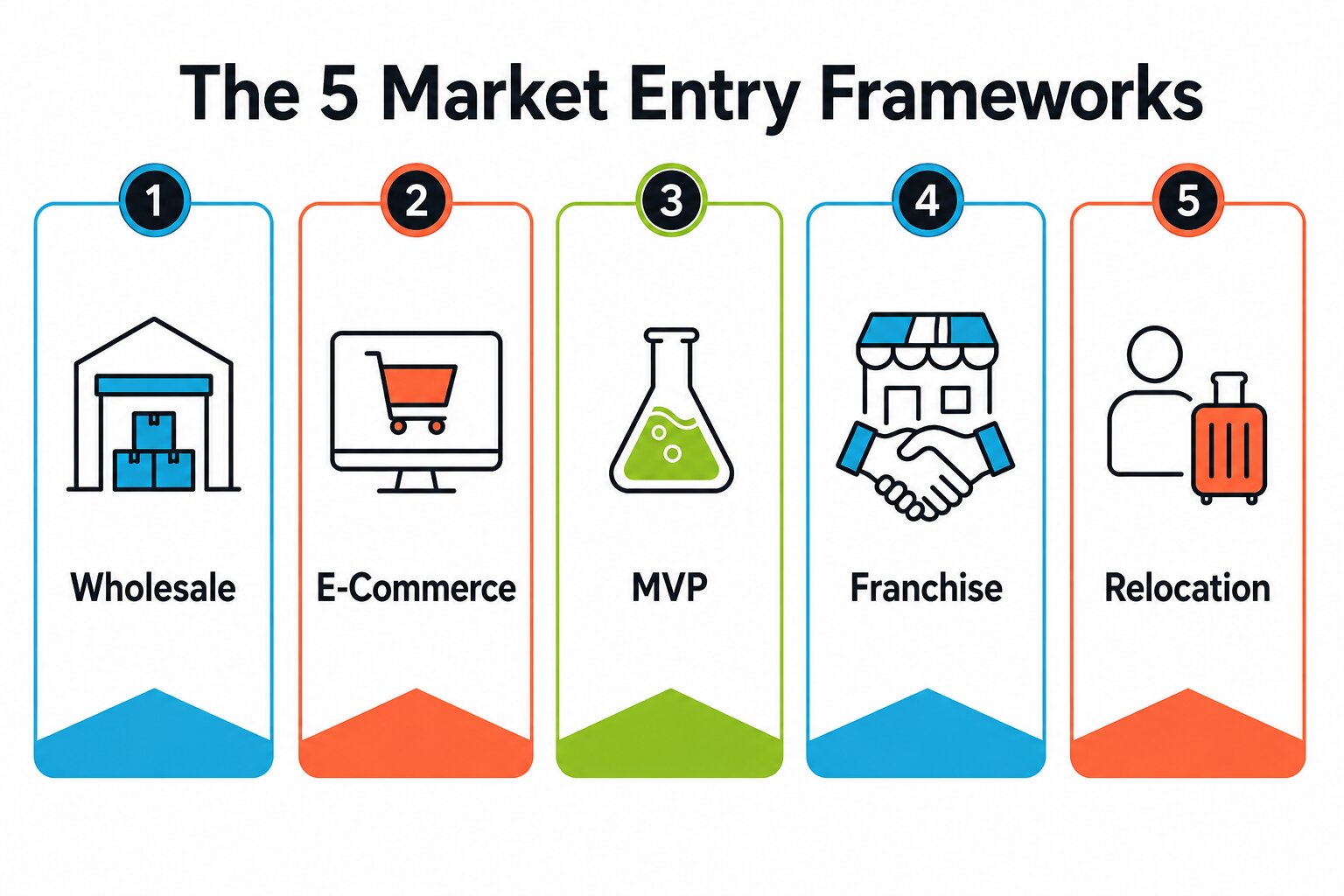
Framework 1: Leveraging Wholesale Distribution and Fair Price Positioning
Utilizing wholesale distribution and fair price positioning functions by shifting capital risk away from fixed retail operations and onto flexible B2B (business-to-business) sales channels. By working through established local showrooms to pitch a value-driven cost structure, a brand secures immediate cash flow and widespread market placement without enduring the heavy liabilities of direct commercial leases.
- Scaling Wholesale Networks with Local Showrooms
Brands partner with local showrooms to rebuild wholesale distribution networks rather than deploying capital into immediate stand-alone flagships. Initial distribution expansion targets independent boutiques to capture niche, underserved customer bases.
This operational method lowers immediate risk and avoids department store distribution during market transitions.
- Establishing Fair Price and Storytelling Competitive Advantages
Expansion plans leverage a fair price or accessible luxury positioning to attract value-conscious consumers during wider market slowdowns.
Firms emphasize family heritage, artisanal craftsmanship, and premium localized fabric sourcing to differentiate from mass-produced high-street competitors.
Market entry plans actively avoid expanding into highly volatile geographic markets where foreign demand remains stagnant.
Negotiating showroom contracts with a tiered commission structure tied directly to regional sell-through rates protects initial profit margins during early wholesale rollouts.
Case Study: Weill
When facing a cooling luxury market and struggling department stores, the fashion label Weill pivoted to a wholesale-led strategy in 2026. By partnering with New York showroom Stylistico to pitch its fair price collections directly to independent boutiques, Weill bypassed massive retail overhead and successfully secured 12 new retail doors within its first sales week.
Framework 2: Testing E-Commerce Performance Before Physical Retail Entry
Analyzing e-commerce performance metrics provides a low-cost framework for identifying geographic demand before committing to permanent physical retail. Once digital demand is validated, companies can coordinate a localized web platform with a first physical storefront to convert proven online interest into omnichannel market share.
- Analyzing Regional Digital Performance Metrics
Corporations analyze existing digital performance and organic online sales within a target country before introducing a physical footprint. Strong international e-commerce metrics provide empirical evidence to justify heavy brick-and-mortar property investments.
Establishing an initial online presence reduces financial risk and validates regional consumer demand ahead of physical rollout.
- Implementing Parallel Omnichannel Store Launches
Firms execute entry strategies by launching regional e-commerce platforms in parallel with an initial brick-and-mortar retail location. Physical store placement prioritizes established, high-traffic commercial shopping malls to ensure immediate consumer exposure.
Following a successful primary location launch, organizations sequentially plan subsequent store openings in adjacent major cities.
Deploying highly targeted digital ad spend over localized landing pages isolates actual regional transaction density before signing long-term commercial property leases.
Case Study: Bershka
To eliminate the extreme financial risks of entering Brazil with zero initial brand presence, Bershka executed a synchronized omnichannel launch in March 2026.
By deploying its localized e-commerce platform in parallel with a 1,000-square-meter flagship store in São Paulo, the brand successfully captured immediate, multi-channel regional market share.
Framework 3: Launching Minimum Viable Products and Data Verification Loops
Deploying minimum viable products and data verification loops minimizes financial exposure by substituting lengthy, expensive development timelines with fast, iterative product releases. Launching an unrefined initial model into a live market allows an organization to use automated user experimentation to continuously adjust features based on objective audience data rather than corporate guesswork.
- Executing Agile Product Verification and Quantitative Refinement
Development teams release a minimum viable product to measure real-time international consumer responses quantitatively. Firms perform intensive A/B testing on single titles or product versions to optimize the consumer user experience.
Product refinements occur rapidly based on aggregated empirical feedback rather than subjective internal opinions.
- Eliminating Departmental Silos for Cross-Functional Execution
Organizations maintain a flat structure devoid of traditional job or departmental silos to maximize operational speed. Technical engineers integrate marketing perspectives directly into the creative production phase.
Teams systematically document data insights and successful models to build an accessible corporate knowledge library.
Capping user testing loops at fixed retention benchmarks prevents development feature creep and surfaces negative user friction points prior to global release.
Case Study: GOODROID
Faced with high engineering costs and unpredictable international consumer tastes, mobile studio GOODROID in 2026 turned to agile data loops. By releasing a minimum viable product and running nearly 100 automated A/B tests via a cross-functional team model, the studio optimized playability, propelling their gaming product Hexa Away to No. 2 on the U.S. Google Play charts.
Framework 4: Utilizing Master Franchise Partnerships and Regional Agreements
Establishing master franchise partnerships and regional agreements leverages the localized expertise and commercial real estate relationships of existing business networks to achieve rapid international scale. By outsourcing store management, wholesale distribution, and hyper-local branding to regional master partners, expanding companies reduce direct administrative friction and high standalone infrastructure costs.
- Expanding via Multi-Year Monobrand Franchise Deals
Firms accelerate geographic scaling by securing franchise partnerships with prominent regional retail groups to manage monobrand stores.
Collaborating with local commercial specialists provides immediate operational placement inside highly restrictive premium shopping centers.
However, master franchise models require strong governance because poor partner execution, inconsistent store standards, or weak local marketing can dilute brand equity faster than a slower direct-entry model.
- Driving Multi-Channel Penetration with Cross-Border Agencies
Companies leverage specialized external agencies to drive brand distribution across specific continents. These partner contracts systematically manage overlapping operational channels, including wholesale networks, e-commerce, and physical retail.
Local partners coordinate localized marketing programs and in-store events to transfer digital brand visibility directly to physical streets.
Partnership agreements can include operational clawback clauses, which allow the brand owner to reclaim specific territory rights, store-opening rights, or unused retail opportunities if the franchise partner fails to lease agreed locations within a defined timeline.
This protects the brand from having key urban markets locked up by an underperforming partner.
Case Study: Footasylum
Seeking international expansion outside the United Kingdom, Footasylum in 2025 faced high standalone retail barriers. The brand signed a multi-channel master franchise agreement with Dubai-based Apparel Group.
This outsourcing process provided immediate placement in premium commercial hubs, launching a five-year plan to build 40 regional storefronts.
Framework 5: Deploying Executive Relocation and Prototype Validation
Implementing executive relocation and prototype validation reduces cross-border failure rates by inserting key corporate decision-makers directly into the destination market to understand localized client expectations. By building active conceptual models and gathering immediate user feedback on-site, leadership adapts brand offerings to regional legal and design frameworks before allocating final expansion budgets.
- Managing Direct Field Research Through Leadership Relocation
Corporate chief executive officers temporarily relocate to the target international market to drive rapid product-market fit. Direct engagement with regional consumers allows leadership to identify specific local design preferences and legal compliance variations.
On-the-ground executive presence enables close, real-time monitoring of local competitor operational strategies.
- Mitigating Expansion Costs via Pre-Build Mockup Validation
Firms build functional digital mockups or prototypes to validate true market demand before investing in a complete product suite. Leadership teams explicitly test and iterate corporate messaging based on direct customer feedback or initial user confusion.
Full organizational infrastructure scales up only after the localized concept achieves documented data verification.
Utilizing collaborative low-code software programs on-site enables executives to alter product interface configurations immediately during live customer focus groups.
Case Study: SeedLegals
When expanding to the United States, SeedLegals in 2025 had to adapt its U.K.-centric legal product model to a different fundraising and compliance environment. Rather than assuming its British templates would transfer directly, the company used market-specific research and product iteration to refine its U.S. offering before scaling broader infrastructure.
Comparison of Traditional versus Modern Market Entry Plans
How to Manage International Operations, Payments, and Compliance
Best practices for managing international operations center on automating multi-currency financial administration, optimizing cross-border payroll logistics, and continuously monitoring evolving regional tariff structures and local sustainability mandates.
Centralizing these administrative workflows minimizes foreign transaction friction and protects operating margins from volatile currency fluctuations.
Operational Note: International expansion introduces distinct administrative friction, currency risks, and logistical challenges that require centralized corporate management.
Financial Automation and Currency Management
Financial automation and currency management optimize international growth by consolidating cross-border transactions into unified digital platforms. Utilizing automated payment systems minimizes foreign exchange risk and lowers administrative overhead.
- Global operations require unified multi-currency business platforms to minimize cross-currency transaction fees.
- Automated batch payment tools allow corporations to process international payroll for overseas contractors via a simple spreadsheet format.
- Firms integrate multi-currency software with existing cloud accounting tools like Xero or QuickBooks to track cross-border expenses instantly.
- Streamlining financial administration reduces daily accounting tasks and allows management to focus more resources on core product scaling.
Regulatory and Tariff Planning
Regulatory and tariff planning secures international supply chains by mapping statutory trade constraints and regional climate mandates before shipping products. Continuously reviewing legal shifts prevents sudden border penalties and maintains localized pricing advantages.
- Expanding firms should monitor regional trade tariffs through global trade management platforms, customs compliance tools, government tariff databases, and freight-forwarder customs updates to maintain pricing competitiveness.
- Teams should assign ownership for tariff classification, rules-of-origin checks, landed-cost modeling, and documentation review before products are shipped.
- Corporate entry strategies should align with active free trade agreements (treaties between nations that reduce import taxes) to maximize supply chain efficiency.
- Operational scaling must respect host-government sustainability efforts and ESG (Environmental, Social, and Governance) compliance frameworks to maintain commercial resilience.
- Firms review regional asset data, local building parameters, and carbon footprint restrictions before securing long-term real estate footprints.
What Global Expansion Mistakes Should Companies Avoid?
Critical global expansion pitfalls include committing capital to unvalidated product lines, expanding into stagnant or declining distribution channels, maintaining rigid corporate silos that delay product-market fit, and utilizing legacy banking systems that impose heavy transactional overhead.
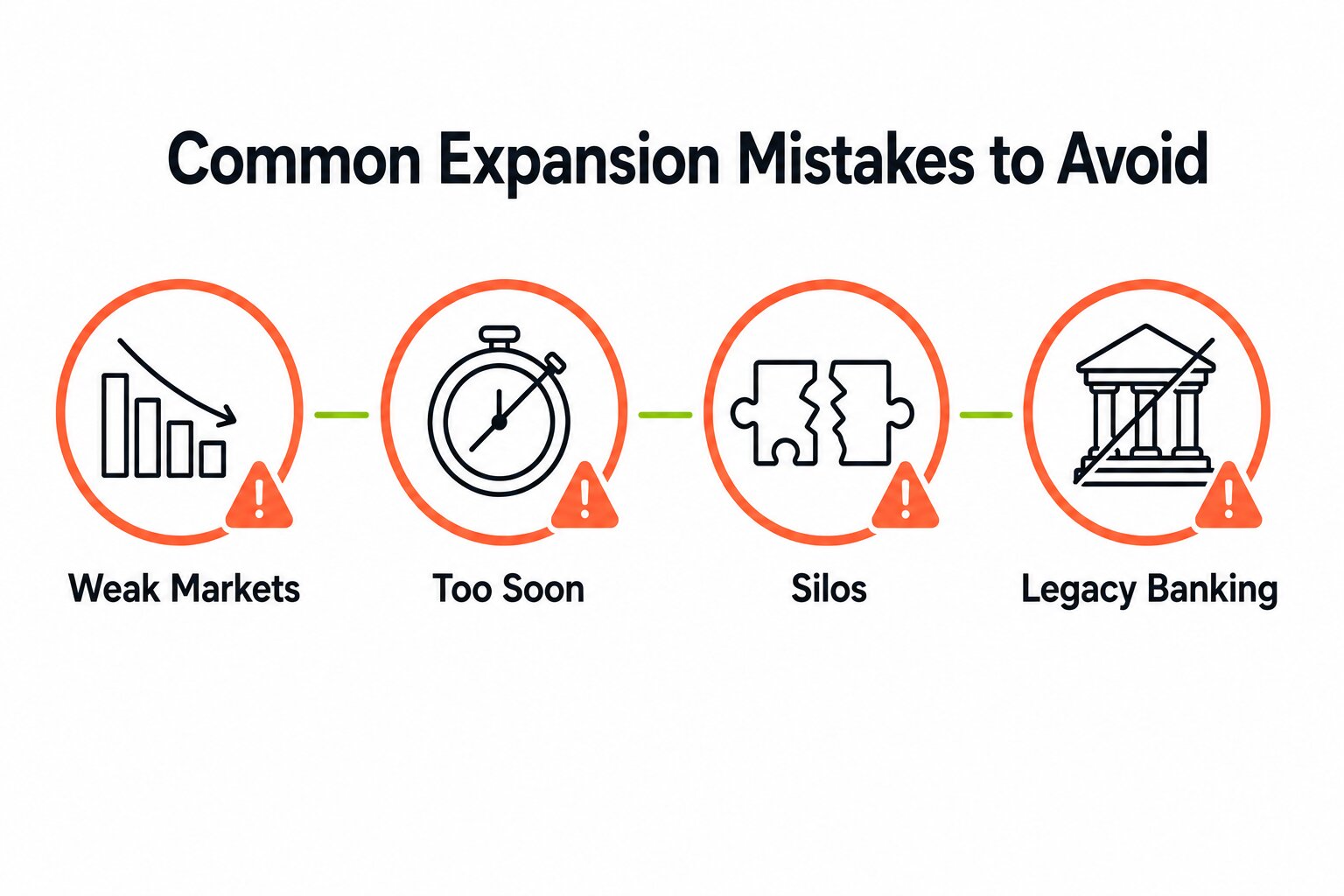
To preserve international market value and protect profit margins, organizations avoid common execution errors by monitoring the following risks:
- Entering Struggling Retail Channels and Weak Markets
Forcing market entry through declining department store networks or within geographic regions suffering severe economic downturns drains corporate capital without yielding successful financial returns.
- Launching New Product Types Too Soon
Expanding a brand immediately into secondary categories like beauty, fragrance, or accessories before securing strong market demand for core clothing or primary software reduces overall operational focus.
- Building Complete Products Before Testing Local Demand
Spending large corporate budgets and months of engineering work to finish an entire product before validating local consumer interest with quick digital mockups creates a high risk of market failure.
- Allowing Strict Departmental Barriers Between Teams
Operating with isolated teams that fail to share information prevents the rapid cross-functional collaboration required to refine localized user experiences based on real-time feedback.
- Ignoring Local Green and Sustainability Rules
Neglecting target-government green standards, environmental targets, and regional carbon footprint expectations strips away key commercial advantages in progressive international markets.
- Using Traditional Banks for International Payments
Managing overseas contractor payroll and global transactions through legacy high-street banks exposes expanding businesses to heavy currency processing fees and major administrative delays.
Final Thoughts
To execute a successful global market entry, organizations can implement the following next steps:
- Verify consumer demand: Track organic international e-commerce sales or launch digital mockups before investing capital into brick-and-mortar locations.
- Automate financial administration: Implement automated multi-currency platforms to streamline cross-border payroll and eliminate legacy banking fees.
- Map regulatory requirements: Align supply chains with active free trade agreements and evaluate regional sustainability mandates before establishing a long-term real estate footprint.
- Remove operational silos: Maintain flat, cross-functional team structures to ensure rapid product refinement based on real-time feedback.
Frequently Asked Questions (FAQs)
What is a modern way to test international demand without heavy spending?
Companies can track existing international web orders or launch a minimum viable product (MVP) to collect live consumer feedback before investing in physical stores.
How do master franchise partnerships accelerate global growth?
They outsource store management and regional branding to local partners, providing immediate access to premium commercial networks and reducing standalone infrastructure costs.
Why should businesses avoid traditional high-street banks for global payroll?
Legacy banks introduce major administrative delays and heavy currency processing fees compared to automated multi-currency platforms.
Read These Next

AI Marketing Automation: How to 10x Your Output with Machine Learning