Marketing Attribution Models: The Complete 2026 Guide




Marketing attribution is the framework for assigning credit to touchpoints in a customer journey. In 2026, it relies on AI-driven probabilistic modeling, first-party data strategy, and privacy-safe tracking systems. By using models like data-driven or position-based attribution, marketers evaluate interactions across fragmented channels to optimize budget allocation and improve incrementality.
Introduction
Marketing attribution identifies which channels and touchpoints contribute to conversions across the customer journey. Instead of relying on a single interaction, attribution models evaluate how multiple interactions influence outcomes.
According to Unifida’s marketing attribution research, 81% of companies use some form of attribution model, while 75% use multi-touch attribution to measure performance.
In 2026, attribution has become more complex due to privacy-first tracking, reduced third-party cookies, and AI-driven campaign optimization. Accurate measurement now depends on first-party data, modeled insights, and integrated tracking systems that connect user interactions across channels.
This shift is also driven by privacy frameworks such as Apple’s SKAdNetwork updates and Google’s Privacy Sandbox, which limit deterministic tracking and increase reliance on aggregated and modeled data.
In practice, not all touchpoints are trackable. A significant portion of influence happens through dark social channels such as podcasts, private sharing, and word-of-mouth, which are not directly captured in attribution systems. To capture these non-trackable touchpoints in 2026, many marketers supplement their digital tracking with "How did you hear about us?" self-reported attribution (SRA) surveys at checkout, providing a direct window into the influence of dark social and word-of-mouth.
What this Guide Covers
This guide explains how marketing attribution works, the different models used to measure performance, and how attribution is applied in a privacy-first, AI-driven environment.
- What marketing attribution is
- How marketing attribution models work
- Types of attribution models
- When to use each attribution model
- How attribution works without third-party cookies
- Common challenges in marketing attribution
What Is Marketing Attribution?
Marketing attribution identifies which channels and touchpoints contribute to conversions across the customer journey. Instead of relying on a single interaction, it evaluates how multiple interactions influence outcomes.
Research from Embryo indicates that most companies now rely on multi-touch attribution, reflecting the need to evaluate multiple interactions instead of a single conversion event.
For example, a user may:
- See a TikTok ad (specific paid social touchpoint)
- Search on Google
- Click an email
- Convert on a website
Attribution models assign value across these interactions.
Key components:
- Touchpoints (ads, emails, website visits — e.g., a TikTok ad, a Google search click, an email open)
- Channels (search, social, display, email)
- Conversion events (purchase, sign-up, lead)
- Attribution model (rules for assigning credit)
This process helps improve budget allocation, optimize campaigns, and understand which channels contribute most to results.
How Do Marketing Attribution Models Work?
Marketing attribution models work by applying rules or algorithms to assign credit to different touchpoints in a customer journey. These models analyze user interactions across channels and determine how much each interaction contributes to a conversion.
The process typically includes:
- Tracking user interactions across channels
- Collecting data from multiple sources
- Applying an attribution model
- Assigning credit to each touchpoint
- Analyzing performance and optimizing campaigns
For example, a user journey might include:
- Clicking a display ad
- Visiting a website
- Returning via search
- Converting after an email
According to MarketingLTB, switching from single-touch to multi-touch attribution can improve budget efficiency by around 22%, highlighting the value of evaluating multiple interactions.
In 2026, attribution models increasingly rely on AI-driven systems that use probabilistic modeling instead of deterministic tracking.
Deterministic models rely on direct, user-level identifiers (e.g., cookies, login data) to track exact journeys, while probabilistic models use aggregated signals and statistical inference to estimate how touchpoints contribute to conversions when direct tracking is limited.
This shift is supported by techniques such as server-side tagging, Marketing Mix Modeling (MMM), and incrementality testing to improve measurement accuracy in privacy-constrained environments.
Quick Comparison of Marketing Attribution Models
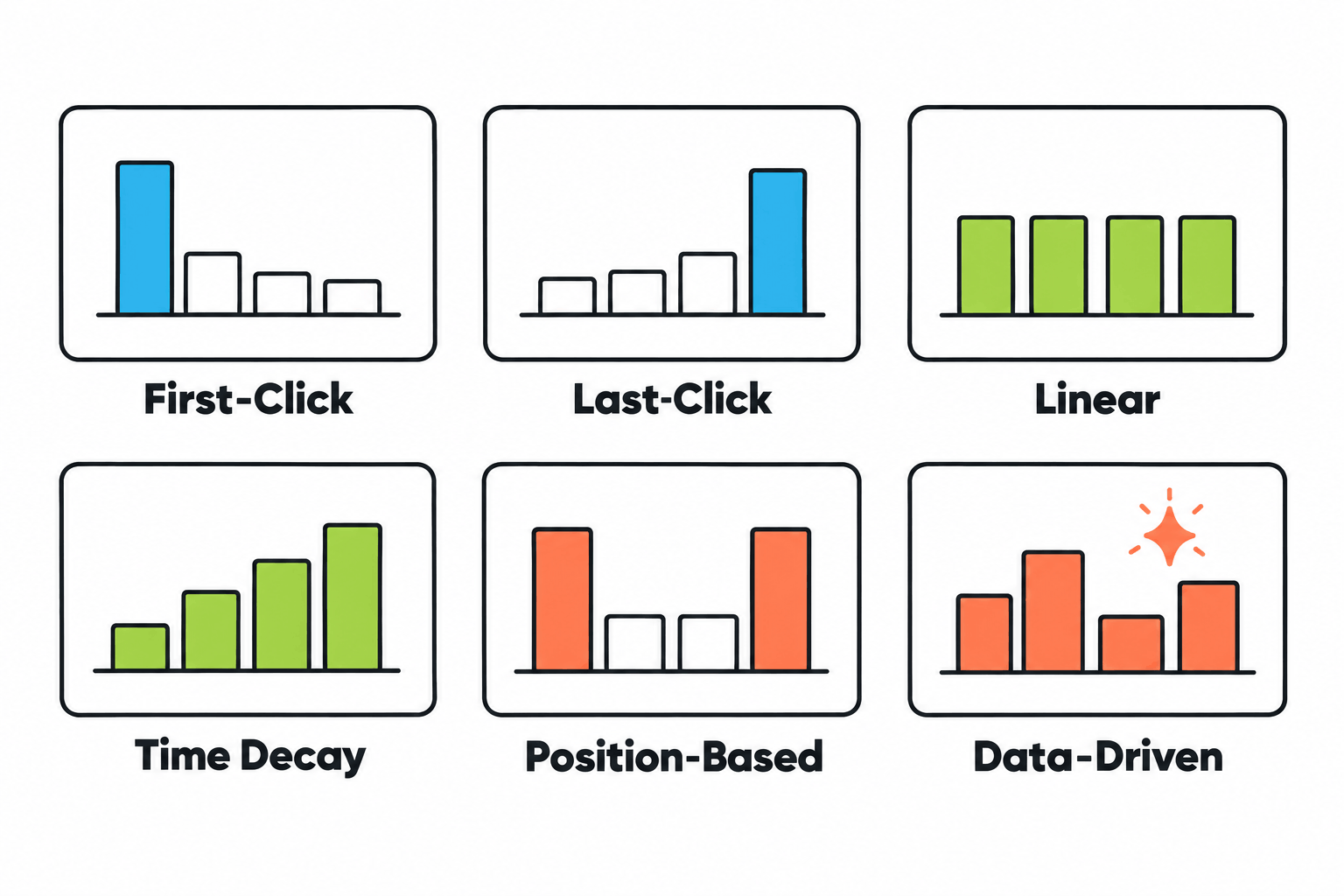
Each attribution model assigns credit differently, which directly affects how marketing performance is measured and optimized.
What Are the Main Types of Marketing Attribution Models?
Marketing attribution models are typically grouped into single-touch, multi-touch, and data-driven models, each assigning credit differently across the customer journey.
Single-Touch Attribution Models
Single-touch attribution models assign 100% of the credit to one interaction in the customer journey.
Common types include:
According to Adobe, these models are simple and widely used but do not account for the full customer journey, as they ignore other influencing touchpoints.
Multi-Touch Attribution Models
Multi-touch attribution models distribute credit across multiple interactions in the customer journey, providing a more complete view of how conversions happen.
Common types include:
Adobe highlights that multi-touch attribution is generally more realistic for non-linear customer journeys, where multiple interactions contribute to a conversion.
Data-Driven Attribution Models
Data-driven attribution models use machine learning to assign credit based on actual performance data.
Key characteristics:
- Uses historical conversion data
- Adjusts credit dynamically
- Identifies patterns across channels
- Improves accuracy over time
Data from MarketingLTB shows that adoption of data-driven attribution remains lower than rule-based models, mainly due to data requirements and technical complexity.
In 2026, most major advertising platforms use data-driven attribution by default, relying on aggregated and anonymized data due to privacy restrictions.
Unlike rule-based models, data-driven attribution uses probabilistic modeling to estimate contribution, rather than deterministic tracking of exact user paths. This allows it to function even when signals are incomplete or anonymized.
When Should You Use Each Attribution Model?
Different attribution models are suited for different campaign types, goals, and data environments. Choosing the right model depends on how complex the customer journey is and how much data is available.
General guidelines:
- Use single-touch attribution (first-touch or last-touch) for:
- Simple funnels
- Direct-response campaigns
- Limited tracking setups
- Use multi-touch attribution models for:
- Multi-channel campaigns
- Longer customer journeys
- Understanding full-funnel performance
- Use data-driven attribution for:
- Large datasets
- Complex, non-linear journeys
- AI-optimized campaigns
In more advanced setups, marketers often combine attribution models with Marketing Mix Modeling (MMM) and incrementality testing to validate results across channels and reduce bias from platform-reported data.
Quick Selection Guide:
- Simple funnel → single-touch (last-click)
- Multi-channel journey → multi-touch (linear or position-based)
- High data volume → data-driven
How Does Marketing Attribution Work Without Third-Party Cookies?
Marketing attribution without third-party cookies relies on first-party data, modeled insights, and privacy-compliant tracking methods. These approaches allow marketers to measure performance without directly tracking users across different websites.
According to research from Improvado, the decline of third-party cookies has reduced the accuracy of user-level tracking, increasing reliance on modeled and aggregated data for attribution.
Key methods include:
- First-party data
Data collected directly from users through websites, apps, and CRM systems - Server-side tracking
Improves data accuracy by sending events directly from servers instead of browsers - Modeled attribution
Uses AI to estimate conversions when tracking signals are incomplete - Aggregated event measurement
Groups data to protect user privacy while maintaining performance insights - Data clean rooms
Secure environments where aggregated data can be analyzed without exposing user-level information
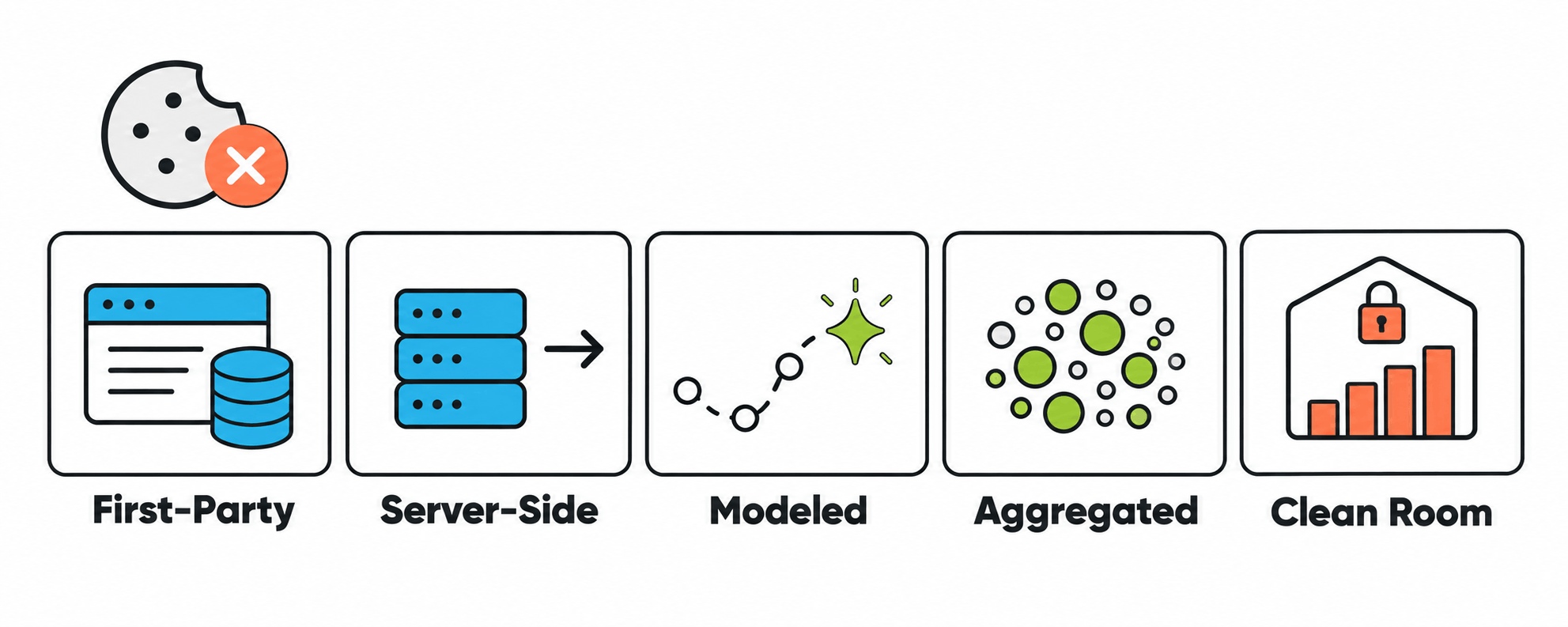
Because user-level tracking is limited, attribution now depends more on statistical modeling and signal-based analysis. This means reported results may vary between platforms, and no single source provides a complete picture. These approaches are typically supported by a first-party data strategy, where data collected directly from owned channels becomes the foundation for attribution.
What Are the Common Challenges in Marketing Attribution?
Marketing attribution faces challenges related to data accuracy, cross-channel tracking, and privacy restrictions. These factors make it difficult to measure performance consistently across platforms.
Research from Cometly highlights that data fragmentation and inconsistent attribution models across platforms are among the most common issues marketers face, especially in multi-channel campaigns.
Common challenges include:
- Cross-device tracking limitations
- Data fragmentation across tools
- Reduced visibility due to privacy regulations
- Differences in platform attribution models
- Over-reliance on platform-reported metrics
For example, one platform may report a conversion that another platform also claims, leading to overlapping attribution.
One of the most common challenges in practice is unifying CRM data with ad platform data. In our experience, inconsistencies in tracking, naming conventions, and data synchronization often lead to mismatched reporting across systems.
Conclusion
Marketing attribution helps businesses understand how different channels and touchpoints contribute to conversions. By assigning value across the customer journey, attribution supports more informed decision-making and better budget allocation.
In 2026, attribution has evolved toward AI-driven models, first-party data, and privacy-compliant tracking. While measurement is more complex, structured attribution models and improved data systems allow marketers to evaluate performance across channels with greater clarity and consistency.
Different attribution models provide different perspectives, so comparing multiple models often leads to more accurate insights.
FAQs
What is marketing attribution?
Marketing attribution is the process of assigning credit to different marketing touchpoints that contribute to a conversion.
Which attribution model is best?
There is no single best model. The right attribution model depends on campaign goals, data availability, and the complexity of the customer journey.
What is data-driven attribution?
Data-driven attribution uses machine learning to assign credit based on how different touchpoints influence conversions.
Why is attribution difficult in 2026?
Attribution is more complex due to privacy restrictions, reduced third-party cookies, and fragmented data across platforms.
Can attribution work without cookies?
Yes. Attribution now relies on first-party data, modeled insights, and privacy-compliant tracking methods instead of third-party cookies.
Related Content
Read These Next
Retention Marketing Tactics: 10 Proven Ways to Stop Your Customers from Leaving