.png)
Media Buying Explained: What You Need to Know Before Your Next Campaign
.png)

.png)

SNAPSHOT
Media buying is the process of purchasing ad placements across channels - paid search, paid social, programmatic display, retail media networks, connected TV, and video - to reach a defined audience at a defined cost. In 2026, the focus has shifted from manual bidding to algorithmic management, where buyers use first-party data and clear commercial objectives to guide AI-driven platforms toward high-value business outcomes.
Introduction
Media buying is the execution side of paid advertising - the process of deciding where to spend, how much to bid, which audiences to reach, and how to measure what the spend actually produces. It sits between media planning, which defines the strategy, and campaign optimization, which refines performance over time.
The environment in which media buying now operates has changed significantly. Programmatic technology means the majority of digital display inventory is now purchased through automated auctions rather than direct deals.
According to AI Digital’s 2025 Global Digital Advertising Outlook Report, more than 90 percent of digital display impressions in the US trade programmatically. Programmatic buying itself spans both the open exchange, where inventory is auctioned broadly across the web, and private marketplaces (PMPs), where advertisers access premium publisher inventory through invite-only deals with tighter brand safety controls.
AI-driven bidding systems on Google, Meta, LinkedIn, Amazon Ads, Walmart Connect, and The Trade Desk have automated decisions that were previously made manually. Retail Media Networks, in particular, have become a major component of 2026 media buying because they combine closed-loop purchase data with high-intent commerce audiences.
Privacy restrictions have fragmented the audience data that targeting depends on. In practice, this fragmentation means platforms can no longer observe users consistently across websites, apps, and devices because third-party cookies, mobile identifiers, and cross-site tracking signals are increasingly restricted. Attribution across multi-touchpoint customer journeys is therefore increasingly modeled rather than directly observed.
The practical implication is that effective media buying in the current environment requires more than knowing which channels exist. It requires understanding how those channels interact, what the algorithm needs to perform, how to set objectives that reflect commercial reality, and how to verify that platform-reported results match what is actually happening in the business. In our observation, the advertisers generating the most stable returns are those building campaigns around first-party data infrastructure rather than relying heavily on third-party audience targeting. This guide covers each of those areas in the order a campaign decision-maker needs them.
What This Guide Covers
This guide explains the core components of media buying and what each one means for campaign decisions, performance, and measurement.
- What media buying is and how it differs from media planning
- The main media buying channels and how they differ
- How to set campaign objectives that the algorithm can optimize toward
- What targeting options are available and where each one applies
- How bidding strategies work and which to use
- Why creative strategy has become a core buying variable
- Key metrics and what they actually measure
- How to build a measurement framework that reflects real performance
- Common campaign mistakes and how to avoid them
Quick Comparison: Media Buying Channels
What Is Media Buying and How Does It Differ from Media Planning?
Media buying is the execution of a paid media strategy - purchasing the actual ad placements defined by the media plan. Media planning decides what to do. Media buying makes it happen and keeps it performing. In practice the two are closely linked, but the distinction matters because they require different skills and different data.
Media planning is a strategic function. It defines campaign objectives, audience targets, channel mix, budget allocation, and the measurement framework for evaluating success. It answers the question of where and why. Media buying is an operational function. It manages the actual purchase of inventory - setting bids, configuring targeting parameters, managing budgets in flight, and adjusting delivery based on performance data. It answers the question of how and at what cost.
In automated environments, the boundary has blurred. AI-driven platforms like Google Performance Max and Meta Advantage+ make real-time decisions about audience, placement, and bid that were previously manual buying tasks. This has reduced the volume of manual buying work required but has not eliminated the need for clear planning inputs. The algorithm executes based on the objective and signals it receives - a poorly planned campaign produces efficient spend in the wrong direction regardless of how well the buying system functions.
Decision clarity: If campaign performance is poor, diagnose whether the problem is in planning (wrong objective, wrong channel, wrong audience definition) or buying (insufficient budget for the algorithm to learn, poor creative, tracking gaps). The fix is different in each case.
What Are the Main Media Buying Channels and How Do They Differ?
Media buying spans paid search, paid social, programmatic display, retail media networks, video, connected TV, and audio. Each channel serves a different function in the customer journey, reaches audiences through different mechanisms, and performs differently depending on the objective, budget, and offer.
Paid search captures existing demand. Users are actively searching for something and the ad appears in response to that intent. This makes search the highest-intent channel available, but its reach is limited to people who are already looking. It cannot build awareness or create demand where none exists.
Paid social generates demand. It places ads in front of audiences based on who they are rather than what they are searching for. This makes it useful for building awareness, introducing new products, and reaching audiences that are not yet in an active search cycle. The tradeoff is a lower baseline intent compared to search.
Programmatic display operates across the open web, placing ads on publisher sites and apps through automated auctions. It provides broad reach at lower CPMs than search or social, but requires stronger brand safety and viewability controls to ensure spend is delivering against quality inventory rather than low-value placements.
Retail Media Networks, such as Amazon Ads and Walmart Connect, operate within commerce ecosystems where the platform has direct purchase data. This gives advertisers access to high-intent audiences close to the point of purchase and has made retail media one of the fastest-growing categories in digital advertising spend.
The right channel mix depends on where the audience is in the purchase journey and what the campaign is trying to achieve:
- Upper funnel - building awareness and reach: programmatic display, CTV, YouTube, paid social brand campaigns
- Mid funnel - consideration and engagement: paid social retargeting, YouTube, native advertising
- Lower funnel - conversion and demand capture: paid search, shopping campaigns, retargeting across programmatic and social
How Do You Set Campaign Objectives That the Algorithm Can Optimize Toward?
Campaign objectives define what the algorithm is trying to achieve. Every bid decision, audience expansion, and budget allocation the platform makes is oriented toward the objective that has been configured. A poorly defined objective produces efficient delivery against the wrong outcome - the system performs correctly while the campaign fails commercially.
Follow these steps to set an objective the algorithm can actually optimize toward:
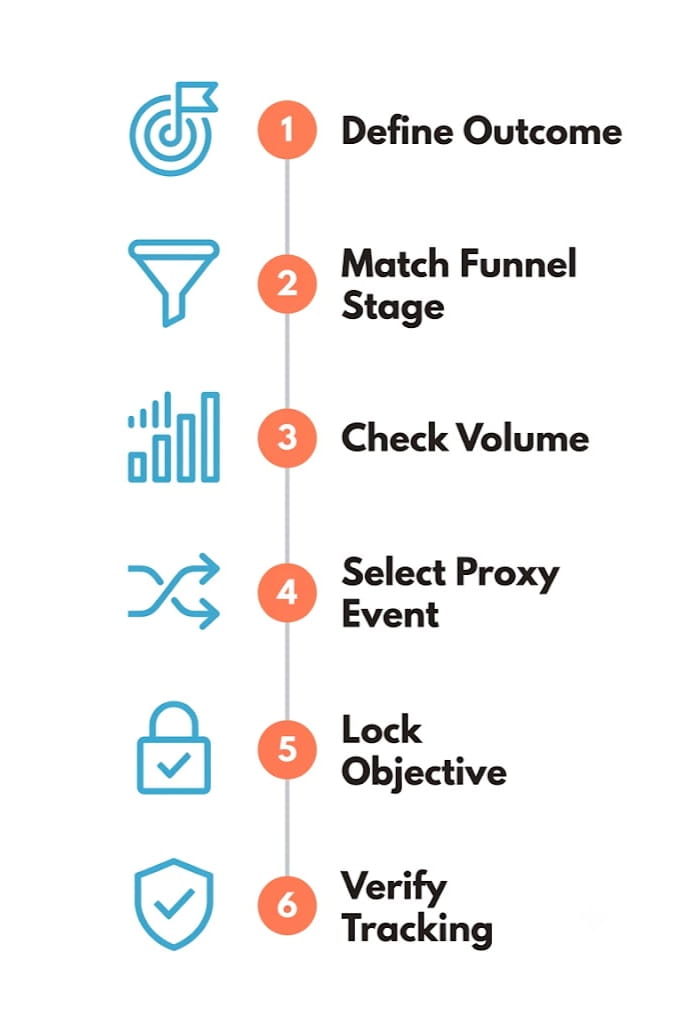
Decision clarity: Choose the objective that is closest to the commercial outcome while being achievable at sufficient volume. If purchase volume is too low for algorithmic optimization, use add-to-cart or checkout initiation as the primary optimization event and track purchases as a secondary signal.
What Targeting Options Are Available and Where Does Each One Apply?
Media buying targeting controls which users see the ad. Different targeting mechanisms work at different funnel stages, use different data sources, and carry different risks as privacy restrictions continue to reduce the quality and availability of third-party audience data.
The main targeting mechanisms available across most platforms:
- Keyword targeting: used in paid search to match ads to active search queries - the highest-intent targeting mechanism available because it reaches users at the moment of expressed interest
- Demographic and interest targeting: used in paid social and display to reach users based on platform-inferred attributes - age, gender, location, interests, and life events; useful for upper and mid-funnel campaigns
- Behavioral retargeting: reaches users who have previously visited the website or interacted with the brand - higher intent than cold audiences and typically lower CPA
- Lookalike audiences: extends reach to new users who share behavioral or demographic characteristics with existing customers - quality depends entirely on the seed audience used to generate it
- Contextual targeting: places ads adjacent to content that is relevant to the product or category - does not rely on user-level data and is therefore unaffected by privacy restrictions
- First-party data targeting: uses CRM records, email lists, and logged-in user behavior to reach known audiences - the most privacy-resilient targeting mechanism and increasingly the primary foundation for advanced targeting strategies
The shift toward first-party data is not optional for advertisers who depend on precision targeting. Third-party cookie deprecation and iOS signal loss have reduced the quality of behavioral targeting data available to platforms. Campaigns built on first-party data foundations consistently outperform those relying on third-party audience segments as signal quality continues to decline.
How Do Bidding Strategies Work and Which One Should You Use?
Bidding strategies control how the platform spends its budget in auctions. Manual bidding sets a fixed maximum bid per click or impression. Automated bidding uses machine learning to adjust bids in real time based on conversion probability, user signals, and campaign history. For most campaigns in competitive markets, automated bidding outperforms manual bidding because it can process signals that manual bidding cannot incorporate at auction speed.
There are still edge cases where manual control remains appropriate. Very low-volume niche B2B campaigns, highly regulated industries, or campaigns with insufficient conversion data can struggle under automated bidding because the algorithm lacks enough signal to optimize safely. In these situations, tighter manual controls may reduce the risk of inefficient spend while data volume accumulates.
The main automated bidding strategies and when each applies:
- Maximize Conversions: spends the full budget to generate as many conversions as possible without a CPA constraint - best for new campaigns building conversion signal volume
- Target CPA: attempts to achieve conversions at a defined cost per acquisition - requires sufficient historical conversion data to function; use once a campaign has 30 or more conversions per week
- Target ROAS: optimizes for revenue return relative to spend rather than conversion volume - appropriate when conversion values vary significantly and higher-value conversions should be weighted more heavily
- Maximize Conversion Value: spends the full budget to maximize total conversion value rather than volume - useful when the goal is revenue maximization rather than volume at a fixed CPA
- CPM bidding: pays per 1,000 impressions regardless of click or conversion outcome - standard for awareness and reach campaigns where the goal is exposure rather than direct response
.png)
Why Has Creative Strategy Become Part of Media Buying?
In 2026, creativity is increasingly the new target. As Privacy Sandbox restrictions, iOS tracking limitations, and broader signal loss reduce the precision of audience targeting, platforms rely more heavily on creative engagement signals to determine who should receive the ad and how aggressively the system should bid.
This has changed the role creative plays inside media buying itself. Creative is no longer simply an asset that the buying team distributes. It is a core optimization variable that directly affects delivery efficiency, CPM stability, click-through rate, and conversion performance.
In our observation, campaigns with strong creative variation routinely outperform campaigns with highly refined audience targeting but weak creative differentiation. Case data suggests that platforms such as Meta Advantage+ and TikTok Smart Performance Campaigns increasingly use early engagement signals - watch time, scroll stopping behavior, click-through rate, and conversion velocity - as proxies for audience quality in environments where direct tracking signals are weaker.
The practical implication is that media buying and creative strategy can no longer operate independently. Buyers now need creative systems that provide meaningful variation in hooks, formats, positioning angles, and offers so the algorithm has enough signal diversity to optimize effectively.
What Are the Key Media Buying Metrics and What Do They Actually Measure?
Media buying generates a large volume of performance data. Not all metrics are equally useful, and some platform-reported metrics are structurally unreliable as measures of business performance. Understanding what each metric measures - and what it does not - is essential for making sound campaign decisions.
How Do You Build a Measurement Framework That Reflects Real Performance?
Platform dashboards report performance using attribution models that favor the platform. All major platforms - Google, Meta, LinkedIn, Amazon Ads, and The Trade Desk - over-attribute conversions to their own channel, particularly when using last-click or platform-modeled attribution.
A reliable measurement framework uses multiple data sources triangulated against each other. No single source is definitive. In 2026, this increasingly includes infrastructure such as Google Ads Data Hub, Meta Conversions API (CAPI), and The Trade Desk’s UID2.0 framework to improve signal continuity in privacy-restricted environments.
Case data suggests that businesses relying only on browser-side pixels experience significantly larger attribution gaps than businesses using server-side event tracking and CRM-integrated measurement systems.
Privacy restrictions and signal loss are central to why this infrastructure matters. As third-party cookies disappear and cross-site tracking weakens, platforms lose visibility into how users move between websites, devices, and apps. This creates fragmented customer journeys where conversion paths can no longer be fully observed, forcing platforms to rely more heavily on modeled attribution and probabilistic matching rather than deterministic user tracking.
Build it in this order:
Benchmark context: Platform-reported ROAS typically overstates actual ROAS by 20 to 60 percent. A campaign reporting 4x ROAS in Meta Ads Manager may deliver 2.5x to 3x when cross-referenced against CRM data and server-side tracking. Scale decisions made on platform-reported numbers alone frequently result in budget increases that do not produce proportional revenue growth.
What Are the Most Common Media Buying Mistakes and How Do You Avoid Them?
Most media buying failures are not caused by the wrong channel or the wrong platform. They are caused by structural errors in how campaigns are configured, measured, or scaled. The same mistakes appear consistently across businesses of different sizes and sectors.
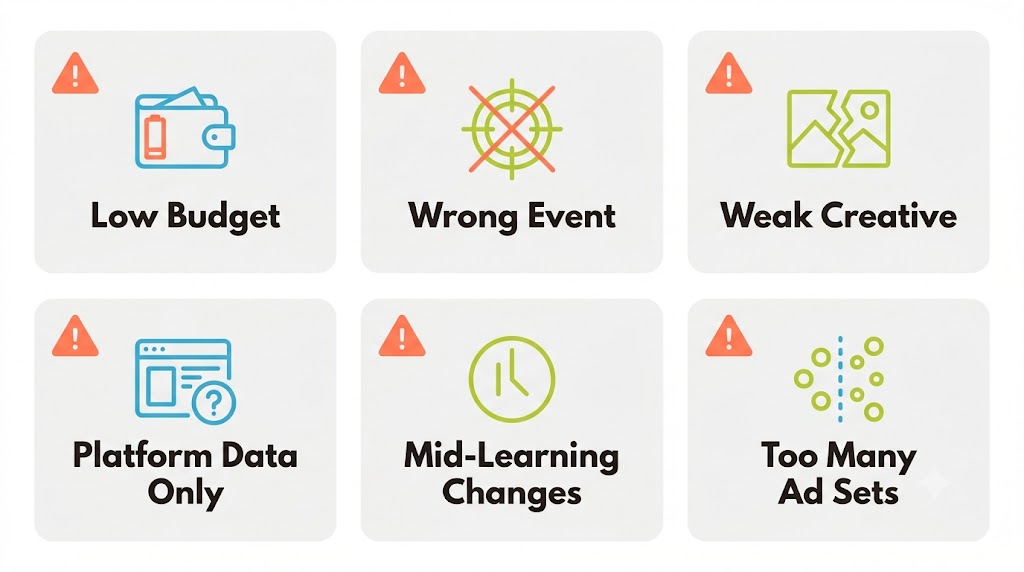
The most common errors and how to correct them:
- Launching with insufficient budget: if the budget cannot generate enough conversion events for the algorithm to optimize, the campaign runs in a permanent learning state - set budgets based on target CPA multiplied by the minimum conversion volume required for the bidding strategy to function
- Optimizing for the wrong event: campaigns set to optimize for clicks or traffic rather than conversions will deliver cheap clicks with no commercial value - always optimize for the action closest to revenue that generates sufficient volume
- Ignoring creative performance: on paid social in particular, creative is the primary signal the algorithm uses to find converting audiences - running the same ad for extended periods without rotation causes frequency fatigue and declining performance
- Scaling on platform data alone: platform-reported ROAS overstates actual returns; increasing budgets without cross-referencing CRM data is the most common cause of overspending on campaigns that are not delivering real returns
- Changing campaigns during the learning phase: adjusting bids, budgets, or targeting during the first 1 to 2 weeks resets algorithmic learning and extends the period before the campaign reaches stable performance
- Running too many ad sets or campaigns simultaneously: splitting the budget across too many campaigns reduces the conversion volume available per campaign, preventing any individual campaign from generating the signal needed to optimize
Decision clarity: Before launching any campaign, confirm three things: the objective is the closest available proxy to the actual business outcome, the budget is sufficient to generate the minimum conversion volume required for the bidding strategy, and the tracking infrastructure is in place to verify platform-reported results against actual revenue.
Conclusion
Media buying is not complicated in principle. It is the process of placing ads in front of the right audience at the right cost with a clear objective and a way to verify what the spend is producing. What makes it difficult in practice is the gap between what platforms report and what is actually happening, the volume of decisions required to manage a campaign well, and the speed at which the underlying technology is changing.
The campaigns that consistently deliver commercial returns are not the ones with the largest budgets or the most sophisticated technology. They are the ones with clear objectives, sufficient conversion signal volume for the algorithm to work with, a creative that gives the system meaningful variation to test, and a measurement framework that cross-references platform data against real business outcomes.
Understanding the components in this guide - channels, objectives, targeting, bidding, metrics, and measurement - does not guarantee campaign success. But it eliminates the structural errors that prevent campaigns from performing before they have the chance to.
FAQs
What is the difference between media planning and media buying?
Planning defines the strategy - channels, audiences, budget, and measurement. Buying executes it by purchasing inventory, managing bids, and optimizing delivery in flight.
How much budget do you need for media buying to work?
Enough to generate 30 to 50 conversion events per week. A $50 target CPA campaign needs roughly $1,500 to $2,500 per week to reach the optimization threshold.
What is a good ROAS for a media buying campaign?
Platform-reported ROAS of 3x to 6x for warm audiences, 1.5x to 3x for cold. Actual ROAS verified against CRM is typically 20 to 60 percent lower.
Why does platform-reported performance differ from actual revenue?
All major platforms over-credit their own channel through last-click, view-through, and modeled attribution. Cross-referencing with CRM and server-side tracking is the only reliable verification.
Read These Next
Marketing Automation Workflow: How to Design High-Converting Sequences from Scratch