.png)
.png)
Media Buying Tools: The Top 10 Platforms for Modern Ad Operations in 2026
.png)

.png)

The top media buying tools in 2026 are defined by AI-automation and privacy-compliant data. Key platforms include The Trade Desk and DV360 for programmatic reach, Meta Ads Manager for social performance, and Amazon DSP or Skai for retail media. Modern ad operations use an Omnichannel Stack, combining these buying platforms with attribution tools like Northbeam to unify cross-channel reporting.
Introduction
Media buying tools have changed significantly in recent years. Instead of running ads from a single platform, contemporary ad tech stacks use multiple tools to manage targeting, bidding, creative production, and reporting across different channels. In 2026, successful campaigns usually combine demand-side platforms (DSPs), social ad managers, retail media networks, and automation tools to improve performance and efficiency.
Privacy changes and cookie restrictions have also affected how ads are bought. Many platforms now rely more on first-party data, contextual targeting, and AI-based optimization instead of traditional tracking methods. At the same time, retail media platforms such as Amazon and Walmart have become important sources of high-intent traffic, making media buying more complex but also more powerful.
Industry reports describe automated media buying workflows as omnichannel systems where automation, AI bidding, creative generation, and unified reporting work together to improve return on ad spend and reduce manual work (Directive, 2026; Klaviyo, 2025; PropellerAds, 2026).
Understanding the main media buying tools helps marketers choose the right platform for each campaign instead of relying on one tool for every situation.
Quick Comparison: Top Media Buying Tools (2026)
What This Guide Covers
This guide explains the main media buying tools used in modern ad operations and how each platform fits different campaign goals.
This guide covers:
- What Are Media Buying Tools
- Top 10 Media Buying Tools in 2026
- How to Choose the Right Media Buying Tool
What Are Media Buying Tools
Media buying tools are platforms used to purchase, manage, and optimize advertising across digital and traditional channels. They allow advertisers to control targeting, bidding, budget, and performance without placing ads manually.
In 2026, media buying usually involves multiple tools working together, including demand-side platforms (DSPs, platforms that allow advertisers to buy ad inventory programmatically across multiple publishers), social ad managers, retail media networks, and automation software. These platforms help run campaigns across search, social, programmatic, and ecommerce channels at the same time.
Because of privacy changes and cookie restrictions, modern tools rely more on first-party data, contextual targeting, and AI-based optimization. Retail media platforms such as Amazon have also become important because they provide high-intent data that improves targeting without depending on third-party tracking (Directive, 2026; Klaviyo, 2025).
Contemporary advertising systems are no longer managed from one platform. Most campaigns use a stack of media buying tools to automate execution, improve reporting, and scale performance across multiple channels.
Top 10 Media Buying Tools in 2026
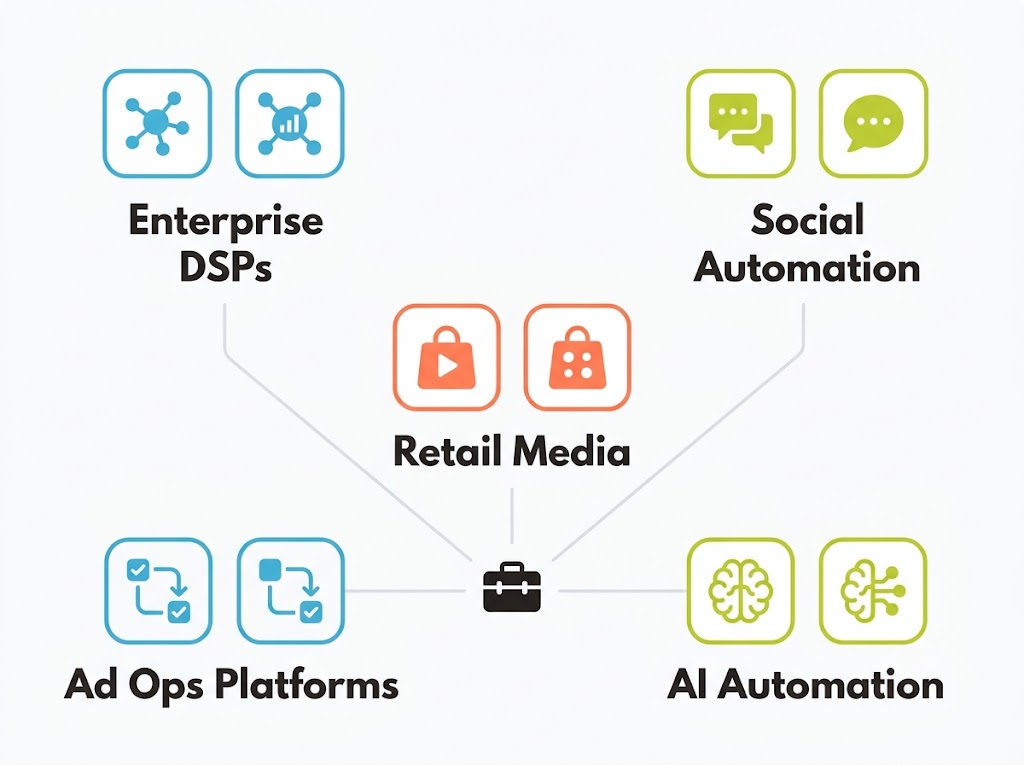
Modern ad operations use different media buying platforms depending on the campaign goal, budget, and channel. In 2026, most teams use a stack of tools instead of a single platform, combining DSPs, social ad managers, retail media networks, and automation software to manage campaigns across multiple channels.
Below are some of the most commonly used media buying tools and how they are used in modern advertising.
#1 The Trade Desk
The Trade Desk is an enterprise demand-side platform (DSP, a platform that allows advertisers to buy ad inventory across multiple publishers using programmatic bidding) used for large-scale programmatic advertising across display, video, audio, and Connected TV (CTV, streaming television content delivered via internet-connected devices instead of traditional cable). It is commonly used when advertisers need full control over media buying, access to premium inventory, and advanced audience targeting in a privacy-first environment.
Ideal for
- Enterprise campaigns
- Programmatic advertising
- Connected TV (CTV)
- Omnichannel media buying
- Large budgets
Why marketers use it
- More control than social ad platforms
- Access to premium publishers
- Works across multiple channels
- Supports cookieless targeting
- Reliable for large-scale campaigns
Limitations
- Complex setup
- Requires programmatic experience
- Higher cost than basic ad platforms
- Not ideal for small advertisers
The Trade Desk is often used when campaigns need scale, control, and premium inventory instead of relying only on social or search ads (Directive, 2026).
#2 Google Display & Video 360 (DV360)
Google Display & Video 360 (DV360) is Google’s enterprise media buying platform used for programmatic display, video, YouTube, and Connected TV (CTV, streaming TV content delivered via internet-enabled devices) campaigns.
Ideal for
- Large programmatic campaigns
- YouTube and video ads
- Omnichannel advertising
- Data-driven campaigns
- Agencies and enterprise teams
Why marketers use it
- Strong integration with Google tools
- Access to large ad inventory
- Works with GA4 and conversion tracking
- Supports automated bidding
- Suitable for high-budget campaigns
Limitations
- Steep learning curve
- Requires experience with programmatic
- Can be expensive for small advertisers
- Setup takes time
DV360 is often used when advertisers need one platform to manage display, video, and programmatic campaigns while keeping reporting connected to analytics and conversion data (Klaviyo, 2025).
#3 Meta Ads Manager
Meta Ads Manager is one of the most widely used media buying platforms for social advertising. It allows advertisers to run campaigns across Facebook, Instagram, and Messenger while using automation and AI optimization to manage targeting, bidding, and creative testing.
Ideal for
- Social media advertising
- Lead generation campaigns
- Ecommerce ads
- Retargeting
- Small to large budgets
Why marketers use it
- Very large audience reach
- Strong conversion optimization
- Easy campaign setup
- Works well for creative testing
- Supports automated bidding (Advantage+)
Limitations
- Performance affected by privacy changes
- Creative fatigue happens quickly
- Requires frequent testing
- Limited control compared to DSPs
Meta Ads Manager remains one of the main tools for performance campaigns, especially when fast testing and audience reach are more important than premium inventory (Klaviyo, 2025).
#4 StackAdapt
StackAdapt is a programmatic advertising platform focused on native, display, and contextual targeting. It is commonly used when advertisers want programmatic buying with strong audience segmentation but without relying heavily on third-party cookies.
Ideal for
- Programmatic campaigns
- Native advertising
- Contextual targeting
- Cookieless environments
- Mid to large budgets
Why marketers use it
- Strong AI targeting
- Works well without cookies
- Supports native and display ads
- Flexible audience segmentation
- Easier to use than some DSPs
Limitations
- Smaller inventory than major DSPs
- Requires programmatic knowledge
- Setup takes time
- Not ideal for very small budgets
StackAdapt is often used in modern media buying because contextual targeting works better in privacy-focused environments where cookie tracking is limited (Directive, 2026).
#5 Smartly.io
Smartly.io is an automation platform designed for managing large-scale social advertising campaigns. It connects creative production with media buying, allowing teams to generate many ad variations and optimize campaigns automatically across platforms like Meta, TikTok, and Pinterest.
Ideal for
- Large social campaigns
- Creative-heavy advertising
- Ecommerce brands
- Agencies managing multiple accounts
- High-volume ad testing
Why marketers use it
- Automates campaign creation
- Speeds up creative testing
- Works across multiple social platforms
- Helps scale campaigns faster
- Useful for managing many ads at once
Limitations
- Expensive for small teams
- Requires structured workflow
- Focused mostly on social ads
- Setup can be complex
Smartly.io is commonly used when campaigns require constant creative testing, which has become more important as ad platforms rely more on automation and less on manual targeting (Directive, 2026).
#6 Amazon DSP
Amazon DSP is a media buying platform that allows advertisers to run display and video ads using Amazon’s first-party shopping data. It is commonly used when campaigns need high-intent targeting based on real purchase behavior instead of only demographics or interests.
Ideal for
- Ecommerce campaigns
- Retail media advertising
- High-intent targeting
- Product-based businesses
- Mid to large budgets
Why marketers use it
- Access to Amazon shopping data
- Strong purchase intent targeting
- Works across Amazon and external sites
- Useful for product advertising
- Reliable in cookieless environments
Limitations
- Best for ecommerce brands
- Requires budget to be effective
- Complex for beginners
- Limited use for non-retail campaigns
Amazon DSP has become more important in recent years because first-party data is more reliable than third-party cookies for targeting and measurement (Amazon Advertising, 2026).
#7 Skai
Skai is an omnichannel media buying platform focused on retail media, search, and social advertising. It is commonly used when advertisers need to manage campaigns across multiple marketplaces such as Amazon, Walmart, and Instacart while connecting ad spend to real sales data.
Ideal for
- Retail media campaigns
- Ecommerce advertising
- Marketplace ads
- Omnichannel campaigns
- Large budgets
Why marketers use it
- Strong retail media integrations
- Connects ads with sales data
- Supports multiple channels
- Advanced reporting
- Useful for large ecommerce brands
Limitations
- Complex setup
- Higher cost than basic tools
- Best for experienced teams
- Not ideal for small advertisers
Retail media platforms like Skai are growing because marketplace data is often more accurate than traditional tracking methods in privacy-first environments (Directive, 2026).
#8 Basis
Basis is a media buying and workflow platform designed to manage programmatic, search, and social campaigns in one place. It is often used by agencies and in-house teams that need a single system to plan, buy, and report on advertising across multiple channels.
Ideal for
- Agencies
- Multi-channel campaigns
- Programmatic + search + social
- Campaign workflow management
- Mid to large teams
Why marketers use it
- Combines planning and buying tools
- Supports multiple ad channels
- Helps manage large campaigns
- Useful for reporting and organization
- Good for team collaboration
Limitations
- Requires setup and training
- Too complex for small campaigns
- Not as specialized as DSP-only tools
- Can be expensive for small teams
Basis is often used when campaigns involve many channels and teams, because managing ads, reports, and workflows in one platform reduces errors and manual work (Directive, 2026).
#9 AdStellar AI
AdStellar AI is an AI-driven media buying platform designed to automate campaign creation, targeting, and optimization. It is often used by advertisers who want faster campaign setup and automatic decision-making based on historical data instead of manual adjustments.
Ideal for
- AI-driven campaigns
- Meta advertising
- Fast campaign setup
- Performance marketing
- Teams with limited time
Why marketers use it
- Automates campaign creation
- Uses historical data for optimization
- Reduces manual work
- Speeds up testing
- Useful for scaling ads quickly
Limitations
- Less control than manual buying
- Works best with existing data
- Limited to supported platforms
- Still requires review
AI-based buying tools are becoming more common because automation helps manage campaigns faster as ad platforms become more complex (Directive, 2026).
#10 Madgicx
Madgicx is an automation tool focused on Meta advertising. It provides AI-based audience targeting, creative insights, and budget optimization to improve performance without managing every setting manually.
Ideal for
- Meta / Facebook / Instagram ads
- Performance campaigns
- Ecommerce brands
- Budget optimization
- Small to mid teams
Why marketers use it
- Helps optimize ad spend
- Suggests audience targeting
- Provides creative insights
- Works with existing Meta campaigns
- Useful for improving ROAS
Limitations
- Focused mainly on Meta
- Not a full DSP
- Requires existing campaigns
- Results depend on data quality
Tools like Madgicx are used when advertisers want automation on top of Meta Ads Manager without switching to a full enterprise media buying platform (Klaviyo, 2025).
How to Choose the Right Media Buying Tool?
Choosing the right media buying platform depends on campaign goals, budget, and the level of control needed. Not every tool is designed for the same type of advertiser. Some platforms are built for large programmatic campaigns, while others are better for social ads or ecommerce.
Important factors to consider:
Campaign size
- Small budgets usually work better with platform-native tools
- Large budgets often require DSPs or automation platforms
Channel focus
- Social → Meta, Smartly, Madgicx
- Programmatic → The Trade Desk, DV360, StackAdapt
- Retail media → Amazon DSP, Skai
- Multi-channel → Basis, DV360
Level of automation
- Manual control → Meta Ads Manager, Google Ads
- Partial automation → Smartly, Madgicx
- Full automation → DSPs, AI tools
Tracking and reporting needs
- Basic reporting → native ad platforms
- Advanced reporting → DSPs, CRM integrations
- Cross-channel reporting → omnichannel tools
Budget and team size
- Small teams → simpler platforms
- Agencies → workflow tools
- Enterprise → DSP + automation stack
Decision Matrix (Example)
To make tool selection more practical, advertisers can apply simple decision logic based on campaign conditions:
- If Budget > $50,000 AND Goal = Brand Awareness, THEN use The Trade Desk or DV360 for large-scale programmatic reach
- If Budget < $10,000 AND Goal = Lead Generation, THEN use Meta Ads Manager or Google Ads for cost-efficient targeting
- If Goal = Ecommerce Sales AND Strong First-Party Data Available, THEN use Amazon DSP or Skai
- If Goal = Creative Testing at Scale, THEN use Smartly.io or Madgicx
- If Need = Multi-channel Management + Reporting, THEN use Basis or DV360
In contemporary ad tech stacks, many companies use more than one platform. A common setup includes social ads, programmatic ads, retail media, and analytics working together instead of relying on a single tool.
Measurement and Attribution Layer
In addition to buying platforms, measurement and attribution tools such as Northbeam or Rockerbox are often used to connect performance data across channels. These tools help track conversions, assign credit across touchpoints, and provide a more accurate view of return on ad spend in privacy-first environments.
Conclusion
Modern media buying is no longer done with a single platform. Campaign performance now depends on how well different tools work together across social, programmatic, retail media, and analytics. The right media buying tool depends on campaign goals, budget, and the level of automation needed.
In 2026, successful advertising workflows usually combine multiple platforms instead of relying on one system. Automation, privacy-first tracking, and omnichannel campaigns have made media buying more technical, but also more scalable when the right tools are used.
Choosing the correct platform helps improve targeting, control costs, and connect advertising data to real business results instead of only clicks or impressions.
FAQs
What are media buying tools?
Media buying tools are platforms used to purchase ad space, manage campaigns, and track performance across channels such as social, search, programmatic, and retail media.
What is the difference between DSP and ad platform?
A DSP allows programmatic buying across many websites, while ad platforms like Meta Ads or Google Ads focus on their own networks.
Which media buying tool is best for beginners?
Platform-native tools like Meta Ads Manager or Google Ads are easier for beginners, while DSPs are better for experienced teams.
Why do companies use multiple media buying tools?
Different tools specialize in different channels, so using multiple platforms helps improve reach, targeting, and reporting.
What changed in media buying in 2026?
Privacy rules, AI automation, and retail media growth have made media buying more focused on first-party data, automation, and cross-channel reporting.
Read These Next
AI Marketing Automation: How to 10x Your Output with Machine Learning