Multi-Touch Attribution Marketing: How to Track the Full Customer Journey




Multi-touch attribution (MTA) is a measurement framework that distributes conversion credit across all digital touchpoints in a customer journey. By leveraging first-party data, AI-driven modeling, and probabilistic methods, MTA identifies the incremental value of early and mid-funnel interactions instead of assigning full credit to the final click.
Introduction
Attribution isn’t as straightforward as it used to be. In 2026, with the near-total deprecation of third-party cookies across major browsers and increasing reliance on privacy-safe signals, marketers are no longer able to track users the way they once did. What used to be deterministic is now partially modeled.
With privacy restrictions, fragmented channels, and AI-driven campaigns handling optimization behind the scenes, relying on last-click data no longer reflects how users actually convert.
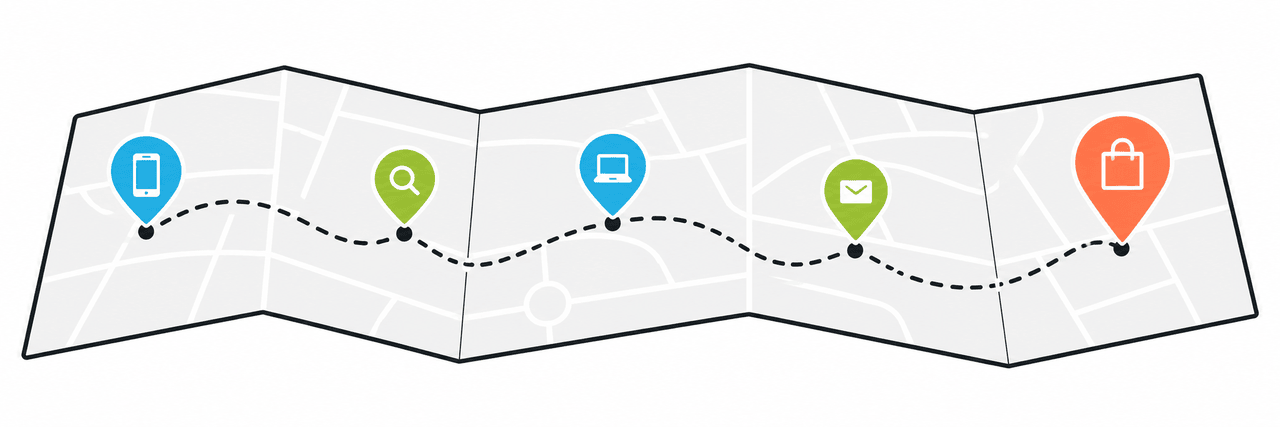
Today’s customer journey is layered. A user might discover a brand through TikTok, revisit through Google search, click a retargeting ad on Instagram, and convert days later via email. Multi-touch attribution exists to make sense of that complexity and give marketers a clearer view of what’s actually driving results.
What Is Multi-Touch Attribution?
Marketing attribution is the process of assigning credit to different marketing efforts that lead to a conversion. Multi-touch attribution (MTA) is a more advanced approach that distributes that credit across multiple interactions instead of assigning it to just one.
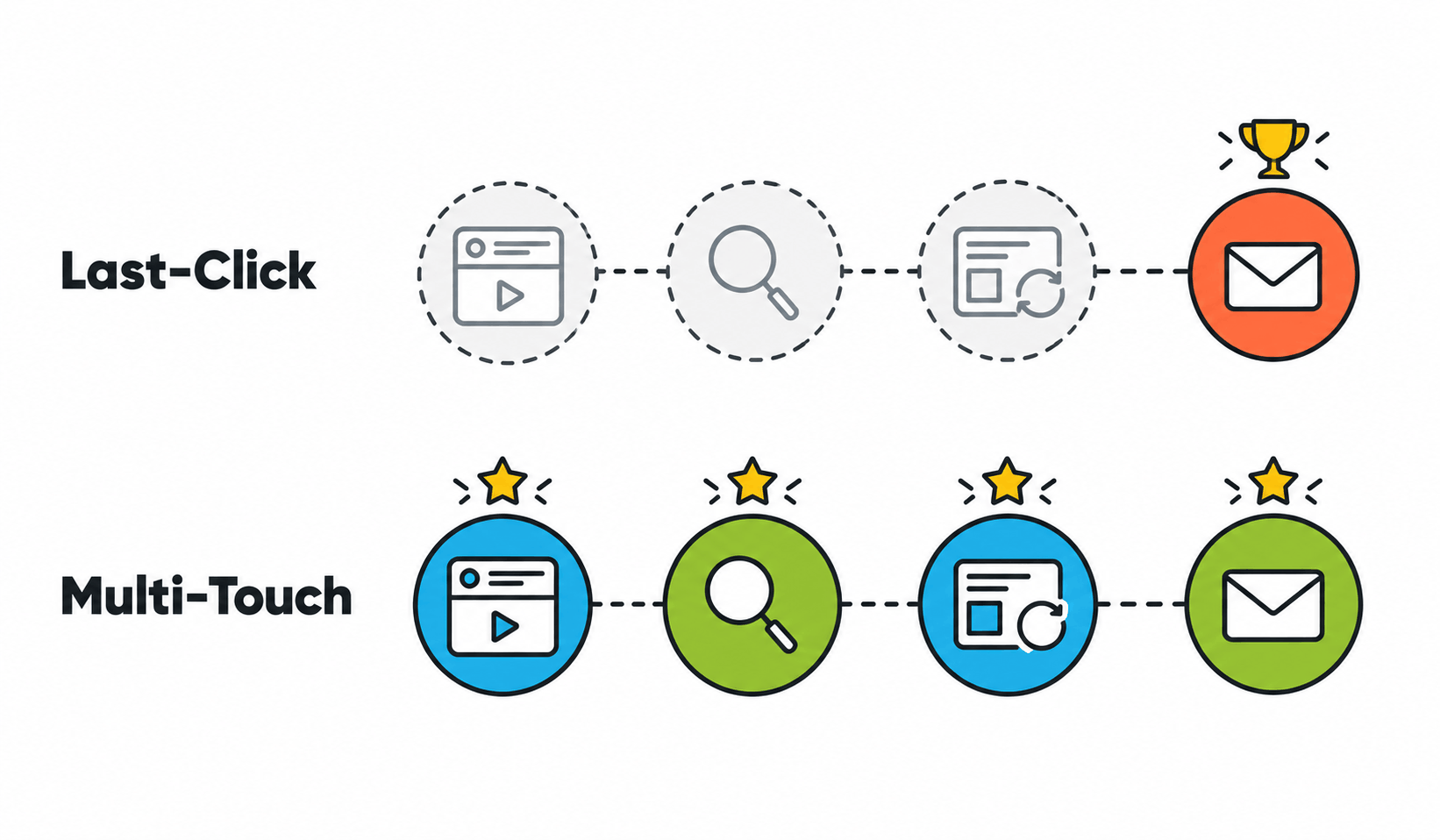
Traditional models like last-click attribution only credit the final interaction before a conversion. While simple, this ignores everything that influenced the decision before that moment.
Multi-touch attribution takes a broader view. It looks at the full journey and assigns value to each touchpoint along the way.
A simple example:
- A user sees a Facebook ad
- Later searches your brand on Google
- Clicks a retargeting ad
- Then converts through email
Instead of giving 100% credit to email, multi-touch attribution distributes credit across all of these interactions.
Why Multi-Touch Attribution Matters in 2026
The way people interact with brands has changed, and attribution needs to reflect that.
First, privacy-first tracking has reduced the reliability of third-party cookies. Platforms now rely more on first-party data and modeled conversions, often powered through server-side tracking methods like Conversion API (CAPI) and probabilistic modeling. This makes single-touch attribution even less accurate.
Second, customer journeys are no longer linear. Users move across devices, platforms, and channels before making a decision. Without a multi-touch approach, most of that journey becomes invisible.
Third, many campaigns now run through AI-driven systems like Meta Advantage+ and Google Performance Max. These platforms optimize delivery automatically, but they don’t always show clearly why something worked. Multi-touch attribution helps fill that gap.
Retail Media Networks (RMNs) also play a role. Platforms like Amazon or Walmart operate within closed ecosystems, where user behavior is tracked using first-party purchase data. This adds another layer of complexity to attribution, especially when combined with external channels.
At a basic level, multi-touch attribution matters because it helps answer a simple question more accurately: Which channels are actually driving results?
What Is First-Party Data?
First-party data refers to information that a company collects directly from its own audience or customers through owned channels.
This includes:
- Website activity (via analytics and tracking pixels)
- CRM and customer databases
- Purchase history
- Email engagement
- App usage
Unlike third-party data, it is consent-based, privacy-compliant, and fully owned by the business. In 2026, it serves as the foundation for attribution, measurement, and targeting.
Types of Multi-Touch Attribution Models
Different attribution models assign credit in different ways. The right model depends on how complex your funnel is and how much data you have.
The most commonly used models include:
Linear attribution: distributes credit evenly across all touchpoints Third-party cookie deprecation
Time decay: gives more credit to interactions closer to the conversion
U-shaped: prioritizes the first interaction and the lead conversion point
W-shaped: focuses on key milestones in the funnel (first touch, lead, opportunity)
Data-driven: uses machine learning to assign weighted credit based on actual performance
Here’s a quick comparison:
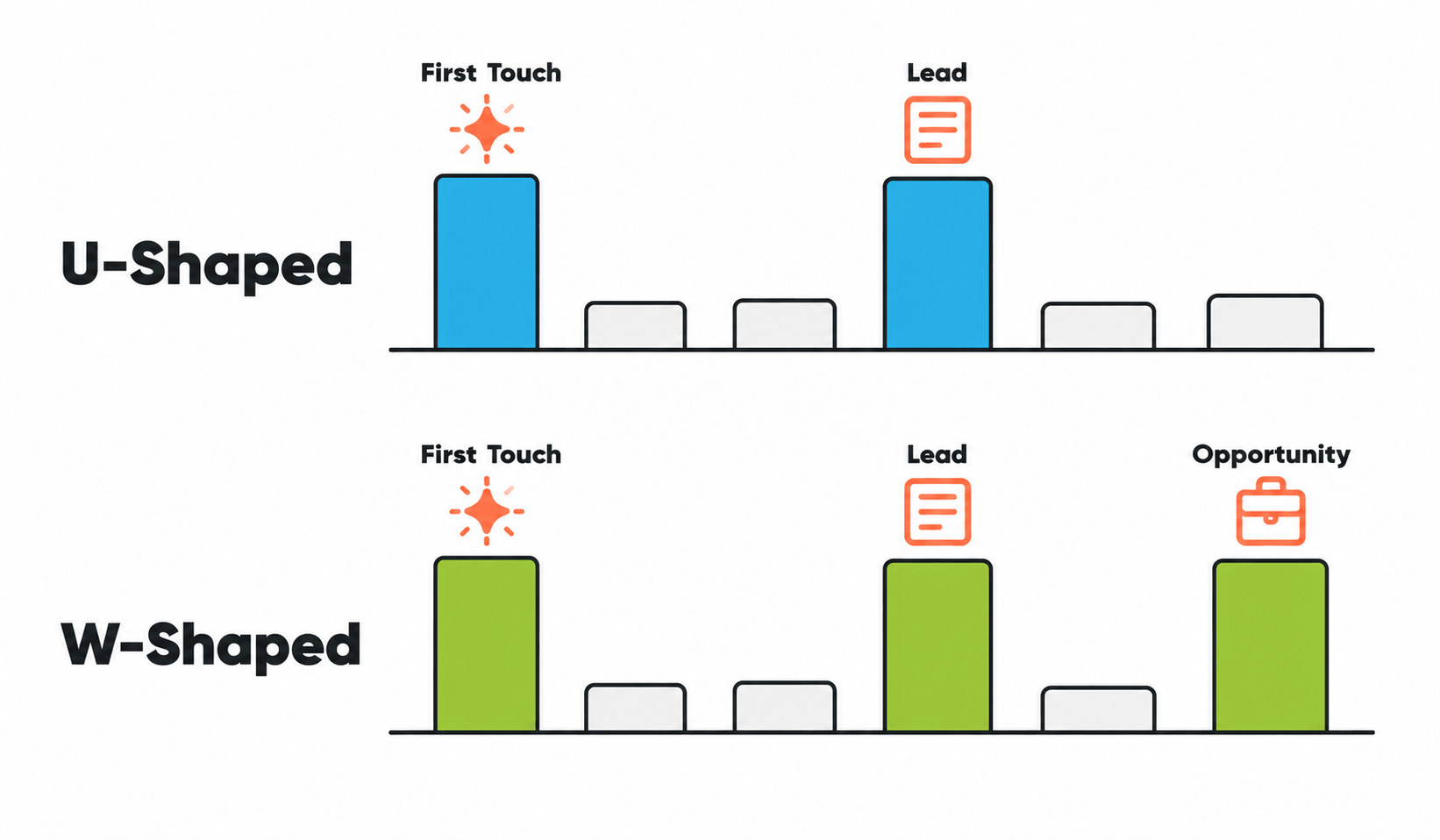
Data-driven models are becoming more common in 2026 because they can adjust dynamically based on actual user behavior, but they also require strong data infrastructure to work properly.
How Multi-Touch Attribution Works
At a high level, multi-touch attribution follows a simple process, even if the underlying systems are complex.
First is data collection. This includes first-party data from your website, CRM, and ad platforms, along with tracked interactions like clicks, impressions, and conversions.
Second is identity resolution. Since users move across devices, systems attempt to connect those interactions into a single journey using identifiers like emails, logins, or modeled data.
Third is model application. An attribution model is applied to distribute credit across touchpoints based on predefined logic or machine learning.
Finally, that data is used for optimization. Budgets, bids, and channel strategies are adjusted based on which touchpoints are actually contributing to conversions.
The goal isn’t perfect tracking—it’s better decision-making.
Attribution Tools and Platforms in 2026
Because most platforms operate in silos, multi-touch attribution usually requires external tools to unify data across channels.
Tools like Northbeam and Rockerbox are commonly used to connect performance data, apply attribution models, and give a more complete view of the customer journey.
These platforms don’t just track clicks. They combine multiple data sources, including ad platforms, website behavior, and revenue data, to provide a clearer picture of what’s working.
However, they are not the only option. Platform-native tools like Google Analytics 4 (GA4) also offer attribution modeling, including data-driven attribution. While more limited in cross-channel visibility and customization compared to dedicated tools, GA4 can still serve as a baseline measurement layer, especially for smaller teams.
Here’s a comparison:
These tools act as the measurement layer in a marketing stack, helping bridge the gap between platform-reported results and actual business performance.
Decision Framework — Choosing the Right Attribution Approach
There’s no single “best” attribution model or tool. The right setup depends on your budget, data quality, and how complex your customer journey is.
A simple way to approach this is through conditional logic:
If budget is below $10,000/month and data is limited, platform-native attribution (Meta Ads Manager, Google Ads, GA4) is usually enough. It’s not perfect, but it’s fast, simple, and cost-efficient.
If you’re an ecommerce brand scaling paid ads, tools like Northbeam or Triple Whale are more suitable. They provide blended attribution and connect ad performance directly to revenue, which is critical when optimizing for ROAS.
If you’re running multi-channel campaigns across search, social, programmatic, and retail media, a tool like Rockerbox makes more sense. It’s designed to unify data across channels and provide a clearer view of how they work together.
If your setup includes programmatic advertising (via DSPs, platforms that allow automated ad buying across multiple publishers) or Connected TV (CTV, streaming TV delivered via internet-connected devices), attribution becomes more complex. In these cases, combining multi-touch attribution with marketing mix modeling (MMM) is often more reliable.
Each option comes with trade-offs. More advanced tools offer better visibility, but they also require higher cost, cleaner data, and more operational effort to manage.
Challenges of Multi-Touch Attribution
While multi-touch attribution provides better visibility than single-touch models, it’s not without limitations.
One of the biggest challenges is data fragmentation. Each platform—Meta, Google, Amazon—operates in its own environment, and their data doesn’t always align. This makes it difficult to get a fully consistent view of performance.
Signal loss is another issue. Privacy changes, especially on iOS, have reduced the amount of trackable user data. As a result, many attribution models rely on estimates or modeled data rather than exact tracking, often using probabilistic modeling instead of deterministic matching.
There’s also the issue of platform bias. Each ad platform tends to overreport its own performance, which can skew results if you rely on platform data alone.
Cost and complexity are practical concerns as well. Advanced attribution tools require investment, and they often need clean data pipelines, proper setup, and ongoing maintenance.
Finally, visibility is limited in walled gardens. Retail Media Networks and large ad platforms don’t always share full user-level data, which creates gaps in attribution models.
Best Practices for Multi-Touch Attribution
To make multi-touch attribution actually useful in practice, a few principles matter more than the model itself.
First, build around first-party data. As third-party tracking becomes less reliable, your own data—website behavior, CRM, and purchase history—becomes the foundation of attribution.
Second, don’t rely on a single source of truth. Platform data, attribution tools, and analytics should be used together, not in isolation.
Third, validate insights through incrementality testing.
What Is Incrementality / Lift Testing?
Incrementality testing measures the true causal impact of a marketing channel by comparing what happens when the channel is active versus when it is reduced or turned off.
A simple example:
- Run ads in Region A
- Pause or reduce ads in Region B
- Compare the difference in conversions or revenue
The “lift” represents the actual contribution of that channel, beyond what would have happened anyway.
This is critical because attribution models can show correlation (a touchpoint appeared in the journey), but not always causation (it actually drove the conversion). In 2026, most advanced teams use incrementality testing alongside MTA to validate results.
Finally, align attribution with business goals. The goal isn’t to track everything perfectly—it’s to make better decisions about where to allocate budget.
Conclusion
Multi-touch attribution is not about finding a perfect model. It’s about improving how you understand and optimize the customer journey.
In a landscape shaped by privacy restrictions, AI-driven campaigns, and fragmented channels, relying on a single touchpoint no longer reflects reality. Multi-touch attribution provides a more complete view, even if it’s not perfectly precise.
The most effective approach is to treat attribution as a system. Combine tools, models, and testing to build a clearer picture of performance, and focus on using that insight to improve efficiency over time.
FAQs
What is multi-touch attribution in marketing?
Multi-touch attribution is a method of assigning credit to multiple marketing interactions that lead to a conversion, instead of giving full credit to a single touchpoint.
Is multi-touch attribution accurate?
It is more accurate than single-touch models, but not perfect. Most models rely on partial data and estimates, especially in privacy-restricted environments.
What tools are used for attribution?
Common tools include Northbeam, Rockerbox, and Triple Whale, along with platform-native analytics like GA4 and ad platform reporting tools.
How does privacy affect attribution?
Privacy changes limit tracking capabilities, which means attribution models rely more on first-party data, server-side tracking (like CAPI), and modeled insights instead of exact user-level tracking.
What is better: multi-touch attribution or MMM?
They serve different purposes. Multi-touch attribution is better for channel-level insights, while marketing mix modeling is used for broader, long-term measurement. Many companies use both together.
Read These Next
B2B Marketing Attribution: A Complete Guide for Modern B2B Teams