.png)
Organic vs Paid Advertising: Which Delivers Better Long-Term ROI?
.png)

.png)

Paid advertising generates immediate, measurable traffic and conversions but stops producing results when spend stops. Organic advertising builds compounding visibility and lower long-term acquisition costs but takes months to gain traction. Long-term ROI favors organic in most cases, but the two channels are most effective when used as a connected system rather than evaluated in isolation.
Introduction
The question of whether to invest in paid or organic advertising rarely has a clean answer. Both approaches generate traffic, leads, and revenue — but they do so at different speeds, at different costs, and with different degrees of durability.
What makes the comparison harder is that the environment both channels operate in has changed significantly. Privacy restrictions have reduced the precision of paid targeting. AI-driven platforms now automate bidding and delivery in ways that reduce manual control. At the same time, organic search is being reshaped by AI Overviews and generative results that change how content earns visibility. Neither channel is as straightforward as it was three years ago.
For C-level decision-makers and growth leaders across APAC, the US, and Australia, the practical question is not which channel wins in isolation — it is how to allocate budget between them given specific business goals, timelines, and competitive conditions.
What This Guide Covers
This guide explains how paid and organic advertising differ in their ROI profiles and how to decide where to focus based on your business situation.
It covers:
- What paid and organic advertising each deliver
- How their ROI profiles differ over time
- Key metrics and realistic performance ranges for each
- Where each channel breaks down in practice
- How paid and organic work together as a system
- How to decide which to prioritize given your goals and stage
What Is the Core Difference Between Paid and Organic Advertising?
Paid advertising generates traffic by purchasing placements on search engines, social platforms, or display networks. Results are immediate and stop when spend stops. Organic advertising generates traffic through content, SEO, and earned visibility — it takes longer to build but continues to deliver without ongoing ad spend.
The functional difference matters for how ROI is calculated. Paid advertising produces results that are directly attributable to spend. Organic advertising produces results that are harder to attribute to any single investment but accumulate over time. A paid campaign that drives 500 conversions this month requires the same budget to drive 500 conversions next month. A blog post that ranks for a high-intent query this month may drive similar traffic for years.
This asymmetry is what makes the long-term ROI of organic advertising structurally stronger for most businesses — but it also explains why paid advertising remains essential for companies that need results before organic traction is established.
How Do Paid and Organic ROI Compare Over Time?
Paid advertising delivers faster ROI but requires continuous investment to maintain it. Organic advertising delivers slower ROI but compounds over time and reduces dependency on ad spend.
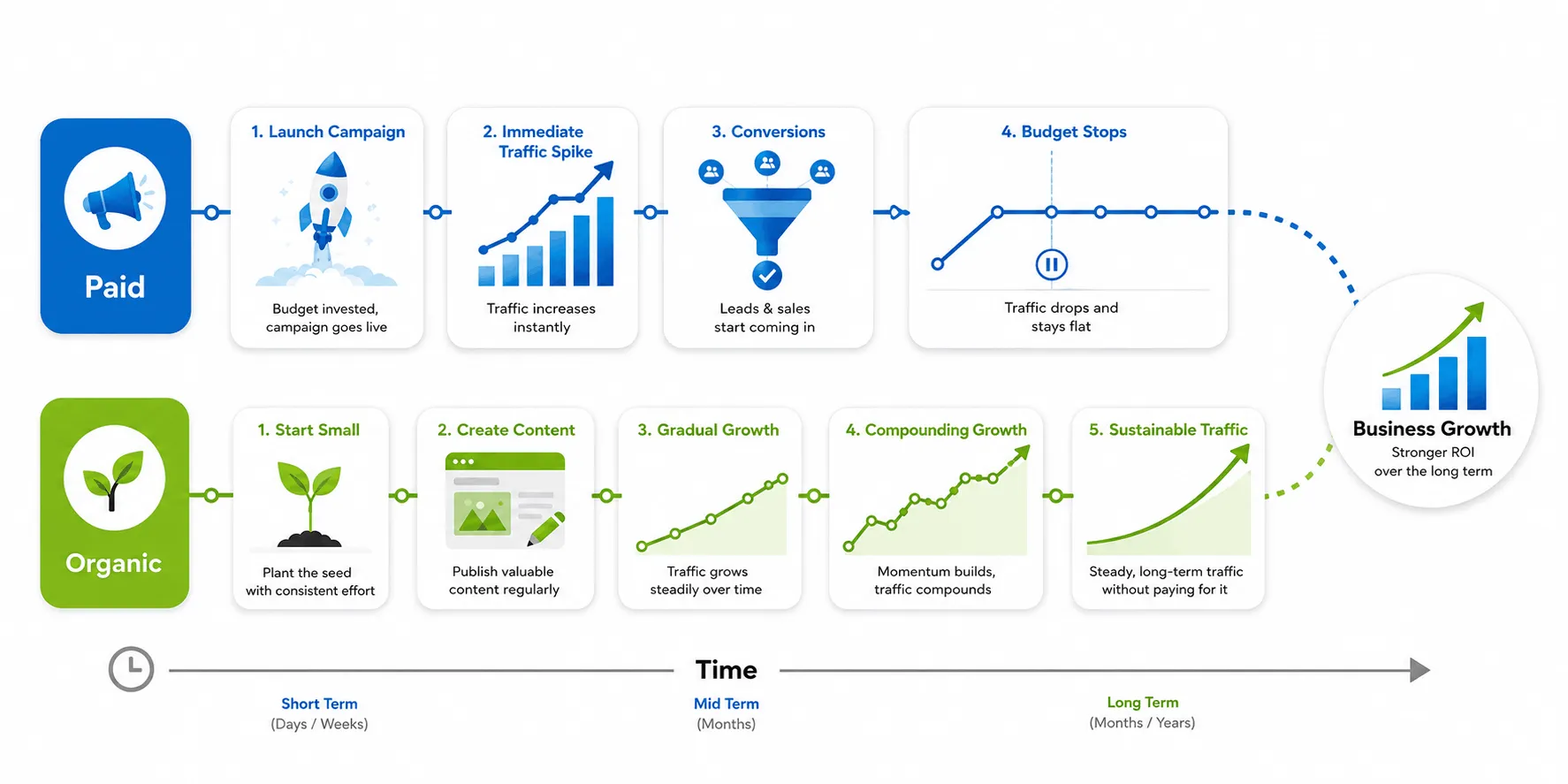
The difference in trajectory is significant. A paid campaign can generate measurable returns within days of launch. The same budget invested in organic content and SEO may take three to six months before generating comparable traffic. But the organic investment does not expire. Once content ranks, the cost per acquisition from that content decreases with every month it continues to perform.
In practice, ROI comparison depends on four variables:
- Time horizon — paid wins at three months; organic often wins at twelve or beyond
- Competition — in highly competitive paid markets, CPC inflation erodes paid ROI faster
- Content quality — organic ROI depends on producing content that earns and maintains rankings
- Conversion infrastructure — both channels require strong landing pages and offers to convert traffic into revenue
Neither channel delivers strong ROI in isolation over the long term. Businesses that rely entirely on paid advertising face rising acquisition costs as competition increases and audiences saturate. Businesses that rely entirely on organic face slow growth and limited ability to scale quickly when needed.
What Are Realistic Performance Benchmarks for Each Channel?
Performance ranges vary significantly by industry, audience, and execution quality. The figures below are directional rather than absolute.
Paid advertising benchmarks:
- Search ads (B2B SaaS): median CPC of $8.50–$14.00 for non-brand campaigns; Cybersecurity and FinTech verticals often reach $16–$18 CPC; conversion rates typically range from 2.5% to 5% for well-optimised landing pages, with top-quartile performers reaching 5–8%
- Search ads (B2C e-commerce): CPCs typically $1–$4 for broad retail categories; conversion rates range from 2% to 6%, with shorter buying cycles supporting higher volume but lower average order values
- Paid social: conversion rates typically range from 1% to 3%, with higher variance depending on audience and offer; Meta Advantage+ campaigns show improved efficiency for B2C audiences
- ROAS across paid channels: 2x to 5x is a common range for well-optimised campaigns; below 2x usually signals structural issues with targeting, creative, or landing page alignment
- LinkedIn (B2B): CPC of $12–$18 for direct-response B2B SaaS campaigns; top-quartile performers achieve $6–$10 through tight audience targeting and high-relevance creative
Organic benchmarks:
- Organic search conversion rates: typically 2% to 5% for well-optimised landing pages; B2B SaaS organic search generates roughly 44% of all B2B revenue, making it the largest single revenue channel
- Time to first-page rankings: three to six months for new content in moderate competition; longer in highly competitive verticals
- Cost per acquisition over time: decreases as content matures; SEO delivers an estimated 702% ROI for B2B SaaS companies with a break-even point of approximately seven months, according to 2026 analysis — significantly outperforming paid channels on a long-run basis
Regional performance benchmarks (B2B/SaaS, 2026 estimates):
Note: APAC figures reflect lower auction competition in India and Southeast Asian markets; Australia sits closer to US benchmarks given market maturity. LinkedIn CPC varies significantly by seniority level targeted — Director and above audiences typically cost 30–50% more than Manager-level in all regions. These ranges are directional; actual costs depend on vertical, audience size, and Quality Score.
These ranges also reflect how differently the two channels measure. Paid performance is visible immediately and adjustable in real time. Organic performance is harder to isolate and slower to confirm, but tends to stabilise at a lower cost per acquisition once established.
Where Does Each Channel Break Down in Practice?
Both paid and organic advertising operate with constraints that are often underestimated before campaigns are live.
Paid advertising limitations:
Paid campaigns depend on accurate tracking to optimise correctly. Privacy changes — including the phase-out of third-party cookies and browser-level restrictions — have reduced the signal quality available to ad platforms. A growing portion of conversions on most platforms is now modelled rather than directly observed, which means campaign performance data is less reliable than it appears. Attribution gaps between paid and organic are also common; platforms tend to over-attribute conversions to paid channels, making ROI look stronger than it may be when measured against backend revenue data.
A practical response to signal loss: implement server-side tagging to reduce data loss from browser restrictions, pass offline conversion events from your CRM (HubSpot or Salesforce) back to Google Ads and Meta, and use incrementality testing or Marketing Mix Modeling alongside platform-reported numbers. Relying solely on platform dashboards in 2026 produces an increasingly optimistic picture of paid performance.
Ad fatigue is a real constraint. Creative performance declines over time as audiences see the same ads repeatedly, which requires ongoing investment in new creative to maintain performance. In competitive markets, rising CPCs compress margins, meaning the same budget produces fewer conversions as competition increases.
Organic advertising limitations:
Organic results take time and are sensitive to algorithm changes. A piece of content that drives consistent traffic today may see reduced visibility after a platform or search engine update. AI-generated search results and AI Overviews are changing how organic content earns clicks, with some high-ranking content receiving less traffic than it did previously even when rankings hold.
Zero-click searches represent a structural shift in the organic channel that has intensified significantly in 2026. Research from SparkToro, Datos, and Bain & Company estimates that approximately 60% of Google searches now end without the user clicking on any external website — up from around 50% in 2019. When AI Overviews appear, that figure rises to approximately 83%.
A randomised field experiment published in early 2026 found that AI Overviews reduced organic clicks on triggered queries by 38%, with zero-click behaviour rising from 54% to 72% on those queries. The practical implication is that content can rank well and generate brand impressions without delivering meaningful traffic — particularly for informational queries.
Transactional and high-intent queries remain more stable, which shifts the organic content priority toward bottom-of-funnel content that captures users closer to a conversion decision. For B2B teams, measuring organic performance through impressions and branded search lift — not only sessions — reflects this new reality more accurately than session-based reporting alone.
Organic also requires sustained investment in content production and technical SEO. It is not a set-and-forget strategy. Content that was optimised two years ago may no longer reflect current search intent or competitive standards, requiring regular updates to maintain performance.
How Do Paid and Organic Advertising Work Together?
Paid and organic advertising are most effective when treated as a connected system rather than independent channels. Each produces data and signals that improve the performance of the other.
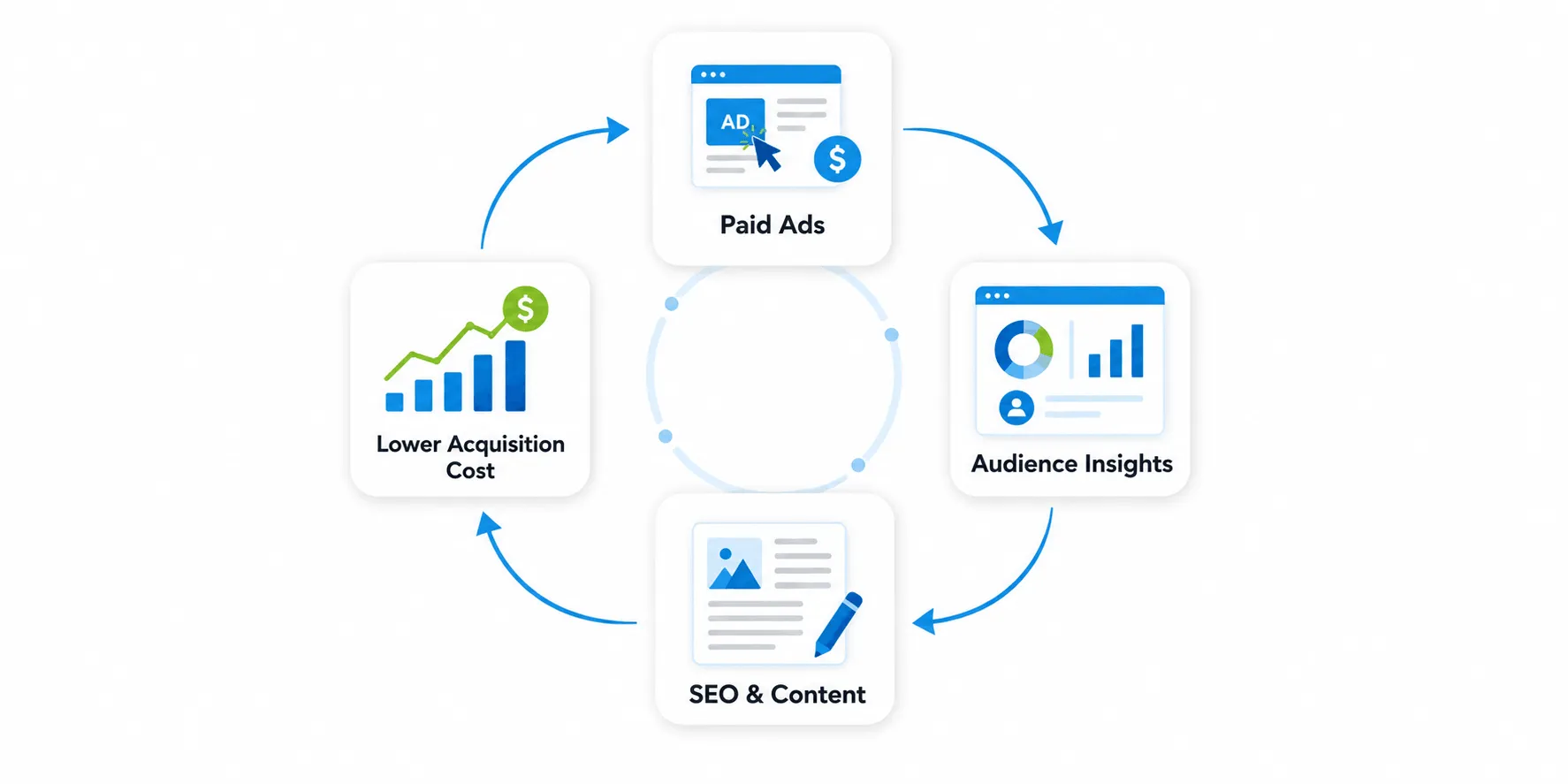
Paid campaigns generate real-time data on which messages, audiences, and offers convert. That data can directly inform organic content strategy — high-performing ad headlines often translate to effective blog titles or landing page copy. Organic content that already demonstrates engagement can be amplified through paid promotion, reducing the cost of testing and increasing the speed at which it reaches targeted audiences.
The interaction also works in the other direction. Strong organic presence — high domain authority, established content rankings, brand recognition — reduces the cost of paid advertising over time. Users who encounter a brand organically before seeing a paid ad convert at higher rates and with lower CPCs in some channels. This is one reason why businesses that invest in both tend to see better paid performance than those relying on paid alone.
It is also worth noting that paid social — typically categorised as a "paid" channel — can serve the same long-term brand-building function as organic content when structured correctly. LinkedIn Sponsored Content running consistent thought leadership over months, or Meta retargeting campaigns that keep a brand visible through a long B2B evaluation cycle, produce brand familiarity and trust that compounds over time.
The paid vs. organic distinction maps cleanly onto direct response vs. brand building at the top and bottom of the funnel, but breaks down in the middle — where paid media is frequently doing the same relationship-building work that organic content does, just at a higher short-term cost.
Middle-of-funnel campaigns across both channels deserve their own measurement framework rather than being evaluated on last-click conversion rates alone.
Pro tip — The Cheat Code: Spend a small amount on paid ads to identify which headlines generate clicks. Then build your organic content strategy around those winning headlines. It eliminates months of guessing about what your audience actually responds to, and means your SEO investment starts from proven signal rather than assumption.
A practical workflow that reflects this system:
- Use paid search to identify high-converting queries, then build organic content around those terms
- Promote high-performing organic content through paid social to extend reach without building campaigns from scratch
- Use retargeting campaigns to re-engage users who found the brand through organic search but did not convert
- Feed first-party data from organic content interactions back into paid audience targeting
The channels are not alternatives — they are stages of the same acquisition system, and misalignment between them is one of the most common causes of underperformance in both.
When Should You Prioritize Paid Advertising?
Paid advertising should be prioritised when speed of results matters more than long-term cost efficiency. It is the right primary channel in specific situations:
- Launching a new product or entering a new market where organic presence does not yet exist
- Running time-sensitive campaigns tied to promotions, events, or seasonal demand
- Testing messaging, offers, or audience segments before committing to organic content production
- Scaling revenue quickly when organic growth alone cannot meet near-term targets
The decision to scale paid spend should be driven by stable performance metrics across a sustained period — not by strong platform-reported numbers alone. CPA should align with margins, ROAS should remain consistent when budgets increase, and conversion rates should hold steady across traffic sources. When any of these deteriorate under scale, it usually signals an audience saturation or offer problem rather than a channel problem.
When Should You Prioritize Organic Advertising?
Organic advertising should be prioritised when the goal is durable, lower-cost acquisition over a longer time horizon. It is the more efficient primary channel when:
- The business has a defined content niche where it can realistically compete for search visibility
- Sales cycles are long and buyers require education before converting — a profile common in B2B markets across APAC, the US, and Australia
- Paid acquisition costs in the relevant market are high enough to make organic the more viable long-term option
- The business is building toward reduced dependency on paid channels as it matures
Organic is not suited to generating immediate revenue. It requires patience and consistency, and the ROI is harder to attribute directly to specific investments. Businesses that treat organic as an afterthought and expect results within 60 days will consistently underestimate what it takes and abandon the strategy before it compounds.
It is also worth noting that the claim that "organic delivers better ROI" depends heavily on context. In low-search-volume categories — niche B2B verticals, emerging product categories, or markets where the audience does not yet search for the solution — organic search may produce limited returns regardless of content quality.
Category maturity matters: where search demand is established and growing, organic compounds effectively. Where demand is nascent or fragmented across non-search platforms, paid channels may deliver more reliable returns even over a 12-month horizon. Organic ROI assumptions should be validated against actual search volume data before committing meaningful resources.
How Do AI and Privacy Changes Affect the Comparison?
The operating conditions for both channels have shifted in ways that affect the paid versus organic calculus.
On the paid side, AI-driven platforms have improved efficiency for campaigns with strong conversion signals. Google Performance Max and Meta Advantage+ automate targeting and delivery in ways that reduce manual control but increase performance when the underlying data is clean. Performance Max campaigns, for example, achieve on average 12% higher conversion rates than standard Search campaigns when conversion signals are well-configured — but the same automation amplifies errors when tracking is incomplete. The problem is that privacy restrictions have degraded signal quality — with 40% to 60% of conversions on some platforms now modelled rather than directly tracked. This makes paid ROI harder to measure accurately and increases the risk of scaling campaigns based on inflated platform-reported performance.
On the organic side, AI Overviews and generative search results — including AI Mode in Google Search and AI-driven discovery via tools like Perplexity Pages — are changing the click behaviour of users who find content through search. Approximately 60% of Google searches now end without a click to any external website. Queries where AI Overviews appear see organic CTR fall to around 0.61%, compared to 1.62% for the same queries without them. The organic content most at risk is broad informational content. Transactional and commercial-intent queries retain higher click rates and remain the more defensible organic surface for businesses measuring conversion outcomes rather than traffic volume.
Both changes point toward the same conclusion: first-party data becomes more valuable as third-party tracking degrades, and content that demonstrates genuine expertise and intent-alignment performs better in both channels than content produced primarily for volume.
Conclusion
Paid and organic advertising serve different functions in the same acquisition system. Paid delivers speed and scalability at a cost that rises over time. Organic delivers durability and compounding efficiency at a cost that decreases over time. Neither is inherently better — the right balance depends on business stage, time horizon, and competitive conditions.
For most businesses, the practical path is to use paid advertising to generate near-term results and gather data, while building organic presence to reduce long-term acquisition costs. The mistake is treating the two as a choice rather than a sequence. Businesses that integrate both — using data from each channel to improve the other — consistently outperform those that optimise them in isolation.
FAQs
Which delivers better ROI: paid or organic advertising? Organic typically wins beyond 12 months due to compounding traffic and falling CPA — but only where search volume and category maturity support it; paid outperforms in nascent or low-volume markets regardless of time horizon.
How long does organic advertising take to show results? Most content takes three to six months to generate consistent traffic in moderate competition, with cost efficiency improving the longer it ranks.
Can paid advertising improve organic performance? Yes — paid campaigns surface high-converting headlines and queries that can directly inform organic content strategy.
What is a realistic ROAS for paid advertising? 2x to 5x for well-optimised campaigns; below 2x consistently usually indicates a structural issue in targeting, creative, or landing page alignment.
How do privacy changes affect paid vs organic decisions? Privacy restrictions degrade paid signal quality and attribution accuracy, shifting the relative advantage toward organic and first-party data — server-side tagging and CRM conversion imports help maintain paid performance under these constraints.
Should SMEs prioritise paid or organic advertising? Start with paid to generate early data and revenue, then build organic to reduce long-term acquisition costs as budget allows.
Read These Next
Marketing Automation Workflow: How to Design High-Converting Sequences from Scratch