.png)
Pay Per Click Marketing Strategy: 7 Steps to a High-ROI Campaign in 2026
.png)

.png)

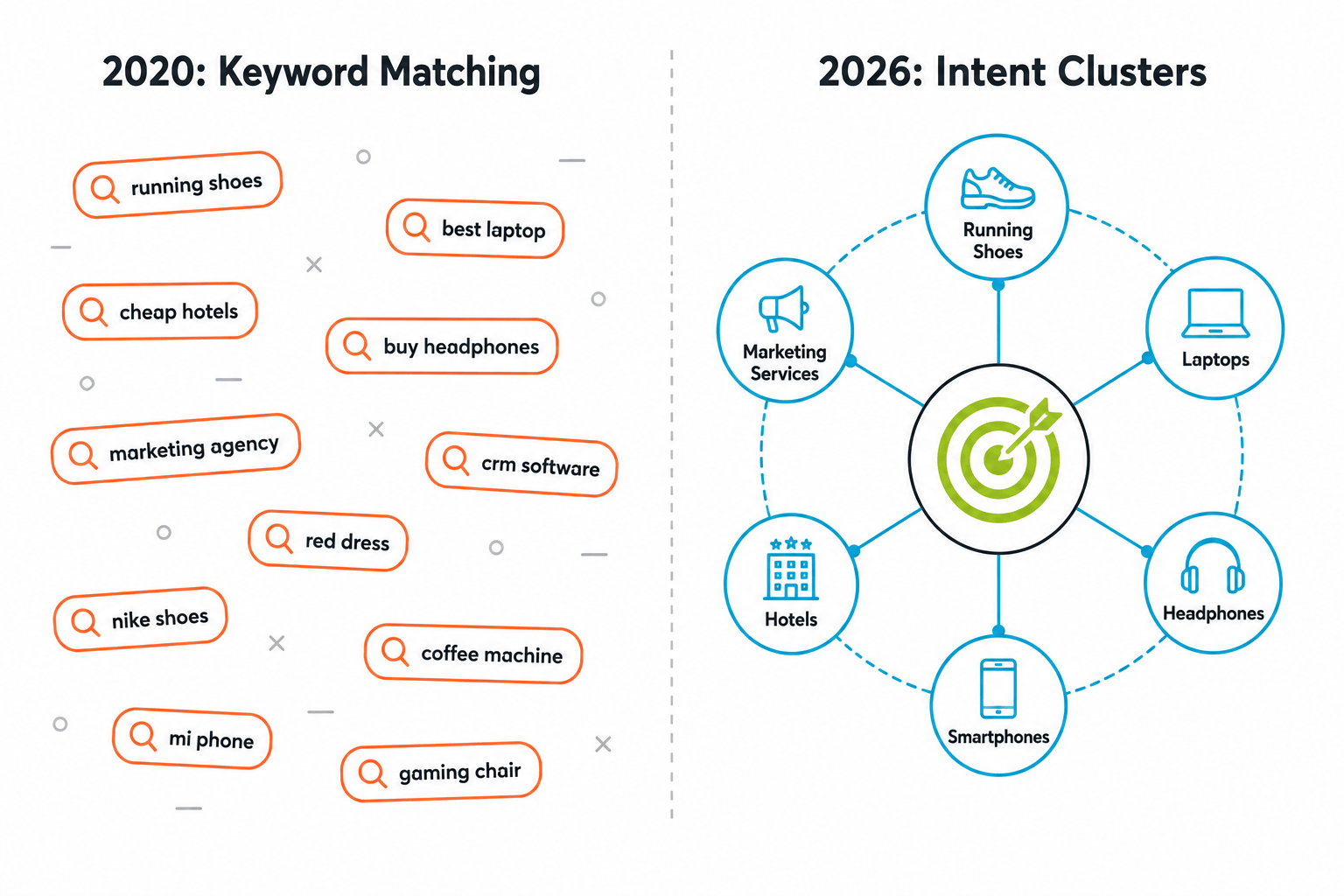
To achieve high ROI in 2026, the PPC strategy must shift from keywords to intent clusters. Success requires defining unit economics (break-even ACoS), implementing server-side tagging for first-party data, and using incrementality testing to verify real-world lift. Modern campaigns leverage AI automation for bidding while ensuring all ad assets are machine-readable for AI assistants.
Key Takeaways
- Successful 2026 campaigns move away from exact keyword matching in favor of intent clusters, allowing AI to target the underlying goals of a search.
- Strategies must be built on unit economics, specifically using the contribution margin to calculate a break-even ACoS or ROAS to ensure profitable scaling.
- To feed AI optimization effectively, businesses must implement first-party data systems and server-side tagging to combat data loss from ad blockers.
- Ad assets and web content must be highly structured so AI assistants and "answer engines" can interpret product details without ambiguity.
- Performance should be validated through testing rather than relying solely on platform-reported metrics.
How PPC Advertising Has Changed in 2026
Modern paid advertising has absorbed keywords into broader intent-modeling systems that evaluate searches, behavior, creative assets, conversion data, and predicted customer value together.
- Intent clusters replace keywords
An intent cluster is a group of related searches that signal the same goal. Platforms automatically group and target these instead of relying on exact keyword matches.
- AI systems mediate discovery
Search engines function as answer engines, generating responses instead of directing traffic, which reduces reliance on traditional click-based journeys.
- Agentic commerce influences decisions
AI assistants evaluate products, compare options, and recommend outcomes, shifting competition toward inclusion in these recommendation layers.
- Machine readability determines visibility
In PPC, “machine-readable” means product details are organized with metadata, feed attributes, or Schema.org markup so platforms can understand them clearly. Content must be structured in a way that systems can interpret product details, relevance, and context without ambiguity.
Overview of Key Changes in PPC in 2026
The shift from keyword matching to intent clustering changes how campaigns are structured, optimized, and measured.
7 Steps to Build a High-ROI PPC Marketing Strategy in 2026
A high-performing PPC strategy requires more than campaign setup. Each step focuses on execution: defining profitability, structuring intent-driven targeting, enabling AI optimization, and validating real performance through data and testing.
Step 1: Set Business Goals and Unit Economics
Define financial constraints before launching campaigns. A contribution margin is the revenue remaining after subtracting product, fulfillment, and operational costs. This determines allowable ad spend.
Calculate the break-even ACoS (Advertising Cost of Sale) to establish the maximum spend threshold.
Example:
A £30 product with a £9.50 contribution margin yields a break-even ACoS of 31.67%. Spend above this level reduces profitability.
Step 2: Use AI to Identify Audience Search Intent
Structure campaigns around intent rather than individual keywords. A search intent is the underlying goal behind a query. Group related queries into intent clusters and assign them to campaigns.
In 2026, platforms increasingly interpret queries through semantic relationships rather than exact wording. This is similar to vector search, where systems compare the meaning of a query, product, ad, or landing page instead of matching only the literal words.
For PPC teams, this means campaigns should be organized around intent themes such as “compare pricing,” “buy now,” “find alternatives,” or “solve a specific problem.”
Digital twinning (simulated user behavior modeling) can be used to test messaging and identify high-probability queries before scaling spend.
Step 3: Build a Privacy-First Data System
Ensure campaign optimization is supported by reliable data. First-party data is information collected directly from users, such as transaction history or CRM records.
Implement server-side tagging, where tracking data is processed through owned infrastructure rather than the browser, improving accuracy and reducing loss from ad blockers.
Use consent-based tracking and conversion modeling, where AI estimates performance when direct tracking is unavailable.
Step 4: Use AI Automation for Campaign Management
Delegate bid optimization and targeting expansion to platform AI systems such as Google Ads Performance Max, Microsoft Advertising automated bidding, Meta Advantage+, and retail media systems connected to Amazon Marketing Cloud. These systems evaluate conversion likelihood, creative relevance, audience signals, product feeds, and predicted customer value.
In practice, a campaign using Target ROAS bidding may initially overspend while the system gathers data. For example, an e-commerce campaign with a 300% ROAS target may operate below efficiency for the first 1–2 weeks before stabilizing once sufficient conversion data is collected. Premature adjustments during this phase often reduce long-term performance.
Step 5: Create Ad Assets for Human and Machine Preference
Create ad assets for both human persuasion and machine interpretation. Strong PPC assets should include clear product names, benefit-led copy, structured product feeds, consistent landing-page messaging, high-quality images, short-form video, and Schema.org markup where relevant.
A machine-readable product page gives platforms enough structured information to understand what is being sold, who it is for, how much it costs, whether it is available, and why it is relevant to a specific intent cluster.
.png)
Step 6: Measure Success with Incrementality Testing
Evaluate whether advertising generates new demand rather than simply capturing existing demand. Incrementality testing compares exposed and non-exposed audiences to determine true lift, while Marketing Mix Modeling (MMM) estimates how different channels contribute to revenue over time. MMM is especially useful when privacy limits user-level attribution or when campaigns run across Google Ads, Microsoft Advertising, Meta, Amazon, and other media channels.
In practice, incrementality testing often shows that some conversions would occur without ads. For example, branded search campaigns may appear highly effective, but control tests can reveal that many of those users would have converted organically. This prevents the budget from being spent on existing demand instead of generating new revenue.
Step 7: Prepare for Agentic Commerce and AI Assistants
Maintain campaign performance through ongoing optimization.
Use negative keywords to remove inefficient traffic, protect brand terms from competitors, and implement structured data to improve machine interpretation.
A structured data format enables systems to interpret attributes such as pricing and availability.
PPC Strategy Readiness Checklist for High-ROI Campaigns
The following checklist assesses whether a PPC strategy is structurally prepared for profitability and scale in 2026:
- Financial foundation is defined
Contribution margin and break-even ACoS are calculated, and campaign objectives (growth, efficiency, or defense) are clearly set.
- Targeting is intent-driven
Campaigns are structured around intent clusters using broad match, with clear prioritization of high-conversion queries.
- Data infrastructure is reliable
First-party data collection is in place, supported by server-side tagging or equivalent tracking, with consent-based measurement and modeled conversions.
- AI optimization is properly configured
Bidding strategies align with financial goals, campaigns are allowed sufficient learning time, and automation inputs (signals, assets, data) are accurate.
- Creative and landing experience are aligned
Multiple ad formats are deployed, messaging is consistent across ads and landing pages, and user experience supports conversion.
- Measurement reflects true performance
Incrementality testing or marketing mix modeling is used to validate actual impact beyond platform-reported metrics.
- Operational controls are maintained
Negative keywords, brand protection, structured data, and ongoing monitoring of unit economics are actively managed.
When Pay-Per-Click Marketing Fails to Increase ROI
Campaigns underperform when cost structure, targeting, or data quality is misaligned.
Below are real-life applications of how PPC Marketing issues were addressed:
- Issue: Negative Unit Economics and Broad Targeting
Case Study: HutnHomes
HutnHomes faced an unsustainable $150 cost per lead caused by broad targeting that ignored specific buyer intent. Using intent segmentation and AI smart bidding models, the company focused its spending only on high-value users. This correction reduced lead costs to $70 and increased the conversion rate to 4%.
- Issue: Poor Landing Page Experience and Friction
Case Study: Cassa Vida
Cassa Vida struggled with low returns on ad spend because an outdated website structure created technical friction for shoppers. After migrating to a mobile-optimized Shopify store and using dynamic retargeting for cart abandoners, the brand fixed these landing page issues. These changes led to a 60% ROAS improvement.
- Issue: AI Bidding Limitations on High-Value Conversions
Case Study: Charlotte Tilbury
Charlotte Tilbury hit a performance plateau where standard AI bidding failed to optimize for high-value, low-volume luxury sales. By implementing Scibids custom algorithms within Display & Video 360, the brand valued nuanced mid-funnel signals like site visits. This correction reduced acquisition costs by 29% and increased conversion rates by 60%.
Future of PPC Strategy: Competing in AI-Driven Search and Zero-Click Environments
PPC performance is increasingly determined by system-level signals rather than campaign-level inputs.
- Campaigns are evaluated within a broader system
Platforms assess data consistency, content clarity, and historical performance alongside bids and creative assets. Campaigns without structured product data are less likely to be surfaced in AI-generated results.
- Visibility is decided before the click
AI systems extract and interpret signals such as pricing, relevance, and availability before determining whether an ad is shown.
- Zero-click behavior reduces direct attribution
Zero-click behavior refers to a search outcome where the user’s query is answered directly on the search results page or within an AI-generated response, without the user clicking through to any external website. This shifts value toward influence rather than traffic.
- Signal alignment drives scale
Structured data, consistent messaging, and accurate conversion feedback determine whether campaigns are expanded or limited.
- PPC operates as part of a unified discovery system
Performance depends on how well paid media, organic content, and data infrastructure reinforce the same intent signals.
Final Thoughts
To capitalize on the 2026 PPC environment, advertisers should move beyond basic campaign setup and focus on structural readiness:
- Calculate your contribution margin for every product.
- Transition to server-side tagging and prioritize first-party data collection to improve AI signal quality.
- Consolidate keyword-heavy campaigns into intent clusters and use broad match to leverage platform automation.
- Ensure all product attributes are machine-readable to maintain visibility in AI-generated responses.
- Regularly run lift tests to ensure paid ads are driving new sales rather than just claiming credit for organic traffic.
Frequently Asked Questions (FAQs)
What is a good ROAS for PPC in 2026?
A typical range is 3:1 to 5:1, depending on margin structure. The required threshold is determined by the break-even ROAS derived from contribution margin.
Is PPC still effective in an AI-driven search environment?
PPC remains effective but functions as part of a broader system that includes AI-driven discovery and recommendation layers.
What is the most common PPC failure point?
The most common issue is misalignment between acquisition cost and profit margin, resulting in unprofitable scaling.
Related Content
Read These Next
E-commerce Marketing Automation: How to Increase Sales on Autopilot in 2026