.png)

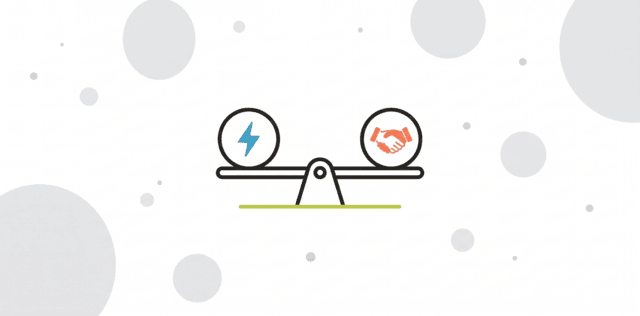
Programmatic vs Non-Programmatic Advertising: Which Is Better for Your Campaign?
.png)

.png)

Programmatic advertising is better for sacale, real-time optimization, and multi-channel efficiency using AI-driven bidding through platforms like The Trade Desk, Google DV360, and Amazon DSP. Non-programmatic (Direct) is superior for premium homepage takeovers, high-touch sponsorships, and guaranteed brand-safe environments where fixed pricing and placement certainty are prioritized over volume.
Introduction
The distinction between programmatic and non-programmatic advertising is no longer simply about automation. It is about how modern digital advertising systems manage fragmentation, optimization, measurement, and scale.
Programmatic advertising uses software and AI-driven bidding systems — operating through DSPs such as Google Display & Video 360 (DV360), The Trade Desk, Amazon DSP, and Criteo — to purchase digital inventory automatically across websites, apps, connected TV (CTV), retail media, audio, and video environments. Non-programmatic advertising relies on direct deals between advertisers and publishers, often involving manual negotiations, fixed pricing, insertion orders, and guaranteed placements.
The difference matters more today because customer journeys are fragmented across multiple devices and channels, while attribution visibility continues weakening due to third-party cookie deprecation, Privacy Sandbox frameworks, and modeled conversions. Media buying now operates inside environments where optimization speed, first-party data integration, and cross-channel measurement increasingly affect commercial performance.
In 2026, tools like Privacy Sandbox’s Topics API, Apple’s Private Relay, and iOS App Tracking Transparency have reduced the amount of direct user-tracking data available to advertisers. As a result, programmatic platforms now rely more on modeled data — estimates based on statistical patterns rather than verified user behavior. This matters because deterministic data comes from confirmed user actions, while modeled data is based on probability and can be less reliable, especially for smaller campaigns or niche audiences with limited data.
According to industry reporting referenced by AdRoll, Strategus, and AsterioSoft, programmatic advertising continues expanding globally because advertisers increasingly prioritize operational efficiency, targeting flexibility, and centralized optimization across fragmented digital ecosystems.
The practical decision is not whether one method completely replaces the other. Most mature advertising systems now combine both approaches depending on campaign objectives, inventory requirements, audience strategy, and measurement constraints.
What This Guide Covers
This guide explains how programmatic and non-programmatic advertising differ operationally and when each approach performs best.
It covers:
- How programmatic and non-programmatic buying work
- Where automation creates meaningful performance advantages
- When direct buying still outperforms automated systems
- How targeting and measurement differ between both models
- What operational limitations affect each approach
- How privacy changes are reshaping media buying decisions
- Which approach makes sense for SMEs, enterprise brands, and regional advertisers
What Is the Difference Between Programmatic and Non-Programmatic Advertising?
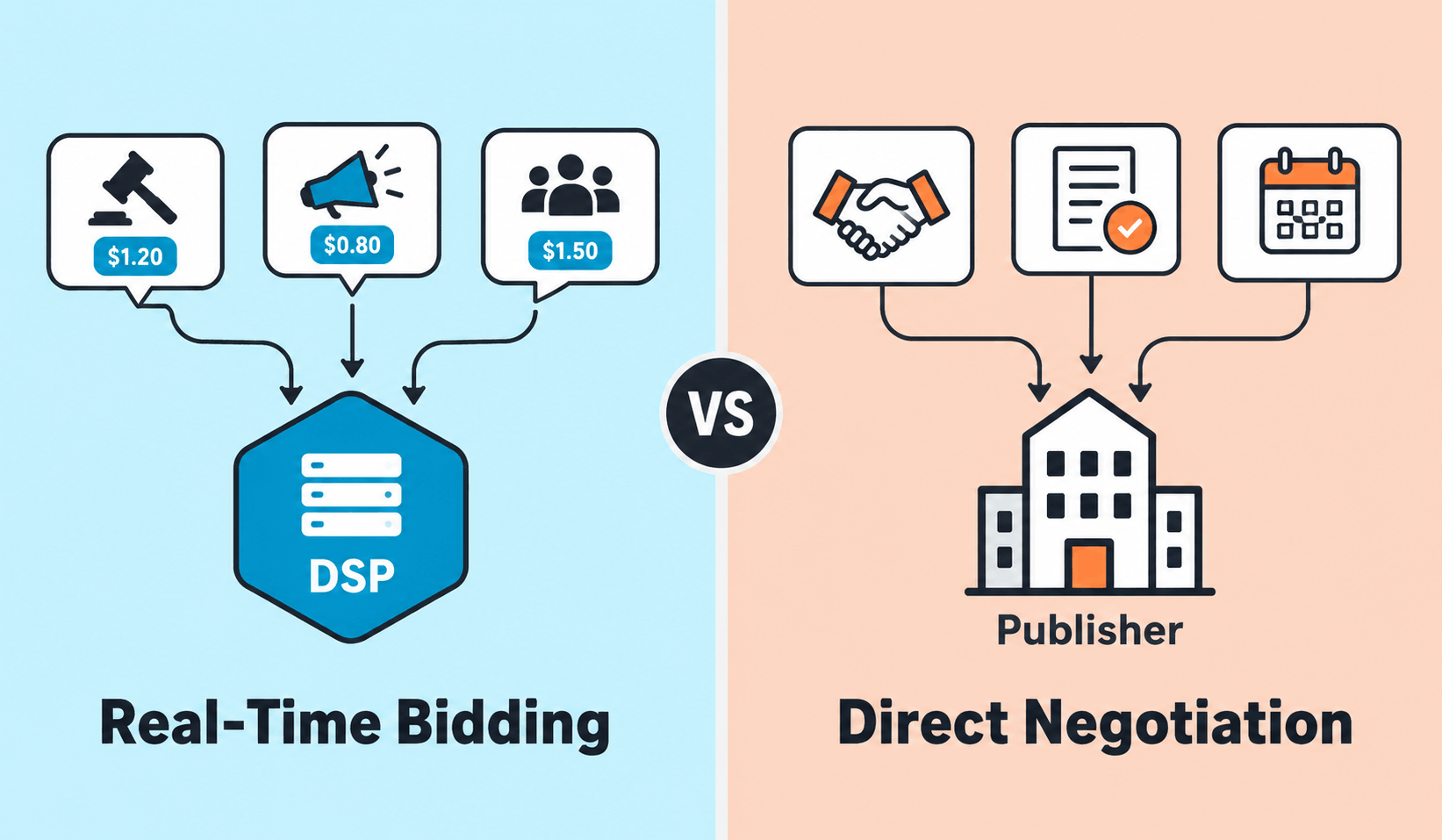
Programmatic advertising automates inventory buying through real-time bidding systems, while non-programmatic advertising uses manual negotiations and direct publisher relationships to secure placements.
In programmatic advertising, advertisers use Demand-Side Platforms (DSPs) such as The Trade Desk, DV360, Amazon DSP, and Criteo to bid on impressions automatically across multiple inventory sources simultaneously. The system evaluates audience data, contextual relevance, device signals, bidding competition, and conversion probability in milliseconds before deciding whether to purchase an impression.
Non-programmatic advertising works differently. Media buyers negotiate directly with publishers or networks to secure placements at fixed rates or guaranteed inventory volumes. Campaign setup, targeting, reporting, and optimization typically involve more manual workflows.
The operational distinction affects how campaigns scale, optimize, and measure performance.
Programmatic buying prioritizes:
- Automation
- Real-time optimization
- Audience-level targeting
- Cross-channel scalability
- Dynamic budget allocation
Non-programmatic buying prioritizes:
- Guaranteed placements
- Fixed inventory access
- Premium publisher relationships
- Brand environment control
- Predictable delivery structures
Neither system operates independently from the broader advertising ecosystem. Traffic quality, creative performance, conversion tracking, and attribution infrastructure still determine overall campaign efficiency regardless of buying method.
Why Does Programmatic Advertising Usually Scale More Efficiently?
Programmatic advertising scales more efficiently because inventory access, optimization, targeting, and reporting operate through interconnected automated systems rather than isolated publisher relationships.
Traditional non-programmatic buying becomes operationally complex as campaigns expand across multiple publishers, formats, regions, and channels. Each publisher relationship introduces separate workflows, reporting structures, trafficking requirements, and optimization processes.
Programmatic consolidates those systems inside centralized buying infrastructure through platforms like The Trade Desk and DV360.
A single DSP can manage:
- Display inventory
- Connected TV campaigns
- Mobile app placements
- Audio advertising
- Retail media inventory (Amazon DSP, Walmart Connect)
- Video campaigns
- Native advertising
The efficiency advantage becomes more significant in fragmented customer environments where users move continuously between streaming platforms, apps, websites, and devices before converting.
This matters because campaign performance is interconnected operationally. Audience signals influence bidding decisions. Conversion tracking affects optimization quality. Supply-Path Optimization (SPO) — the practice of selecting inventory routes that offer the best combination of price transparency, quality, and fee efficiency — reduces wasted spend caused by unnecessary intermediary hops between DSP and publisher. Attention metrics, which measure active viewing time, scroll depth, and interaction signals rather than proxy metrics like impressions, are also gaining adoption in 2026 as a more reliable proxy for ad effectiveness in environments where direct tracking is constrained. Weakness in any of these areas affects the entire acquisition system.
In our observation, SMEs and mid-market businesses frequently underestimate the operational cost of managing fragmented non-programmatic buying environments manually. Labor inefficiency often becomes a larger constraint than media cost itself.
Benchmark context: mid-market advertisers commonly reduce campaign management time by 20% to 40% after consolidating fragmented display and video buying into centralized programmatic workflows.
When Does Non-Programmatic Advertising Still Perform Better?
Non-programmatic advertising still performs well in environments where inventory quality, guaranteed placement control, or publisher alignment matter more than automation efficiency.
Certain premium publishers continue limiting inventory access through direct relationships or private deals because they prioritize brand safety, sponsorship quality, and pricing stability over open-auction scalability.
Non-programmatic buying frequently performs best for:
- Homepage takeovers
- Fixed sponsorship campaigns
- Premium editorial placements
- Industry publication advertising
- Event sponsorship integrations
- Guaranteed video inventory
- Brand-sensitive campaigns
The value comes from predictability and placement certainty.
For example, enterprise B2B advertisers targeting highly specific executive audiences may achieve stronger engagement through direct partnerships with niche industry publications than through broader programmatic prospecting campaigns.
The tradeoff is operational flexibility. Manual buying structures generally optimize slower because bidding adjustments, targeting changes, and reporting updates depend on human workflows rather than automated auction systems.
Case data suggests that premium direct placements often improve brand lift and awareness metrics while programmatic systems typically outperform on lower-funnel efficiency and scalable acquisition costs.
What About Programmatic Guaranteed — The Hybrid Model?
Many advertisers treat programmatic and non-programmatic as a binary choice: open auction or direct insertion order. In 2026, the more common operating model sits between them.
Programmatic Guaranteed (PG) allows advertisers to negotiate fixed inventory volumes, fixed pricing, and confirmed placements directly with a publisher — then execute the delivery through programmatic infrastructure. There is no auction. The deal terms are agreed in advance, as with a traditional direct buy, but trafficking, reporting, optimization signals, and creative delivery all run through the DSP rather than manual workflows.
This makes PG particularly relevant for:
- Brand tentpole campaigns requiring assured delivery on specific premium publishers
- CTV campaigns where completion rates and placement quality matter more than CPM efficiency
- Seasonal campaigns with fixed inventory needs and hard campaign windows
- Advertisers wanting publisher-level brand control without abandoning programmatic measurement infrastructure
The operational advantage over standard direct buying is significant. Reporting integrates into the same DSP dashboard used for open auction and PMP campaigns, enabling frequency capping, cross-channel reach measurement, and audience deduplication that isolated publisher reporting cannot provide.
The tradeoff compared to open RTB is flexibility. Budget committed to PG deals cannot be dynamically reallocated based on live performance data, the way open auction spend can. PG works best when the campaign objective is guaranteed delivery and placement certainty rather than CPA-driven optimization.
For most mature advertisers in 2026, PG has become the default structure for high-value, brand-sensitive placements — combining the commercial certainty of direct buying with the measurement efficiency of programmatic infrastructure.
How Do Targeting and Optimization Differ Between the Two Approaches?
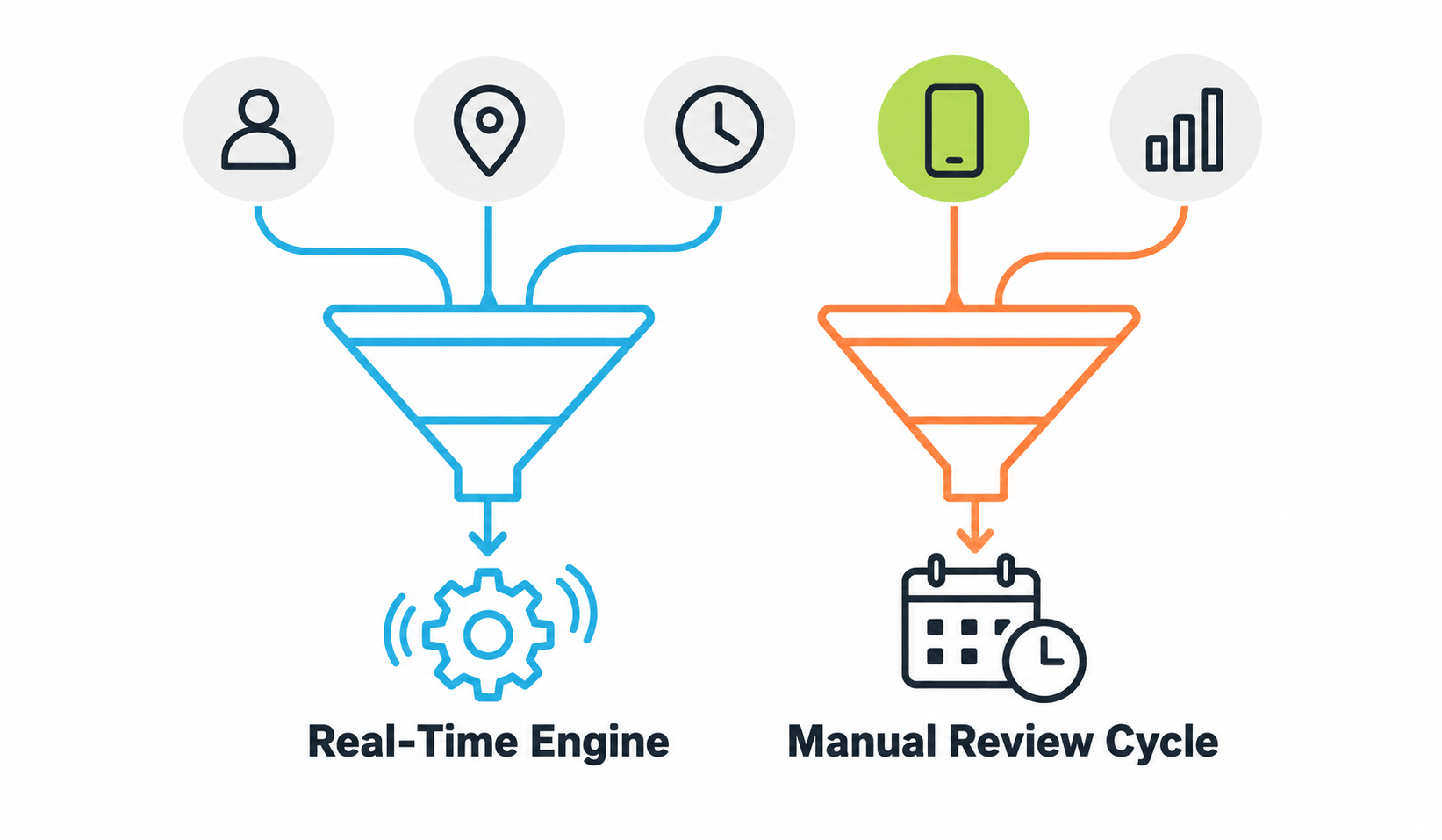
Programmatic advertising optimizes continuously at the impression level, while non-programmatic advertising optimizes primarily at the placement or publisher level.
Programmatic systems evaluate:
- User behavior
- Device signals
- Contextual relevance
- Geographic location
- Frequency exposure
- Historical conversion data
- Audience quality
- Time-of-day engagement patterns
The system uses those signals to determine whether an impression is worth purchasing and how aggressively the budget should be allocated.
Non-programmatic campaigns generally optimize more slowly because changes occur through scheduled reporting reviews and publisher coordination rather than real-time auction-level decision-making.
The targeting difference is operationally significant.
Programmatic buying increasingly depends on:
- First-party CRM audiences
- Contextual targeting
- Lookalike modeling
- Retargeting pools
- Retail purchase signals
- AI-driven predictive bidding
- First-Party Data Clean Rooms — secure environments where advertiser and publisher first-party data can be matched for audience targeting without either party exposing raw user data, which are becoming the preferred infrastructure for privacy-compliant audience activation in 2026
Direct buying depends more heavily on:
- Publisher audience alignment
- Content environment
- Placement visibility
- Sponsorship integration
- Manual audience assumptions
Privacy-first advertising environments have also changed how both systems operate. Privacy Sandbox's Topics API, Apple's Private Relay, and third-party cookie deprecation reduce visibility into cross-site behavior across both buying methods. The shift from deterministic data (verified, directly observed user signals) to modeled data (statistically inferred estimates) is accelerating in both environments — but programmatic systems adapt faster because automated optimization models can process probabilistic signals more efficiently than static manual targeting structures.
This does not mean programmatic always performs better. Low-volume campaigns with weak conversion signals can still struggle under automated optimization systems because the algorithm lacks sufficient learning data.
Which Model Provides Better Measurement and Attribution?
Programmatic advertising generally provides broader measurement visibility because reporting systems consolidate campaign data across multiple inventory environments simultaneously.
Non-programmatic buying often produces fragmented reporting structures because publishers measure delivery and attribution differently.
Programmatic platforms improve visibility into:
- Cross-channel frequency
- Audience overlap
- Assisted conversions
- View-through activity
- Incremental reach
- Placement-level performance
This creates stronger directional decision-making even when perfect attribution is no longer fully possible in privacy-constrained environments.
The limitation is platform bias.
Programmatic platforms frequently over-attribute conversions to their own inventory, particularly for view-through conversions and retargeting environments. Non-programmatic campaigns can suffer from similar attribution distortions when publishers rely on isolated reporting methodologies.
Measurement quality depends less on the buying method itself and more on:
- Conversion tracking quality
- CRM integration
- Offline conversion imports
- Attribution modeling
- First-party data consistency
- Incrementality testing
In our recent audits, one of the most common operational mistakes is scaling spend based purely on platform-reported Return on Ad Spend (ROAS) without validating blended acquisition cost against CRM revenue.
Benchmark context: blended acquisition costs across omnichannel campaigns frequently vary by 20% to 40% from platform-reported ROAS, depending on attribution structure and offline revenue integration.
What Limitations Affect Both Approaches?
Neither programmatic nor non-programmatic advertising eliminates structural media-buying limitations.
Programmatic systems face:
- Signal loss from Privacy Sandbox, Apple Private Relay, and iOS ATT — all of which reduce the share of deterministic data available to bidding algorithms and shift platforms toward modeled attribution
- Attribution fragmentation
- Fraud exposure
- Platform bias
- Inventory quality inconsistencies
- Privacy-related tracking limitations
Non-programmatic systems face:
- Slower optimization
- Limited scalability
- Operational fragmentation
- Reduced audience flexibility
- Higher manual overhead
- Inconsistent reporting structures
Privacy regulations, including GDPR, CPRA (California Privacy Rights Act), the EU Digital Markets Act (DMA) — which places additional obligations on major platforms classified as "gatekeepers" — and evolving APAC privacy frameworks increasingly affect both models because user-level tracking visibility continues declining across devices and platforms.
Third-party verification systems such as IAS, DoubleVerify, and Oracle Moat remain operationally necessary regardless of buying method because inventory quality and invalid traffic issues affect both direct and programmatic environments.
Performance is never determined by buying method alone. Creative quality, audience relevance, conversion tracking accuracy, frequency management, and commercial alignment still determine whether campaigns generate profitable outcomes.
Which Advertising Model Is Better for Your Campaign?
The best model depends on campaign structure, operational maturity, and commercial objectives rather than industry hype.
Programmatic advertising generally performs better when:
- Campaigns require scale
- Audience targeting matters heavily
- Cross-channel buying is necessary
- Real-time optimization improves efficiency
- Internal teams need operational centralization
- First-party data infrastructure already exists
Non-programmatic advertising generally performs better when:
- Premium placement control matters
- Guaranteed inventory is necessary
- Sponsorship integration is central
- Publisher relationships drive performance
- Campaigns prioritize brand environment stability
Programmatic Guaranteed is typically the right choice when:
- Placement certainty and programmatic measurement need to coexist
- CTV campaigns require assured delivery on specific streaming publishers
- Brand tentpole events require fixed inventory at agreed CPMs
- The advertiser wants publisher-level control without abandoning DSP reporting infrastructure
Most mature advertisers now combine all three models operationally. Programmatic may handle retargeting and scalable acquisition through The Trade Desk or Criteo. Direct publisher buys may handle sponsorships and premium editorial placements. Programmatic Guaranteed may handle CTV tentpoles and premium brand-safe inventory where delivery certainty and programmatic measurement both matter.
The decision should remain commercially grounded.
Scale campaigns when:
- Attribution remains directionally stable
- CPA stays commercially sustainable
- Frequency exposure remains controlled
- Incremental lift continues improving
Pause or restructure campaigns when:
- Attribution deteriorates
- Audience saturation increases
- CPA exceeds customer value thresholds
- Conversion quality declines
- Reporting inconsistencies expand
The objective is not automation for its own sake. The objective is sustainable acquisition efficiency across the full advertising system.
FAQs
Is programmatic advertising better than non-programmatic advertising?
Programmatic generally performs better for scalable acquisition, audience targeting, and operational efficiency, while non-programmatic buying remains valuable for premium placements and guaranteed inventory access. Programmatic Guaranteed sits between both and is increasingly the default for high-value placements in 2026.
What is the biggest advantage of programmatic advertising?
Real-time optimization across fragmented inventory environments using automated bidding and centralized targeting systems through platforms like The Trade Desk, DV360, and Amazon DSP.
Is non-programmatic advertising still relevant?
Yes. Premium publishers, sponsorship campaigns, and highly controlled brand environments still frequently rely on direct buying relationships — often combined with programmatic delivery infrastructure through PG deals.
Does programmatic advertising work without third-party cookies?
Yes, but targeting increasingly relies on first-party data, contextual targeting, First-Party Data Clean Rooms, modeled attribution, and server-side tracking rather than traditional cross-site deterministic signals.
Is programmatic advertising more cost-effective?
Often, yes, at scale, particularly for performance campaigns. However, premium direct placements and Programmatic Guaranteed deals may outperform open RTB for certain brand-awareness or niche audience campaigns.
Can advertisers use both programmatic and non-programmatic advertising together?
Yes. Most mature advertising systems combine open RTB, direct publisher buys, and Programmatic Guaranteed, depending on inventory requirements, audience strategy, and campaign objectives.
Conclusion
Programmatic and non-programmatic advertising solve different operational problems inside modern media-buying systems. Programmatic excels at automation, scale, audience targeting, and cross-channel optimization through platforms like The Trade Desk, DV360, Amazon DSP, and Criteo — while non-programmatic buying continues providing value through premium placements, guaranteed inventory, and publisher control. Programmatic Guaranteed bridges both models and has become the standard structure for high-value campaigns where placement certainty and measurement efficiency both matter.
The strongest advertising strategies increasingly combine all three approaches based on campaign objectives, measurement infrastructure, audience quality, and commercial realities rather than treating either system as universally superior. As deterministic data continues to decline and modeled attribution becomes the operating norm, the quality of first-party data infrastructure, Clean Room environments, and SPO practices will increasingly differentiate campaign performance across both buying models.
Read These Next
Marketing Attribution Models: The Complete 2026 Guide