.png)
Types of Paid Advertising: Which Format Is Best for Your Business Goals?
.png)

.png)

The best format for paid advertising depends on your funnel stage: Search and Retail Media are best for immediate conversions where intent is already high. Social and Native ads drive demand generation and brand consideration. Video, Display, and Connected TV are optimized for broad awareness and retargeting. Most 2026 strategies require a hybrid approach to balance reach with ROI.
How Do You Choose the Right Paid Ad Format for Your Goals?
Paid advertising is not a single channel. It is a set of formats that each operate differently, reach audiences at different stages of the buying process, and produce different results. Search ads capture users who are already looking for a solution. Display ads build visibility among users who are not yet actively searching. Social ads reach audiences based on behavior and interest. Misaligning format with objective is one of the most common causes of wasted ad spend.
The environment these formats operate in has also changed. AI-driven platforms now automate targeting, bidding, and delivery in ways that reduce manual control. Privacy restrictions have reduced the precision of third-party audience data, making format selection and first-party signal quality (data collected directly from your own customers and website visitors) more important than before. Effective campaigns align format selection with specific funnel goals rather than defaulting to a single approach.
For C-level decision-makers and growth leaders across APAC, the US, and Australia, understanding which format does what — and where each breaks down — is the foundation of any paid advertising strategy that scales efficiently.
Regional context: In Australia and mature APAC markets such as Singapore and Japan, search and social CPCs have risen in line with US benchmarks, making format efficiency increasingly important for mid-market budgets. In emerging APAC markets (India, Southeast Asia), lower auction costs make display and video more accessible at scale, but measurement infrastructure is less mature. Privacy regulation also differs by market — Australia's Privacy Act, Singapore's PDPA, and evolving US state laws each affect how first-party data can be collected and activated across formats.
What Are the Main Types of Paid Advertising in 2026?
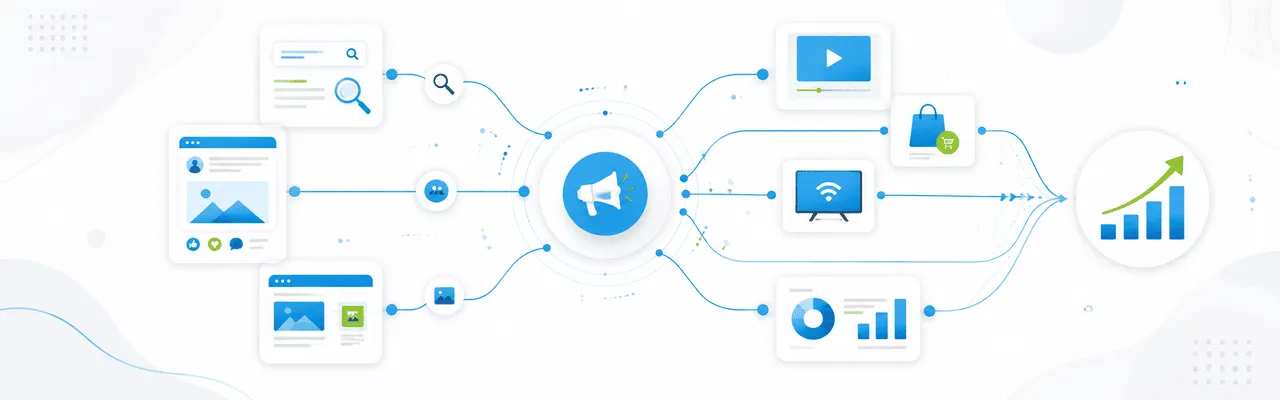
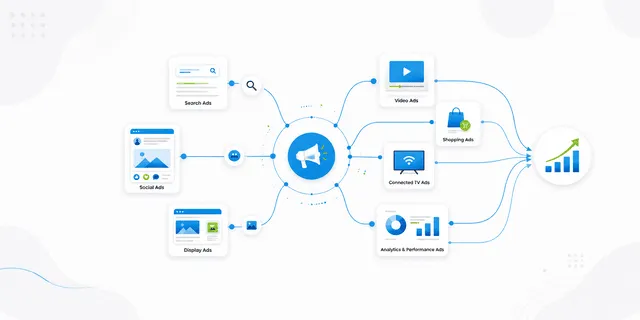
The main types of paid advertising are search ads, social ads, display ads, video ads, native ads, retail media ads, and connected TV (CTV). Each format reaches audiences differently, operates on different pricing models, and produces different results depending on the campaign objective and funnel stage.
Format selection determines which stage of the customer journey a campaign influences and how performance will be measured. Choosing the wrong format for a goal — running display ads to drive immediate conversions, for example — produces weak results not because the campaign was poorly executed, but because the format was not designed for that outcome.
When Should You Use Search Ads for High-Intent Conversion?
Use search ads when your primary goal is bottom-of-funnel conversion or lead generation. Because they target users actively typing specific queries into search engines like Google, they capture existing demand better than any other format, making them the highest-converting paid channel for direct response.
Ads appear based on a combination of bid amount and quality score — a platform assessment of ad relevance and landing page experience. Budget alone does not determine visibility. A well-structured campaign with relevant copy and a strong landing page will outperform a higher-spending competitor with poor alignment between keyword, ad, and destination.
Search ads are most effective for bottom-of-funnel objectives: driving purchases, generating leads, or capturing demand that already exists. They are less effective for creating demand among audiences who are not yet searching for a solution.
Key optimization areas:
- Match keyword intent to the offer — broad keywords generate volume but reduce conversion efficiency
- Align ad copy directly with the search query to improve quality score and CTR
- Ensure landing pages reflect the specific promise made in the ad
Benchmark context: Industry averages typically range from 2.5% to 5% for B2B SaaS search campaigns and 3% to 8% for high-intent B2C queries, according to 2026 analysis from Lever Digital and GrowthSpree across 300+ accounts.
These figures vary significantly by vertical — FinTech and Cybersecurity SaaS often see lower rates (1.2%–3%) due to longer evaluation cycles, while B2C e-commerce in categories with high purchase intent (apparel, consumer electronics) can exceed 5%.
ROAS for well-optimised search campaigns commonly ranges from 3x to 6x depending on industry and competition level (WordStream, 2026).
How Do Social Ads Drive Demand and Audience Awareness?
Social ads appear within the feeds, stories, and content surfaces of platforms such as Meta, LinkedIn, TikTok, and Instagram. Unlike search ads, they reach users based on who they are — demographics, interests, and behaviors — rather than what they are actively searching for.
Because audiences are not in an active buying mindset, social ads typically produce lower direct conversion rates than search. Their strength is in reaching large, precisely defined audiences earlier in the buying journey — building awareness, generating interest, and warming audiences for retargeting.
AI systems like Meta Advantage+ now automate much of the audience targeting and delivery optimisation. This reduces manual work but also reduces transparency into which placements are driving results. Performance increasingly depends on creative quality rather than targeting precision.
Social ads work best for:
- Awareness and demand generation among defined audience segments
- Retargeting warm audiences who have already engaged with the brand
- Reaching B2B decision-makers through platforms like LinkedIn
Benchmark context: Social ad conversion rates typically range from 1% to 3% for cold audiences (Lever Digital, 2026). Retargeting campaigns often produce conversion rates two to three times higher than prospecting campaigns.
What Is the Role of Display Advertising in Brand Visibility?
Display ads are visual placements — banners, responsive image ads, and rich media formats — that appear across websites, apps, and content networks. They reach users while they are consuming content elsewhere, rather than during active search or social browsing.
Display advertising works through two mechanisms: audience targeting, which serves ads to users who match a defined profile regardless of the site they visit, and contextual targeting, which places ads alongside relevant content. Contextual targeting has become more prominent as third-party cookie deprecation reduces the reliability of behavioral audience data.
Display ads are well-suited for:
- Keeping a brand visible during long consideration cycles
- Retargeting users who visited a website but did not convert
- Supporting awareness at scale with a lower CPM than search or social
One important limitation is brand safety. Without active placement management, programmatic display inventory can appear in low-quality contexts. Private marketplace deals and placement exclusions are commonly used to address this.
Benchmark context: Display ads typically generate CTRs between 0.1% and 0.5% on standard placements. CPMs are lower than search or social, making display cost-effective for reach-based objectives.
Why Are Video Ads Most Effective for Top-of-Funnel Engagement?
Video ads deliver promotional content through platforms such as YouTube, TikTok, Instagram Reels, and programmatic video networks. Formats range from short pre-roll ads to longer in-feed videos users encounter while browsing.
Video is the highest-engagement paid format for awareness and brand recall. The combination of visual, audio, and motion creates stronger memory encoding than static formats — making it effective for introducing new products, communicating complex value propositions, or building recognition at the top of the funnel.
Performance depends heavily on the first few seconds. On skippable formats, users decide within three to five seconds whether to continue watching, which reduces the window to capture attention considerably.
Video ads are less efficient for direct response. Cost per view tends to be higher than cost per click on search or social, and attribution is more complex because the conversion path from video exposure to purchase typically involves multiple subsequent touchpoints.
Benchmark context: Skippable YouTube ads typically see completion rates between 20% and 40%. CPMs for video are generally higher than display but comparable to premium social placements.
What Is Connected TV (CTV) and When Should You Use It?
Connected TV (CTV) advertising delivers non-skippable or interactive ads through streaming platforms — including YouTube on TV, Netflix ad-supported tiers, Hulu, Peacock, Tubi, and similar services — accessed on internet-connected television screens. CTV sits between video and display in the format ecosystem, combining the large-screen impact of traditional TV with the targeting precision and measurability of digital.
US CTV ad spend is projected to reach $37.95 billion in 2026, a 15% year-on-year increase, with over 90% of CTV inventory now transacted programmatically (eMarketer, 2026). Ad completion rates on CTV consistently exceed 95% — significantly higher than skippable pre-roll video — because most CTV ad formats are non-skippable by design. Australia's CTV ad spend is projected to reach $1.19 billion in 2026 (+11.1% YoY), reflecting strong growth in streaming adoption across the region.
CTV is most effective for:
- Upper-funnel brand awareness at scale, reaching audiences in a lean-back, high-attention environment
- Retargeting users who visited a website or engaged with other ads, using household-level targeting
- Reaching cord-cutters and younger demographics (18–44) who are underrepresented in linear TV audiences
- Connecting streaming ad exposure to downstream purchase behavior via retail media data partnerships
The main limitation of CTV is attribution. Because most viewers do not convert directly on a television screen, last-touch attribution models miss most of CTV's contribution to eventual purchases. Incrementality testing and multi-touch attribution frameworks are required to measure CTV's true impact on pipeline and revenue. Cross-platform measurement remains fragmented, with each streaming platform using different measurement frameworks.
Benchmark context: CTV CPMs typically range from $25 to $50 in the US and Australia. Ad completion rates exceed 95%. Interactive CTV ads see engagement rates of 1.8% to 3.5% (StackAdapt, 2026).
How Do Native Ads Improve Engagement Without "Ad Fatigue"?
Native ads are paid placements that match the visual format and editorial tone of the content surrounding them. They appear as sponsored articles, recommended content widgets, or in-feed posts on publisher sites — blending with the content experience rather than interrupting it. Platforms such as Taboola and Outbrain are the primary distribution networks for native content at scale.
Because native ads match editorial content, they typically generate higher engagement and lower banner blindness than standard display formats. They are particularly effective for content-led demand generation — driving users to articles or guides that build consideration before a conversion offer is presented.
Native requires content that provides genuine value. Promotional content that reads like an advertisement loses the engagement advantage that makes native effective. The format works best in B2B and high-consideration purchase categories where buyers require education before they are ready to convert.
Benchmark context: Native ads typically generate CTRs between 0.2% and 0.8% — higher than standard display. Engagement metrics such as time on page tend to outperform display placements significantly.
What Is Retail Media and Why Is It Best for Ecommerce?
Retail media refers to paid advertising within ecommerce platforms — Amazon Advertising, Walmart Connect, and similar networks — where ads appear close to the point of purchase. Rather than reaching users across the open web, retail media connects advertisers with shoppers whose intent is already expressed through active browsing and purchasing behavior.
The key advantage is data quality. These platforms use first-party purchase and browsing data to target users based on actual shopping behavior — past purchases, search queries, and product category interest. This makes retail media highly effective for lower-funnel conversion campaigns and product launch visibility.
Retail media is most relevant for:
- Consumer goods and ecommerce brands selling through marketplace channels
- Lower-funnel campaigns where purchase intent is already high
- Product visibility within competitive category search results
As third-party data availability declines, retail media's reliance on first-party purchase data makes it increasingly valuable relative to open-web targeting alternatives.
Benchmark context: Retail media campaigns often generate higher conversion rates than equivalent search or social campaigns for relevant product categories, because the audience is already in a shopping context.
How Do Different Ad Formats Function as a Connected System?
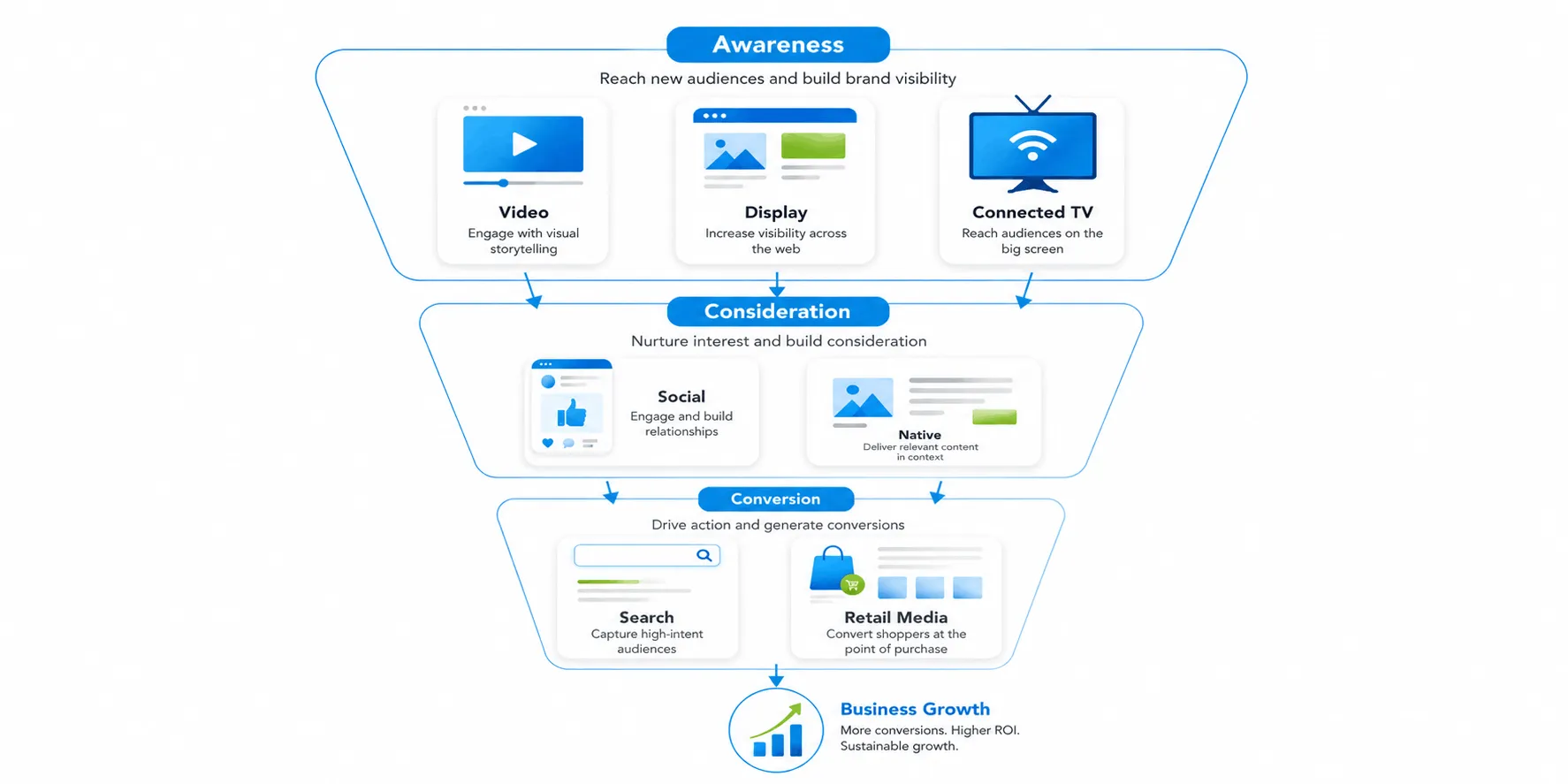
Paid advertising formats are most effective when treated as a connected system rather than independent channels. Each format influences a different stage of the customer journey, and misalignment between stages reduces overall funnel efficiency.
.webp)
A typical multi-format approach works across three layers:
- Awareness — CTV, video, and display introduce the brand to new audiences and build recognition
- Consideration — social ads and native content reach users who need more information before forming a preference
- Conversion — search ads and retail media capture users who are ready to act
Retargeting connects these layers, re-engaging users who were exposed to awareness-stage content but have not yet converted — without the cost of re-acquiring them as cold traffic.
The data each format produces also feeds the others. High-performing search keywords inform social ad copy. Social engagement data builds lookalike audiences for prospecting. CTV exposure data can be matched against site visitor logs to identify high-intent households for retargeting via display or search. This feedback loop between formats is where the system advantage over single-channel campaigns becomes most visible.
Budget-friendly hybrid approach for SMEs: Running a full multi-format system simultaneously requires budget that most SMEs do not have. A more practical entry point is a two-phase approach. Start with search — it captures existing demand with the most direct attribution and the lowest risk of wasted spend. Once conversion tracking is stable and CPA is acceptable, add a small retargeting layer using display or paid social to re-engage users who visited but did not convert.
These two formats together — search for acquisition, retargeting for recovery — replicate the most commercially important part of the hybrid system at a fraction of the full-funnel cost. CTV, video, and native can be introduced later as budgets grow and brand-building becomes a priority.
A functional two-channel setup with $3,000–$5,000 per month will produce more reliable data and better outcomes than spreading the same budget thinly across all formats at once.
What Are the Common Risks and Limitations of Each Ad Format?
Every format operates with constraints that affect performance in ways not always visible in platform-reported metrics.
Search ads depend on demand that already exists. In categories where awareness is low, search volume is insufficient to scale. Rising competition has also increased CPCs significantly, compressing margins for advertisers who rely on search as their primary acquisition channel. Tools like Google Ads' Keyword Planner and third-party platforms like SEMrush can help assess whether sufficient search volume exists before committing budget.
Social ads are affected by signal loss from privacy changes. Platforms including Meta Advantage+ increasingly rely on modelled conversions rather than directly observed data — in some cases, 40% to 60% of reported conversions are estimated rather than tracked. This makes social ROAS difficult to validate against backend revenue data.
Display and native ads suffer from attribution complexity. Because these formats operate earlier in the funnel, their contribution to eventual conversions is often invisible in last-click attribution models — causing them to be systematically undervalued in budget decisions. Platforms like Taboola and Outbrain provide engagement data, but connecting that engagement to downstream revenue requires CRM integration.
CTV faces fragmented measurement across platforms. Each streaming service reports performance using different methodologies, making cross-platform comparison difficult. Most CTV conversions happen on a different device than the TV screen, requiring multi-touch or incrementality measurement rather than last-click attribution.
Retail media is constrained by platform scope. Amazon Advertising is highly effective within Amazon's ecosystem but provides limited visibility into brand building or cross-channel impact.
Which Paid Advertising Format Is Best for Your Specific Business Goal?
Format selection should follow campaign objective, not budget or platform familiarity. The most common mistake is defaulting to the format that is easiest to set up rather than the one that best matches the intended outcome.
For most businesses, the most efficient long-term approach uses formats in sequence — awareness formats build the audience, consideration formats nurture it, and conversion formats capture it. Running only conversion-stage formats without awareness investment produces diminishing returns over time.
Conclusion
Paid advertising is a set of tools with distinct functions across the customer journey. Search ads capture intent, social ads build reach, display maintains visibility, video drives awareness, native generates consideration, CTV delivers large-screen brand impact, and retail media converts at the point of purchase.
Choosing the right format requires understanding what each channel does well and where it breaks down. Campaigns that align format selection with funnel stage and treat paid advertising as an interconnected system consistently outperform those that optimise each channel in isolation.
FAQs
What are the main types of paid advertising? Search, social, display, video, connected TV (CTV), native, and retail media — each suited to different funnel stages and campaign goals.
Which type has the best ROI? It depends on the objective. Search delivers the highest direct conversion ROI. Retail media performs strongly for ecommerce. CTV and video deliver better ROI for awareness goals.
What is the difference between search and display ads? Search reaches users actively looking for a solution — effective for conversion. Display reaches users consuming other content — better for awareness and retargeting.
When should a business use social ads? For awareness, demand generation, and retargeting defined audience segments. Less effective as a standalone conversion channel for cold audiences.
How do you choose the right format? Start with the campaign objective. Conversion goals call for search or retail media. Awareness calls for video, CTV, or display. Most effective campaigns combine formats across funnel stages.
Why do results sometimes differ from platform reports? Platforms credit the last touchpoint and use modelled data to fill attribution gaps from privacy restrictions — which can inflate reported ROAS relative to actual revenue.
Read These Next
Marketing Automation Workflow: How to Design High-Converting Sequences from Scratch