.png)

What is a Growth Loop and How to Build One for Your Business in 2026?
.png)

.png)

Building a growth loop in 2026 requires shifting from one-off campaigns to an automated feedback system. Growth teams map customer data, identify friction with behavioral analytics, test improvements through experimentation platforms, and use AI agents or lifecycle automation to turn referrals, purchases, product usage, and retention signals into compounding growth inputs.
Key Takeaways
- A growth loop turns a single completed action into the input for the next cycle, reinvesting value into acquisition, activation, or retention.
- Businesses can scale through Viral Loops (user invites), Content Loops (organic traffic), Paid Loops (reinvested profit), or Product-Led Loops (usage-driven value).
- Successful 2026 strategies rely on data warehouses like Snowflake and AI-driven experimentation platforms to remove friction and track loop velocity.
- Modern loops utilize Generative Engine Optimization (GEO) and AI agents to automate complex processes, such as payroll data migration or personalized content creation.
- Sustainable growth requires predictive behavioral analytics to prevent churn, as a loop loses momentum if users leave the system quickly.
What is a Growth Loop?
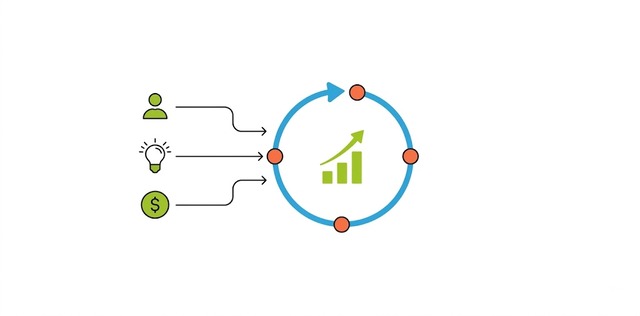
A growth loop is a self-reinforcing system where the output of one cycle—such as a new user, data point, or dollar of profit—is automatically reinvested as an input for the next. Unlike linear funnels, loops create compounding growth by reducing the marginal cost of acquisition and increasing long-term retention through automated feedback cycles.
How Does a Growth Loop Work?
A growth loop works by turning one completed action into the input for the next cycle of growth. Instead of ending at conversion, the system captures value from a user action and reinvests it into future acquisition, activation, retention, or revenue.
To build a growth loop, start by identifying the customer action that can create future growth. Then define the output that gets reinvested into the next cycle, such as a referral, content insight, product signal, retained customer, or additional revenue. From there, remove friction from the action, measure the loop with a small set of metrics, test improvements, and scale only when the loop is repeatable.
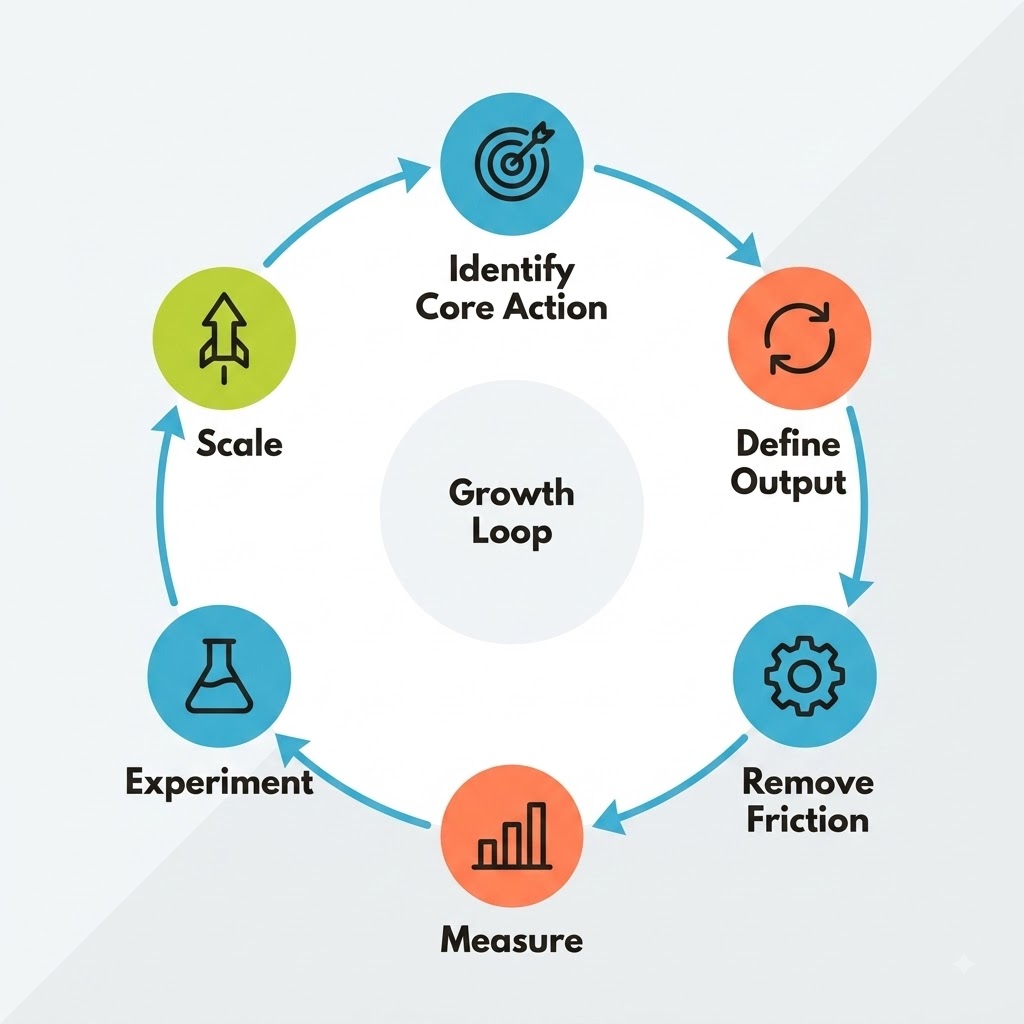
Common Steps when Building a Growth Loop:
1. Identify the core action
Choose the behavior that can feed future growth. For example, a user invites a teammate,
2. Define the reinvestment output
Clarify what the action creates, such as a new user, prompting a referral code, sending a content idea, or offeing product signal.
3. Remove friction
Make the action easier to complete by adding in-app prompts or automated follow-ups.
4. Measure the loop
Track whether each cycle improves the next using metrics, such as:
- referral rate: percentage of users who refer others
- activation rate: percentage who complete a key value-driving action
- retention: the share of customers who keep using the product
- LTV/CAC: how much revenue a customer generates over time against the cost to acquire them
5. Run experiments
Test changes that improve loop performance. These can be achieved through offering Incentives, onboarding, landing pages, and prompts.
6. Scale carefully
Increase investment only when the loop is repeatable. Scale budget, integrate automation, or infrastructure only after validation of what process best works for the customers.
A strong growth loop becomes more efficient over time because each completed cycle produces data, revenue, users, or engagement that helps the next cycle perform better.
Where Automation Fits Into a Growth Loop
Automation turns a growth loop into a scalable system by triggering the next step after a valuable user action. In 2026, this increasingly includes agentic AI, which refers to AI systems that can plan, decide, and complete multi-step tasks with limited human input.
High-impact loops should still use human-in-the-loop (HITL), where a person reviews, approves, or corrects automated decisions before they affect customers.
Automation can trigger the next step in a growth loop, but human oversight protects trust, compliance, pricing accuracy, and brand quality when automated decisions carry real customer or business risk.
Expert Tip: Start With One Closed Loop Before Automating Everything
Many teams over-engineer growth systems too early by connecting every workflow, CRM trigger, and AI agent at once. In practice, high-performing teams often validate a single loop before expanding it.
For example:
- User completes onboarding
- Product triggers a referral request
- Referral creates a new signup
- New signup reaches activation
Once this loop consistently improves acquisition or retention metrics, businesses can layer in AI agents, behavioral triggers, and additional automation.
What Are the Main Types of Growth Loops?
The main types of growth loops are viral, content, paid, and product-led loops. Choose the loop type based on what your business can repeatedly reinvest: users for viral loops, search demand for content loops, profit for paid loops, and product usage for product-led loops.
Quick Comparison of Growth Loops
The effectiveness of these loops is often tracked through a data warehouse like Snowflake or BigQuery and increasingly paired with Vector Databases, which store information based on semantic relationships rather than exact matches. This enables AI systems to retrieve context-aware information to support recommendations, personalization, and agent-driven workflows.
By analyzing this data, businesses can calculate the viral coefficient, a metric that indicates how many new users are generated by each existing user.
Viral Loops and Referral Systems
A viral loop uses existing users to bring in new ones. To build one, place referral prompts after high-satisfaction moments, offer incentives that benefit both sides when appropriate, and measure referral rate, invite conversion rate, and viral coefficient to confirm the loop is creating incremental growth.
- Referral rate: The percentage of users who refer someone else.
- Conversion rate: The percentage of referred people who sign up, buy, or complete another target action.
- Viral coefficient: The average number of new users each existing user brings in.
- Incremental growth: New growth caused by the referral loop that would not have happened otherwise.
Platforms like ReferralCandy or Friendbuy are commonly used for viral loops. These are specialized software services that track which users sent an invitation and automatically deliver rewards, such as discounts or credits, once the new person signs up.
In 2026, successful loops use product-led virality. This means the product is designed so that it cannot be fully used unless other people are invited. This makes growth a natural part of using the software rather than an external marketing effort.
Case Study: Toki Mats
Toki Mats (now Toki Kids) earned over $500,000 in sales by automating referrals, with an automated system that connected directly to their online store. Whenever a customer made a purchase, the software automatically sent them a unique link to share with friends. The setup used double-sided rewards, giving both the original customer and their friend a $15 discount, achieving a 12% referral rate with automation.
Content Growth Loops
A content loop turns search intent into a repeatable acquisition engine. In the era of Generative Engine Optimization (GEO), this loop relies on creating high-quality, data-backed content that AI engines prefer to cite. The strongest content loops use performance data from each article to decide what to create next.
Businesses use tools like Semrush or Ahrefs, platforms that analyze search patterns and competitor data, to identify what their audience is asking.
The loop works when new content attracts organic visitors, who then share the content or provide data. This data is used to improve content, attracting more links and higher rankings in a self-sustaining cycle.
Case Study: Instatus
Instatus in 2026 grew its monthly income by 833% by becoming an expert voice on specific technical topics. They used Google Search Console to find the exact problems their users faced, such as website outages.
By publishing helpful guides that solved these problems, Instatus outranked much larger competitors and showed up at the top of search results for 348 different topics.
Paid Growth Loops
A paid growth loop works when revenue from acquired customers can be profitably reinvested into more acquisitions. The goal is to ensure the revenue from a customer is significantly higher than the cost to acquire them.
To keep paid growth loops profitable, businesses often use attribution tools like Northbeam to see exactly which ads are driving sales.
By constantly testing new ad creatives and landing pages, a business can lower its acquisition costs, allowing it to spend more on ads and spin the loop faster.
Case Study: SharkNinja
SharkNinja increased its online sales from $5 million to $52 million in two years by using Northbeam to see exactly which ads led to purchases. They built a system that automatically tested hundreds of different ad images and headlines, increasing the budget for winning ads. This led to 500% revenue in the first year and used those profits to buy even more ad space, creating a fast-moving growth loop.
Product-Led Growth Loops
A product-led growth loop uses the product experience itself to drive activation, expansion, retention, or referrals. The loop becomes stronger when users receive immediate value, and their usage naturally creates more reasons to invite others, adopt more features, or keep returning.
Platforms like Pendo or Appcues help businesses design in-app guides and messages to show users how to get the most out of a product. As users adopt more features, they become more likely to stay, creating a retention loop that provides the stable base needed for all other growth efforts.
Case Study: Remote
Remote.com used AI tools like LangChain and LangGraph to automate the process of moving large customer files during sign-up. Instead of manual data checking, they built an AI agent that processes complex payroll information with high accuracy at a faster speed. This system allows the company to handle thousands of new users instantly without needing to hire a larger support team.
Retaining Growth Loops for Long-Term Stability
Retention is the foundation of any sustainable growth loop. If users leave the system too quickly, the loop loses its momentum. In 2026, retention is viewed as a primary indicator of a company’s financial health.
To protect retention, businesses use predictive behavioral analytics to identify patterns that suggest a user may stop using the product. Automation can then trigger timely lifecycle messages, support prompts, loyalty offers, or onboarding help before the customer churns.
With this data, companies can intervene before a customer drops off by building automated systems that trigger personalized offers to handle users experiencing friction.
Technical Infrastructure for Growth Loops
Building a loop that can handle millions of users requires a scalable technical stack. The infrastructure must be able to process data in real-time to provide personalized experiences.
Key Technical Platforms for 2026 Growth
To ensure long-term stability, leadership must manage technical debt, the future cost of fixing software problems that were created when a company chose a fast, easy solution instead of a better, long-term one.
How to Identify High-performing Growth Loops
A high-performing growth loop creates a clear, repeatable connection between one customer action and the next source of growth. To identify one, look for loops where the output is measurable, the reinvestment step is obvious, and each cycle improves acquisition, retention, revenue, or product usage without relying entirely on manual effort.
Future Trends in Growth and Automation
Growth loops in 2026 are becoming more automated, privacy-aware, and AI-readable, but the core requirement remains the same: each cycle must create a measurable input for the next.
- Agentic Commerce
A shift where AI agents find, evaluate, and purchase products on behalf of humans.
Businesses must ensure their data is accessible to modern AI systems such as GPT-5, Claude 4, Gemini 3.1, and other agent-capable models that increasingly influence product discovery, recommendations, and purchasing behavior.
- Generative Engine Optimization (GEO)
The process of making website content easy for AI answer engines to find and cite. In 2026, GEO has become a major layer of discoverability as AI assistants increasingly influence how users find information. Traditional SEO remains important for legacy search behavior, browsers, and direct search experiences, but growth teams increasingly optimize for both search rankings and AI citation visibility.
- Intent-Based Personalization
Systems that change a website’s layout or offers in real-time based on why a user is visiting.
- Privacy-First Growth
A move toward using first-party data ecosystems, including First-Party Data Clean Rooms, secure environments that allow companies to analyze customer data collaboratively without exposing raw personal information. Businesses increasingly rely on these systems to maintain compliance while preserving measurement accuracy and personalization capabilities.
- Model Drift Monitoring
The practice of checking AI systems to ensure they do not become less accurate over time as they process new data.
By building systems that reinvest their own success, companies can achieve rapid growth and limit the constant friction of manual processes.
Final Thoughts
To transition from one-off campaigns to a compounding growth engine, businesses should focus on these actionable steps:
- Determine which specific customer behavior (such as a referral or feature usage) can naturally trigger the next cycle of growth.
- Use behavioral analytics to find where users drop off and implement automated prompts or AI assistance to smoothen the path.
- Use A/B testing platforms to ensure the loop is repeatable and profitable before increasing infrastructure or ad spend.
- Build a scalable technical stack that centralizes data to comply with privacy laws while powering personalized AI experiences.
Frequently Asked Questions (FAQs)
How does a growth loop differ from a traditional marketing campaign?
A traditional campaign is often a one-time effort that requires constant manual work and new spending to find customers. A growth loop is a permanent infrastructure where the output of one cycle (such as a new user or profit) is automatically reinvested as an input for the next, making the system more efficient over time.
How do AI agents impact growth loops in 2026?
AI agents facilitate automation, where they find and purchase products for customers. They also streamline loops by handling technical friction, such as processing complex data with high accuracy or providing real-time personalization based on user intent.
What metrics are most important for measuring a loop’s success?
Instead of just looking at total leads, businesses track reinvestment metrics like the viral coefficient (how many users each person brings in), LTV/CAC ratio, and retention rates.
Read These Next
AI Marketing Automation: How to 10x Your Output with Machine Learning