.png)
B2B Media Buying: Everything You Need to Know in 2026
.png)

.png)

SNAPSHOT
B2B media buying is the strategic acquisition of ad placements across LinkedIn, paid search, programmatic display, Connected TV (CTV), and account-based channels targeting multi-stakeholder buying committees rather than individuals. In 2026, the focus is pipeline generation over immediate clicks, using account-level intent data, CRM integration, and first-party measurement infrastructure to evaluate success through influenced revenue, cost per opportunity, and account engagement rather than platform-reported ROAS alone.
Introduction
B2B media buying is built around a purchasing reality that most standard ad frameworks are not designed for. The purchase decision is made by a group of 6 to 13 stakeholders, not a single individual. The sales cycle spans weeks or months. The conversion event is a signed contract or a qualified meeting that happens offline. Offline conversion events refer to actions that happen outside the advertising platform itself - such as booked sales calls, CRM-qualified opportunities, signed contracts, or closed-won revenue attributed back to ad exposure through CRM integration. And the value of a single customer relationship often justifies acquisition costs that would be unworkable in consumer advertising.
The buying environment has shifted further. According to Corporate Visions’ 2025 B2B Buying Behavior Research and 6Sense’s 2025 Revenue AI Benchmark Report, the average B2B purchase now involves 6 to 13 stakeholders, depending on deal size and complexity, with 80 percent of buyer interactions occurring through digital channels before any sales conversation begins. Buyers arrive at that first conversation with a pre-formed shortlist, having completed the majority of their evaluation independently. The media buying question in B2B is not just how to generate leads - it is how to be present and credible across all the channels where that independent research happens.
Attribution across fragmented B2B customer journeys is increasingly difficult to measure accurately. A prospect may touch 15 to 20 pieces of content across LinkedIn, paid search, programmatic display, review platforms, Dark Social channels, webinars, and organic content over four to six months before a sales conversation begins. Standard platform attribution captures only the touchpoints it can observe and consistently over-credits the last measurable click. The gap between what platforms report and what is actually driving pipeline is wider in B2B than in almost any other advertising context.
The fragmentation problem has become more severe in 2026 because Privacy Sandbox changes, third-party cookie deprecation, and the decline of IP-based tracking have weakened B2B retargeting accuracy across the open web. Many advertisers can no longer reliably identify or follow users across devices and websites using traditional tracking methods. This has accelerated the shift toward privacy-first targeting built around first-party CRM data, server-side tracking, LinkedIn matched audiences, Salesforce Data Cloud integrations, HubSpot Operations Hub workflows, and account-level intent platforms.
In our experience managing multi-channel B2B spend across long sales cycles, campaigns that rely heavily on third-party audience overlays consistently underperform compared to campaigns structured around first-party CRM audiences and verified pipeline feedback loops. The businesses generating the most stable pipeline performance are typically the ones investing earliest in clean CRM architecture and offline attribution infrastructure rather than only optimizing ad delivery itself.
What This Guide Covers
This guide explains how B2B media buying works across channels, audiences, and measurement frameworks specific to long-cycle, multi-stakeholder purchasing decisions.
- How the B2B buying journey shapes channel and content decisions
- Which channels work best at each stage of the B2B buying cycle
- How to target buying committees rather than individual leads
- How account-based marketing changes the B2B media buying model
- How LinkedIn advertising works in B2B and when it justifies the cost
- How to set B2B campaign objectives and bidding strategies
- How to measure B2B media buying performance against pipeline and revenue
- Common B2B media buying mistakes and how to avoid them
1. How Does the B2B Buying Journey Shape Channel Decisions?
The B2B buying journey is not a funnel. It is a non-linear process in which multiple stakeholders are at different stages simultaneously, consuming different types of content for different reasons. Understanding where stakeholders spend time and what they are looking for at each stage determines which channels and content formats to use.
Research from 6Sense’s 2025 Revenue AI Benchmark Report and Corporate Visions’ Buyer Preference Research indicates that 83 percent of B2B buyers define their purchase requirements before speaking to a vendor, and the average buying group has been through eight to nine prior purchase journeys for similar solutions. Buyers arrive with context. They are not discovering categories - they are evaluating specific vendors against criteria they have already developed. Media buying that treats B2B buyers as if they are unfamiliar with the category wastes budget on education that is not needed and misses the credibility-building that is.
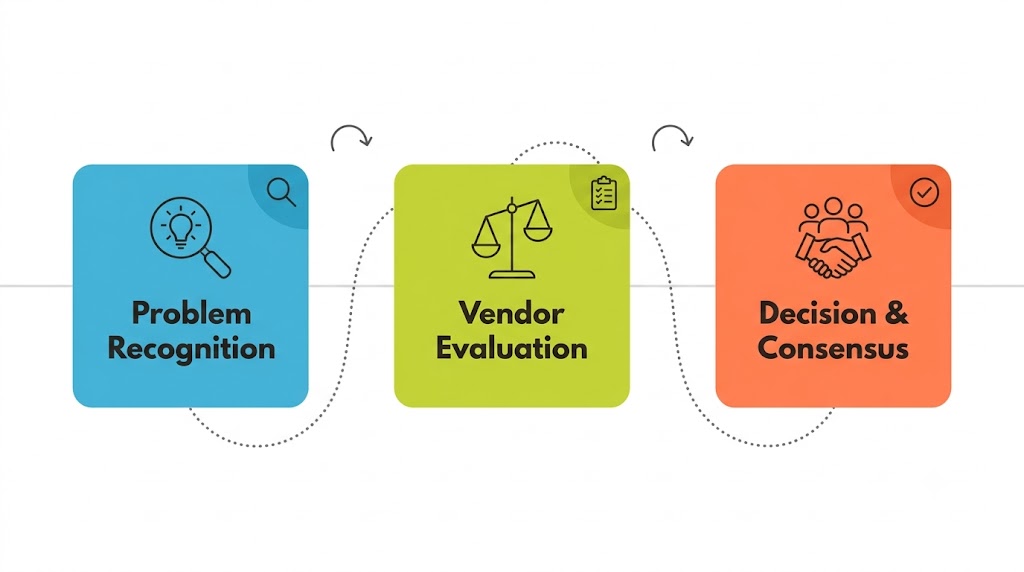
The journey maps roughly to three phases, each requiring a different approach:
- Problem recognition and category research: buyers are defining the problem and identifying solution categories - content and brand presence across search, LinkedIn, industry publications, and Demand Generation channels builds early visibility before a shortlist forms
- Vendor evaluation: buyers are comparing specific vendors against defined criteria - thought leadership, case studies, peer reviews, and comparison content on search and programmatic channels influences which vendors remain on the list
- Decision and consensus building: internal stakeholders are aligning on a choice - retargeting, account-level display, LinkedIn Sales Navigator-assisted outreach, and sales-aligned content supports the champion who is building internal consensus
Benchmark context: B2B buyers complete 57 to 70 percent of their evaluation process before engaging a sales representative, according to Gartner’s 2025 B2B Buying Journey Report and Corporate Visions research. Media buying that only activates when a prospect submits a form is missing the majority of the buying journey.
2. Which Channels Work Best at Each Buying Stage?
No single channel covers the full B2B buying cycle. Effective B2B media buying uses a channel mix matched to the funnel stage, the audience, and the objective - with each channel contributing to a system rather than operating independently.
The channels interact. A prospect who sees a LinkedIn ad is more likely to click a paid search result. A retargeting campaign on programmatic display keeps the brand visible between sales conversations. Content syndication generates leads that can be added to LinkedIn matched audiences. Building the channel mix as a system - with each channel reinforcing the others - consistently outperforms running each channel in isolation.
3. How Do You Target Buying Committees?
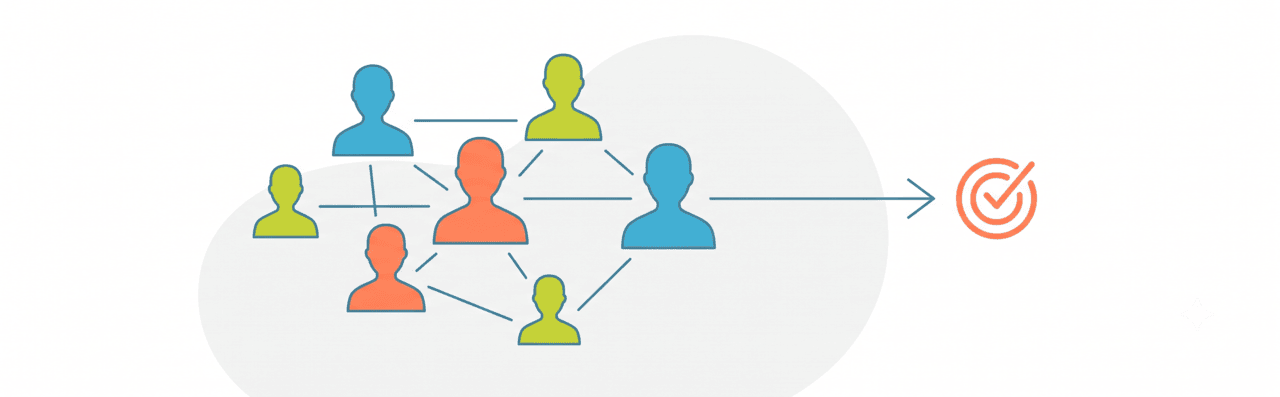
Most B2B media buying is configured to generate individual leads. The platform targets a job title, a person submits a form, and a lead enters the CRM. This approach misses the structural reality of B2B purchasing: the decision is made by a group, and reaching only one member of that group leaves the rest of the buying committee uninfluenced.
Buying committee targeting shifts the unit of measurement from the individual lead to the account and the stakeholder group within it. According to Forrester’s 2025 B2B Buying Networks Report, B2B deals where marketing has engaged three or more stakeholders close at significantly higher rates than single-threaded deals. The media buying implication is that campaigns should be structured to reach multiple roles within target accounts, not just the most obvious decision-maker title.
Practical approaches to buying committee targeting:
- Role-based targeting: run separate ad sets or campaigns for each major stakeholder role - economic buyer, technical evaluator, end user, finance, and procurement - with messaging matched to each role's specific concerns and evaluation criteria
- Account-level retargeting: use account lists from the CRM to retarget all individuals associated with a target account, not just the contacts already in the pipeline
- Intent signal targeting: platforms like LinkedIn and programmatic DSPs with B2B data overlays from providers such as Bombora and Demandbase can identify accounts showing active research behavior and serve ads to multiple roles within those accounts simultaneously
- Matched audience expansion: upload CRM contact lists and use platform lookalike modeling to reach additional stakeholders within the same companies and similar companies
Benchmark context: The average B2B buying committee ranges from 6 to 13 stakeholders depending on deal size and organizational complexity, according to research from Gartner, Forrester, and 6Sense. Enterprise deals with six-figure contract values that regularly involve 10 or more decision-makers. Campaigns that reach only one or two contacts in an account are leaving the majority of the buying committee unaddressed.
4. How Does Account-Based Marketing Work in B2B?
Account-based marketing (ABM) inverts the standard media buying model. Instead of casting broadly to generate lead volume and filtering down to qualified prospects, ABM starts with a defined list of target accounts and focuses all media spend on reaching and influencing stakeholders within those accounts.
This changes the metrics that matter. Reach, impressions, and lead volume become secondary. Account engagement - the percentage of target accounts showing ad exposure, website visits, or content consumption - becomes the primary indicator of whether the campaign is working. Pipeline generated from target accounts and influenced revenue are the commercial measures.
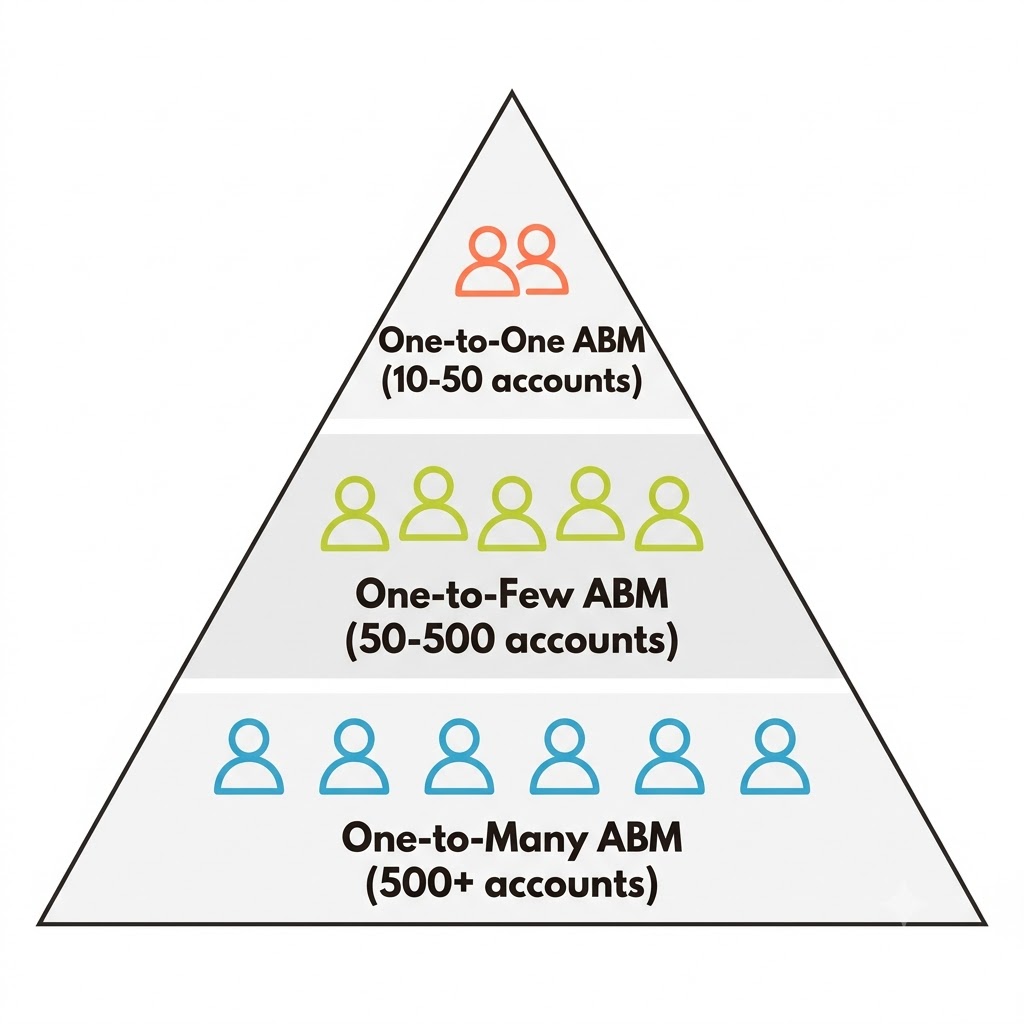
ABM media buying operates at different scales depending on the target account list and budget. The most common tiers are:
- One-to-one ABM: highly personalized campaigns targeting a small number of strategic accounts - typically 10 to 50 - with bespoke creative, custom landing pages, and coordinated sales outreach; commonly requires $5,000 to $20,000+ per month per account depending on deal size and channel mix, but produces the highest engagement rates
- One-to-few ABM: campaigns targeting clusters of 50 to 500 accounts that share similar characteristics - industry, company size, technology stack - with semi-personalized messaging; the most practical entry point for most B2B advertisers
- One-to-many ABM: programmatic campaigns targeting account lists of 500 or more with standardized creative differentiated by industry or segment; closer to traditional programmatic buying but with account-level measurement
Field Note: In our experience, one-to-one ABM campaigns underperform most often when personalization is limited to company-name insertion rather than actual operational or industry-specific relevance. Campaigns tied to a specific operational pain point or strategic initiative consistently produce stronger engagement from buying committees than generalized enterprise messaging.
The limitation of ABM is data quality. Account lists sourced from CRM records degrade as contacts change roles and companies. Intent signal data from third-party providers varies in reliability. And the measurement of account engagement requires tracking infrastructure - specifically, the ability to connect anonymous website traffic and ad exposure data back to named accounts - that many businesses do not have in place. ABM that lacks this infrastructure produces account-level activity data that cannot be connected to pipeline outcomes.
5. When Does LinkedIn Advertising Justify the Cost?
LinkedIn is the primary paid social channel for B2B advertising because it is the only major platform where professional identity data - job title, seniority, company, industry, skills - is both accurate and available for targeting. This makes it the most precise channel for reaching defined business audiences, and the most expensive by CPM.
LinkedIn CPMs typically range from $30 to $80 or more depending on the audience, objective, and competitive pressure. The cost is justified when the target audience is defined by professional attributes that cannot be reliably reached through other channels, and when the lifetime value of a converted customer is sufficient to sustain the higher acquisition cost.
The main LinkedIn ad formats and how they are used in B2B:
- Sponsored Content: native ads in the LinkedIn feed - the standard format for awareness, thought leadership, and lead generation; most effective when the creative offers genuine value rather than a product pitch
- Message Ads and Conversation Ads: direct messages delivered to LinkedIn inboxes - higher engagement rates than display formats but limited by opt-out rates and platform restrictions on frequency; best used for high-value offers directed at warm audiences
- Lead Gen Forms: native forms that pre-populate with LinkedIn profile data, reducing friction for lead capture - typically generate higher form completion rates than click-to-landing-page campaigns but lower lead quality in some categories
- Thought Leader Ads: promoted posts from individual profiles rather than company pages - growing in effectiveness as personal content consistently outperforms brand content on the platform
Decision clarity: LinkedIn advertising is justified when the target audience is defined by job title, seniority, or company attributes; when average deal values are high enough to absorb CPMs of $30 to $80+; and when the offer is strong enough to generate engagement from a professional audience that is not in active buying mode. Cold professional audiences require multiple exposures before taking action - LinkedIn campaigns with consistent engagement over 6 to 8 weeks often precede pipeline generation that last-click attribution will assign to a different channel entirely.
6. How Do You Set B2B Campaign Objectives?
B2B campaign objectives need to reflect the length and structure of the buying cycle, not just the platform's available options. Selecting a conversion objective when the business goal is pipeline generation only works if the conversion event being tracked is a reliable proxy for pipeline - a form fill that generates low-quality leads is not the same as a qualified meeting request.
Most B2B campaigns should map objectives to the funnel stage rather than defaulting to whichever objective the platform recommends. Awareness campaigns for cold account lists should optimize for reach or video views, not leads. Retargeting campaigns against warm accounts can optimize for form fills or site visits. Bottom-funnel search campaigns should optimize for the conversion event closest to a sales conversation - demo requests, contact forms, or phone calls rather than content downloads.
This distinction increasingly aligns with the broader B2B shift from Demand Generation toward Demand Capture. The majority of B2B buyers are not actively in-market at any given time - often referred to as the 95:5 Rule - which means campaigns must balance long-term category visibility with short-term conversion capture among active buyers.
Bidding strategy selection in B2B follows the same logic as general media buying with one additional constraint: B2B conversion volumes are typically lower than B2C, which limits the effectiveness of algorithmic bidding strategies that require 30 to 50 conversion events per week to optimize. For campaigns that cannot generate that volume, manual bidding or maximum delivery strategies are more appropriate than Target CPA or Target ROAS, which will underperform in learning states indefinitely.
Pro Tip: In our experience, the strongest B2B search campaigns optimize initially toward higher-volume proxy events such as pricing-page visits, demo-request starts, or sales-qualified form submissions before transitioning toward offline pipeline events once sufficient conversion volume exists for stable optimization.
7. How Do You Measure B2B Media Buying Performance?
Standard digital advertising metrics - impressions, clicks, cost per lead, platform ROAS - are insufficient for measuring B2B media buying performance. They measure activity at the top of the funnel without connecting that activity to the pipeline and revenue outcomes that determine whether the spend is commercially justified.
B2B media measurement requires connecting ad data to CRM data at the account level. This means tracking which accounts were exposed to advertising, which of those accounts subsequently engaged with sales, which progressed through the pipeline, and which converted to revenue. Without this connection, campaign decisions are made on lead volume and cost per lead metrics that frequently do not correlate with pipeline quality.
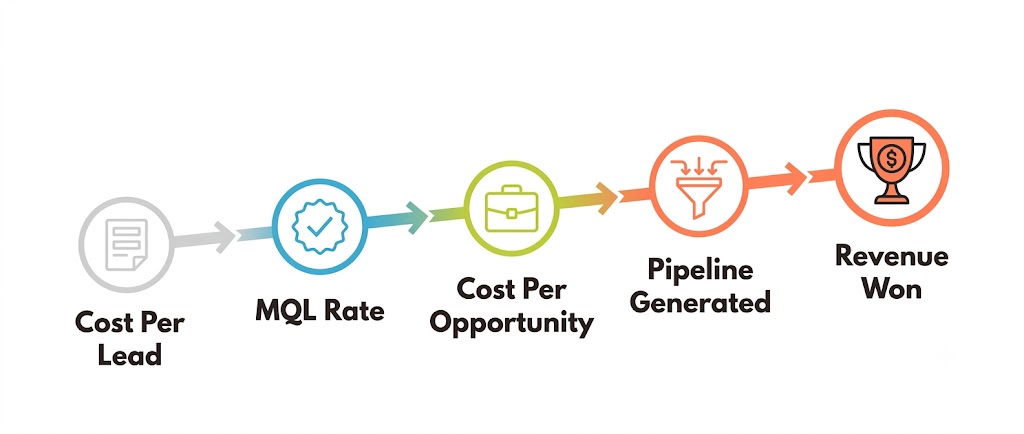
Benchmark context: The median B2B conversion rate from lead to opportunity sits around 15 percent, with significant variation by industry and lead source. Content syndication and gated content leads typically convert at lower rates (5 to 10 percent) than inbound search leads (20 to 30 percent). Cost per opportunity benchmarks vary widely by segment and deal size - what matters is the ratio of CPO to average contract value, not the absolute number.
8. What Are the Most Common B2B Media Buying Mistakes?
B2B media buying fails in predictable ways. Most failures trace back to measurement frameworks and campaign structures that were not designed for long buying cycles, multiple decision-makers, and offline conversion events.
The most common errors and how to correct them:
- Optimizing for lead volume rather than lead quality: high lead volume at low CPL is a vanity metric if the leads do not convert to pipeline - define MQL criteria jointly with sales before launching campaigns and measure cost per opportunity, not cost per lead
- Using short attribution windows: B2B sales cycles of 3 to 12 months mean that 30-day or 90-day attribution windows miss most of the commercial impact of brand and upper-funnel campaigns - extend attribution windows and use CRM data to track pipeline influence over the full sales cycle
- Running campaigns to individual job titles rather than accounts: reaching one person at a target account leaves the rest of the buying committee uninfluenced - structure campaigns around account lists and target multiple stakeholder roles within each account
- Ignoring the pre-sales evaluation phase: most B2B buyers complete the majority of their research before engaging sales - campaigns that only activate at the bottom of the funnel miss the majority of the journey that happens before a form fill
- Measuring LinkedIn on direct response metrics: LinkedIn CPMs are significantly higher than programmatic; expecting direct response performance at those CPMs sets campaigns up to be cut before they have the exposure frequency required to influence a professional audience
- Not connecting ad data to CRM: without CRM integration, it is impossible to know whether the accounts being reached by advertising are the ones generating pipeline - build this infrastructure before scaling spend
Decision clarity: Before launching a B2B media campaign, confirm three things: success is defined in pipeline and revenue terms rather than lead volume, the target account list is defined and connected to CRM tracking, and the attribution window is long enough to capture the full buying cycle for the segment being targeted.
Conclusion
B2B media buying works when the campaign structure matches the reality of how B2B purchases are made. The decision involves a committee, not an individual. The journey spans months and is mostly complete before a sales conversation begins. The commercial outcome - pipeline and revenue - is separated from the media touchpoint by offline activity that standard platform attribution cannot measure.
The campaigns that generate consistent B2B pipeline reach the right accounts at the right stage with content that is relevant to each stakeholder role, supported by tracking infrastructure that connects ad exposure to pipeline outcomes rather than just form fills.
Defining success in commercial terms before spending begins, structuring targeting around accounts and buying committees rather than individual leads, and building measurement that reflects actual pipeline outcomes - these are the conditions that determine whether B2B media investment delivers a return.
FAQs
What is B2B media buying?
The process of purchasing ad placements to reach business decision-makers and buying committees across LinkedIn, paid search, programmatic display, and content syndication, with the goal of generating pipeline and revenue.
Which channels work best for B2B media buying?
LinkedIn for job-title and account-level targeting, paid search for capturing active research intent, programmatic display for account retargeting, and content syndication for reaching opted-in B2B audiences at scale.
How much does B2B media buying cost?
LinkedIn CPMs range from $30 to $80+. Programmatic display with B2B overlays ranges from $5 to $20 CPM. Content syndication CPL typically ranges from $40 to $150+ depending on audience and content type.
How do you measure B2B media buying performance?
Cost per opportunity, pipeline generated, pipeline influenced, and win rate on target accounts. Cost per lead alone is insufficient without CRM integration to verify pipeline quality.
What is ABM in B2B media buying?
Account-based marketing focuses media spend on a defined list of target accounts. Success is measured by account engagement and pipeline generated from those accounts rather than lead volume.
How long does B2B media buying take to show results?
Upper-funnel brand campaigns require 6 to 12 weeks before meaningful pipeline impact is visible. Lower-funnel search and retargeting campaigns can generate pipeline faster but depend on active demand already in the market.
Related Content
Read These Next
E-commerce Marketing Automation: How to Increase Sales on Autopilot in 2026