.png)
Media Planning vs Media Buying: Understanding the Vital Difference in Your Ad Cycle
.png)

.png)

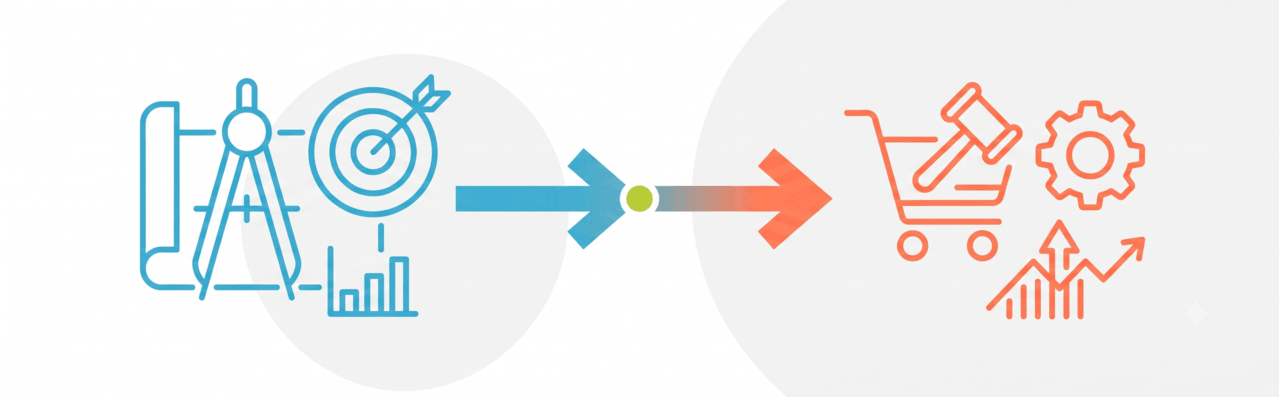
Media planning is the strategic phase of an ad cycle where target audiences, channels, budgets, and KPIs are defined using data and research. Media buying is the execution phase, focused on purchasing placements, optimizing bids, and managing performance. Planning sets direction, while buying controls delivery and efficiency.
Introduction
Media planning and media buying are often used together, but they describe different parts of the advertising process. Media planning focuses on strategy, while media buying focuses on execution. Campaigns usually perform best when both roles are clearly defined instead of handled as one task.
In advertising environments shaped by privacy-first tracking, algorithm-driven bidding, and cross-device attribution, the difference has become more important because campaigns run across multiple platforms such as search, social, programmatic, and native advertising. Without proper planning, budgets may be spent on the wrong audience or channel. Without effective buying, even a strong plan can fail due to poor placements or inefficient spending.
Industry guides describe media planning as the process of defining the audience, channels, and budget before a campaign starts, while media buying focuses on purchasing placements and optimizing performance once the campaign is running (Havas Edge, 2024; updated industry benchmarks, 2025–2026).
Understanding how these roles work together helps explain why some campaigns scale efficiently while others struggle even when the ads themselves look correct.
What This Guide Covers
This guide explains the difference between media planning and media buying and how both roles affect campaign performance across the advertising cycle.
This guide covers:
- What media planning means
- What media buying means
- Where they fit in the ad cycle
- The media planning process
- The media buying process
- How planning and buying work together
- Why both are needed for effective campaigns
What Is Media Planning?
Media planning is the strategic process of deciding how advertising should reach the target audience. This includes defining campaign goals, identifying the audience, selecting channels, setting the budget, and deciding how success will be measured.
The purpose of media planning is to determine the most efficient way to deliver a message to the right people at the right time. This step usually happens before any ad placements are purchased.
Typical media planning decisions include:
- Who should the campaign target?
- Which platforms should be used?
- How much budget should be allocated?
- When should ads run?
- What metrics will define success?
The result of this process is a media plan, which acts as the blueprint for the campaign. It outlines the audience, channel mix, budget distribution, and expected performance.
Research on advertising workflows shows that campaigns without proper planning often overspend on the wrong channels or fail to reach the intended audience, which reduces overall efficiency (updated industry benchmarks, 2025–2026).
Because campaigns now operate across privacy-restricted environments and multiple devices, media planning relies heavily on audience data, modeling, and performance forecasting instead of guesswork.
What Is Media Buying?
Media buying is the execution stage of the advertising cycle. After the media plan is created, media buying focuses on purchasing ad placements, setting up campaigns, and managing budget across selected platforms.
The goal of media buying is to get the best possible performance within the limits defined in the media plan.
Typical media buying responsibilities include:
- Purchasing ad inventory
- Negotiating rates or bids
- Setting up campaigns in ad platforms
- Monitoring performance
- Adjusting budget allocation
- Optimizing placements
Media buyers work directly with advertising platforms, publishers, or programmatic networks to secure the placements defined during planning.
Industry guides describe media buying as the process of turning strategy into action, ensuring ads run in the right place, at the right time, and at the right cost (Havas Edge, 2024; updated benchmarks, 2025–2026).
Even a strong media plan can fail if buying is inefficient. Poor bidding, wrong placements, or slow optimization can waste budget even when the strategy is correct.
For this reason, advertising systems today treat media planning and media buying as separate but connected roles, even as automation begins to overlap their functions.
Quick Comparison: Media Planning vs Media Buying
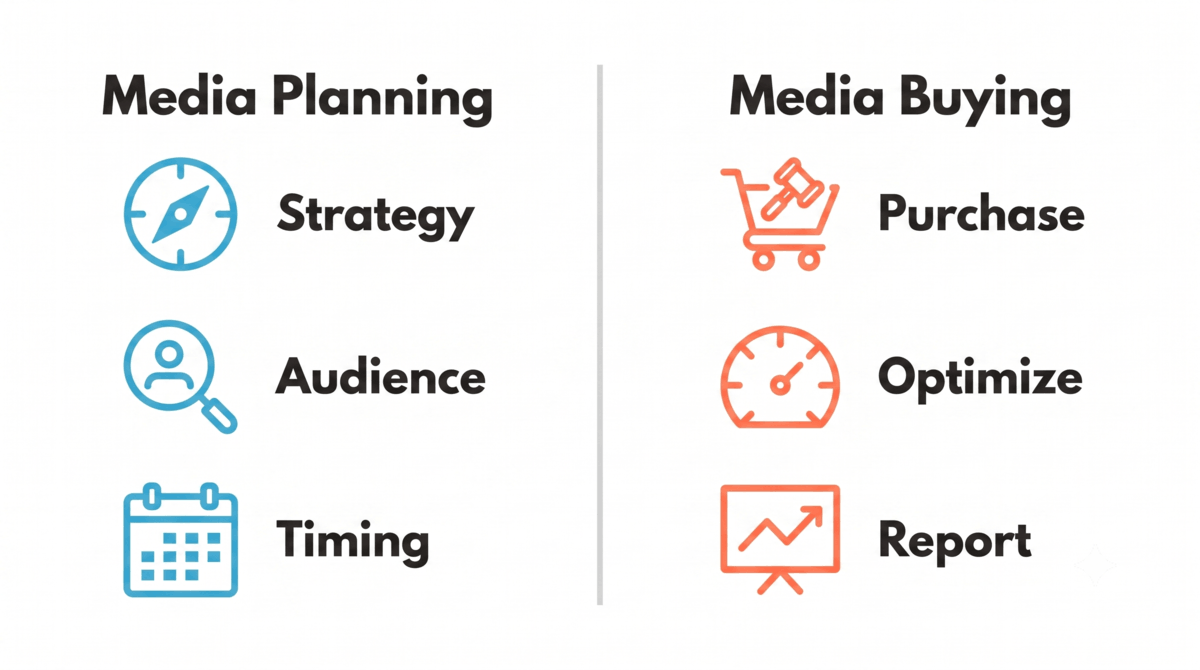
Media planning decides what should happen. Media buying makes it happen.
Where Media Planning and Media Buying Fit in the Ad Cycle
Advertising campaigns usually follow a cycle where strategy, execution, and optimization happen in sequence. Media planning and media buying are two different stages inside this cycle, and each has a specific role in how campaigns are prepared and launched.
A typical ad cycle includes:
- Research and goal setting
- Media planning
- Media buying
- Campaign launch
- Optimization
- Reporting and analysis
Media planning happens before any ads are purchased. At this stage, the target audience, channels, budget, and campaign goals are defined. The purpose of planning is to decide how the campaign should run before money is spent.
Media buying happens after the plan is created. This stage focuses on purchasing ad placements, setting up campaigns in advertising platforms, and managing performance while the campaign is live.
Understanding this sequence is important because problems in one stage affect the next. Poor planning can lead to wasted budget during buying, while weak buying execution can reduce performance even when the strategy is correct.
For this reason, media planning and media buying are usually treated as separate steps in the advertising cycle, but both must work together for campaigns to perform consistently.
The Media Planning Process: How Campaign Strategy Is Built
Media planning is the stage where the advertising strategy is defined before any ads are purchased. The goal is to decide how a campaign should reach the right audience using the available budget and channels. A structured planning process helps reduce wasted spend and improves the chances of reaching campaign goals.
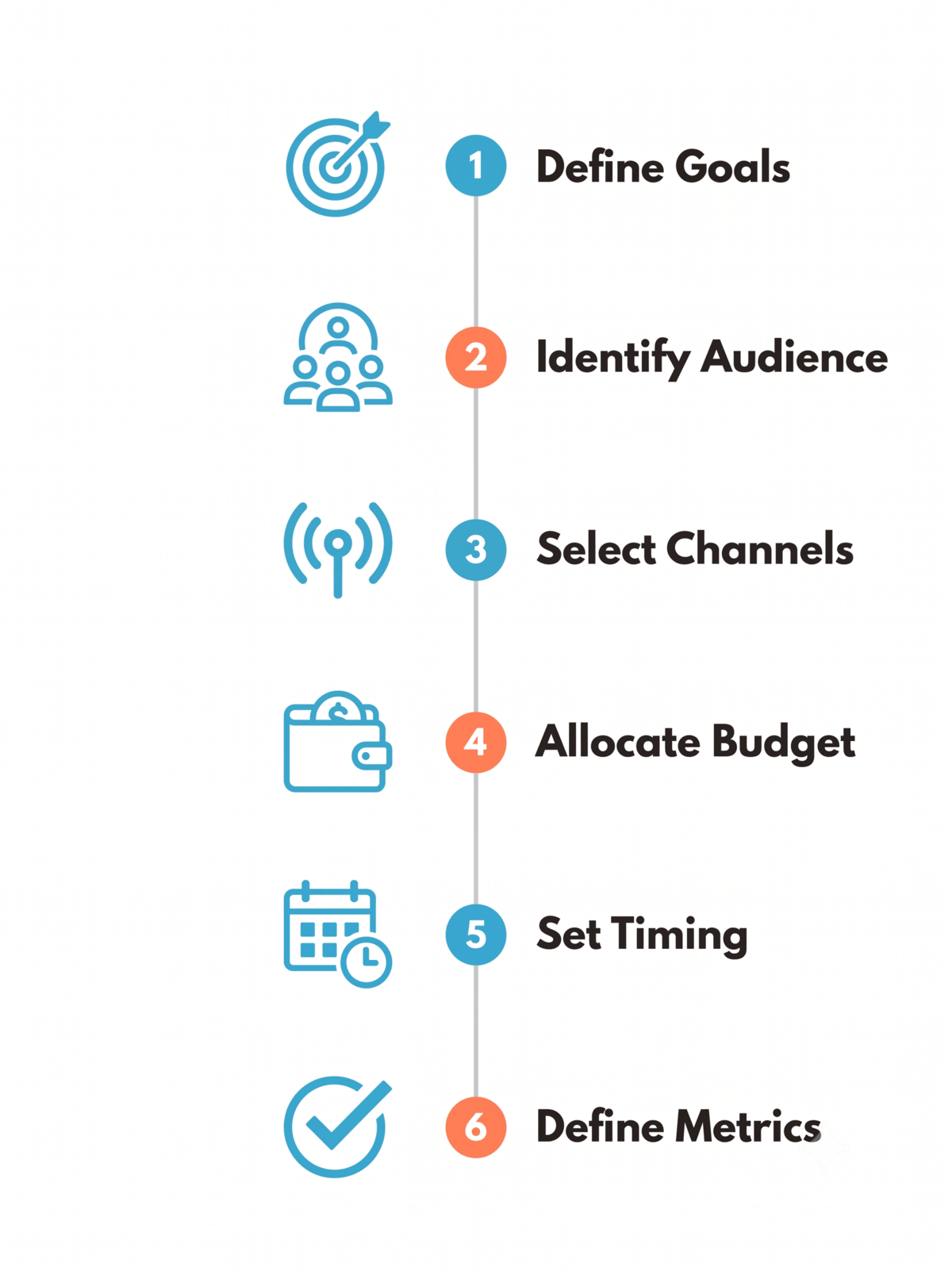
A typical media planning process includes several steps:
- Define campaign objectives
The first step is deciding what the campaign should achieve. Goals may include awareness, lead generation, sales, or customer retention. Clear objectives help determine which channels and metrics should be used. - Identify the target audience
Media planning requires understanding who the campaign should reach. This may include demographics, interests, location, behavior, or professional roles in B2B campaigns. Audience research helps avoid spending budget on users who are unlikely to convert. - Select the right channels
After defining the audience, planners choose where ads should run. Campaigns today operate across privacy-first ecosystems and multiple devices, including search, social media, display, native advertising, streaming, or traditional media. Channel selection depends on where the target audience is most active. - Allocate the budget
Media planners decide how much budget should be assigned to each channel. Budget allocation usually depends on expected reach, cost, and performance forecasts. - Define timing and schedule
Campaign timing can affect performance. Planners decide when ads should run, how long the campaign should last, and whether spending should be consistent or concentrated in specific periods. - Define success metrics
Before the campaign starts, planners decide how performance will be measured. Metrics may include impressions, clicks, conversions, pipeline, or revenue depending on the campaign goal.
The result of this process is a media plan, which acts as the blueprint for the campaign. Research on advertising workflows shows that campaigns with clear planning are more likely to use budget efficiently and reach the intended audience (updated industry benchmarks, 2025–2026).
The Media Buying Process: How Ads Are Purchased and Managed
Media buying is the execution phase of the advertising cycle. Once the media plan is complete, media buyers are responsible for purchasing ad placements, setting up campaigns, and managing budget across selected platforms.
The purpose of media buying is to get the best possible performance while staying within the limits defined in the media plan.
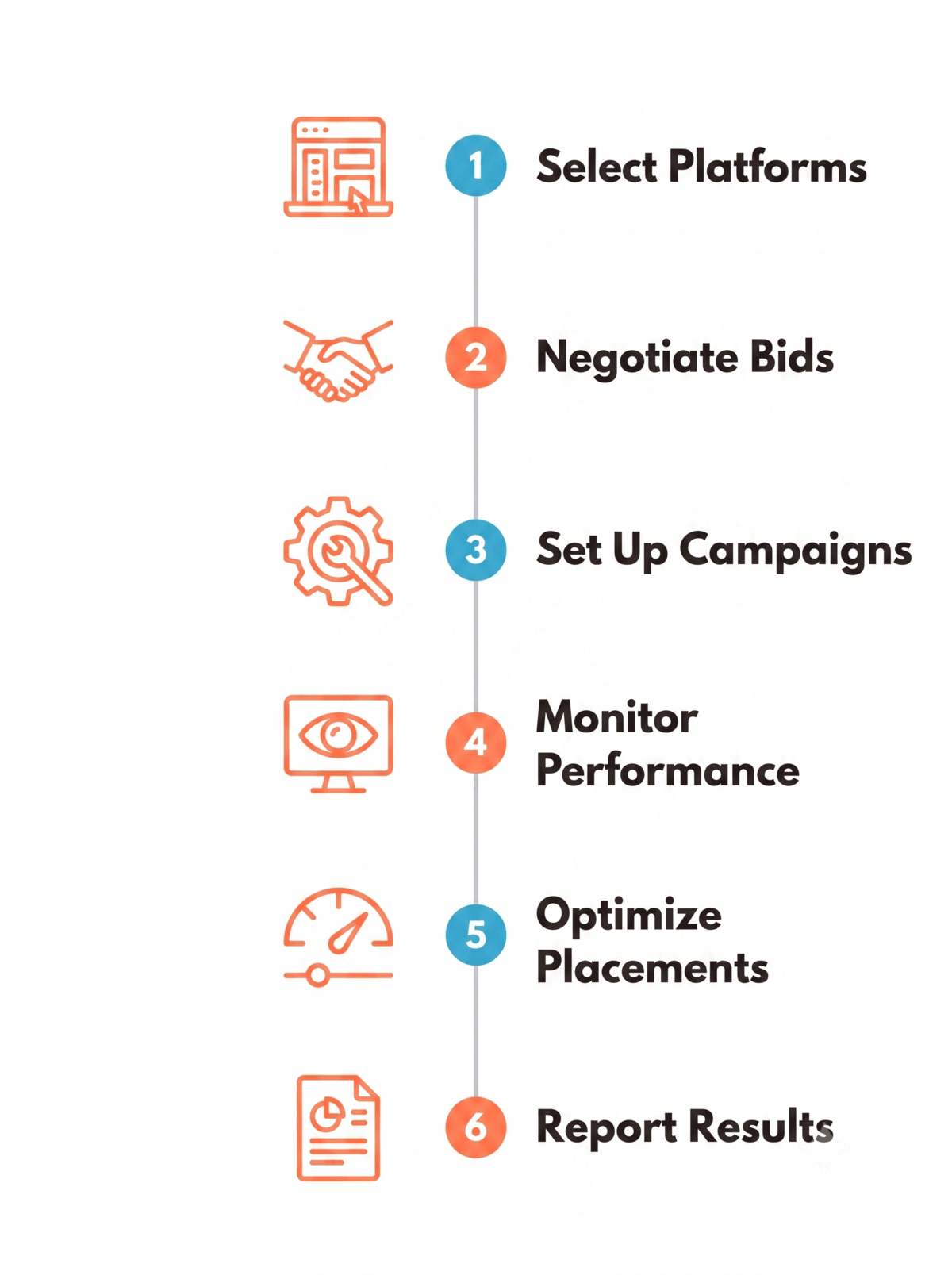
A typical media buying process includes:
- Selecting publishers or platforms
Media buyers choose where the ads will run based on the media plan. This may include platforms like Google Ads, Meta Ads, LinkedIn, programmatic networks, or direct publisher placements. - Negotiating rates or bids
In some cases, buyers negotiate prices with publishers or networks. In digital advertising, bidding systems are often used instead of fixed prices, but budget efficiency is still a key responsibility. - Setting up campaigns
Media buyers create campaigns inside ad platforms, define targeting, upload creatives, and configure budgets based on the media plan. - Monitoring performance
Once ads are live, buyers track results such as impressions, clicks, conversions, and cost. Monitoring helps identify whether the campaign is performing as expected. - Optimizing placements and budget
Media buying is not only about purchasing ads. Buyers adjust bids, budgets, and placements to improve performance during the campaign. - Reporting results
After or during the campaign, results are compared with the original plan to see whether goals were achieved.
Industry guides describe media buying as the stage where strategy becomes execution, and performance depends on how well placements are managed after the campaign starts (Havas Edge, 2024; updated benchmarks, 2025–2026).
Even with a strong media plan, poor buying decisions can reduce performance by placing ads in the wrong channels or overspending on inefficient placements.
How AI Is Changing Media Planning and Media Buying
AI-driven systems such as Google Performance Max, Meta Advantage+, and LinkedIn Predictive Audiences are increasingly automating both planning and buying decisions. These platforms use machine learning to handle targeting, bidding, and budget allocation in real time.
As a result, the traditional boundary between planning and buying is becoming less distinct. Planning inputs such as audience signals and creative strategy now directly influence automated buying decisions, while buying platforms continuously feed performance data back into planning.
This shift means advertisers must focus more on data quality, creative inputs, and strategic direction, while relying on AI systems to execute and optimize campaigns at scale.
How Media Planning and Media Buying Work Together
Media planning and media buying are separate roles, but campaign success depends on how well they work together. Planning defines the strategy, while buying controls execution. If either part is weak, the campaign may fail even when the other part is correct.
Media planning answers questions such as:
- Who should see the ads?
- Where should ads run?
- How much should be spent?
- What results are expected?
Media buying focuses on:
- Purchasing the placements
- Managing the budget
- Optimizing performance
- Adjusting campaigns during execution
Because campaigns now operate across algorithm-driven platforms and multiple devices, coordination between planning and buying is more important than before. Poor communication between the two can lead to problems such as:
- Budget spent on the wrong audience
- Incorrect channel selection
- Inconsistent performance data
- Wasted ad spend
Research on advertising workflows shows that campaigns perform best when planning and buying are aligned, especially in multi-channel campaigns where budget, targeting, and timing must stay consistent across platforms. 2026 benchmarks show that synchronized workflows are the top driver of ROAS in lean campaigns.
In digital advertising environments, planning and buying are often connected through data. Analytics tools, CRM systems, and ad platforms allow planners and buyers to adjust campaigns based on real performance instead of assumptions.
Because of this, successful campaigns usually treat media planning and media buying as parts of the same system rather than separate tasks.
Conclusion
Media planning and media buying are different stages of the advertising cycle, but both are required for strong campaign performance. Planning defines the strategy, including audience, channels, budget, and timing, while buying executes the plan by purchasing placements and managing spend.
Campaigns now run across privacy-first, algorithm-driven platforms, which makes coordination between planning and buying more important. A strong plan without proper execution can waste the budget, and efficient buying cannot fix a weak strategy.
Campaigns usually perform best when planning and buying work as one system, supported by data, analytics, performance tracking, and AI-driven optimization.
FAQs
What is media planning vs media buying?
Media planning defines the strategy, while media buying executes the campaign by purchasing ad placements and managing budget.
Which comes first, media planning or media buying?
Media planning comes first. Media buying follows the plan.
Can campaigns work without media planning?
Yes, but performance is usually less efficient without a clear strategy.
Is media planning only for traditional ads?
No. It is used for digital, social, search, programmatic, and traditional media.
Why is the difference important today?
Campaigns now operate across multiple platforms and automated systems, so separating planning and buying helps control budget and performance.
Related Content
Read These Next
E-commerce Marketing Automation: How to Increase Sales on Autopilot in 2026