.png)
.webp)
SEO vs Paid Advertising: Which Strategy Wins in the Long Run?
.png)

.png)

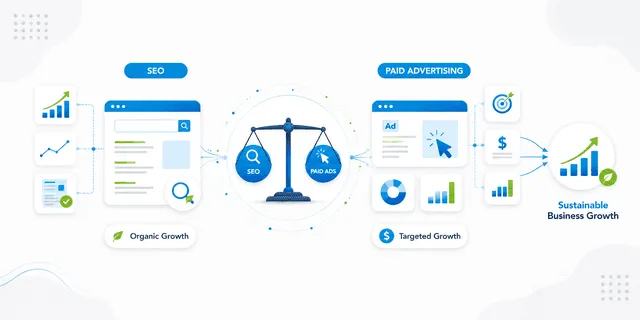
SEO wins for long-term ROI and sustainable growth, typically achieving a 30–60% lower CPA than paid channels after 12 months — provided the SEO investment is adequately funded and the market has sufficient search volume. Paid advertising wins for speed, testing, and immediate scaling. In 2026, the most effective approach is a hybrid system where paid data informs SEO content strategy and organic authority reduces paid CPCs over time.
Introduction
The question of whether to invest in SEO or paid advertising is one of the most common strategic decisions in digital marketing — and one of the most frequently misframed. Both strategies drive traffic and generate leads, but they do so through fundamentally different mechanisms, on different timelines, and with different cost structures.
What makes the comparison more complex is that both channels are being reshaped by the same forces. AI-driven search is changing how organic content earns visibility, with AI Overviews from Google Gemini now appearing above traditional organic results for a growing range of queries — and AI search tools like Perplexity increasingly cited as alternative discovery surfaces. On the paid side, automated bidding systems have reduced manual control while privacy restrictions have degraded tracking precision. According to multiple 2025–2026 SEO timeline studies, SEO typically takes four to six months to begin generating measurable rankings and traffic — a threshold that has remained broadly consistent, though significant business-level ROI usually matures between nine and twelve months, and timelines lengthen in more competitive verticals as content volume and AI Overview prevalence increase.
For C-level decision-makers and growth leaders across APAC, the US, and Australia, the practical question is not which strategy wins in the abstract — it is which to prioritize given specific business goals, timelines, and the competitive conditions of the relevant market.
What This Guide Covers
This guide explains how SEO and paid advertising differ in their long-term ROI profiles and how to decide where to focus based on your business situation.
It covers:
- What SEO and paid advertising each deliver
- How their ROI profiles differ over time
- Key metrics and realistic benchmarks for each
- Where each strategy breaks down in practice
- How SEO and paid advertising work together as a system
- How to decide which to prioritize and when
What Is the Core Difference Between SEO and Paid Advertising?
SEO generates traffic by earning visibility in search engine results through content quality, technical optimisation, and authority signals. Results build over time and persist without ongoing spend. Paid advertising generates traffic by purchasing placements in search results or on other platforms — results are immediate but stop when the budget stops.
The functional difference matters for how ROI is calculated. Paid advertising produces results directly attributable to spend. SEO produces results that are harder to attribute to any single investment but accumulate over time. A paid campaign that drives 500 conversions this month requires the same budget to repeat next month. A page that ranks for a high-intent query this month may drive similar traffic for years.
How Do SEO and Paid Advertising ROI Compare Over Time?
Paid advertising delivers faster ROI but requires continuous investment to maintain it. SEO delivers slower ROI but compounds over time, reducing dependency on ad spend as content matures.
The difference in trajectory is significant. A paid campaign can generate measurable returns within days. The same investment in SEO — content production, technical optimisation, link building — may take four to six months to produce comparable traffic, with meaningful business-level ROI typically maturing between nine and twelve months. But the SEO investment does not expire. Once content ranks, the cost per acquisition from that content decreases with every month it continues to perform.
It is also worth noting that SEO's ROI advantage is not guaranteed — it depends on adequate investment. An underfunded SEO programme producing two to three pieces of content per month will rarely outperform a well-funded paid search campaign, regardless of time horizon. The 30–60% CPA advantage SEO typically delivers at the twelve-month mark assumes consistent content production, active technical maintenance, and sufficient link-building activity. Based on 2025–2026 performance observations across B2B markets in Australia and Southeast Asia, we have found that underfunded SEO programmes — those operating below the content velocity needed to establish topical authority — consistently fail to reach the compounding phase and end up being compared unfavourably against paid performance that is simply better-resourced.
In practice, the ROI comparison depends on four variables:
- Time horizon — paid wins at three months; SEO often wins at twelve months or beyond
- Competition — in highly competitive paid markets, rising CPCs erode paid ROI faster than SEO costs increase
- Content quality — SEO ROI depends on producing content that earns rankings and sustains them through algorithm updates
- Conversion infrastructure — both strategies require strong landing pages and offers to convert traffic into revenue
Neither strategy delivers strong long-term ROI in isolation. Businesses relying entirely on paid advertising face rising acquisition costs as competition increases. Businesses relying entirely on SEO face slow growth and limited ability to scale quickly when needed.
What Are Realistic Performance Benchmarks for Each Strategy?
Performance ranges vary significantly by industry, audience, and execution quality. The figures below are directional.
SEO benchmarks:
- Time to first-page rankings: four to six months for new content targeting low-to-moderate competition keywords (keyword difficulty scores of roughly 20–40 in tools like Ahrefs or Semrush); six to twelve months for competitive terms in global SaaS or financial services; three to four months for local service businesses competing in a single city or region. A Semrush study found that 41% of domains reached the top 10 within six months, but only 27% maintained that position through month thirteen — a reminder that ranking is not the same as sustained performance. In 2026, these timelines are further complicated by AI Overviews: content may earn citation visibility in AI summaries within the first few months before reaching a traditional top-10 ranking, shifting what "early results" looks like
- Organic search conversion rates: typically 2% to 5% for well-optimised landing pages
- Cost per acquisition over time: decreases as content matures; established SEO programmes often achieve CPA 30% to 60% lower than equivalent paid campaigns
- Click-through rates: organic position one typically generates CTRs between 25% and 35% for branded queries; lower for competitive non-branded terms
Paid advertising benchmarks:
- Search ads: conversion rates typically range from 3% to 8% for high-intent queries — though this varies significantly by vertical; B2B SaaS campaigns commonly see 2.5% to 5%, while high-intent B2C e-commerce can reach 5% to 8% or higher (Lever Digital / GrowthSpree, 2026)
- ROAS across paid search campaigns: 3x to 6x for well-optimised campaigns, though this varies significantly by category
- CPC in competitive B2B markets: can range from $5 to $50+ depending on keyword and platform
- Time to results: days from campaign launch, with optimisation cycles of two to four weeks
These ranges reflect how differently the two strategies are measured. Paid performance is visible immediately and adjustable in real time. SEO performance is slower to confirm but tends to stabilise at a lower long-term acquisition cost once established.
Where Does Each Strategy Break Down in Practice?
Both SEO and paid advertising operate with constraints that are frequently underestimated before implementation.
SEO limitations:
Organic rankings are sensitive to algorithm updates. A page that drives consistent traffic today may see reduced visibility after a search engine update — with no advance notice and no direct recourse. AI Overviews and generative search results from tools like Google Gemini and Perplexity are also changing how organic content earns clicks. Some queries that previously drove strong organic traffic now return AI-generated summaries at the top of the page, reducing click volume even when rankings hold — a January–February 2026 randomised field study found AI Overviews reduced organic clicks on triggered queries by 38%. This is particularly relevant for informational content, shifting the SEO priority toward higher-intent queries closer to a conversion decision.
SEO also requires sustained investment in content production and technical maintenance. Rankings earned two years ago may no longer reflect current search intent, competitive content quality, or technical standards — requiring ongoing updates to remain effective. It is not a set-and-forget channel.
Paid advertising limitations:
Paid campaigns depend on tracking accuracy to optimise correctly. Privacy changes — browser-level restrictions, the deprecation of third-party cookies, and platform-side signal loss — have reduced the quality of data available to ad platforms. A growing portion of attributed conversions (conversions that the platform claims credit for based on its own tracking) is now modelled rather than directly observed (meaning the platform is estimating, not measuring, what caused the conversion), which means reported ROAS figures are less reliable than they appear. Cross-referencing platform data against attribution tools such as Northbeam or Rockerbox, or against backend CRM revenue, provides a more accurate picture of true paid performance. Attribution gaps between paid and organic channels are also common; platforms tend to over-attribute conversions to paid touchpoints, making paid ROI look stronger than backend revenue data often confirms.
Ad fatigue compounds this. Creative performance degrades over time as audiences see the same ads repeatedly, requiring ongoing investment in new formats and messaging to maintain performance levels. In competitive markets, rising CPCs compress margins, meaning the same budget produces fewer conversions as competition increases.
How Do SEO and Paid Advertising Work Together?
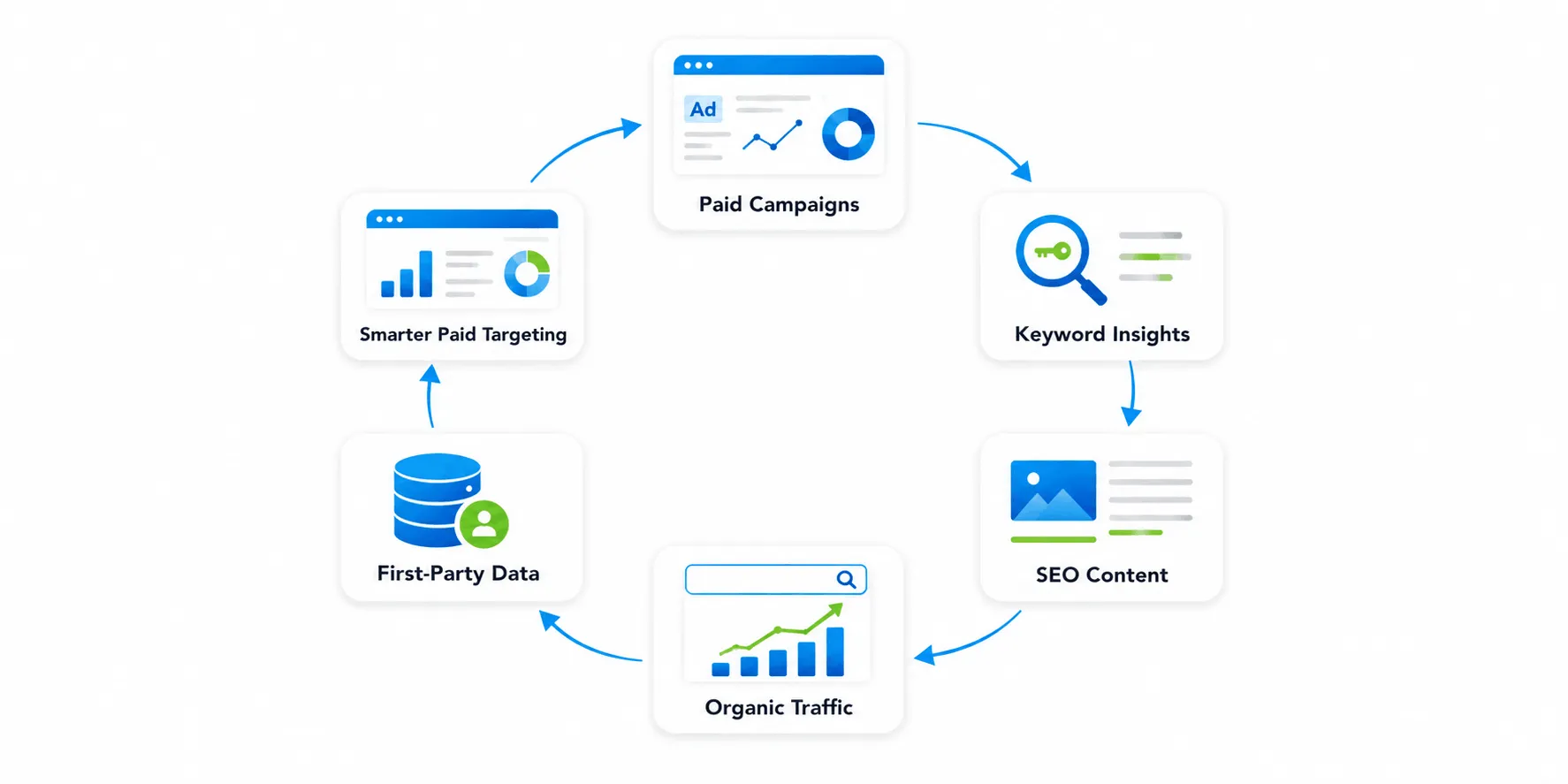
SEO and paid advertising are most effective when treated as a connected system rather than independent strategies. Each produces data and signals that improve the performance of the other, and the two channels interact across the customer journey in ways that neither can replicate alone.
Paid search campaigns generate real-time data on which queries, messages, and offers convert. That data directly informs SEO content strategy — high-converting paid keywords are often the best candidates for organic content investment, because demand is already validated. Organic content that demonstrates engagement can be amplified through paid promotion, accelerating reach without building campaigns from scratch.
The interaction works in the other direction as well. Strong organic presence — established content rankings, brand recognition, high domain authority — reduces paid advertising costs over time. Users who encounter a brand through organic search before seeing a paid ad convert at higher rates, and in some channels at lower CPCs. This is one reason businesses investing in both tend to see better paid performance than those relying on paid alone.
A practical workflow connecting both strategies:
- Use paid search to identify high-converting queries, then build organic content around those terms
- Promote high-performing organic content through paid social to extend reach cost-efficiently
- Use retargeting to re-engage users who found the brand through organic search but did not convert
- Feed first-party data from organic content interactions back into paid audience targeting
The channels are not alternatives — they operate at different stages of the same acquisition system, and misalignment between them is one of the most common causes of underperformance in both.
When Should You Prioritize Paid Advertising?
Paid advertising should be prioritised when speed of results matters more than long-term cost efficiency. It is the right primary channel in specific situations:
- Launching a new product or entering a new market where organic visibility does not yet exist
- Running time-sensitive campaigns tied to promotions, events, or seasonal demand
- Testing messaging, offers, or audience segments before committing to content production
- Scaling revenue quickly when organic growth alone cannot meet near-term targets
The decision to scale paid spend should be driven by stable performance across a sustained period — not by strong platform-reported numbers alone. CPA should align with margins, ROAS should remain consistent when budgets increase, and conversion rates should hold across traffic sources. When these metrics deteriorate under scale, it usually signals an audience saturation or offer problem rather than a channel problem.
When Should You Prioritize SEO?
SEO should be prioritised when the goal is durable, lower-cost acquisition over a longer time horizon. It is the more efficient primary strategy when:
- The business has a defined content niche where it can realistically compete for search visibility
- Sales cycles are long and buyers require education before converting — a profile common in B2B markets across APAC, the US, and Australia
- Paid acquisition costs in the relevant market are high enough to make organic the more viable long-term option
- The business is building toward reduced dependency on paid channels as it matures
SEO is not suited to generating immediate revenue. It requires patience and consistency, and ROI is harder to attribute directly to specific investments. Businesses that treat SEO as an afterthought and expect results within 60 days consistently underestimate the investment required and abandon the strategy before it compounds.
How Do AI and Privacy Changes Affect the SEO vs Paid Decision?
The operating conditions for both strategies have shifted in ways that change the relative calculus between them.
On the paid side, AI-driven platforms have improved delivery efficiency but degraded attribution accuracy. Privacy restrictions mean that a significant portion of attributed conversions on most platforms is now modelled rather than directly tracked, making paid ROI harder to validate and easier to misread. Scaling campaigns based on platform-reported performance without cross-referencing attribution software like Northbeam or Rockerbox — or backend CRM revenue — is a growing source of budget waste.
On the SEO side, AI Overviews and generative search results are changing click behaviour for informational queries. Content that previously ranked well and drove consistent traffic now faces reduced click volume as Google Gemini and Perplexity surface AI-generated answers that satisfy the query without a click. This is shifting the SEO priority away from top-of-funnel informational content toward higher-intent content that captures users closer to a decision — a shift that makes SEO and paid search more complementary than they have historically been.
Both changes point toward the same practical conclusion: first-party data becomes more valuable as third-party tracking degrades, and content that demonstrates genuine expertise and intent-alignment performs better in both channels than content produced primarily for volume or broad keyword coverage.
Conclusion
SEO and paid advertising serve different functions in the same acquisition system. Paid delivers speed and scalability at a cost that tends to rise over time. SEO delivers durability and compounding efficiency at a cost that decreases as content matures. Neither is inherently better — the right balance depends on business stage, time horizon, competitive conditions, and the budget committed to each.
For most businesses, the practical path is to use paid advertising to generate near-term results and gather data, while building SEO to reduce long-term acquisition costs. The mistake is treating the two as a choice rather than a sequence. Businesses that integrate both — using data from each channel to improve the other — consistently outperform those that optimise them in isolation.
FAQs
Which delivers better ROI: SEO or paid advertising? SEO typically delivers better ROI over a 12-month or longer horizon due to compounding traffic and declining CPA — but only when the investment is adequately funded; an underfunded SEO programme will not outperform a well-resourced paid campaign regardless of time horizon.
How long does SEO take to show results? Four to six months to generate measurable rankings and traffic in moderate competition (keyword difficulty 20–40); nine to twelve months for meaningful business-level ROI. In 2026, AI Overview citations may surface brand visibility earlier, though click volume takes longer to compound.
Can paid advertising improve SEO performance? Yes — paid campaigns identify high-converting queries and messages that directly inform organic content strategy, and paid promotion of organic content can accelerate reach and support link acquisition.
What is a realistic ROAS for paid search? Well-optimised campaigns typically generate 3x to 6x ROAS; consistently below 2x usually indicates a structural issue in targeting, creative, or landing page performance.
How do AI Overviews affect SEO strategy? AI Overviews reduce click volume for informational queries by surfacing answers directly in search results, shifting the SEO priority toward higher-intent content closer to a conversion decision where organic clicks remain more stable.
Related Content
Read These Next
E-commerce Marketing Automation: How to Increase Sales on Autopilot in 2026