.png)

What is Growth Hacking? - The Definitive 2026 Guide for Modern Marketers
.png)

.png)

Growth hacking is a data-driven system for rapid business scaling through continuous testing across the AARRR funnel (Acquisition, Activation, Retention, Referral, Revenue). In 2026, modern growth teams combine AI-native workflows, automated outreach, and Generative Engine Optimization (GEO) to maximize capital efficiency and improve LTV:CAC ratios.
Key Takeaways
- Growth hacking has evolved from one-off viral tricks into repeatable enterprise systems focused on capital efficiency, sustainability, and LTV/CAC ratios rather than sheer user volume.
- High-performing teams leverage autonomous prospecting agents while maintaining human strategic oversight to scale outreach effectively without inflating headcount.
- With searches resulting in zero clicks due to AI summaries, growth teams must prioritize Generative Engine Optimization (GEO) and structured data to remain visible.
- Modern growth teams combine product, data, and marketing into single unified cells consisting of five core roles to execute rapid, daily experimentation.
- Organizations must actively manage data silos, overautomation, and technical debt to prevent system fragility and testing delays.
How Growth Hacking Tactics Evolved from 2010 to 2026
The discipline of growth hacking has transitioned from creative technical tricks to mature enterprise systems. This change reflects a shift from focusing on sheer speed to focusing on sustainable profitability and capital efficiency.
- Single Viral Loops → Repeatable Growth Systems
In 2010, the field focused on identifying a single viral loop, such as a referral program. By 2026, market saturation and changing algorithms have made single-channel successes temporary. High-performing teams now build a testing engine. This engine identifies multiple, overlapping paths to growth across all product features. This system provides a way for the business to have several data-validated paths to maintain momentum if one channel fails. This transition to Rapid Experimentation aims to prevent a business from becoming dependent on a single tactic.
- Experimental Tactics → Enterprise Frameworks
Early growth hacking was a method for startups with small budgets. In 2026, large organizations have adopted Enterprise Scalability frameworks to maintain agility. Legacy companies that fail to adopt an Agile Methodology often struggle to keep pace with AI-native competitors.
These frameworks allow global corporations to test and deploy changes at the speed of a small team. This removes the slow approval cycles that typically hinder innovation.
- High User Volume → Capital Efficiency
Success was once measured by the total number of new sign-ups. In 2026, profitability is the mandatory focus. High-growth leaders prioritize the LTV:CAC Ratio and the Payback Period. This ensures that the revenue a customer generates is at least three to four times higher than the cost to acquire them.
In a tighter funding environment, chasing user volume without profit increases the risk of bankruptcy. Elite teams focus on the Customer Acquisition Cost as a primary lever for long-term health.
- Manual Task Execution → AI-Native Workflows
Spreadsheets and basic automation can no longer process the volume of modern growth data. In 2026, high-performing teams use Autonomous Prospecting Agents to handle repetitive research, enrichment, and outreach preparation while humans remain responsible for strategy and quality control.
For example, an Autonomous Prospecting Agent might scrape publicly available LinkedIn company data, enrich the account with firmographic signals from Clay or Apollo, verify email syntax, check CRM history in HubSpot or Salesforce, and stage a personalized outbound sequence without human intervention. The human operator then reviews the logic, approves the messaging, and ensures the workflow stays aligned with brand voice and compliance standards.
In our growth experiments, we found that the strongest AI-native workflows do not remove humans from the process. They remove low-value manual execution so growth teams can spend more time on positioning, segmentation, offer testing, and conversion analysis.
The human role has shifted to a Strategic Architect. These architects set ethical guardrails, train AI systems on brand-specific context, connect tools such as Zapier, Clay, HubSpot, Salesforce, Perplexity, and the OpenAI API, and perform quality control before campaigns reach prospects. This is the Human-in-the-Loop requirement.
Without human strategic oversight, automated systems can produce robotic or irrelevant communication that damages brand reputation.
Adopting AI-Native Workflow Automation allows teams to scale outreach without necessarily increasing headcount.
- Traditional Search SEO → Generative Engine Optimization (GEO)
Organic traffic is declining as AI assistants answer queries directly. Brands must pivot to Generative Engine Optimization (GEO) to remain visible. GEO helps brands structure content, so AI-powered search engines and assistants can discover, understand, and cite them as a resource.
Teams that focus on Answer Engine Optimization and Structured Data work to ensure their brand is the source cited by the AI. Those who remain focused only on traditional search rankings risk a loss of visibility as users move to AI-first interfaces.
Organizational Structure of a Successful 2026 Growth Team
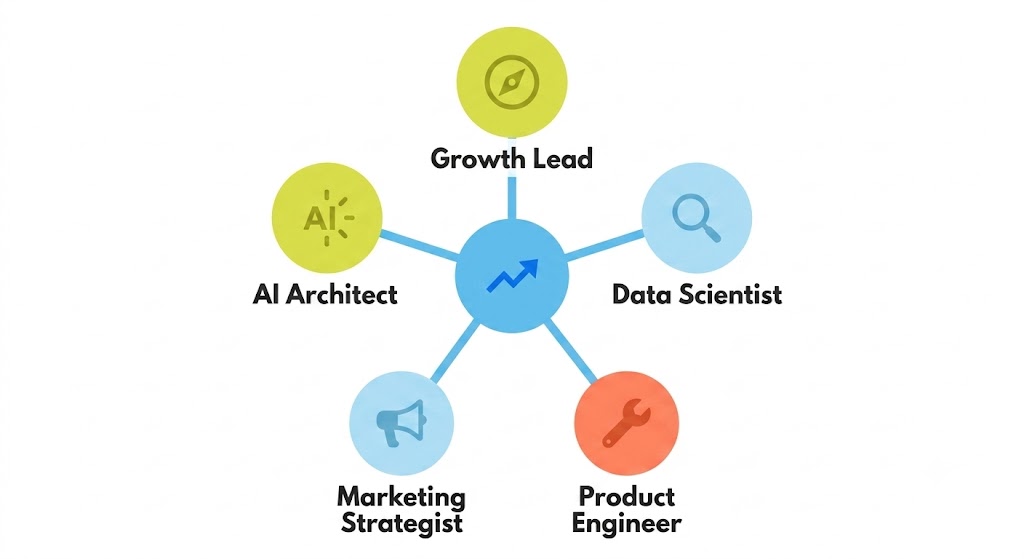
A modern Growth Hacking team operates as a single, cross-functional cell rather than a group of isolated departments. This structure ensures that product, data, and marketing are perfectly aligned. To function correctly, the model typically includes five core roles:
- The Growth Lead (The Architect): This individual manages the testing engine. The role ensures experiments move quickly from the idea phase to the analysis phase and maintains the overall strategy.
- The Data Scientist (The Analyst): This role provides real-time analysis of user behavior. They identify friction points where users get stuck and provide the data needed to validate or reject a hypothesis.
- The Product Engineer (The Builder): Growth in 2026 is built into the software. This engineer implements technical experiments, such as new onboarding flows or referral triggers, directly into the product.
- The Marketing Strategist (The Distributor): This person manages the channels that bring users to the product. They focus on Generative Engine Optimization and ensuring the brand is visible where AI agents search for information.
- The Strategic AI Architect (The Controller): This role oversees the AI-Native Workflows. They train Autonomous Prospecting Agents, perform quality control on automated outreach, and ensure the AI remains grounded in trusted brand data.
This integrated model allows the team to identify a problem, build a test, and analyze the results in days rather than months. When every member of the team has access to the same data, the organization makes faster and more accurate decisions.
Main Differences Between Traditional Marketing and Growth Hacking
Traditional marketing and growth hacking share similar goals but use distinct methods and metrics. The following table outlines the differences between these two approaches in the 2026 business landscape.
Traditional marketing primarily focuses on the beginning of the customer journey. It relies on large-scale campaigns planned several months. Conversely, growth hacking focuses on the entire lifecycle of a customer. It uses high-velocity testing to make incremental improvements daily.
Modern growth hackers prioritize how AI engines summarize brand information rather than just traditional search engine rankings. While marketing aims to tell a story, growth hacking aims to build a scalable system for revenue.
Optimizing the AARRR Funnel for the AI Era
The AARRR funnel remains the essential framework for growth hacking. This acronym represents Acquisition, Activation, Retention, Referral, and Revenue. In 2026, data and AI optimize every stage of this sequence to support capital efficiency.
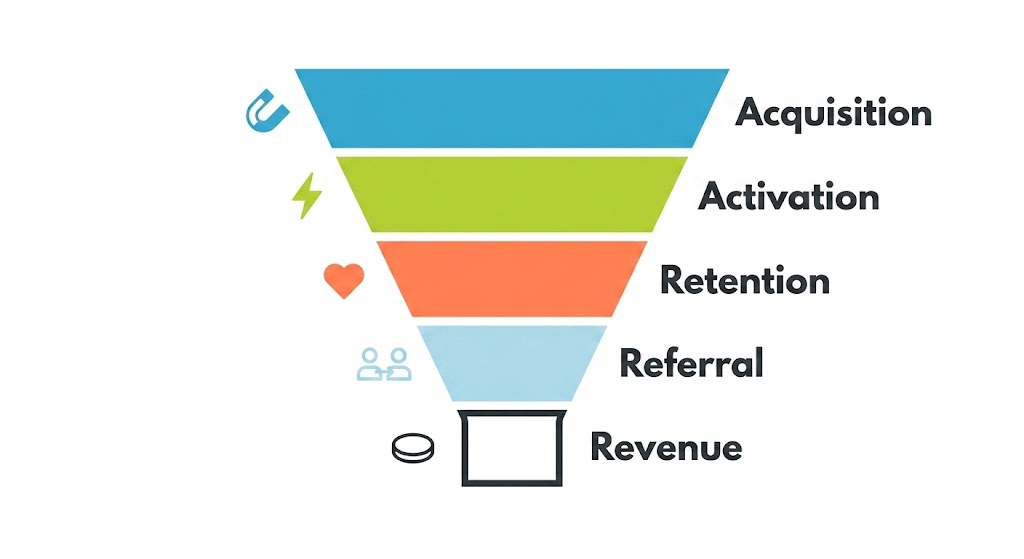
Acquisition: Identifying Profitable Channels
Acquisition involves identifying the most profitable channels for attracting new users. Growth hackers analyze data to determine which platforms provide the highest return on investment.
Customer acquisition cost (CAC) benchmarks vary widely by industry, business model, and target market, so they should be used as general reference points rather than fixed standards. According to Data-Mania’s 2026 figures estimate an average CAC of approximately $536 for B2B technology startups. In fintech, the estimated average rises to about $1,450 for standard accounts and can reach approximately $14,772 for enterprise clients.
These figures are useful directional benchmarks, but they should not be treated as universal targets. Customer acquisition costs fluctuate widely by sub-industry, deal size, sales motion, geography, sales cycle length, and whether the company relies on product-led growth, outbound sales, paid acquisition, partner channels, or enterprise account-based marketing.
When auditing B2B tech stacks, we observed that the more useful question is not “Is our CAC above or below the benchmark?” but “Which channel, segment, or workflow is pushing CAC up without improving payback period or lifetime value?”
Activation: Reducing Time to Value
Activation focuses on reducing the time it takes for a new user to realize the value of a product. This period is known as Time to Value. If a user does not understand the benefit of a product within the first few minutes, the likelihood that they will stop using the product increases.
Growth teams use data to identify the exact point where a user becomes comfortable with the service.
Retention: Prioritizing Customer Loyalty
Retention is a critical stage for sustainable scaling. Maintaining existing customers is more cost-effective than finding new ones.
Data indicates that reducing consumer loss from 2% to 1.5% can increase the total lifetime value of a customer by 33% (SaaS Hero, 2026).
Referral: Creating Organic Growth Loops
Referral systems are designed to encourage current users to invite new users organically. This reduces the need for additional advertising spend.
Modern growth hacking integrates these loops directly into the product experience. This makes it natural for users to share the service with colleagues or friends during their normal work.
Revenue: Optimizing Unit Economics
Revenue optimization ensures that the business model is profitable. Growth hackers test pricing models, checkout processes, and expansion revenue strategies.
The goal is to reach a ratio of customer value to customer cost of at least 3:1. High-growth leaders often target a 4:1 ratio or better (SaaS Hero, 2026).
Role of Generative Engine Optimization (GEO) in Growth Hacking
The nature of search engine visibility has changed. In the past, the objective was to rank at the top of a list of search results.
In 2026, users often receive answers directly from AI assistants such as ChatGPT5, Gemini3,1, or Claude. This shift has led to the development of Generative Engine Optimization.
Modern growth hacking requires content and documentation that AI engines can easily interpret, retrieve, and cite. This includes structured content, Schema.org markup, JSON-LD, clean Markdown documentation, and technically consistent product pages that can be parsed by AI search systems.
Growth teams increasingly pair Generative Engine Optimization (GEO) with Retrieval-Augmented Generation (RAG) workflows. In practice, this means organizing brand knowledge inside internal documentation, vector databases, and CRM-connected knowledge systems so AI tools can retrieve accurate product, pricing, use-case, and customer data.
Tools such as Perplexity, ChatGPT, Claude, Gemini, and AI-enabled search engines reward content that is specific, well-structured, and connected to recognizable entities.
In our growth experiments, we found that pages with clearly named integrations are easier for both search engines and AI assistants to classify. These named entities help anchor the article in real commercial workflows rather than abstract growth theory.
To support LLM visibility, growth teams should document workflows in machine-readable formats wherever possible. This strategy involves the use of Structured Data, a specific code that labels information on a webpage, such as facts, prices, or reviews. This code helps AI software understand the context and recommend the brand to users.
Common Barriers to Scaling: Technical Debt and Data Silos
- Managing Technical Debt
Rapid expansion often introduces new structural challenges. One of the most significant issues in 2026 is Technical Debt. Technical debt refers to the accumulation of unorganized code or fragmented automation.
This happens when a team prioritizes speed over the health of their systems. Because AI can generate code with limited expert input, called vibe-coding, organizations are accumulating this debt at an accelerated rate.
Unmanaged technical debt makes systems fragile and difficult to update. Complexity becomes more expensive with every change, which can slow down the testing cycle.
Leaders must implement strategies to reduce this debt before it stalls growth. Successful teams allocate time to clean up codebases and ensure that all automation is documented and sustainable.
- Fixing Data Silos with a Unified System
A data silo occurs when information is trapped within one department and not shared across the organization. Growth hacking requires a single source of truth to be effective. If the marketing team cannot access data from the product team, experiments carry a higher risk of failure.
High-performing organizations work to ensure that data flows freely across all platforms. This transparency allows the team to understand the full customer journey and make informed strategic decisions.
- Preventing Overautomation with Human Oversight
As organizations deploy autonomous prospecting agents to handle manual lead generation, the risk of overautomation increases. Complete reliance on automated software without human oversight can lead to repetitive, unaligned messaging that alienates prospective buyers. To prevent this, successful frameworks use a human-in-the-loop integration model.
The HITL model prompts human teams to act as the strategic controllers of the automated workflows. While AI agents execute the automated research and outreach, humans provide the critical thinking required for creative testing, high-level strategy, and contextual refinement.
This balanced integration ensures that the scaling engine remains highly productive without sacrificing the authenticity and accuracy needed to convert leads successfully.
Growth hacking in 2026 is a disciplined approach that combines human strategic thinking with machine efficiency.
By focusing on continuous testing, capital efficiency, and new search engine realities, organizations can build resilient systems that scale effectively in a rapidly changing market.
Final Thoughts
To successfully implement modern growth hacking, organizations should take the following actionable steps:
- Dedicate specific operational cycles to clean up codebases and document automated workflows to prevent future testing delays.
- Add specific code to label webpage information, ensuring AI engines can easily read and cite the brand.
- Break down departmental data silos between marketing and product teams to establish a single source of truth for experiments.
- Refine the AARRR funnel stages to target an ideal customer lifetime value to acquisition cost ratio of 3:1 or 4:1.
Frequently Asked Questions (FAQs)
What is Generative Engine Optimization (GEO)?
GEO is the practice of optimizing website content using structured data so AI assistants can easily interpret, recommend, and cite the brand within AI-generated summaries.
Why has the focus shifted from user volume to capital efficiency?
In a tighter funding environment, chasing user sign-ups without profit increases bankruptcy risks. High-growth leaders now prioritize profitability and metrics like the LTV:CAC ratio.
What is the "Human-in-the-Loop" requirement?
While automated systems handle execution, humans must act as Strategic Architects to set ethical guardrails, provide brand context, and perform quality control to prevent damaging brand reputation.
Related Content
Read These Next
E-commerce Marketing Automation: How to Increase Sales on Autopilot in 2026