.png)
.webp)
AI Performance Marketing: How to Use Artificial Intelligence to Hyper-Scale Results
.png)

.png)

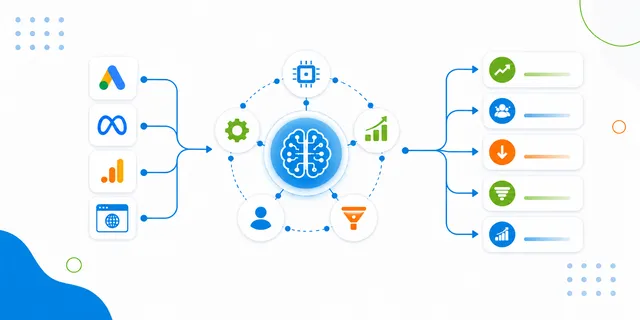
AI performance marketing is a data-driven strategy that uses machine learning to automate bidding, targeting, and creative optimization based on bottom-funnel business outcomes such as revenue, CAC, and pipeline value instead of clicks or impressions. It connects ad platforms, analytics, and CRM systems so campaigns can scale using predictive optimization rather than manual adjustments.
Artificial intelligence is now part of performance marketing because modern campaigns generate more data, run across more platforms, and require faster decisions than manual optimization can handle. As advertising costs increase and customer journeys become fragmented across search, social, email, and CRM systems, scaling results depends on automation, analytics, and predictive models rather than manual campaign management alone.
In modern ad platforms, machine learning controls bidding, targeting, and delivery using performance signals. Features such as Google Performance Max, Meta Advantage+, predictive lead scoring, and automated bidding models decide where the budget should go based on conversion data, CRM inputs, and historical performance. Because of this shift, campaign results depend more on data quality than on manual optimization.
To scale reliably, advertising platforms, analytics tools, and CRM systems must be connected so AI can optimize toward real business results instead of activity metrics. This guide explains how AI performance marketing works, where artificial intelligence is used, how the full system is built, and why scaling with AI requires strong data signals, correct tracking, and clear conversion goals.
What This Guide Covers?
This guide explains how artificial intelligence is used in performance marketing to improve efficiency, decision-making, and scalability across campaigns.
It covers:
- what AI performance marketing means
- where AI is used in campaigns
- how AI helps scale results
- how AI performance systems work
- workflow for using AI in marketing
- why AI performance marketing fails
- modern limits of AI-driven optimization
1. What Is AI Performance Marketing?
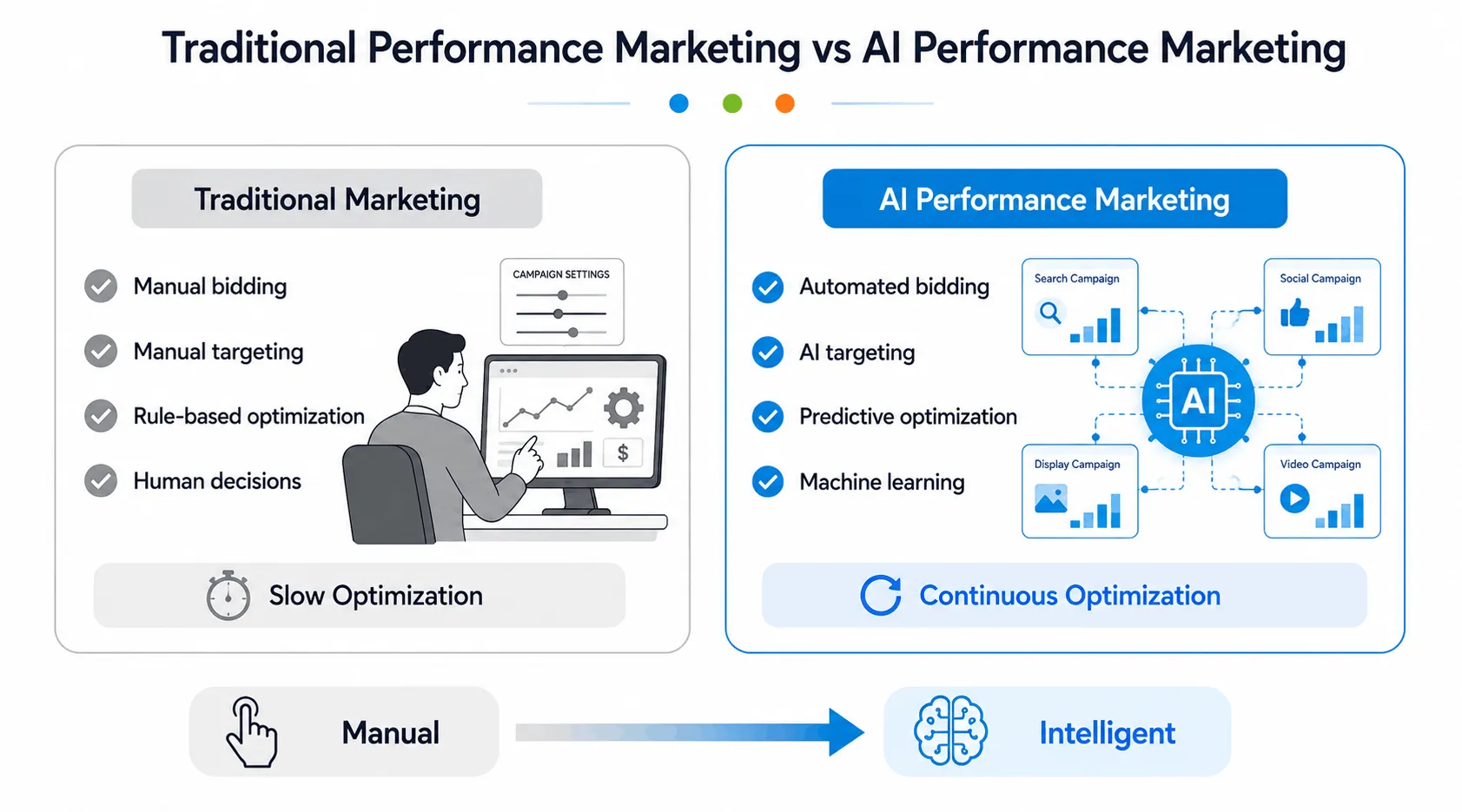
AI performance marketing is the use of artificial intelligence to optimize marketing based on measurable results such as conversions, revenue, customer acquisition cost, and pipeline value instead of clicks or impressions.
In this approach, automation follows performance signals, which means campaigns improve only when the data used for optimization reflects real business outcomes.
Artificial intelligence analyzes campaign data, predicts user behavior, and adjusts bidding, targeting, and delivery automatically across channels. Modern platforms use machine learning models trained on historical performance to decide where budget should go and which users are most likely to convert.
Common optimization signals include:
- conversions
- revenue
- CAC (customer acquisition cost)
- ROAS (return on ad spend)
- pipeline value
- profit or margin
Results depend on the quality of these signals. If tracking is incomplete or conversion goals are wrong, AI may optimize for activity instead of profit.
Pro tip:
AI does not understand profit margins unless margin or cost data is included in the system. If campaigns optimize only for revenue without COGS or profit signals, automation may hyper-scale the easiest products to sell instead of the most profitable ones.
AI performance marketing also requires enough data to work correctly. Most automated bidding systems need consistent conversion volume to learn effectively. When conversion volume is too low, the signal-to-noise ratio becomes weak, and automation may produce unstable results instead of improvements.
2. Where AI Is Used in Marketing Campaigns
Artificial intelligence is used across multiple parts of the marketing workflow, not only inside ad platforms. Modern performance marketing systems rely on AI to analyze data, automate decisions, and improve efficiency across advertising, analytics, content, and CRM tools.
Common areas where AI is used:
- Advertising platforms — automated bidding, targeting, and budget allocation in Google Ads, Performance Max, and Meta Advantage+
- Content generation — creating variations and drafts using AI tools
- Analytics and reporting — identifying performance patterns in dashboards
- CRM systems — predictive lead scoring and pipeline analysis
- CRO — testing layouts, headlines, and offers automatically
- Attribution and modeling — estimating channel influence across touchpoints
AI improves speed and accuracy by using historical data to guide decisions, but automation only works when performance signals are strong.
A common limitation in AI performance marketing is the signal-to-noise ratio. Automated systems need enough conversions to learn which users are valuable. When campaigns produce too few conversions, the algorithm cannot distinguish real patterns from random behavior.
Most bidding systems require consistent conversion volume per campaign to perform reliably. Without enough data, automation may increase spend without improving results.
To scale with AI, campaigns usually need:
- clear conversion events
- consistent tracking
- enough data volume
- stable performance signals
When these conditions are missing, AI may appear to work at small scale but fail when budgets increase.
3. How AI Performance Marketing Works (Full System)
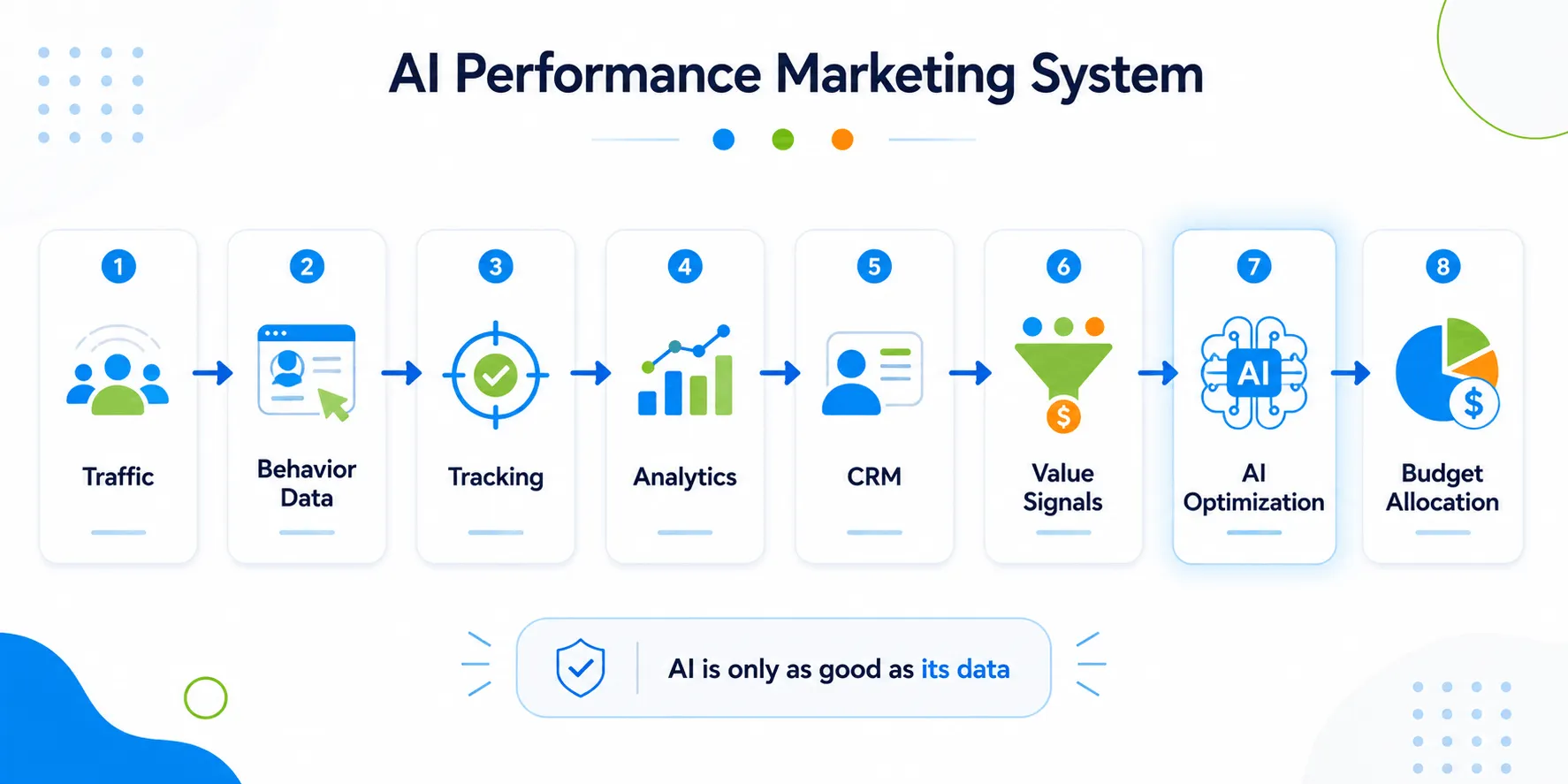
AI performance marketing works as a connected system where traffic, behavior data, conversions, and revenue signals are combined so automation can optimize campaigns based on real outcomes. Artificial intelligence does not improve performance by itself. It follows the data it receives, which means analytics, tracking, CRM, and attribution must be connected for optimization to be accurate.
Traditional flow:
Traffic → Click → Page → Conversion → CRM → Revenue
Modern AI-driven flow:
Traffic → Click → Behavior data → Conversion → CRM → Value signal → AI optimization → Budget allocation
In modern platforms, optimization depends on the strength of the data pipeline. If the system does not send correct signals, automation becomes blind and may optimize for clicks instead of profit.
Main parts of the system:
- Data collection — ads, website events, and CRM activity
- Analytics — performance reports and dashboards
- Tracking — pixels, events, conversion APIs
- AI / automation — bidding, targeting, delivery models
- Attribution — estimating channel impact
- CRM — leads, opportunities, and revenue
- Value signals — revenue, profit, LTV, or pipeline used for optimization
Modern performance setups require a first-party data operating system, where the company owns its tracking and conversion data instead of relying only on platform reports. If a company does not control its data pipeline, AI cannot see the full customer journey and optimization becomes unreliable.
Technical requirements for reliable AI optimization usually include:
- correct conversion tracking
- CRM integration
- value-based bidding or revenue tracking
- server-side or first-party tracking
- consistent event definitions
- enough conversion volume
Some advanced teams also use agentic AI workflows, where automation tools, dashboards, and models work together to monitor performance and adjust campaigns automatically based on predefined rules.
When the system is complete, AI can scale campaigns efficiently. When data is missing, automation may increase spend without improving real business results.
4. What Metrics Matter in AI Performance Marketing
In AI performance marketing, optimization depends on the signals used to guide automation. Campaigns should be evaluated using business outcomes instead of platform activity metrics, because machine learning systems adjust bidding, targeting, and delivery based on the data they receive.
Advertising platforms usually report activity metrics, but real performance must be measured using analytics and CRM data. Tools such as GA4, HubSpot, Salesforce, or data warehouses are often used to connect traffic, leads, and revenue so AI models can optimize toward meaningful outcomes.
Modern optimization increasingly uses value-based bidding, where campaigns are trained using revenue, margin, or pipeline value instead of conversion count alone. This allows AI to prioritize higher-value customers instead of the easiest conversions.
For example:
- optimize for revenue instead of conversions
- optimize for profit instead of revenue
- optimize for pipeline value instead of leads
Without value signals, automation may scale low-quality conversions because they are easier to generate.
Because users interact with multiple channels, measurement is not exact. Some teams use Marketing Mix Modeling (MMM), incrementality testing, or offline conversion tracking to estimate real impact when attribution data is incomplete.
Pro tip:
AI systems optimize whatever signal they receive. If the signal does not represent real business value, automation will scale the wrong outcome faster.
5. How to Use AI to Hyper-Scale Marketing Results (Step-by-Step Playbook)
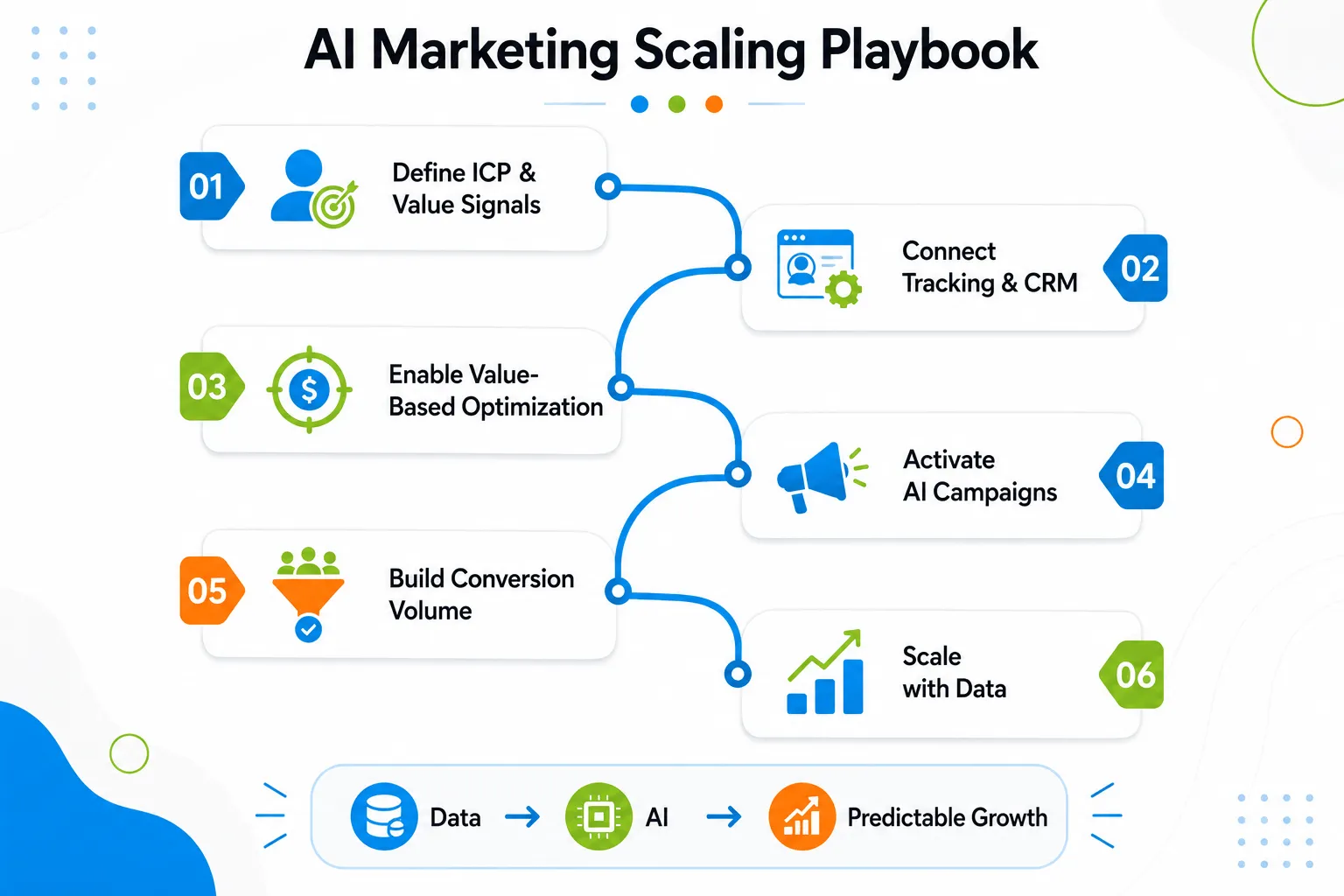
AI can help hyper-scale marketing results only after campaigns have reliable data, defined conversions, and connected tracking systems. Scaling means increasing budget while maintaining efficiency, which requires automation to optimize using real performance signals instead of activity metrics.
Typical workflow used in AI performance marketing:
- Define ICP and value signals — identify the customers that generate revenue, profit, or pipeline, not just conversions.
- Set up tracking and CRM integration — connect analytics, pixels, and CRM so campaigns send accurate performance data.
- Use value-based optimization — train campaigns using revenue, margin, or pipeline value instead of conversion count.
- Enable AI-driven campaign types — use Performance Max, Meta Advantage+, or automated bidding models.
- Ensure enough data volume — AI requires consistent conversions or the signal-to-noise ratio becomes weak.
- Measure and scale carefully — evaluate pipeline, revenue, and CAC, and increase budget only after results are stable.
AI scaling fails when automation receives weak signals. If tracking, value data, or conversion volume is missing, campaigns may spend more without improving results.
Example
A B2B company connected CRM pipeline data to Google Ads and switched to value-based bidding. After sending offline conversion values to the platform, the algorithm prioritized higher-quality leads instead of cheaper ones, allowing the company to scale without increasing cost per opportunity.
6. Why AI Performance Marketing Fails
AI performance marketing fails when the data, metrics, or system used for optimization are incorrect, incomplete, or unstable. Artificial intelligence does not fix weak campaigns automatically. It follows the signals it receives, which means errors in tracking, targeting, or conversion setup can cause automation to scale the wrong results instead of improving performance.
Common causes of failure:
- Bad data — incorrect tracking or missing events
- Wrong metrics — optimizing for clicks instead of revenue
- Weak funnel — traffic does not convert
- Low demand — not enough audience to scale
- Small budget — not enough data for AI to learn
- Over-automation — relying on AI without strategy
- Tracking gaps — missing cross-device or offline data
- Platform dependency — relying on one ad platform only
Cannibalization problem
A common issue in AI performance marketing is cannibalization, where automation claims credit for conversions that would have happened anyway. For example, retargeting campaigns or branded search campaigns may show strong efficiency because the user was already likely to convert. AI may increase spend on these campaigns to improve reported metrics, even though they do not create new demand.
This happens when optimization is based only on platform conversions instead of incremental results.
To avoid this:
- use incrementality tests
- compare holdout groups
- measure pipeline or revenue, not only CPA
- evaluate new vs returning users
External limits
Even with strong automation, performance depends on factors outside the campaign:
- privacy restrictions reduce tracking data
- higher competition increases costs
- platform algorithm changes affect delivery
- market demand limits scaling
AI often makes problems more visible because it scales what already exists. If the system is strong, results improve faster. If the system is weak, spending increases without improving revenue.
Conclusion
AI performance marketing works best when it is treated as a system rather than a tool. Artificial intelligence can optimize bidding, targeting, and delivery, but results depend on data quality, tracking accuracy, and how well advertising platforms, analytics tools, and CRM systems are connected.
Scaling with AI requires strong conversion signals, enough data volume, and optimization based on revenue, pipeline, or profit instead of clicks alone. When campaigns use value-based bidding, first-party data, and reliable reporting, automation can increase spend while maintaining efficiency.
As advertising platforms rely more on machine learning, companies that control their data pipeline and optimize for real business outcomes will be able to scale more predictably, while campaigns built on weak signals will struggle to grow.
Read These Next
B2B Marketing Attribution: A Complete Guide for Modern B2B Teams