.png)

B2B Paid Media Strategy: 5 Tactics to Align Paid Ads with Long Sales Cycles
.png)

.png)

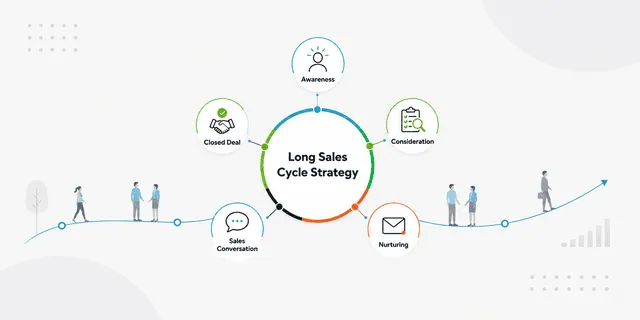
Paid media for long sales cycles (B2B, SaaS) shifts focus from immediate conversion to multi-touch nurturing. By utilizing stage-based retargeting, Account-Based Marketing (ABM), and CRM-data integration, brands maintain visibility across 6–12 month decision windows. Success is measured by pipeline contribution and Sales Qualified Leads (SQLs) rather than raw click volume or initial CPL.
Quick Summary: Paid Media Tactics for Long Sales Cycles
Introduction
Most paid media strategies are built for short sales cycles. However, in industries with longer buying processes—such as B2B, SaaS, or high-value services—decisions take time and involve multiple stakeholders. The average B2B sales cycle has stretched to 6.5 months, up from 4.9 months in 2019, and deals over $100K regularly run 6–9+ months. In these cases, running direct-response ads alone leads to low conversion rates and wasted spend.
Long sales cycles require a different approach. Instead of focusing only on clicks or immediate leads, paid media must support the entire buyer journey. B2B purchases typically involve 7–10 meaningful marketing touchpoints spread across 3–6 months, which makes consistency and sequencing more important than one-time campaigns.
Modern strategies focus on nurturing rather than pushing for immediate action. Retargeting becomes more strategic, messaging becomes more educational, and campaigns are aligned with sales activity instead of operating separately. In practice, many B2B campaigns operate within a “dark funnel,” where buyers research solutions through private communities and internal discussions that are not directly trackable. Paid media plays a role in maintaining visibility in these unmeasurable spaces.
What This Guide Covers
- What Paid Media Strategy for Long Sales Cycles Means
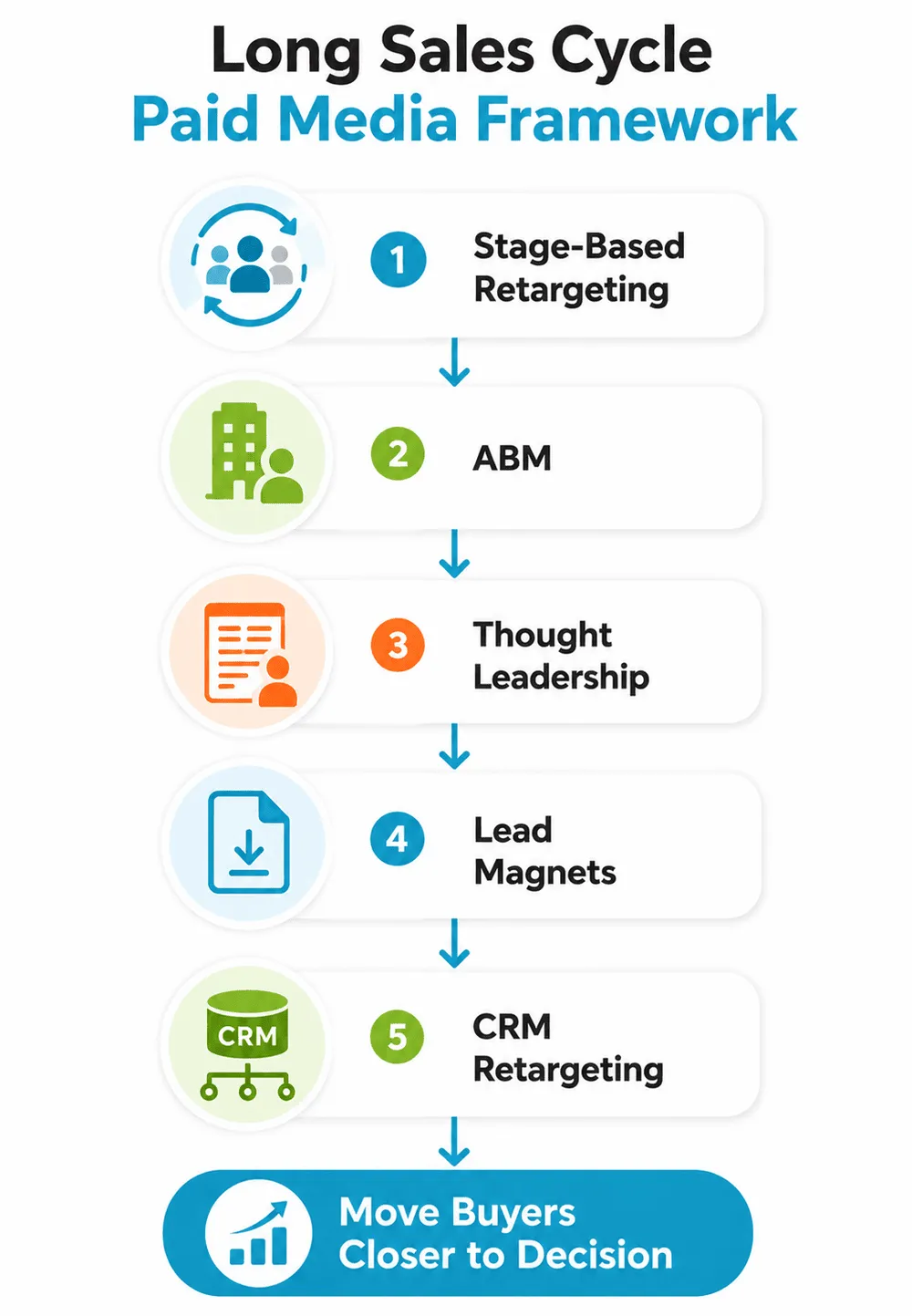
- Tactic 1: Stage-Based Retargeting to Nurture Buyers Over Time
- Tactic 2: Account-Based Paid Media (ABM) for High-Value Accounts
- Tactic 3: Thought Leadership Ads to Build Trust
- Tactic 4: Gated Content to Capture and Qualify Leads
- Tactic 5: CRM-Based Retargeting to Align Ads with Sales Activity
- How to Structure Campaigns for Long-Term Nurturing
What Is Paid Media Strategy for Long Sales Cycles?
Paid media strategy for long sales cycles focuses on influencing decisions over time instead of pushing immediate conversions. In industries where buying decisions take weeks or months, a single ad interaction is rarely enough to generate a sale.
Unlike short sales cycles where campaigns optimize for quick actions, long-cycle strategies are built around multiple touchpoints. Buyers often consume content, compare options, and revisit brands several times before making a decision. Because of this, paid media needs to stay visible and relevant throughout the process.
This changes how campaigns are measured. Instead of focusing only on cost per lead (CPL), marketers need to look at:
- Pipeline quality
- Sales-qualified leads (SQLs)
- Revenue influenced by ads
These metrics are typically tracked by integrating ad platforms with CRM systems such as HubSpot or Salesforce, using tools like offline conversion imports, UTM parameter mapping, and lead status tracking. This allows marketers to connect ad clicks to actual sales outcomes instead of relying only on platform-reported conversions.
The biggest shift is from conversion-first thinking to nurture-first thinking. Nurtured leads produce a 20% increase in sales opportunities on average compared to non-nurtured leads, while 79% of marketing leads never convert into sales due to lack of proper nurturing (MarketingSherpa).
Tactic 1: Stage-Based Retargeting to Nurture Buyers Over Time
One of the most common mistakes in paid media is showing the same ad to everyone who visits a website. In long sales cycles, this approach is ineffective because users are at different stages of decision-making. Stage-based retargeting fixes this by adjusting messaging based on user behavior.
How It Works in Practice
A simple structure might look like this:
- A user reads a blog post → show a case study
- A user downloads a guide → show a product demo
- A user visits pricing page → show testimonials or offers
Each step introduces more specific and persuasive content, instead of jumping straight to a sale.
Why Repeating the Same CTA Fails
Many campaigns retarget users with “Book a demo” or “Buy now” regardless of their intent. This fails because the user may still be researching, trust has not been built yet, and the offer feels too early. As a result, engagement drops and costs increase.
What Works Better
Effective retargeting aligns with where the user is in the journey:
- Early stage → educational content (e.g., webinars, whitepapers, industry guides)
- Mid stage → comparisons and case studies
- Late stage → proof and decision-focused messaging
Tactic 2: Account-Based Paid Media (ABM) for High-Value Accounts
Most paid media campaigns target broad audiences. In long sales cycles, this often leads to wasted spend because not all leads have the same value. Account-based paid media (ABM) focuses on targeting specific companies and decision-makers instead of large audiences. The typical B2B buying group now consists of 6–10 stakeholders, and deals over $50K see 130% higher win rates when multiple stakeholders are engaged.
How It Works in Practice
Instead of targeting general demographics, campaigns focus on predefined accounts:
- Upload a list of target companies → run ads to employees in those companies
- Target specific job roles → decision-makers, managers, or stakeholders
- Tailor messaging → based on industry or company needs
Why Broad Targeting Fails
In long sales cycles, not all leads convert. Broad targeting often results in low-quality leads, longer sales cycles, and wasted budget on unqualified audiences.
What Works Better
ABM focuses on precision over volume. Fewer leads, but higher quality. Messaging tailored to specific industries or roles. Ads aligned with the buying committee.
In most B2B environments, the buying committee includes 6–10 stakeholders across roles such as decision-makers, influencers, and end users. Paid media needs to influence multiple people within the same account, not just a single lead. Platforms like LinkedIn Campaign Manager and account-based tools like 6sense are commonly used to activate these audiences.
Tactic 3: Thought Leadership Ads to Build Trust
In long sales cycles, buyers rarely convert after seeing one ad. They need time to understand the product, evaluate options, and build trust. Organizations recognized as thought leaders generate 31% more leads and close deals 1.4x faster than competitors without established industry voices.
How It Works in Practice
Instead of promoting offers, campaigns promote expertise:
- Whitepapers or research reports
- Industry insights
- Founder or expert perspectives
- Educational video content
Why Direct-Response Ads Fail Early
Many campaigns try to sell too soon. This fails because the buyer is still researching, the brand is not yet trusted, and there is no urgency to act. As a result, conversion rates stay low.
What Works Better
Thought leadership builds familiarity over time. It educates buyers before they are ready to purchase, positions the brand as an expert, and keeps the company top-of-mind. When the buyer is ready, they are more likely to choose a brand they already recognize and trust.
Tactic 4: Mid-Funnel Lead Magnets (Gated Content)
In long sales cycles, not all leads are ready to buy, but many are willing to engage if the content provides value. Mid-funnel lead magnets help capture and qualify these users. Companies with mature lead nurturing practices generate 50% more sales-ready leads at 33% lower cost per lead.
How It Works in Practice
Examples of effective lead magnets include:
- ROI calculators
- Industry reports
- Templates or frameworks
- Maturity assessments
Instead of “Book a demo,” an ad might offer a calculator that helps users estimate potential results. This attracts users who are already evaluating solutions.
Why Generic Lead Forms Fail
Many campaigns rely on simple forms with little value. This often leads to low-quality leads, low engagement, and poor conversion to sales. Users submit information but are not truly interested.
What Works Better
High-value content filters and qualifies leads. It attracts users who are actively researching, provides useful insights before a sales conversation, and helps segment leads based on interest or behavior. This improves lead quality and makes follow-up more effective.
Tactic 5: CRM-Based Retargeting to Align Ads with Sales Activity
Paid media and sales often operate separately, which creates gaps in the buyer journey. CRM-based retargeting connects both by using sales data to guide advertising. 75% of B2B buyers say they are taking longer to make purchase decisions than in 2023, which makes maintaining consistent ad presence throughout the cycle critical.
How It Works in Practice
Campaigns use CRM signals to adjust messaging:
- Leads who had a sales call → show case studies or proof
- Opportunities not yet closed → show testimonials or comparisons
- Existing leads → reinforce key benefits or objections
After a discovery call, ads can highlight customer success stories relevant to the prospect’s industry. Platforms like LinkedIn Campaign Manager and account-based tools like 6sense are often used to activate CRM audiences and align paid media with sales pipeline stages.
In practice, a 15–25% improvement in conversion rates or a shorter sales cycle is commonly observed when CRM-based retargeting is consistently applied (based on internal campaign observations and industry benchmarks).
Why Disconnected Campaigns Fail
When ads are not aligned with sales activity, messaging becomes repetitive, objections are not addressed, and opportunities go cold. This slows down the sales process.
What Works Better
CRM-based targeting keeps campaigns relevant. It aligns ads with where the buyer is in the process, reinforces conversations already happening, and supports decision-making instead of restarting it.
How to Structure Campaigns for Long-Term Nurturing
Long sales cycles require campaigns to be structured across time, not just channels. Instead of running isolated campaigns, effective strategies connect touchpoints into a sequence. Plan for 6–12 months before marketing influence shows up in a closed pipeline — teams that measure at 90 days and cut programmes are cutting investment at exactly the wrong moment.
A simple structure includes:
- Top of funnel → thought leadership and awareness campaigns
- Mid funnel → lead magnets and retargeting
- Bottom funnel → CRM-based retargeting and sales-aligned messaging
To handle the “messy middle” of long sales cycles, where buyers move back and forth between stages, multi-touch attribution (MTA) models are used. These models assign weighted credit to interactions such as webinar attendance, case study views, or repeated site visits. Multi-touch attribution models provide up to 40% more accurate ROI assessment than single-touch models (Bizible research).
Conclusion
Paid media for long sales cycles is not about generating immediate conversions. It is about building familiarity, trust, and relevance across multiple touchpoints.
The most effective strategies combine retargeting, account-based targeting, thought leadership, and sales-aligned messaging into a single system. When campaigns are structured this way, they improve lead quality, maintain engagement, and support the sales process instead of working against it.
In these environments, success is not measured by how quickly a lead converts, but by how effectively paid media influences the final decision.
FAQs
What is paid media strategy for long sales cycles?
It is an approach that focuses on nurturing and guiding buyers over time instead of pushing immediate conversions.
Why don’t paid ads convert immediately in long sales cycles?
Because buyers need time to research, compare options, and build trust before making a decision. The average B2B sales cycle is now 6.5 months, and 89% of B2B buyers report a purchase deal stalled in the past year.
What is account-based marketing (ABM) in paid media?
ABM targets specific companies and decision-makers with personalized campaigns instead of broad audiences.
How long should nurturing campaigns run?
They typically run continuously, adapting based on engagement and sales activity. Enterprise software purchases often take 12–18 months, while mid-market solutions average 6–9 months.
What metrics matter most in long sales cycles?
Metrics such as pipeline value, sales-qualified leads, and revenue are more important than cost per lead alone.
Related Content
Read These Next
E-commerce Marketing Automation: How to Increase Sales on Autopilot in 2026