

B2B Performance Marketing: 2026 Complete Guide




Performance marketing in B2B refers to marketing activities that are evaluated based on measurable business outcomes such as pipeline, opportunities, or revenue rather than only clicks, impressions, or leads. Companies increasingly expect marketing to show a clear connection between advertising spend and sales results, which makes measurement more complex than in traditional digital campaigns.
This guide explains how performance marketing works in a B2B environment, how results are measured across the funnel, how attribution connects marketing to revenue, and why linking ad performance to business outcomes often requires data from advertising platforms, analytics tools, and CRM systems such as HubSpot or Salesforce.
What This Guide Covers
This guide explains the main concepts behind B2B performance marketing and how companies measure marketing using business outcomes instead of platform metrics.
- What performance marketing means in a B2B context
- How performance is measured across the funnel
- How attribution connects marketing to revenue
- Which channels are commonly used
- How companies apply performance marketing in practice
- Common problems with measurement
- What to consider before investing in performance marketing
- Attribution and how marketing is connected to revenue
- Channels used in B2B performance marketing
- How companies apply performance marketing in practice
- Common problems companies face
- Practical considerations before investing
What Is Performance Marketing in a B2B Context?
Performance marketing in B2B is an approach where marketing campaigns are evaluated using measurable outcomes such as qualified leads, opportunities, pipeline, or revenue instead of only activity metrics like clicks or impressions. The goal is to understand whether marketing contributes to business results, not just advertising performance.
Performance marketing is not a separate channel but a way of measuring marketing activity across platforms such as Google Ads, LinkedIn Ads, email campaigns, or content marketing. A company can run digital marketing without tracking business outcomes, but performance marketing requires defined metrics, consistent tracking, and reporting across multiple systems.
Measurement is more complex in B2B than in B2C because the buying process usually involves more steps. In many consumer purchases, a user may see an ad, click, and buy in one session. In B2B, the process often includes research, multiple conversations, and approval from several people before a deal is closed.
Several factors make B2B performance harder to measure:
- Longer sales cycles
- Multiple decision-makers
- Higher deal value
- Offline sales conversations
- CRM-based deal tracking
Because of this, the final result is usually recorded in a CRM such as Salesforce or HubSpot, not inside the advertising platform. Companies often need to connect data from Google Ads, LinkedIn Ads, website analytics (GA4), and CRM systems to understand how marketing influenced a sale.
Gartner research shows that the average B2B buying group involves 6–10 decision-makers, each conducting independent research across multiple channels before a decision is made. B2B buyers now go through an average of 27 touchpoints before a purchase decision, and spend only 17% of their total buying time in direct contact with potential vendors. This makes performance marketing dependent on full-funnel tracking rather than single-platform reports.
How Performance Is Measured in B2B
Performance in B2B marketing is measured using both marketing metrics and business metrics, because advertising platforms track activity while companies evaluate results using pipeline, opportunities, and revenue recorded in CRM systems. Understanding the difference between these measurements is necessary to evaluate real marketing performance.
Marketing reports usually focus on platform metrics from tools like Google Ads, LinkedIn Ads, or GA4:
- Clicks
- Impressions
- Conversions
- Cost per lead (CPL)
These numbers show how campaigns perform inside the platform but do not always show whether marketing leads to actual sales.
Business teams focus on business metrics, which are typically tracked in CRM systems such as HubSpot or Salesforce:
- Qualified leads
- Opportunities
- Pipeline value
- Revenue
- Customer acquisition cost (CAC)
Because deals often close outside the advertising platform, business metrics are closer to real results but harder to measure.
Marketing Metrics vs. Business Metrics
The B2B Marketing Funnel
To understand how marketing affects business results, companies use a marketing funnel that describes the stages a prospect goes through before becoming a customer.
Typical funnel sequence:
- Visitor — website traffic
- Lead — contact captured
- MQL — marketing qualified lead
- SQL — sales qualified lead
- Opportunity — active deal
- Closed deal — customer
Optimizing only the top of the funnel can be misleading. A campaign may generate many clicks or leads, but only a small number may become opportunities or customers. In that case, marketing metrics look strong while business results remain weak.
Different companies also define performance differently. Some optimize for lead volume, while others focus on pipeline or revenue. The correct definition depends on deal size, sales cycle length, and how marketing and sales are connected.
Because of this, performance marketing in B2B requires combining data from advertising platforms like Google Ads and LinkedIn Ads, analytics tools like GA4, and CRM systems like HubSpot or Salesforce instead of relying on one metric alone.
Attribution: How Companies Try to Connect Marketing to Revenue
Attribution in B2B performance marketing is the process of assigning credit to marketing activities that influenced a lead, opportunity, or sale. Because buyers often interact with multiple channels before making a decision, attribution models are used to estimate which campaigns contributed to revenue.
Common attribution models include:
- First-touch — credit goes to the first interaction
- Last-touch — credit goes to the final interaction
- Multi-touch — credit is shared across interactions
Attribution is more complex in B2B than in B2C because the buying journey usually involves many touchpoints. Gartner research shows that B2B buyers go through an average of 27 touchpoints before a purchase decision, which makes it difficult to determine which campaign influenced the final result.
A prospect may click a Google Ads search result, see a LinkedIn Ads campaign, download a guide, attend a webinar, and later speak with sales before the deal closes in Salesforce or HubSpot. Because of this, numbers shown in advertising platforms rarely match CRM reports.
Many companies now use more advanced attribution methods such as:
- Marketing Mix Modeling (MMM) — statistical analysis of aggregate channel spend to measure contribution to revenue
- Incrementality testing — geo holdouts and controlled experiments to measure true causal impact
- Multi-touch attribution (MTA) tools — track individual buyer journeys across touchpoints
- CRM-based attribution in HubSpot or Salesforce
Multi-touch attribution adoption reached 47% in 2026 (up from 31% in 2023), and companies switching from single-touch to multi-touch models report a 15–30% reduction in CAC. However, nearly 90% of B2B teams still struggle with attribution due to siloed systems across CRM, ad platforms, and analytics tools. Attribution should be treated as an estimate, not an exact calculation.
Channels Commonly Used in B2B Performance Marketing
B2B performance marketing usually combines multiple digital channels, each serving a different role in the buying process. Results rarely depend on one platform alone, but on how well advertising, landing pages, analytics, and CRM systems work together.
Common channels include:
- Google Ads — capture high-intent search traffic from prospects actively looking for a solution
- LinkedIn Ads — target specific job roles, industries, and company sizes
- Paid social — awareness and retargeting across the buying cycle
- Email automation — nurture leads with behavioral sequences
- Landing pages — convert traffic into demo requests or form submissions
- Retargeting — stay visible to prospects during longer sales cycles
Gartner data confirms that 80% of B2B sales interactions now occur through digital channels, which is why performance marketing usually combines search, social, and email rather than relying on one platform.
According to the HubSpot State of Marketing Report (2025), the top B2B channels generating ROI in 2024 were website/blog/SEO, paid social media content, and social media. 89% of B2B marketers use LinkedIn for lead generation, and the most commonly used lead generation channels are email (66%), paid social (58%), and paid search (50%).
Because of this, performance usually depends on the full system rather than the ad alone. Targeting, messaging, landing pages, tracking, and the sales process all affect the final result.
How Performance Marketing Is Used in a B2B Context
In B2B companies, performance marketing is usually set up as a structured system that connects Google Ads, LinkedIn Ads, GA4, and CRM tools like HubSpot or Salesforce. Instead of running isolated campaigns, companies build a workflow where leads, opportunities, and revenue can be tracked across the entire funnel.
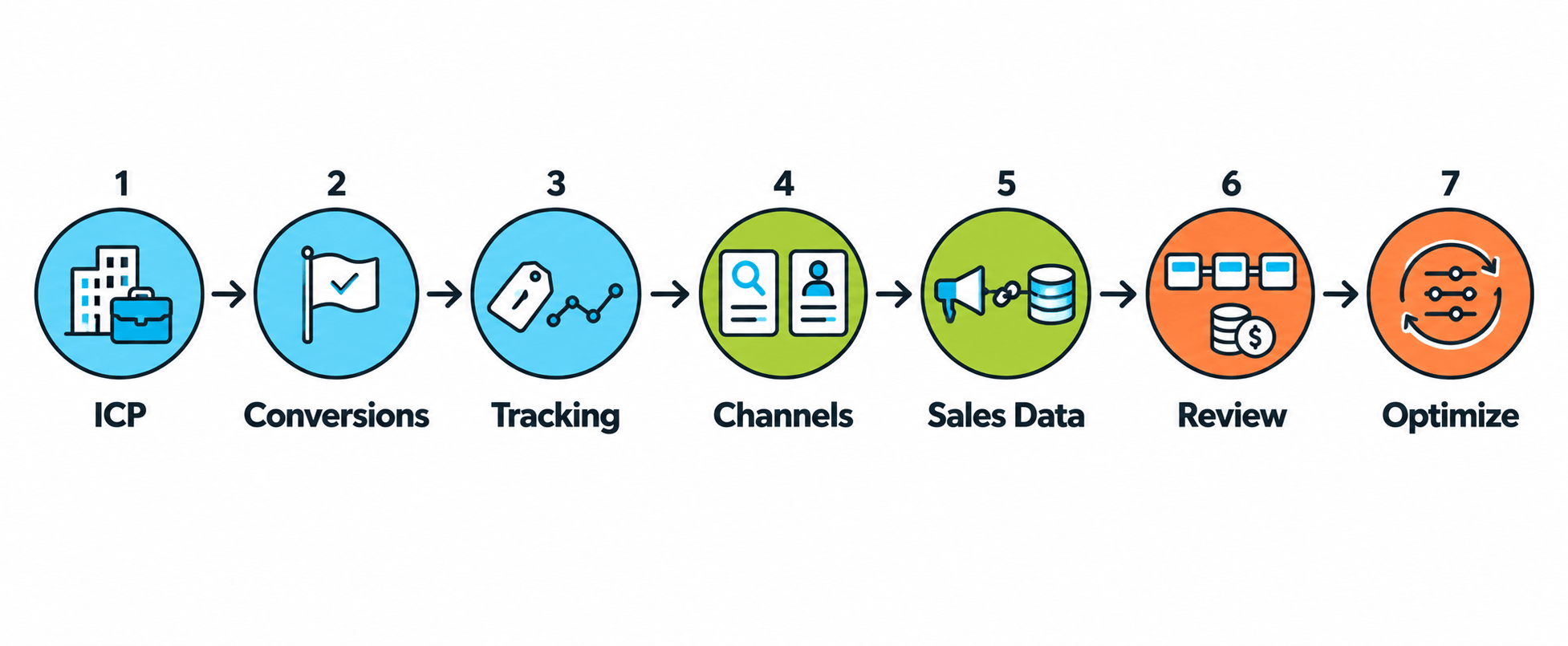
A typical setup includes:
Step 1 — Define the ideal customer profile (ICP)
Use CRM data from HubSpot or Salesforce to identify industries, company sizes, and job roles most likely to convert.
Step 2 — Define conversions that matter
Decide what counts as success—demo requests, qualified leads, pipeline creation, or revenue—not only clicks or form submissions.
Step 3 — Set up tracking and analytics
Connect GA4, Google Ads, LinkedIn Ads, and CRM tools so conversions can be tracked across the full funnel.
Step 4 — Choose the main channels
Most B2B teams use Google Ads, LinkedIn Ads, retargeting, and email automation together.
Step 5 — Connect marketing and sales data
Leads from campaigns should appear in HubSpot or Salesforce so opportunities and revenue can be measured.
Step 6 — Review performance using business metrics
Instead of only cost per lead, teams check pipeline value, opportunity rate, and customer acquisition cost.
Step 7 — Optimize over time
Campaigns are adjusted based on sales feedback, conversion rates, and pipeline quality.
The HubSpot State of Marketing Report (2025) shows that teams connecting advertising data with CRM systems are more likely to measure pipeline and revenue accurately. Gartner research confirms that B2B buying decisions involve an average of 6–10 stakeholders, making full-funnel tracking necessary.
Because B2B sales cycles are longer, performance improvements may take weeks or months to appear.
Marketing Metrics vs. Business Metrics
Marketing metrics measure activity, while business metrics measure outcomes. In B2B performance marketing, strong advertising reports do not always mean strong revenue results because sales happen later in the funnel.
HubSpot research (2025) shows that lead volume alone does not predict revenue unless leads are qualified and tracked through the sales pipeline.
Gartner research shows that B2B buyers spend only 17% of their total buying time in direct contact with vendors, completing much of their research independently before speaking with sales. This makes it difficult to attribute revenue to a single campaign, which is why performance marketing reports should combine advertising data, analytics data, and CRM reports instead of relying on one source.
Common Problems Companies Face With B2B Performance Marketing
Performance marketing in B2B often produces unclear results because tracking is incomplete, attribution is uncertain, and sales cycles are long. Campaign reports may look strong while pipeline or revenue changes slowly.
Common problems include:
- High ad spend but low pipeline
- Many leads but low quality
- Reports look strong, but revenue stays flat
- Attribution numbers do not match CRM data
- Results take longer than expected
AI and Performance Marketing in 2026
AI has fundamentally changed how B2B performance marketing is executed. According to the Salesforce State of Marketing 2026, 87% of marketers now use generative AI in at least one recurring workflow—up from 51% in 2024. AI-driven campaigns deliver an average 22% higher ROI, 32% more conversions, and 29% lower acquisition costs compared to traditional methods.
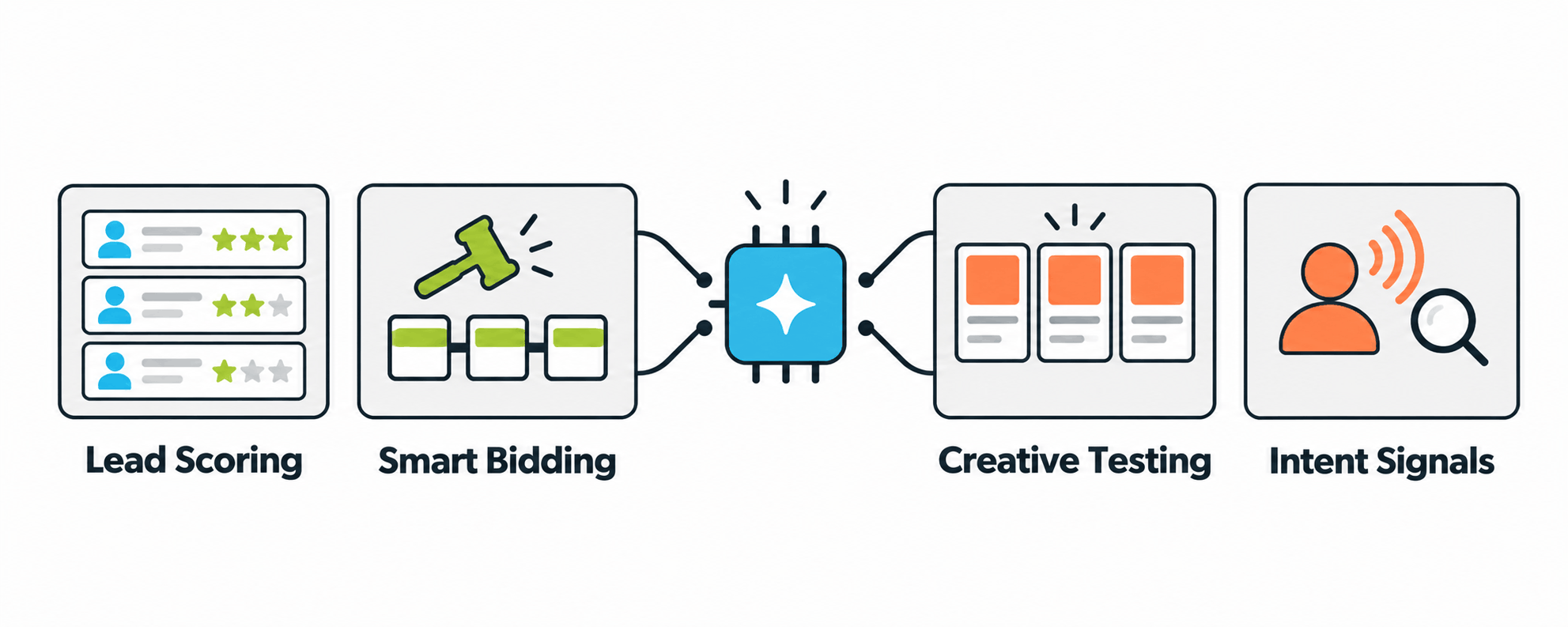
In B2B performance marketing specifically, AI is being used to:
- Score leads more accurately based on behavioral patterns across CRM and ad data
- Optimize Google Ads and LinkedIn Ads bidding automatically based on pipeline signals
- Generate and test ad creative variations at scale
- Identify prospects most likely to convert based on intent signals
- Predict pipeline contribution per channel using Marketing Mix Modeling (MMM)
HubSpot AI Trends 2026 reports that marketers save an average of 6.1 hours per week using AI tools, with senior practitioners saving up to 8–10 hours. However, the trade-off is increased competition: more teams are producing more content faster, which raises the bar for targeting precision and message relevance in B2B campaigns.
Privacy and Tracking Changes
Privacy changes have also affected performance marketing. Apple’s App Tracking Transparency (ATT) and updates from Google and Meta between 2023 and 2025 reduced tracking accuracy across the board. As a result, many companies now use incrementality testing or Marketing Mix Modeling (MMM) to estimate campaign impact more reliably without relying on individual user-level data.
Because of these changes, performance marketing requires continuous adjustment rather than one-time setup.
Practical Considerations Before Investing in Performance Marketing
Before investing heavily in performance marketing, companies should confirm that the basic conditions for measurement exist. Without reliable tracking across GA4, Google Ads, and a CRM like HubSpot or Salesforce, advertising data may look accurate but not reflect real business results.
Important questions include:
- Can conversions be tracked in GA4 and CRM?
- Do we know our ideal customer profile?
- Are marketing and sales aligned on success metrics?
- Is the budget large enough to test channels properly?
- Is there enough demand in the market?
Performance marketing improves decision-making by providing more data, but it does not remove uncertainty. Attribution may not be perfect, results may take time, and some outcomes cannot be measured exactly.
Final Thoughts
In B2B companies, performance marketing is mainly about measurement and system design rather than only running ads. Campaigns produce reliable results only when tracking, attribution, and CRM data are connected across the full funnel.
Differences between advertising reports and revenue data are normal, especially when sales cycles are long and involve multiple stakeholders. Because of this, performance marketing should be used as a tool for improving decisions, not as a guarantee of growth.
Companies that combine clear goals, reliable tracking, and realistic expectations are more likely to see consistent results over time.
FAQ
What is B2B performance marketing?
B2B performance marketing is an approach where marketing campaigns are measured based on business outcomes such as qualified leads, opportunities, pipeline, or revenue instead of only clicks or impressions.
Why is performance marketing harder in B2B?
B2B sales cycles are longer, buying decisions involve an average of 6–10 stakeholders, and deals often happen outside advertising platforms, which makes tracking more complex.
What metrics matter most in B2B performance marketing?
Pipeline, opportunities, revenue, qualified leads, and customer acquisition cost are usually more important than clicks or cost per lead.
How is AI changing B2B performance marketing?
87% of marketers now use generative AI in at least one recurring workflow, up from 51% in 2024. In B2B, AI is most commonly used for lead scoring, campaign optimization, and content creation—helping teams identify high-intent prospects faster and allocate budget more accurately.
Read These Next
Performance Marketing Strategy: The Data-Driven Playbook for 2026