SEO Growth Strategy: Navigating the Shift to AI Search




SEO is changing from keyword targeting to a source-of-truth model. In "zero-click" search results, brands must focus on Information Gain and technical credibility. Success now depends on three pillars:
- Retrieval-Augmented Generation (RAG) Optimization: Organizing content so AI can easily find and use it.
- EEAT Experience, Expertise, Authoritativeness, and Trustworthiness (EEAT): Proving deep human expertise.
- SEO Optimization: Using related concepts instead of just repeating keywords.
The future belongs to brands that provide unique data that AI models cannot derive from the existing web.
How SEO Is Changing in the Age of AI Search
SEO is moving beyond keyword targeting toward content that provides genuine value. AI-powered search tools can summarize common information directly in search results, reducing the need for users to visit individual websites.
To remain visible and attract clicks, brands need content that goes beyond existing answers by offering original research, real-world examples, expert perspectives, and practical insights. Technical credibility and trustworthy information also help establish a website as a reliable source.
Why Traditional SEO Fails in the AI Era
Old search models gave users a list of links. New models synthesize multiple sources to give answers directly on the search page.
Brands should stop answering basic "What is" queries and focus on expert tasks that require proprietary tools. The goal is to provide enough data to be cited by AI models while keeping valuable assets, like case studies, behind a click.
Comparing Traditional SEO vs AI Search
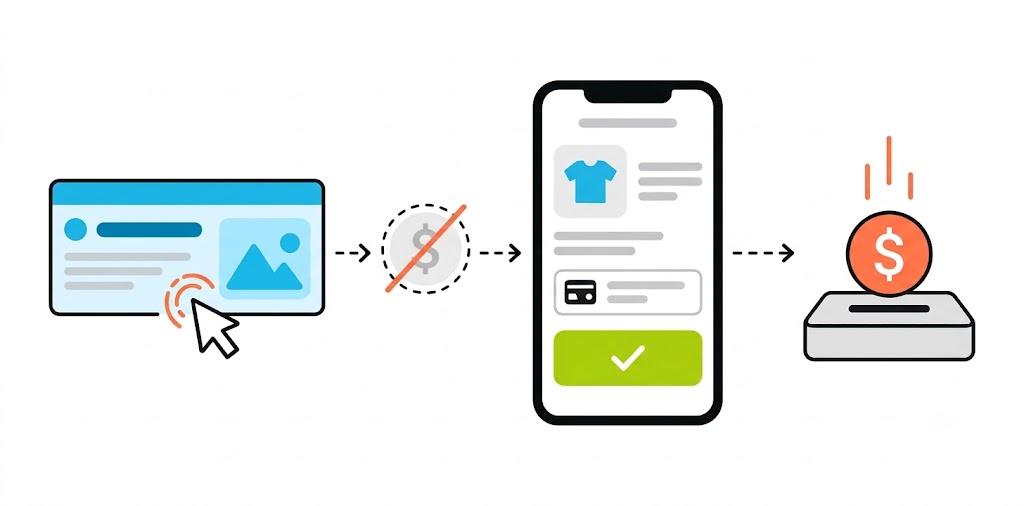
Traditional SEO focuses on improving search rankings and attracting website visitors, while AI search focuses on delivering direct answers and citing relevant sources. As search behavior evolves, businesses need to consider not only website traffic but also how often their content is referenced in AI-generated responses.
How to Optimize for AI Search: Strategies
Modern SEO success depends on three technical pillars: AI Overviews, EEAT, and Semantic SEO. These elements work together to ensure your content is found, trusted, and correctly understood by AI search engines.
AI Overviews and RAG
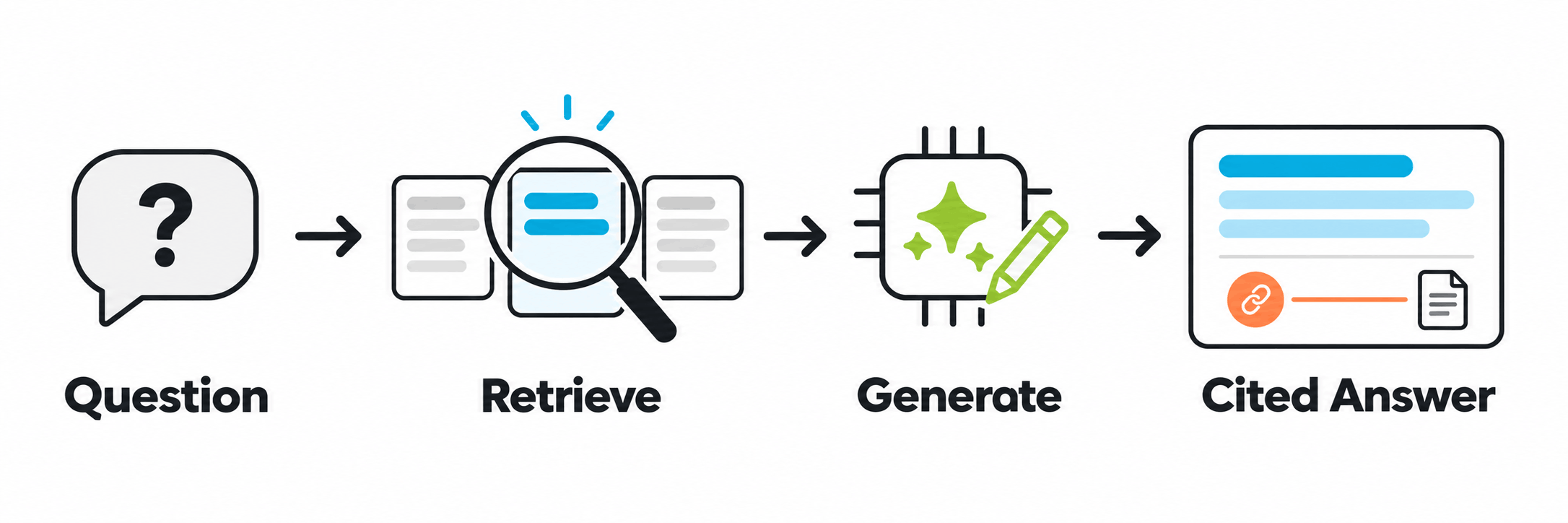
AI Overviews use Retrieval-Augmented Generation (RAG) to create answers from web documents. To rank here, content must be easy for AI models to read and extract information.
Retrieval-Augmented Generation (RAG) is a process AI uses to create answers. First, it retrieves (finds) reliable facts from the internet. Then, it generates (writes) a clear response using those specific facts. This helps AI models give accurate information instead of guessing. While old SEO used page hierarchies, RAG uses semantic chunking. Page sections must be self-contained so AI can understand them without the rest of the page.
AI Overviews are transforming search. The Digital Bloom in 2025 reports that they appear on over 13% of queries (reaching 2 billion users) and target long-tail, informational keywords 88% of the time. However, the impact on traffic is significant: PEW Research Center in 2025 reports that click-through rates drop by 47% when an AI summary is present. With users clicking cited links only 1% of the time, 60% of all Google searches now result in no clicks (The Digital Bloom, 2025).
AI Overviews make things faster for people asking questions, but they make things harder for website owners. Since AI models summarize answers, users are less likely to click. To stay relevant, brands must move beyond writing basic information and focus on becoming the "expert source" that AI is forced to cite. If you aren't the source the AI quotes, your brand loses its voice in the search results.
The Role of EEAT
Google uses Experience, Expertise, Authoritativeness, and Trustworthiness (EEAT) to pick reliable sources. For AI models, Trustworthiness is key. Search engines look for:
- Human Expertise Wins: Sharing real expert knowledge is highly rewarded. A report by Neil Patel’s team in 2025 states that regularly publishing expert articles helps B2B companies generate 88% more leads, while B2C companies see a 67% increase.
- Trust Drives Clicks: Users are more likely to trust an AI answer when it cites a consistent, reliable source. As public trust in AI fell by 3% according to the AI Index Report by Stanford University AI in 2025, the need for human-verified insights has never been higher.
- Accuracy Matters: If your digital information is inconsistent across the web, it can reduce an AI’s accuracy and hurt your visibility.
Proving real-world experience and building verifiable trust is no longer optional. It must be a strict requirement to survive and grow your online visibility.
Semantic SEO and Vector Embeddings
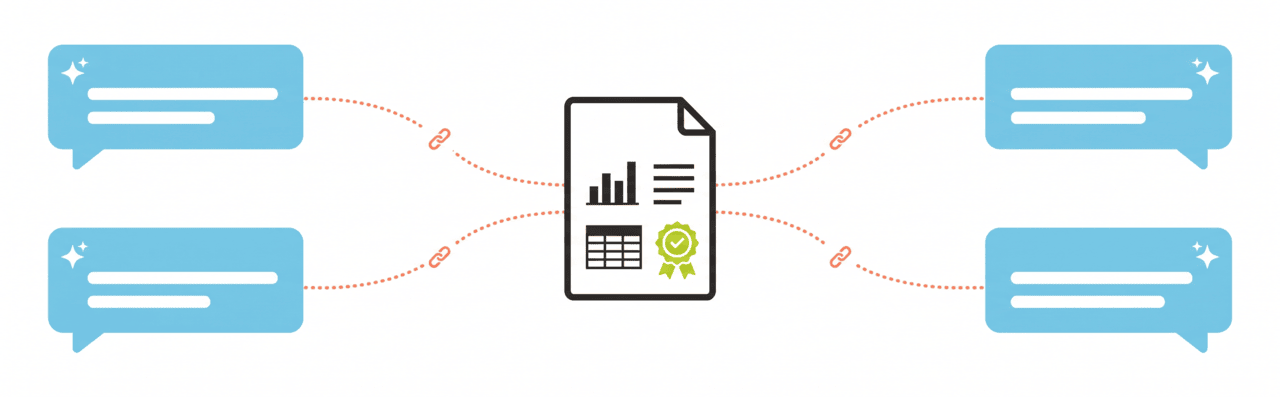
Modern search engines map queries and documents into a shared space to find matching concepts rather than exact words. AI models look at how close your content is to related topics. Success requires proving your brand is mathematically relevant to specific technical concepts.
- Semantic SEO: This focuses on the meaning and intent behind a search rather than literal keyword matching.
- Vector Embeddings: These are mathematical "locations" used to map how close your content sits to related key concepts
Defining the Brand-as-a-Source Strategy
The brand-as-a-source model means your website is the original creator of the facts that AI tools fetch to answer questions. This strategy moves away from summarizing existing articles and focuses on publishing new, unique findings.
- Original Information: This model focuses on creating your own statistics and case study reports.
- Unique Value: It prioritizes information that does not already exist in the AI's database.
- AI Citations: By providing unique facts, brands increase the chance that an AI will link to them as the expert source when answering a user.
How to Write Content for Effective AI Retrieval
To help AI find and use your content, you must provide clear facts and specialized details that are easy to organize. High-ranking content now relies on sharing new data that fits the way modern AI databases store information.
- Publish Original Research to Build Authority: Share your own surveys and reports so you provide "new" information that AI cannot find elsewhere. This is important because Microsoft reports in 2025 that 66% of CEOs say AI engines already help their business efficiency, and they need fresh data to keep improving.
- Use Simple Language to Help AI Map Your Ideas: Write with direct, factual sentences to help AI tools turn your text into math-based maps of meaning. Since most large companies now use AI, they need content that is easy for their systems to read and find.
- Organize Data for Easy Database Entry: Put your main findings into simple tables or lists so they can be saved into AI databases without errors. This helps because the industry is moving toward storing search facts directly inside main databases to save money and improve accuracy.
- Write Specialized Content for Specific Problems: Focus your writing on solving one specific problem rather than giving a broad overview. Buhler of Sequoia Capital notes that 2026 will be defined by the specialization of AI, meaning it will look for niche experts to answer complicated questions.
IDC predicts that by 2030, global investments in AI will create a $22.3 trillion impact, meaning every dollar spent on AI generates an extra $4.90 for the global economy. This massive growth shows why companies must integrate AI into their daily workflows now to stay competitive as the technology expands.
Technical Standards for AI Reading and Indexing
Technical SEO now focuses on machine-readability so AI engines can easily extract facts from a website. This requires structured data formats that define the relationships between different pieces of information.
- Organized Labels: Use specific code to tell search engines exactly what your content is about, such as a "Dataset" or "Technical Article."
- Simple Sentences: Use direct, factual statements to define terms, as these are easier for AI to turn into summaries.
- Data Accessibility: Arrange your information so search engines can see it as a list of clear facts rather than a messy wall of text.
What are the New KPIs for AI Search in 2026?
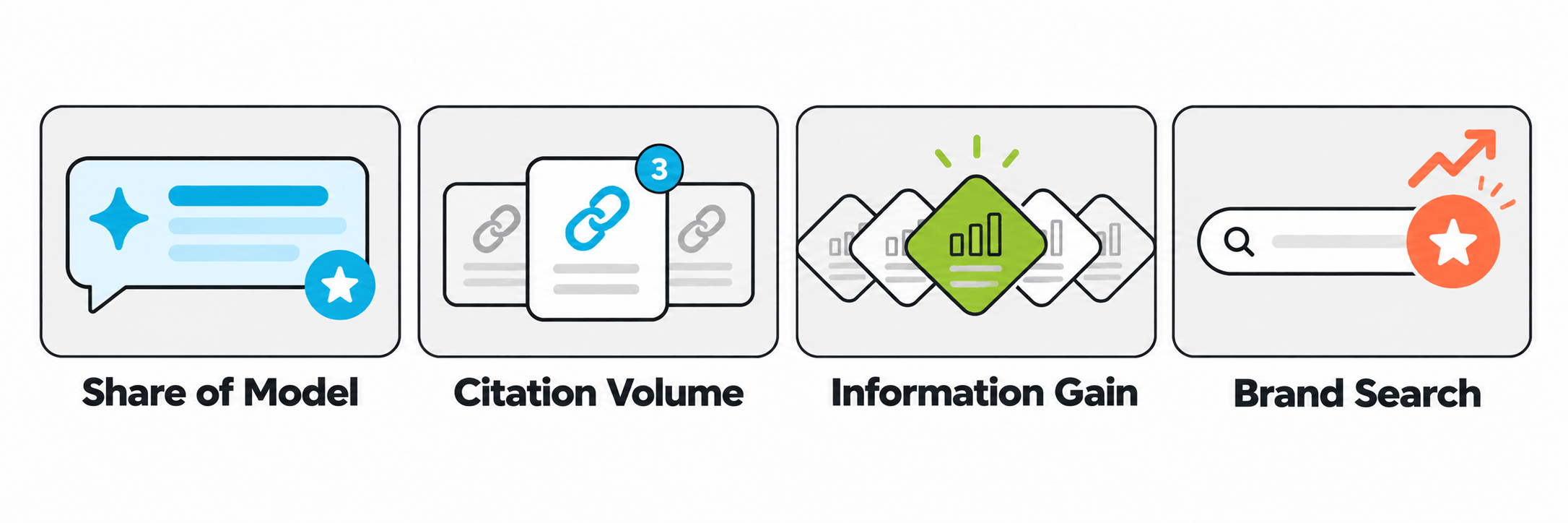
Traditional click tracking is no longer sufficient to measure the value of AI-driven search. New metrics focus on brand presence within AI responses and the uniqueness of the information provided.
- Share of Model (SoM): Measures how often an AI mentions a brand or its specific data in generated answers.
- Citation Volume: Tracks how many times AI search engines provide a direct link to a domain as a factual reference.
- Information Gain: A benchmark that compares unique data against redundant information found elsewhere online.
- Assisted Brand Search: Monitors increases in direct searches for a brand after it appears in AI summaries.
To strengthen this strategy, track the specific percentage of zero-click searches in your industry—instances where AI summarizes your content directly on the search page, satisfying the user without a website visit.
When an AI uses your data to answer a query, your Share of Model (SoM) grows even if your click count is maintained. By monitoring this shift, you can shift effort from high-volume clickbait and focus instead on the high-authority, original research that forces AI models to cite you as the primary source.
Where is the Future of Content Headed with AI Engines?
AI engines are reshaping the creative process, moving content generation toward hyper-personalization, automation, and interactive media:
- Automated and Personalized Engagement: Generative AI is automating content creation to ensure fresh materials are always ready. By crunching numbers to create highly personalized customer experiences, AI is successfully boosting conversion rates and helping teams launch marketing campaigns much faster.
- Advanced Multimedia Generation: AI tools are transforming written stories into engaging short videos, a format that can generate up to 10 times more revenue than traditional written pieces. Companies are also using AI engines to automatically generate royalty-free background music for audiovisual storytellers and produce tens of thousands of localized images daily.
- Synthetic Voices and Interactive Avatars: AI is enabling new forms of content delivery, such as localized weather forecasts read by lifelike synthetic voices that outperform traditional markets. Brands are also deploying digital human avatars and interactive AI chatbots that allow consumers to have hyper-personalized, real-time conversations in dozens of languages.
- Accelerated Creative Development: Beyond media, generative AI is revolutionizing broader innovation by speeding up product development, allowing creators to rapidly generate ideas, design prototypes, and significantly reduce the time it takes to bring new concepts to market.
3 Common AI Search Myths Debunked
To build a long-term strategy, reevaluate these three common misconceptions:
Myth 1: "SEO is dead because of AI."
Google reports in 2025 that while search volume remains steady, the nature of traffic is shifting.
High-quality content now primarily drives brand impressions. By securing status as a named expert source in AI responses, brands build the mental availability necessary to capture clicks from users seeking the specific information required for future purchases.
Myth 2: "AI-generated content is penalized by Google."
Google’s ranking systems are designed to reward high-quality content that demonstrates EEAT, regardless of how it is produced. However, the risk of “average” output in AI-generated content is that it lacks information gain because it is trained on existing data.
To rank, content must include a unique value element (such as unique data, contrarian opinions, or case studies) not found in the Top 5 results.
Myth 3: "Keyword density still drives rankings."
Repeating keywords no longer helps and can look like spam. SEO Optimization now focuses on matching the user's intent with clear and technically accurate content.
Final Thoughts
To succeed, move beyond keyword lists and focus on being a source of truth. Use these steps to align with AI search:
- Share Unique Information: Update your pages with original data, case studies, or expert opinions. AI models cannot copy this from other sites, making it more likely to cite your brand as the expert source.
- Organize Content for AI: Use clear headings and keep each section focused on one specific point. This chunking helps AI models easily find, understand, and use your information for its summaries.
- Show Proof of Expertise: Clearly display author credentials and real-world experience. AI search engines prioritize trustworthy sources, so proving who wrote your content is essential for staying visible.
Frequently Asked Questions (FAQs)
What is the "Brand-as-a-Source" strategy?
It is a model where your website acts as the original creator of unique facts, such as statistics or original surveys. This increases the likelihood that AI tools will cite your brand as the expert source when answering users.
How does Retrieval-Augmented Generation (RAG) affect my content?
RAG allows AI engines to pull data from authoritative external documents to formulate answers. To be "retrieved," your content must be easy for AI to process, featuring clear facts and organized labels like "Dataset".
Why is specialized content more important than broad topics?
AI can already summarize general topics. Experts predict that the next phase of AI will be defined by specialization, meaning systems will specifically look for niche experts to answer complicated questions.
How should I measure SEO success in 2026?
Beyond traditional clicks, you should track citation volume (how often AI links to you) and Share of Model (how often an AI mentions your brand in its generated answers).
Does Google penalize content generated by AI?
No, Google rewards high-quality info regardless of how it was made. However, basic AI usually lacks Information Gain. To rank well, you must add unique value like original data or personal stories. If your AI text just repeats what is already online, it likely won't perform well.
Read These Next

B2B Performance Marketing: 2026 Complete Guide