
Growth Marketing vs Performance Marketing: Which One Drives Long-Term Success?




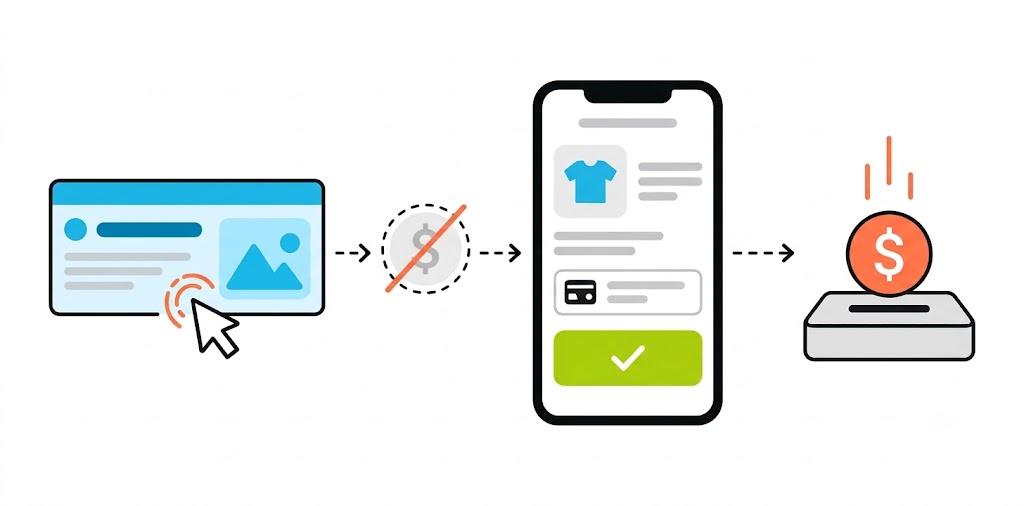
Performance marketing is a tactical distribution layer that captures immediate demand via paid channels (ROAS-focused). In contrast, growth marketing is a full-funnel framework that optimizes the entire customer journey (LTV-focused). While performance marketing drives speed to market, growth marketing ensures sustainable scaling by building compounding retention and referral loops.
- Performance Marketing: A subset of digital marketing where advertisers pay only for specific actions like clicks or sales. It relies on platforms to find ready-to-buy customers.
- Growth Marketing: A process of continuous experimentation across the entire journey. It analyzes how customers use products, stay subscribed, and refer others.
Understanding these differences is essential for building a sustainable revenue engine in 2026.
Key Takeaways
- Performance marketing acts as a tactical layer to capture immediate demand, while growth marketing serves as the overarching framework to optimize that demand into long-term assets
- Performance marketing focuses on short-term acquisition and immediate efficiency (ROAS), whereas growth marketing prioritizes the full customer journey and long-term sustainability (LTV).
- Success in performance marketing is measured by direct-response data like CPC and CAC; growth marketing looks at retention rates, viral coefficients, and the LTV: CAC ratio.
- Early-stage startups often use performance marketing to prove a concept, but mature companies must transition to growth marketing to ensure acquisition costs don't exceed customer value.
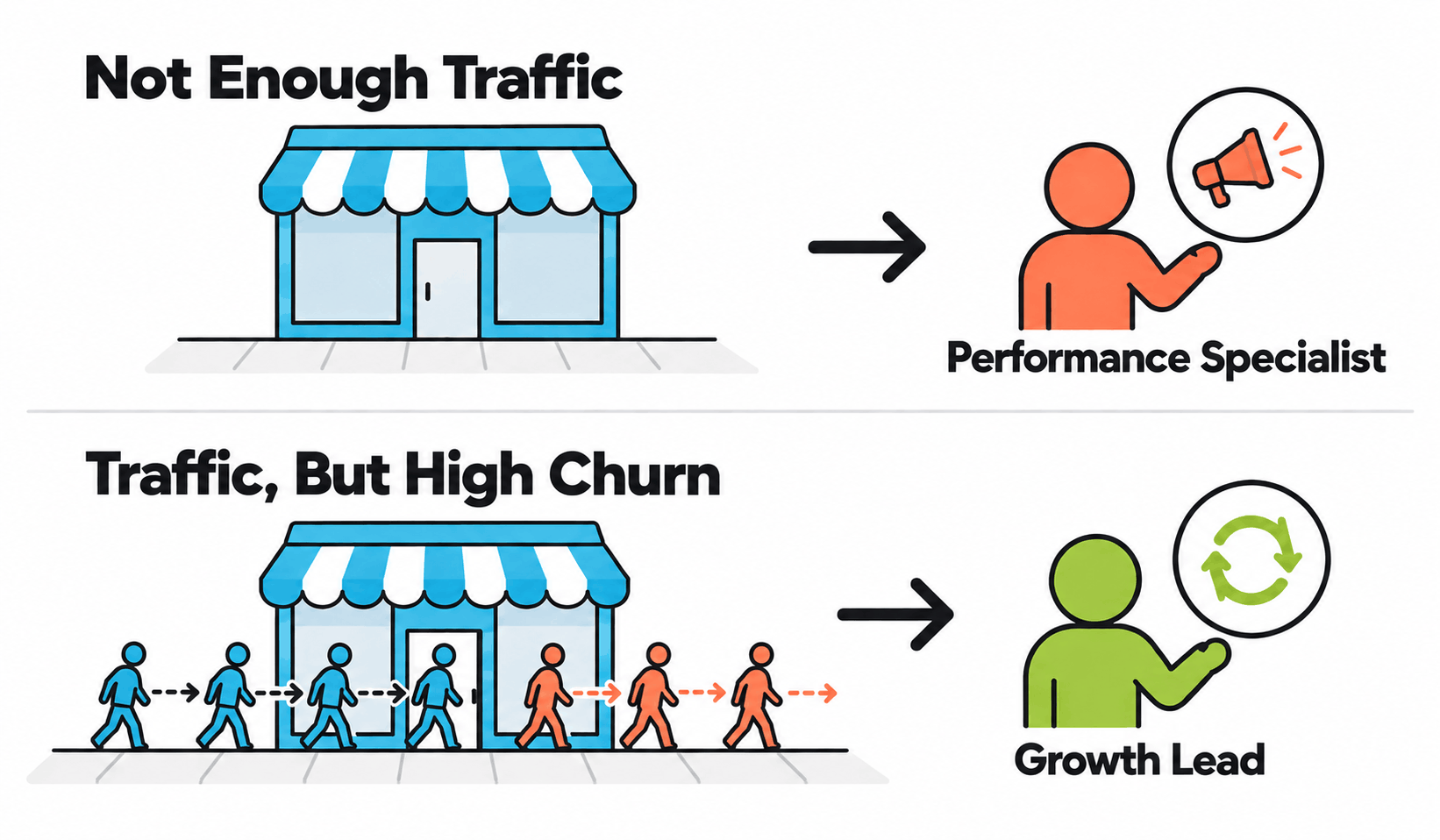
- Hire a performance specialist if your bottleneck is a lack of traffic; hire a growth lead if you have traffic but suffer from high churn or stagnant revenue.
Growth vs. Performance Marketing: Identifying the Key Differences
The primary distinction between these strategies lies in their time horizons and how they measure financial success. Performance marketing prioritizes immediate efficiency, whereas growth marketing focuses on the total wealth generated over a customer's lifespan.
Below is a breakdown of these differences:
The "winner" between these strategies depends on your business stage. While performance marketing drives the initial traffic, growth marketing builds the systems that turn those visitors into long-term, profitable customers.
The ideal strategy depends on a business's stage; early-stage startups often use performance marketing to prove a concept with quick data. However, mature companies must transition to growth marketing to ensure acquisition costs do not exceed total customer value.
Is Performance Marketing Part of Growth Marketing?
Performance marketing is a tactical distribution layer within a broader growth marketing framework rather than a separate or opposing entity.
While performance marketing captures demand through targeted ads, growth marketing optimizes that demand into a long-term asset through data science and product alignment.
Why Growth Marketing Focuses on the Entire Funnel
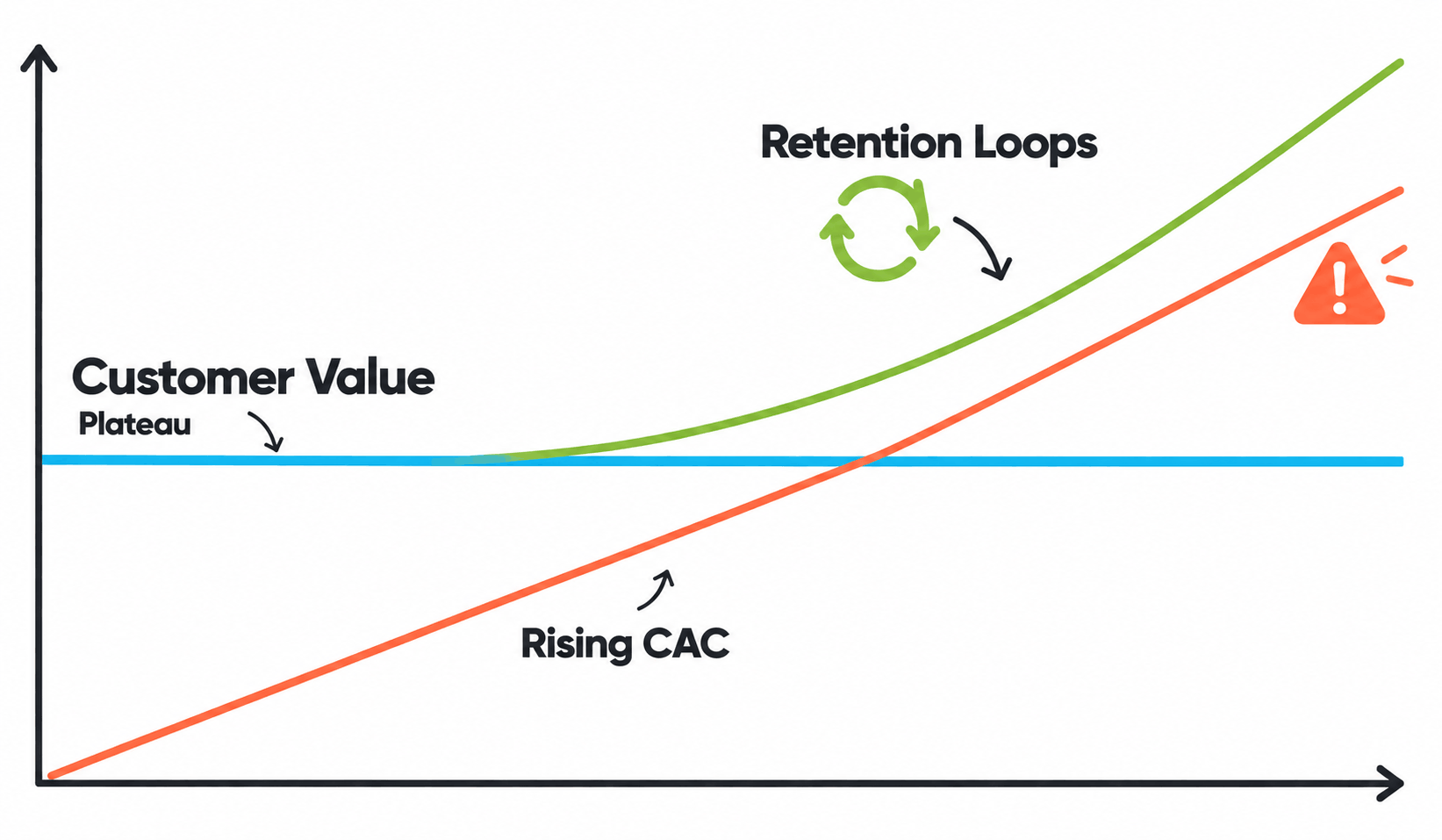
Companies often hit a performance plateau when rising market competition causes acquisition costs to exceed the value of a new customer. This occurs when capital is spent driving traffic to a product that fails to retain its users.
Growth marketing prevents this collapse by building retention loops—automated systems and product optimizations that decrease reliance on constant paid acquisition and create compounding returns.
How Growth Marketing Improves Performance Marketing
Growth marketing improves performance marketing by turning one-time buyers into long-term advocates through a focus on the entire customer journey. While performance marketing excels at the initial sale, growth marketing uses data to optimize what happens after the click, ensuring that the money spent on ads leads to sustainable, recurring revenue rather than a single transaction.
Core Differences in Metrics: From ROAS to Customer Lifetime Value
Performance marketing prioritizes immediate efficiency through Return on Ad Spend (ROAS). Growth marketing prioritizes long-term health through Customer Lifetime Value (LTV) and Retention Rates, ensuring the business remains profitable as advertising costs increase.
To measure performance marketing, you typically look at direct-response data. The basic components of a performance marketing strategy include:
- Cost Per Click (CPC): The amount paid for each individual interaction.
- Cost Per Acquisition (CAC): The total spend divided by the number of new customers.
- Return on Ad Spend (ROAS): A calculation of Revenue / Ad Cost.
These metrics tell you if an individual campaign is profitable today. However, they do not tell you if the business is sustainable. This is where key metrics for growth versus performance marketing success diverge.
A growth marketing team focuses on:
- Retention Rate: The percentage of users who remain active over 30, 60, or 90 days.
- Customer Lifetime Value (LTV): The total revenue a customer generates over years, not just the first transaction.
- Viral Coefficient: The number of new users generated by existing users through referrals.
If you only focus on ROAS, you may ignore the fact that your customers are leaving after one month. Growth marketing identifies these gaps. While performance marketing aims for a high ROI on a single ad, growth marketing aims for a high LTV/CAC ratio across the entire organization.
Quick Wins vs. Long-Term Value: A Quick Look at Advertising Returns
Performance marketing measures the speed of a transaction, but growth marketing captures the depth of profit over time.
While paid ads provide speed, immediate efficiency is often lower than the value created by long-term strategies. ROAS may not reflect true profit, especially in long sales cycles.
To understand the difference between these two strategies, we can look at data from the First Page Sage 2025 ROAS Statistics and LTV to CAC Ratio reports.
When comparing industry results, the contrast between immediate returns and long-term health is stark:
Performance metrics track the immediate return on every dollar spent, but growth metrics reveal the actual wealth generated over the entire lifespan of a customer relationship. Performance shows how fast you get your money back; growth shows how much you actually keep.
Growth Marketing versus Performance Marketing Roles
Daily tasks reflect the differing scopes of these two roles, moving from channel specialization to systems engineering:
Understanding these roles is essential when deciding to hire a performance marketing specialist versus a growth lead. If your primary bottleneck is a lack of traffic, a performance specialist is the immediate requirement. If your bottleneck is a high churn rate or stagnant revenue despite high traffic, a growth lead is required to optimize the system.
Why You Need Both Strategies to Scale Your Business
The most successful businesses combine growth and performance marketing methods to balance immediate sales with long-term brand health. If you only use performance marketing, your costs will eventually rise as competition increases. If you only use growth marketing, it may take too long to see your first dollar. By using them together, you can use ads to find new people (performance) and high-quality experiences to keep them coming back (growth).
The strategic prioritization of growth marketing versus performance marketing depends heavily on a company's current bottlenecks.
- Early Stage: New ventures need performance marketing to establish a distribution layer and test product-market fit.
- Growth Stage (Scaling): Once traffic is consistent, organizations must adopt a growth framework. Ignoring high churn leads to a plateau where acquisition costs exceed customer value.
The shift toward a focused strategy is no longer optional. Industry analysis from Delante and recent 2026 benchmarks indicate that Google Ads costs are climbing, with the global average Cost Per Click (CPC) reaching approximately $2.69 and competitive sectors like B2B seeing averages as high as $3.33 per click.
As AI-driven automation prioritizes expensive high-intent signals over traditional low-cost keywords, businesses relying strictly on ad spend risk hitting a performance plateau. In this environment, the cost to acquire a customer can quickly exceed the profit they provide.
Looking toward 2026, building a stable user base becomes even more critical as consumer habits shift. A 2026 Customer Loyalty Report by Antavo highlights that 67.7% of Gen Z consumers (the next major wave of purchasing power) plan to join more loyalty programs in the coming year. Unlike older generations, these users prioritize emotional connection and consistent value over simple discounts.
To stay competitive, companies must pivot from viewing ads as a one-off expense to building a growth engine that extracts maximum long-term value from every paid visitor.
How the Customer Journey Influences Marketing Strategy
The growth marketing versus performance marketing debate often focuses on budget, but the best strategy treats them as interdependent systems. Performance Marketing manages the initial click, while Growth Marketing optimizes the post-click experience and onboarding to convert high-intent leads into active users.
When an organization improves its activation rate (the speed at which users experience a product’s core value), acquisition spend becomes objectively cheaper - e.g., if you double your activation rate, you effectively cut your Cost Per Activated User (CPAU) in half. This shifts the focus from top-of-funnel metrics like CPC toward the compounding effects of an integrated funnel.
McKinsey’s 2023 data confirms that improving customer satisfaction delivers better results than increasing acquisition. With growth marketing, it uses consumer profiles to identify drop-off points and deploys targeted experiments (like behavioral emails or in-app education) to fix funnel processes. This ensures spend contributes to a stable user base rather than low-LTV cohorts.
Choosing a strategy goes beyond fixing a broken signup form; it means using data to create personalized experiences that earn long-term trust. By focusing on these loyalty-driven behaviors, businesses can ensure their marketing spend builds a community of advocates rather than just a list of one-time buyers.
How to Choose the Right Strategy for Your Current Goals
To assess how to transition your approach in growth engineering and performance marketing, an organization must move from treating acquisition as a one-time transaction to viewing it as the start of a value loop.
- Identify the Leak: Analyze cohort data to determine where users drop off after the initial click (e.g., failed Activation or low Retention).
- Optimize the LTV: Shift focus toward raising LTV through retention and upsell strategies rather than just lowering CAC.
- Cross-Functional Alignment: Integrate marketing and product teams to address friction in the user experience through product engineering and behavioral psychology.
- Implement Growth Loops: Use existing users to drive organic growth through automated referral triggers, decreasing total reliance on paid acquisition.
Summary
Transitioning from a performance-only mindset to a growth strategy allows an organization to move beyond linear acquisition. By widening understanding of lifecycle optimization, businesses can achieve compounding returns and avoid the diminishing efficiency of a performance plateau
Reliable scaling is not a choice between these two frameworks, but an integration where performance marketing acts as the distribution layer for a robust growth architecture.
Frequently Asked Questions (FAQs)
1. Which strategy should an early-stage startup choose?
This is usually dictated by cash flow. Performance marketing often comes first to provide the data and revenue needed to prove a concept. However, as a company matures, it must transition to growth marketing to ensure long-term profitability and prevent acquisition costs from exceeding customer value.
2. Why is looking at ROAS sometimes misleading?
ROAS measures the speed of a transaction but ignores the full financial picture. A campaign might have a high ROAS but low margins if the sales cycle is long or if customers don't stay long enough to cover costs. Growth metrics like LTV:CAC provide a more accurate measure of true profit.
3. Why shouldn't I just focus on getting new customers through ads?
Relying only on ads leads to a "performance plateau" where competition drives costs up until they exceed the profit from a sale. Without a growth strategy to keep those customers coming back, your business remains stuck in a cycle of expensive, one-time transactions.
4. How can I improve my marketing results without just spending more money?
You can assess the process in your customer journey. By improving your activation rate—how fast a user sees the value of your product—your existing ad spend becomes more efficient, and your growth becomes self-sustaining.
Read These Next

B2B Performance Marketing: 2026 Complete Guide