.png)
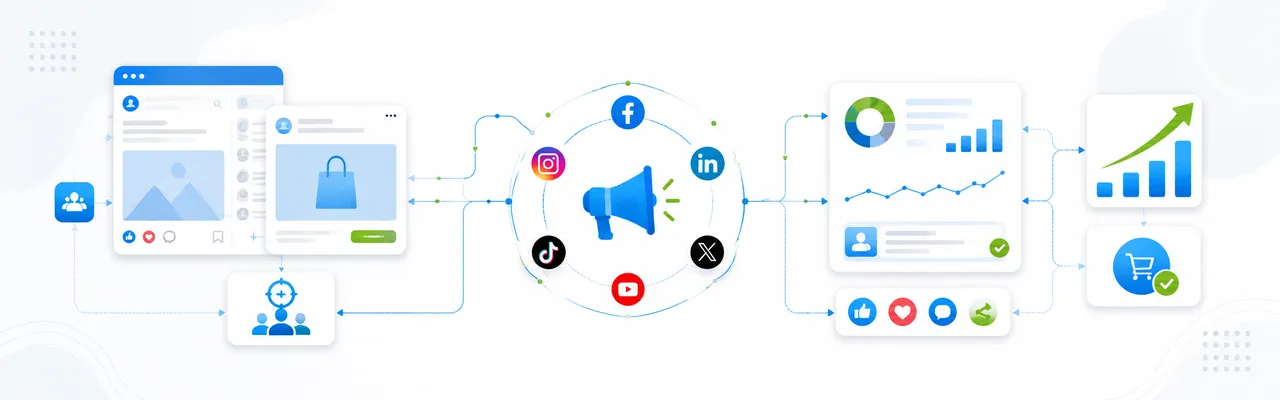
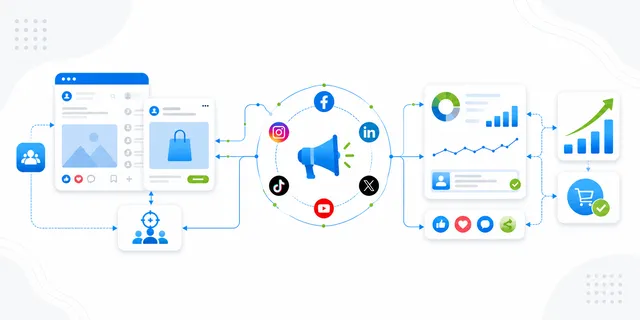
Benefits of Paid Social Media Advertising: 9 Reasons to Start Today
.png)

.png)

Paid social media advertising provides immediate market entry, granular audience targeting, and direct scalability by purchasing placement in user feeds. Unlike organic growth, it delivers results within 24–48 hours for validated offers, though visibility is contingent on continuous spend. In 2026, its primary value lies in its ability to bypass algorithmic reach limits and provide real-time performance data for rapid offer validation.
Introduction
Paid social media advertising has become a primary acquisition channel for businesses across APAC, the US, and Australia — not because organic reach has declined, but because social platforms now offer audience targeting infrastructure that no other channel matches. The ability to reach a defined segment at a defined moment, with a defined message, is the structural advantage that paid social media provides.
The environment in which this happens has changed significantly. Privacy restrictions — including Apple's App Tracking Transparency framework, third-party cookie deprecation, and platform-level signal loss (the reduction in observable conversion data caused by users opting out of tracking, browser restrictions, and deprecated attribution windows) — have reduced the precision of behavioral targeting that paid social was built on. At the same time, AI-driven campaign systems like Meta Advantage+ and TikTok Smart Performance Campaigns have automated delivery in ways that improve efficiency but reduce visibility into what is actually working. Attribution across fragmented customer journeys is increasingly modelled rather than directly observed.
According to Dilate Digital, paid advertising has become a necessity rather than an option in competitive digital markets. The businesses generating consistent returns from paid social are not necessarily spending more — they are tracking more accurately, testing more systematically, and treating paid social as one component of a larger acquisition system rather than a standalone channel.
This guide breaks down nine core benefits of paid social media advertising, how each benefit works, where it holds, and where it breaks down in real-world conditions.
Paid Social vs Organic: A Direct Comparison
What This Guide Covers
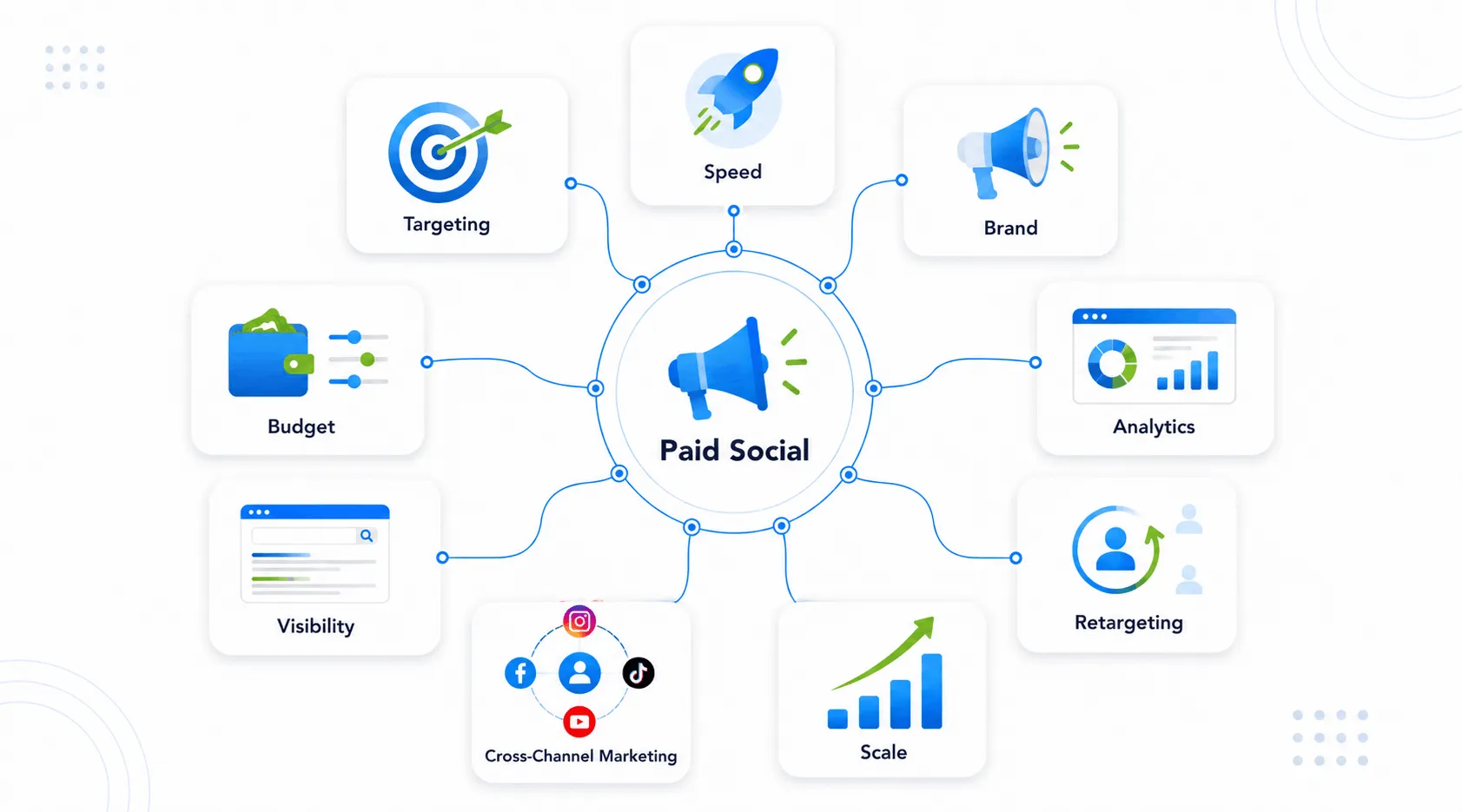
This guide explains the nine core benefits of paid social media advertising and the conditions under which each benefit actually delivers.
- Speed: Why paid social delivers faster results than organic channels
- Targeting Precision: How audience targeting reduces wasted spend
- Brand Awareness: How paid social builds recognition at scale
- Measurable Performance: Why real-time data accelerates optimisation
- Retargeting: How re-engaging past visitors improves conversion rates
- Cross-Channel Integration: How paid social makes other channels work better
- Scalability: What scaling spend actually looks like and when it plateaus
- Competitive Visibility: How paid social creates presence in crowded markets
- Budget Control: How flexible spend reduces campaign risk
9 Benefits of Paid Social Media Advertising
1. Speed — Why Does Paid Social Produce Results Faster Than Organic?
Paid social delivers traffic and conversions from the moment a campaign goes live. There is no ranking process, no algorithm to satisfy over months, and no audience to build incrementally. A well-structured campaign with a validated offer can generate its first conversions within 24 to 48 hours of launch — though this assumes the offer itself has been tested and confirmed to convert; a new or unvalidated offer will not produce conversions at speed regardless of how well the campaign is configured.
The mechanism is direct: advertisers purchase placements in social feeds based on targeting criteria and bid levels. When users match the defined parameters, ads are served immediately. Speed is most valuable in situations where revenue is needed before organic channels can mature:
- Product launches that need immediate market feedback
- Seasonal or time-limited promotions with a fixed window
- New market entry where brand recognition starts at zero
- Offer validation before committing to long-term organic investment
Speed, however, is conditional. It requires continuous spending. Paid social produces no residual traffic and visibility resets to zero when campaigns stop. Businesses that rely entirely on paid-for acquisition have no compounding asset, which increases long-term costs compared to channels that build over time. The speed advantage is most useful when paired with a longer-term organic or retention strategy, not as a permanent substitute for one.
Benchmark context: Meaningful optimisation data typically accumulates within two to four weeks of consistent spend, depending on traffic volume and conversion rate. Launching with an insufficient budget to generate this data volume extends the learning period and delays informed decisions.
2. Targeting Precision — How Does Paid Social Reduce Wasted Ad Spend?
Paid social allows campaigns to reach specific audiences based on demographics, interests, behaviors, life events, job titles, and past interactions with the brand. This precision reduces wasted impressions and improves the relevance of traffic delivered to a landing page or offer — which directly affects conversion rates and cost per acquisition.
Different targeting mechanisms serve different funnel stages:
- Interest and demographic targeting: reaches users who match a defined profile but may not yet be aware of the brand
- Behavioral retargeting: re-engages users who have already interacted with the brand
- Lookalike audiences: extends reach to new users who resemble existing customers based on first-party data signals
- In-market and intent signals: platforms like LinkedIn allow targeting by job title, seniority, and company size for B2B campaigns
The reliability of this precision has declined as privacy restrictions have reduced the quality of third-party audience data. iOS signal loss alone reduced the observable conversion data available to Meta's algorithm significantly after the 2021 ATT rollout. AI-driven systems like Meta Advantage+ now automate audience selection, which can improve delivery efficiency but reduces advertiser control over which specific segments are being targeted. Performance increasingly depends on creative quality, landing page experience, and first-party data rather than manual audience configuration.
Targeting precision is most effective when first-party data is clean, conversion signals are strong, and the offer is validated. Campaigns with well-defined audiences consistently outperform broad campaigns at the same budget — but only when the tracking infrastructure to measure that performance is in place.
3. Brand Awareness — Can Paid Social Build Recognition at Scale?
Paid social exposes a brand repeatedly to a defined audience across feeds, stories, and video placements. This repeated exposure — particularly for users who are not yet in an active buying cycle — builds familiarity that influences conversion decisions later in the journey.
The mechanism works through frequency. Users who encounter a brand multiple times across social platforms are statistically more likely to convert when they reach a purchase decision, even if the conversion is attributed to a different channel. Brand awareness campaigns tend to show returns across:
- Organic search lift: branded query volume increases as exposure builds recognition
- Direct traffic: users who recall the brand return without clicking an ad
- Email engagement rates: subscribers who have seen the brand in paid placements open and click at higher rates
- Conversion rate improvement on retargeting: audiences already exposed to brand ads convert more efficiently when retargeted
Frequency without relevance produces the opposite effect. Creative fatigue sets in when the same audience sees the same ad too often without variation. Effective brand awareness campaigns rotate creative consistently, refresh messaging, and segment audiences to ensure the ad experience remains relevant rather than repetitive.
For C-level decision makers and SME owners evaluating brand investment, the limitation to understand is that the impact of brand awareness is difficult to measure in isolation. Incrementality testing — comparing a group exposed to brand ads against a holdout group — provides the most accurate read, but requires sufficient budget and platform support to run meaningfully.
4. Measurable Performance — What Does Real-Time Data Actually Allow You to Do?
Paid social provides real-time performance data at a granularity no other marketing channel matches at an equivalent speed. This compresses the iteration cycle from months to weeks or days. The core metrics available in real time include:
- Impressions and reach: how many users saw the ad and how many were unique
- Click-through rate (CTR): the share of users who clicked after seeing the ad
- Cost per click (CPC) and cost per acquisition (CPA): what each action costs relative to spend
- Return on ad spend (ROAS): revenue generated relative to campaign spend, as reported by the platform
- Frequency: average number of times a user has seen the ad, which signals creative fatigue risk
The practical value is in creative and messaging validation. Advertisers can run multiple ad variants simultaneously, identify which combinations drive the lowest CPA, and reallocate budget toward what works without waiting for organic feedback loops. High-converting paid social messages also provide validated signals for content strategy, email copy, and landing page optimisation.
Accurate data collection depends on proper tracking infrastructure. Server-side tagging via the Meta Conversions API (CAPI) or Google's Conversions API ensures conversion signals reach ad platforms even when browser-based tracking is blocked — without CAPI in place, a significant share of conversion data is either lost entirely or estimated through statistical modelling. Meta Events Manager is the central interface for configuring and monitoring these signals. Third-party attribution tools such as Triple Whale, Northbeam, and Rockerbox provide a cross-platform view that accounts for the full customer journey rather than relying on any single platform's self-reported numbers.
Real-time data is only as accurate as the tracking infrastructure behind it. According to 2025–2026 industry analysis, advertisers not running Conversion API lose 40 to 60 percent of conversion visibility, and Meta reports on average 26 percent more conversions than independent analytics tools due to modelled conversions and view-through attribution (Varos Industry Benchmark, 2024; DOJO AI, 2026). Platform dashboards systematically over-attribute conversions to paid touchpoints, meaning reported ROAS frequently differs from what CRM and backend revenue data show.
Real-time data supports directional decisions reliably. It should not drive major budget changes without cross-referencing external sources — specifically, CRM data, server-side tracking, and multi-touch attribution tools that account for the full customer journey.
5. Retargeting — How Does Re-Engaging Past Visitors Improve Conversion Rates?
Retargeting campaigns serve ads specifically to users who have already interacted with a brand but did not convert. Because these users have already demonstrated intent, they convert at significantly higher rates than cold audiences. The most common retargeting triggers include:
- Product or service page visits: users who viewed specific pages without taking action
- Cart or checkout abandonment: high-intent users who started but did not complete a purchase
- Video views: users who watched a threshold percentage of a brand video, signaling engagement
- Lead form opens: users who started filling out a form but did not submit
The structural advantage is efficiency. A user who visited a pricing page and left is a fundamentally different prospect than one who has never encountered the brand. Retargeting allows advertisers to deliver a tailored message — a reminder, a discount, a testimonial — that addresses the specific point of friction that prevented conversion on the first visit.
Retargeting requires audience minimums to function. Meta requires a minimum of 1,000 users in a custom audience before ads can be served. For smaller businesses or those in niche markets, building retargeting pools large enough to support meaningful campaigns takes time. Privacy restrictions have also reduced the size of retargeting audiences, as iOS users who opt out of tracking cannot be included in pixel-based segments. First-party data — email lists, CRM records, and logged-in user behavior — has become the more reliable retargeting foundation as third-party pixel data quality declines.
6. Cross-Channel Integration — How Does Paid Social Make Other Channels Work Better?
Paid social does not operate in isolation. It interacts with SEO, content, email, and direct channels in ways that improve overall marketing efficiency when the system is managed as a whole rather than optimised in silos.
The integration works in both directions. Paid social campaigns generate first-party data — email signups, CRM records, engagement signals — that improve targeting precision across all other channels. Conversely, organic content that has already proven engagement can be amplified through paid social to extend its reach cost-efficiently, rather than investing in new creative for every paid campaign.
A practical integration workflow looks like this:
- Use paid social data to identify which messages and offers convert, then build SEO content and email sequences around those validated signals
- Promote high-performing organic content through paid social to reach audiences beyond existing followers
- Use retargeting to re-engage users who found the brand through organic search or content but did not convert
- Feed CRM and first-party behavioral data back into paid audience targeting to improve lookalike quality
Cross-channel integration requires integrated tracking infrastructure to measure accurately. Without server-side tracking, CRM integration, and consistent UTM attribution, the interactions between channels are invisible — and budget decisions default to optimising each channel independently, which consistently underperforms a systems-level approach.
7. Scalability — When Does Increasing Budget Actually Increase Conversions?
Paid social scales directly with the budget within a defined range. A campaign generating a consistent CPA at a given spend level can, in principle, be scaled by increasing budget — making it one of the most direct growth levers available to a business that has validated its offer and funnel.
AI-driven bidding systems on Meta, TikTok, LinkedIn, and Pinterest optimise delivery based on accumulated conversion data. As campaigns build signal, the algorithm improves at identifying which users are most likely to convert. This means performance often improves in the first few weeks of a campaign before plateauing as the most efficient audience segments are exhausted.
Scaling beyond high-intent audiences increases CPA because the pool of high-intent users is finite — once those segments are reached, the system expands into broader, lower-converting audiences to fulfil additional spend. This is not a sign that the campaign is underperforming; it reflects the natural ceiling of addressable demand. Higher average order values or lifetime customer values give businesses more room to scale before margins compress. Businesses with thinner margins reach their efficient ceiling faster.
Creative fatigue compounds this dynamic at scale. In 2026, when AI-driven platforms handle bidding automatically, creative quality has become the primary lever for paid social performance. As spend increases and audiences are reached more frequently, the same ad loses effectiveness — not just from audience exhaustion but from diminishing creative impact. Campaigns that scale without a systematic creative refresh cadence will see CPA rise faster than audience saturation data alone would predict. Creative-led growth — a disciplined approach to testing hooks, formats, and messaging variations as the primary optimisation lever — is now the defining characteristic of high-performing paid social accounts at scale.
Decision clarity:
- Scale when CPA stays within target margins and conversion rate holds steady across two to three consecutive weeks
- Pause or reduce spend when CPA consistently exceeds margins or conversion rate declines without a clear external cause
- Validate platform ROAS against CRM and backend revenue data before significantly increasing budget — platform reporting systematically overstates returns
Benchmark context: According to 2025–2026 industry benchmarks, well-optimised paid social campaigns targeting warm or retargeting audiences typically generate ROAS between 3x and 6x. Cold audience campaigns generally range from 1.5x to 3x. These figures are highly industry-dependent — luxury goods, high-consideration SaaS, and financial services will see very different ranges from e-commerce or B2C subscription products. Below 2x consistently usually indicates a structural issue with the offer, landing page, or audience match rather than a channel problem.
8. Competitive Visibility — How Does Paid Social Create Presence in Crowded Markets?
Paid social allows businesses to appear in feeds alongside — and often above — organic content from competitors, regardless of follower count, post frequency, or account age. This gives smaller businesses and new market entrants access to the same placements as established brands.
In markets where organic social reach is algorithmically suppressed for business accounts, paid placement is often the only reliable way to reach audiences beyond existing followers at scale. A brand launching in a new geography or vertical can build meaningful reach within days of a campaign launch — a process that would take months through organic content alone.
Beyond reach, paid social functions as a creative sandbox for market positioning. The ability to run multiple ad variants simultaneously — testing different value propositions, brand angles, and audience framings — provides validated positioning data at a speed and cost that traditional market research cannot match. What resonates in a paid social test often reflects genuine market appetite, making paid social a legitimate strategic input for product positioning decisions, not just a traffic channel.
Competitive visibility through paid social is subject to auction dynamics. In highly competitive categories — financial services, SaaS, legal, insurance, and consumer electronics — CPMs can be high enough to make paid acquisition unviable for businesses with thinner margins. Rising competition consistently increases the cost of maintaining visibility over time. This is one reason businesses invest in organic content as a long-term hedge against paid cost inflation — organic visibility, once earned, does not require ongoing spend to maintain.
Benchmark context: CPMs on Meta range from $5 to $30+, depending on audience, placement, and competitive pressure. LinkedIn CPMs for professional audiences typically range from $30 to $80+. TikTok CPMs are generally lower but rising as advertiser adoption increases. These ranges shift with market conditions and campaign objectives.
9. Budget Control — How Does Flexible Spend Reduce Campaign Risk?
Paid social allows full control over how much is spent, where it is spent, and when campaigns run. Unlike traditional media commitments — broadcast, print, or out-of-home — paid social campaigns can be started, paused, adjusted, and reallocated in real time based on performance data.
This flexibility is most valuable during validation phases. A business testing a new offer, entering a new market, or validating a message can start with a limited budget — enough to generate statistically meaningful conversion data — before committing to larger spend. This reduces the risk of allocating significant budget to an unvalidated campaign.
Budget control does not eliminate budget dependency. Paid social campaigns require ongoing spend to maintain visibility and conversion volume. Total acquisition costs compound over time, and small businesses that scale paid spend before establishing a profitable CPA can find themselves dependent on a channel delivering diminishing returns as audiences saturate and CPMs rise. Budget flexibility is a feature of the channel, not a structural protection against these dynamics.
The practical implication for C-level decision makers and SME operators is that budget control works best when combined with clear CPA targets, regular performance reviews against backend revenue data, and a defined threshold for scaling versus pausing spend.
Conclusion
Paid social media advertising's nine core benefits — speed, targeting precision, brand awareness, measurable performance, retargeting, cross-channel integration, scalability, competitive visibility, and budget control — are genuine structural advantages. No other channel provides the same combination of speed, measurability, and audience reach.
What differentiates campaigns that scale from those that plateau is not access to these benefits but the system built around them. Accurate tracking infrastructure, strong creative, validated offers, and cross-channel integration determine whether the flexibility of paid social compounds into sustainable growth or produces diminishing returns.
The businesses generating the most consistent returns from paid social are not necessarily the largest spenders. They are measuring more accurately, testing more systematically, and treating paid social as one component of a larger acquisition and retention system — not the only engine driving it.
FAQs
What are the main benefits of paid social media advertising? The nine core advantages are speed, targeting precision, brand awareness, measurable performance, retargeting, cross-channel integration, scalability, competitive visibility, and budget control — each operates most reliably when tracking infrastructure and offer validation are in place first.
How quickly does paid social media advertising produce results? For validated offers with confirmed conversion rates, first results typically appear within 24 to 48 hours. The more useful milestone is two to four weeks of consistent spend, at which point there is enough data to make informed optimisation decisions rather than reacting to early noise.
Is paid social media advertising worth it for small businesses? The right question is whether margins support the channel's CPA at the budget available. Start at the minimum spend needed to generate statistically meaningful data — typically 30 to 50 conversion events — validate that CPA is profitable, then scale. Launching with an insufficient budget produces unreliable data, not low-cost learning.
What is a good ROAS for paid social advertising? According to 2025–2026 industry benchmarks, warm and retargeting audiences typically generate 3x to 6x ROAS; cold audiences typically range from 1.5x to 3x. These figures vary significantly by vertical — luxury goods and high-consideration SaaS operate very differently from B2C e-commerce. The more useful question is whether ROAS exceeds the break-even threshold for your specific margin structure.
Why does paid social stop working when you pause spend? Organic channels compound over time; paid social does not. This structural difference is why businesses treat paid social as a demand generation lever and organic as the long-term acquisition foundation.
How does privacy regulation affect paid social advertising performance? iOS ATT, GDPR, and CCPA have collectively reduced the share of directly observable conversion data. Without server-side tracking via Conversions API (CAPI), configured through Meta Events Manager, a significant portion of reported results relies on statistical modelling — cross-referencing platform numbers against CRM data and third-party tools like Triple Whale or Northbeam is now standard practice for any serious measurement setup.
Read These Next
Pay Per Click Marketing Strategy: 7 Steps to a High-ROI Campaign in 2026
Media Buying Explained: What You Need to Know Before Your Next Campaign
%20(1).png)