.png)
D2C Performance Marketing: The Complete Funnel Optimization Blueprint
.png)

.png)

D2C Performance Marketing Funnel Optimization is the process of improving how users move across awareness, interest, consideration, conversion, and retention stages. By leveraging first-party data, AI-driven creative testing, and resilient tracking systems, brands reduce acquisition costs and increase lifetime value. In 2026, success depends on full-funnel alignment rather than isolated campaign optimization.
INTRODUCTION
D2C (direct-to-consumer) brands rely on performance marketing to drive measurable growth across the entire customer journey, from first exposure to repeat purchases.
Unlike traditional retail models, D2C brands control:
- customer acquisition
- on-site experience
- post-purchase engagement
This makes funnel optimization a core part of performance.
In 2026, performance marketing is shaped by:
- AI-driven campaign automation
- privacy-first tracking reducing user-level visibility
- increasing competition and rising acquisition costs
At the same time, customer behavior is becoming harder to predict. According to Emarsys (2024), 77% of marketers report difficulty predicting customer behavior, which reduces the effectiveness of broad targeting and static strategies.
Because of this, performance depends less on individual campaigns and more on how efficiently users move through each stage of the funnel.
WHAT THIS GUIDE COVERS?
This guide explains how D2C performance marketing works across a five-stage funnel and how to optimize each stage to improve efficiency, reduce drop-offs, and increase overall performance.
It covers:
- What D2C performance marketing is
- The structure of a 5-stage D2C funnel
- How to optimize awareness, interest, consideration, conversion, and retention
- A step-by-step funnel optimization blueprint
- Where users drop off in the funnel and how to fix it
- How AI and privacy changes affect funnel performance in 2026
What Is D2C Performance Marketing?
D2C performance marketing is a data-driven approach where brands acquire, convert, and retain customers through measurable channels such as paid ads, email, and owned platforms. It focuses on improving conversion efficiency and lifetime value rather than only increasing traffic.
Unlike traditional models, D2C brands:
- control the entire funnel
- collect first-party data directly
- optimize performance using real-time data, including server-side conversion API events, GA4 enhanced conversions, and CRM-integrated first-party signals
This allows continuous improvement across all funnel stages:
- awareness (traffic generation)
- interest (engagement and signal capture)
- consideration (intent building)
- conversion (purchase)
- retention (repeat behavior)
Performance marketing in D2C includes every interaction that influences whether a user converts and returns.
What Does a D2C Performance Marketing Funnel Look Like?
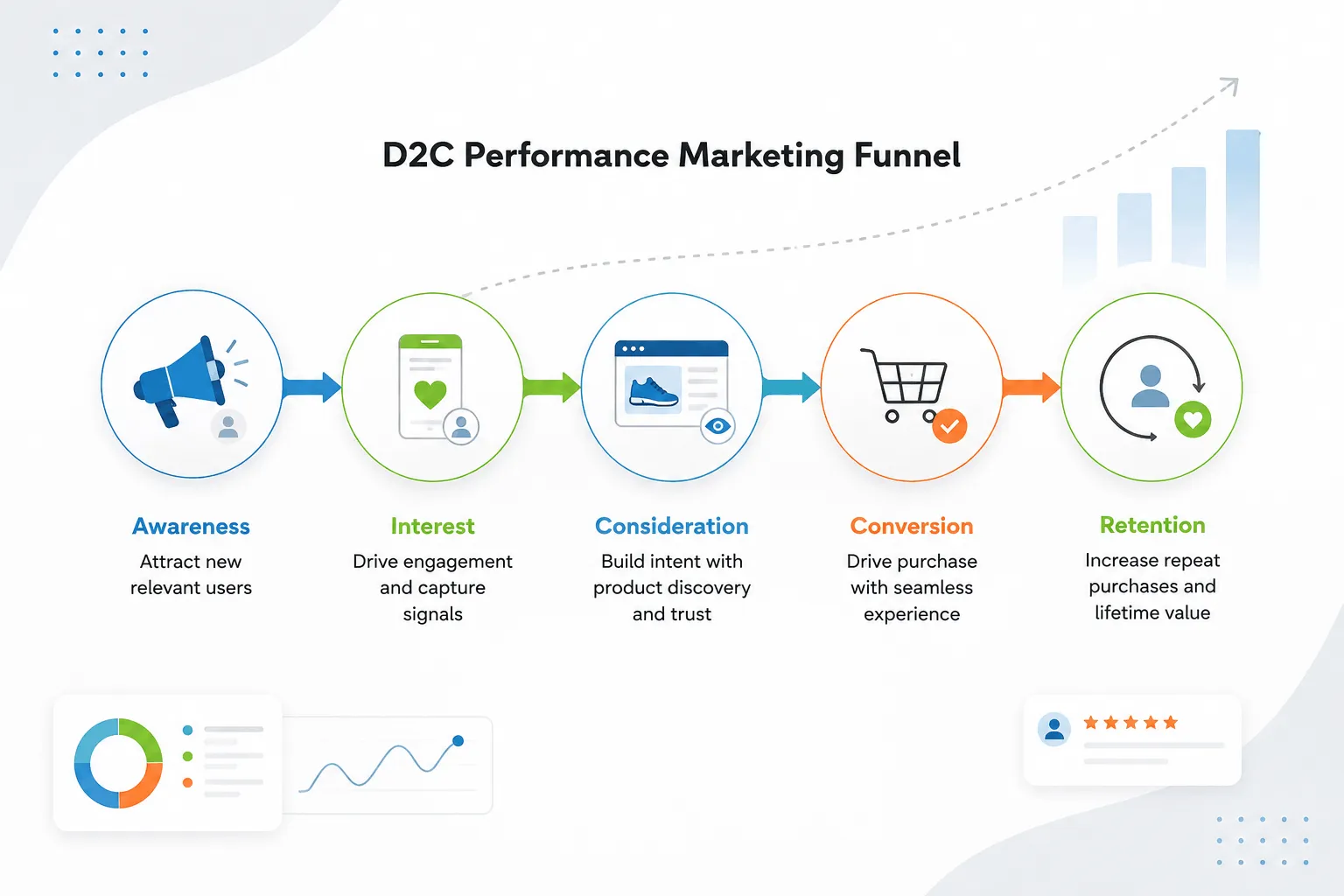
A D2C performance marketing funnel represents the stages a user moves through, from discovering a brand to becoming a repeat customer. Each stage serves a different function and must be optimized to reduce drop-offs.
Core Funnel Stages
Each stage builds on the previous one.
For example:
- strong awareness with weak interest leads to low engagement
- high interest with weak consideration reduces purchase intent
- strong conversion with weak retention limits long-term growth
Because of this, performance marketing functions as a connected system, not separate campaigns.
How Do You Optimize the Awareness Stage?
Optimizing awareness focuses on reaching relevant audiences and generating high-quality traffic. Poor targeting at this stage increases costs and reduces downstream performance.
Awareness performance is affected by:
- increased competition in paid channels
- reduced targeting precision due to privacy changes
- AI-driven delivery prioritizing predicted engagement
Key Optimization Areas:
1. Audience Targeting
- use first-party and lookalike data
- focus on relevant audience segments
- exclude low-intent users
2. Creative Strategy
- test multiple hooks and formats
- use short-form video and UGC
- refresh creatives regularly
3. Channel Selection
- use paid social for discovery
- combine with search for intent capture
Benchmark Context:
Low engagement at this stage increases costs. Improving click-through rates (CTR) directly improves traffic quality and reduces cost per acquisition.
How Do You Optimize the Interest Stage?
Optimizing interest focuses on capturing attention and encouraging users to engage after initial exposure. This stage signals whether users are moving deeper into the funnel.
Interest is where users:
- follow the brand
- sign up for email or SMS
- engage with content
Key Optimization Areas:
1. Engagement Content
- use storytelling and educational content
- highlight product benefits
- create interactive formats
2. Retargeting
- re-engage users who interacted but did not convert
- use dynamic ads based on behavior
3. Lead Capture
- collect emails and phone numbers
- offer incentives such as discounts or content
- use zero-party data collection methods such as quizzes, preference centers, and surveys to capture user intent directly
Strong interest improves the efficiency of later stages by increasing the number of qualified users entering consideration.
How Do You Optimize the Consideration Stage?
Optimizing consideration focuses on building purchase intent by helping users evaluate the product. This stage determines whether engagement turns into buying intent.
Many users drop off here due to lack of clarity or trust.
Key Optimization Areas:
1. Social Proof
- reviews and testimonials
- user-generated content
- before-and-after results
2. Product Education
- explain features and benefits clearly
- provide comparisons and use cases
3. On-Site Experience
- improve product pages
- highlight key information
- reduce confusion
In one example scenario, a D2C brand experiencing high traffic but low purchases identified a drop-off between consideration and conversion. By improving product page clarity, adding user-generated content, and reinforcing trust signals, the brand increased conversion rates without increasing traffic. This highlights how small improvements in the consideration stage can significantly impact revenue.
Pro-Tip: In 2026, we’ve found that UGC performs most effectively in the Consideration stage. While often used for Awareness, its greatest value is now in providing "authentic validation" that converts high-intent prospects who are hesitant to buy.
Benchmark Context:
According to Saras Analytics (2024), average ecommerce conversion rates range from 2% to 5%, which indicates that most users do not complete purchases.
Improving consideration increases the likelihood that engaged users move to conversion.
How Do You Optimize the Conversion Stage?
Conversion optimization focuses on reducing friction between intent and purchase. Small improvements at this stage can significantly increase revenue without increasing traffic.
Common issues include:
- complex checkout processes
- slow page load times
- unexpected costs
Key Optimization Areas:
1. Checkout Optimization
- reduce steps in checkout
- simplify forms
- offer multiple payment options
2. Pricing and Offers
- use limited-time offers
- provide first-time discounts
3. Trust Signals
- display guarantees and policies
- show reviews and ratings
According to WebEngage (2024), personalization can increase conversion rates by up to 20%–25%, especially when based on user behavior.
How Do You Optimize the Retention Stage?
Retention optimization focuses on increasing repeat purchases and customer lifetime value. This reduces reliance on paid acquisition and improves overall profitability.
Retention determines long-term performance.
Key Optimization Areas:
1. Lifecycle Marketing
- use email and SMS flows
- segment users based on behavior
2. Loyalty Programs
- reward repeat purchases
- incentivize referrals
3. Subscription Models
- encourage repeat purchases
- automate reorders
According to Emarsys (2024), 36% of consumers use subscription services, showing how structured retention systems influence repeat behavior.
Retention increases lifetime value, which allows higher acquisition spend while maintaining profitability.
What Is the Complete D2C Funnel Optimization Blueprint?
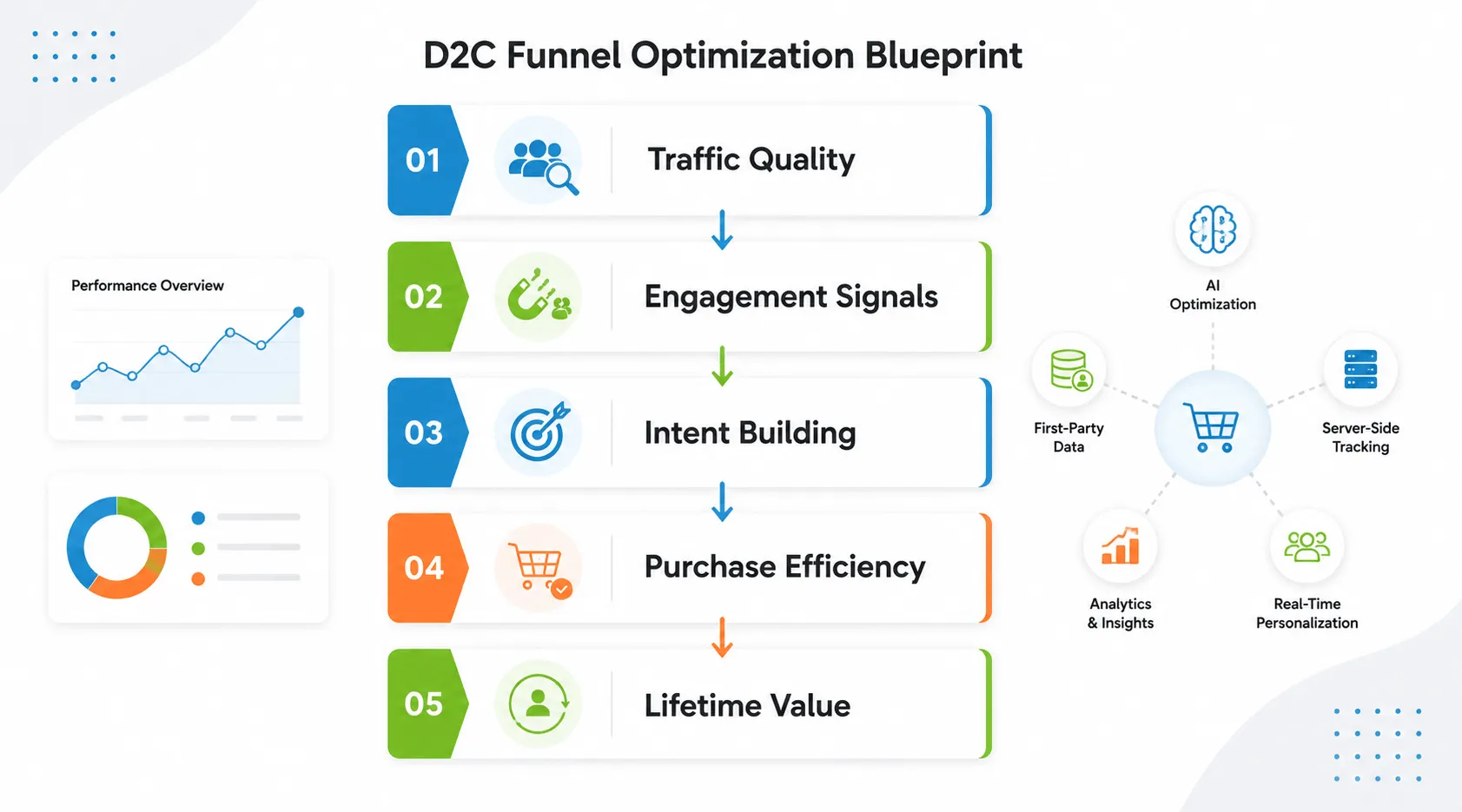
Optimizing the funnel as a system means aligning messaging, targeting, and user experience across all five stages so that each stage supports the next. Misalignment between stages leads to drop-offs and reduced performance.
Step-by-Step Funnel Optimization
Step 1: Optimize Awareness (Traffic Quality)
- target audiences likely to engage
- test creatives to improve click-through rates
- reduce low-intent traffic
→ Output: higher-quality users entering the funnel
Step 2: Capture Interest (Engagement Signals)
- encourage follows, sign-ups, and content interaction
- use retargeting to re-engage users
- collect first-party data (email, SMS)
→ Output: identifiable and engaged users
Step 3: Strengthen Consideration (Intent Building)
- provide product education and social proof
- improve product page clarity
- address objections early
→ Output: users with higher purchase intent
Step 4: Improve Conversion (Purchase Efficiency)
- simplify checkout process
- reduce friction and delays
- align pricing, offers, and expectations
→ Output: higher conversion rate
Step 5: Build Retention (Lifetime Value)
- implement lifecycle marketing
- personalize communication
- encourage repeat purchases
→ Output: increased lifetime value and repeat revenue
How Do You Identify and Fix Funnel Drop-Offs?
Identifying funnel drop-offs requires analyzing where users exit between stages and addressing the cause of friction or misalignment. Each drop-off point indicates a breakdown in user progression.
Common Drop-Offs vs. Solutions
Common Drop-Off Points:
- Awareness → Interest: low engagement or weak creatives
- Interest → Consideration: lack of relevance or unclear value
- Consideration → Conversion: friction in product pages or checkout
- Conversion → Retention: no post-purchase engagement
Fixing Drop-Offs:
1. Analyze Stage-Specific Metrics
- engagement rate (interest)
- add-to-cart rate (consideration)
- conversion rate (conversion)
- repeat purchase rate (retention)
2. Identify Root Causes
- mismatch between ad and landing page
- unclear product value
- poor user experience
3. Implement Targeted Fixes
- improve messaging alignment
- reduce friction
- strengthen retention systems
Fixing drop-offs improves overall funnel efficiency without increasing traffic.
How Do AI and Privacy Changes Affect the D2C Funnel in 2026?
AI-driven systems and privacy-first tracking are changing how each stage of the funnel is optimized. These changes reduce manual control and increase reliance on data quality and funnel structure.
Key Impacts Across the Funnel:
1. Awareness and Interest Depend on AI Optimization
- platforms automate targeting and delivery
- performance depends on creative quality and engagement signals
- broad targeting is replaced by algorithmic matching
2. Consideration and Conversion Depend on On-Site Experience
- reduced tracking limits visibility into user behavior
- conversion relies more on landing page clarity and speed
- user experience becomes a primary performance driver
3. Retention Becomes More Valuable
- first-party data replaces third-party tracking
- email, SMS, and CRM systems become central
- repeat customers reduce dependency on paid acquisition
4. Attribution Becomes Less Precise
- platforms rely on modeled data instead of exact tracking
- individual touchpoints are harder to measure
- performance must be evaluated at the funnel level
5. Modern tracking infrastructure increasingly includes:
- Server-side tagging to improve data reliability
- Customer Data Platforms (CDPs) to unify first-party data
- GA4 enhanced conversions for improved attribution accuracy
- AI-driven creative testing tools to optimize messaging and performance
To address these limitations, many teams now use Marketing Mix Modeling (MMM) and incrementality testing to measure true performance impact across channels without relying on user-level tracking. These methods provide a broader, more reliable view of performance in privacy-first environments.
CONCLUSION
D2C performance marketing is a system where awareness, interest, consideration, conversion, and retention work together to drive growth. Performance depends on how efficiently users move through each stage, not just on traffic volume or individual campaigns.
Improving results requires:
- increasing traffic quality
- strengthening engagement and intent
- reducing friction at conversion
- building retention to increase lifetime value
In 2026, AI-driven systems and privacy limitations reduce visibility and control at the campaign level. As a result, performance depends more on structured funnel optimization than on isolated tactics.
Brands that align all five stages achieve more consistent performance, lower acquisition costs, and stronger long-term growth.
FAQs
What is a D2C performance marketing funnel?
A D2C funnel includes awareness, interest, consideration, conversion, and retention stages that guide users from discovery to repeat purchase.
Why is the interest stage important?
The interest stage captures engagement signals such as sign-ups and interactions, which indicate whether users are moving deeper into the funnel.
What is the biggest issue in D2C funnels?
The most common issue is drop-off between stages, especially between engagement and conversion.
How does AI impact D2C performance marketing?
AI automates targeting and optimization, making performance more dependent on data quality, creatives, and funnel structure.
How can D2C brands improve overall performance?
By optimizing each stage of the funnel and reducing drop-offs rather than focusing only on increasing traffic.
Related Content
Read These Next
What is Retention Marketing? - The 2026 Guide to Customer-First Growth