.png)

Digital Growth Strategies: How to Future-Proof Your Business in an AI-First World
.png)

.png)

How Do You Future-Proof A Business For AI?
Future-proofing requires transitioning from a software-first to an AI-first strategy. This involves consolidating fragmented data into a unified cloud layer, refactoring technical debt to support autonomous agents, and implementing Generative Engine Optimization (GEO) to ensure your brand is cited as a primary source by AI search engines.
Key Takeaways
- An AI-first strategy requires rebuilding workflows around autonomous agents and unified data rather than just adding AI to existing tools.
- As traditional search clicks decline, businesses must use GEO to ensure their content is cited as a primary source by AI engines.
- AI effectiveness relies on a centralized data system to prevent errors caused by fragmented or inconsistent data.
- Scaling AI requires cleaning up messy legacy systems to prevent amplifying existing inefficiencies.
- Human-in-the-Loop (HITL) installs strategic judgment and ethical oversight that remain human responsibilities, even as AI handles speed and scale.
What is an AI-First Business Strategy?
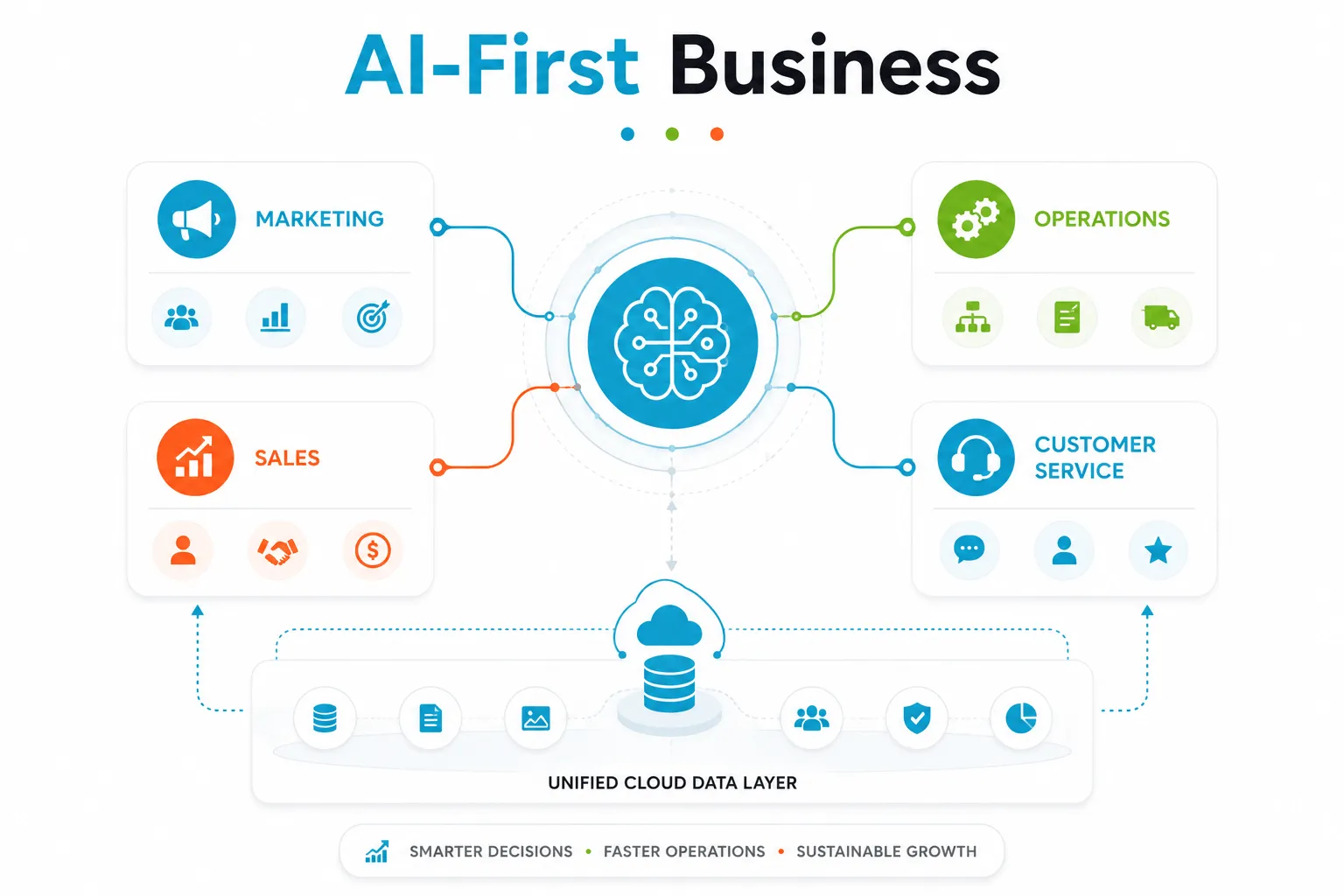
An AI-first business strategy redesigns automated operations. Instead of layering AI onto existing tools, companies rebuild workflows around autonomous agents (task execution), unified data systems (decision accuracy), and continuous learning loops (optimization).
To future-proof your business in an AI-first world, you must centralize data, adopt AI-driven workflows, optimize for AI search (prioritizing Generative Engine Optimization), manage technical debt, and balance human oversight with automation.
Legacy Digital Strategy vs AI-First Strategy 2026
AI-first strategy shifts businesses from digitizing existing processes to redesigning workflows around AI agents, unified data, GEO visibility, modular architecture, privacy controls, and human oversight for expert judgment, exceptions, and ethical accountability.
What is the primary difference between SEO and GEO?
In 2026, SEO focuses on ranking web pages for human clicks, while GEO (Generative Engine Optimization) focuses on making content extractable so AI engines cite it. While SEO wins a position, GEO wins a brand recommendation within an AI-generated summary.
Why Businesses Need a Digital Strategy for 2026
Competitive advantage comes from how effectively a company orchestrates its data. Businesses need a digital growth strategy because AI is changing cost structures, customer acquisition, and operational speed simultaneously.
Key Shifts Driving Urgency
- Rising AI Costs (Usage-Based Pricing)
AI platforms increasingly charge based on compute and usage, not seats. Without monitoring, costs can scale unpredictably. - Decline of Traditional Search Traffic
AI-generated answers (e.g., ChatGPT, Perplexity) reduce clicks to websites. Visibility increasingly depends on being cited, not just ranked. - Operational Speed Becomes a Competitive Advantage
Manual workflows cannot match AI-executed processes that operate 24/7. - Fragmented Data Reduces AI Effectiveness
AI systems often fail when pulling from disconnected or inconsistent data sources.
How to Future-Proof Your Business: 5-Step AI Growth Framework
1. Optimize for AI Search
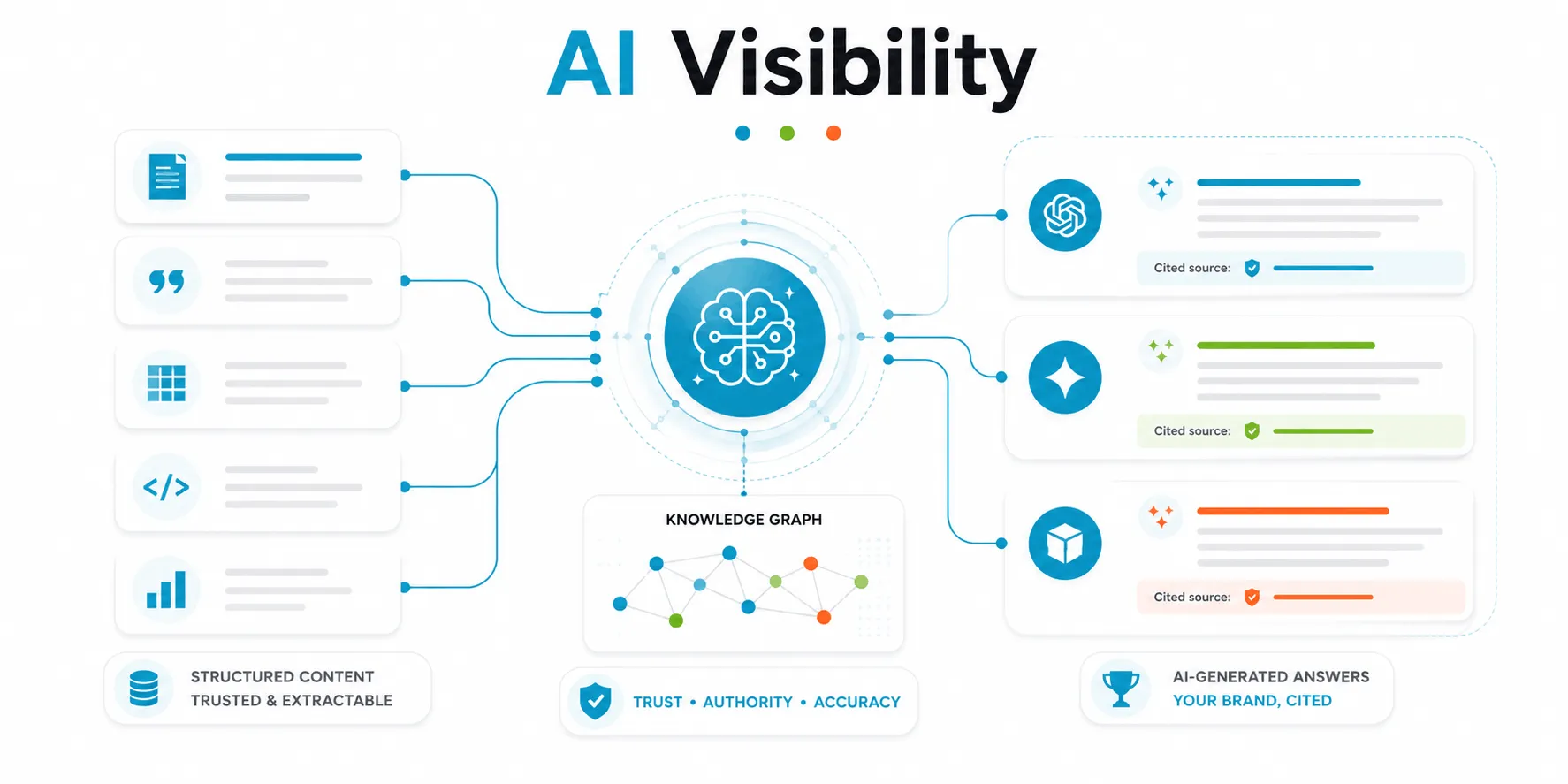
To stay visible, businesses must optimize content for AI-generated answers, not just traditional rankings. Adopting content for Generative Engine Optimization (GEO) maximizes citation and recommendations by AI engines as a primary source.
Structure Content for Direct Answers
AI systems prioritize content that can be easily extracted into answers. Write in clear, self-contained sections that directly respond to specific questions. Use headings that mirror real queries (e.g., “What is Generative Engine Optimization?”) and follow with concise, factual answers before expanding.
Prioritize Trustworthy Content (EEAT)
AI models favor content that demonstrates Experience, Expertise, Authoritativeness, and Trustworthiness. This means:
- Back claims with data, examples, or real-world outcomes
- Avoid vague or exaggerated statements
- Show practical knowledge (not just theory)
- Keep content accurate and updated
In practice, this increases the likelihood that AI systems will cite your content as a reliable source.
Build Topical Authority, Not Just Keywords
Instead of targeting isolated keywords, create clusters of related content that fully cover a topic. For example, a GEO strategy should include articles on AI SEO, zero-click search, content structuring, and AI visibility. This signals depth and authority to both search engines and AI systems.
Use Clear, Extractable Language
Avoid overly complex phrasing or jargon-heavy sentences. This improves both human readability and AI extractability.
AI systems prefer:
- Simple sentence structures
- Explicit definitions
- Direct cause-and-effect explanations
Mitigate Zero-Click Search Risks
With a large portion of searches resolved directly on AI interfaces, traffic may decline even if visibility increases. To offset this:
- Capture first-party data (email signups, lead forms, gated content)
- Build owned channels (email newsletters, communities)
- Offer value beyond the answer (tools, templates, deeper insights)
This provides alternative generation for business outcomes even when users don’t click through.
Focus on High-Intent, High-Conversion Content
AI-referred users tend to be more informed and closer to decision-making. This improves conversion rates even if overall traffic volume is lower. Create content that supports:
- Comparisons (“X vs Y”)
- Decision frameworks
- Implementation guides
Reinforce Entities and Context
Clearly mention relevant tools, platforms, and concepts (e.g., Snowflake, OpenAI, GEO, AI agents). AI systems rely on entity recognition to understand and rank content. The clearer your context, the higher your chances of being cited.
Case Study: Major League Baseball
Major League Baseball (MLB) adapted to AI-driven search by using Adobe’s LLM Optimizer to track how its content is interpreted and cited across AI systems. This allowed real-time content adjustments, helping MLB maintain visibility and authority as a trusted source when users search for baseball-related information through AI tools.
2. Deploy AI Agents for High-Impact Workflows
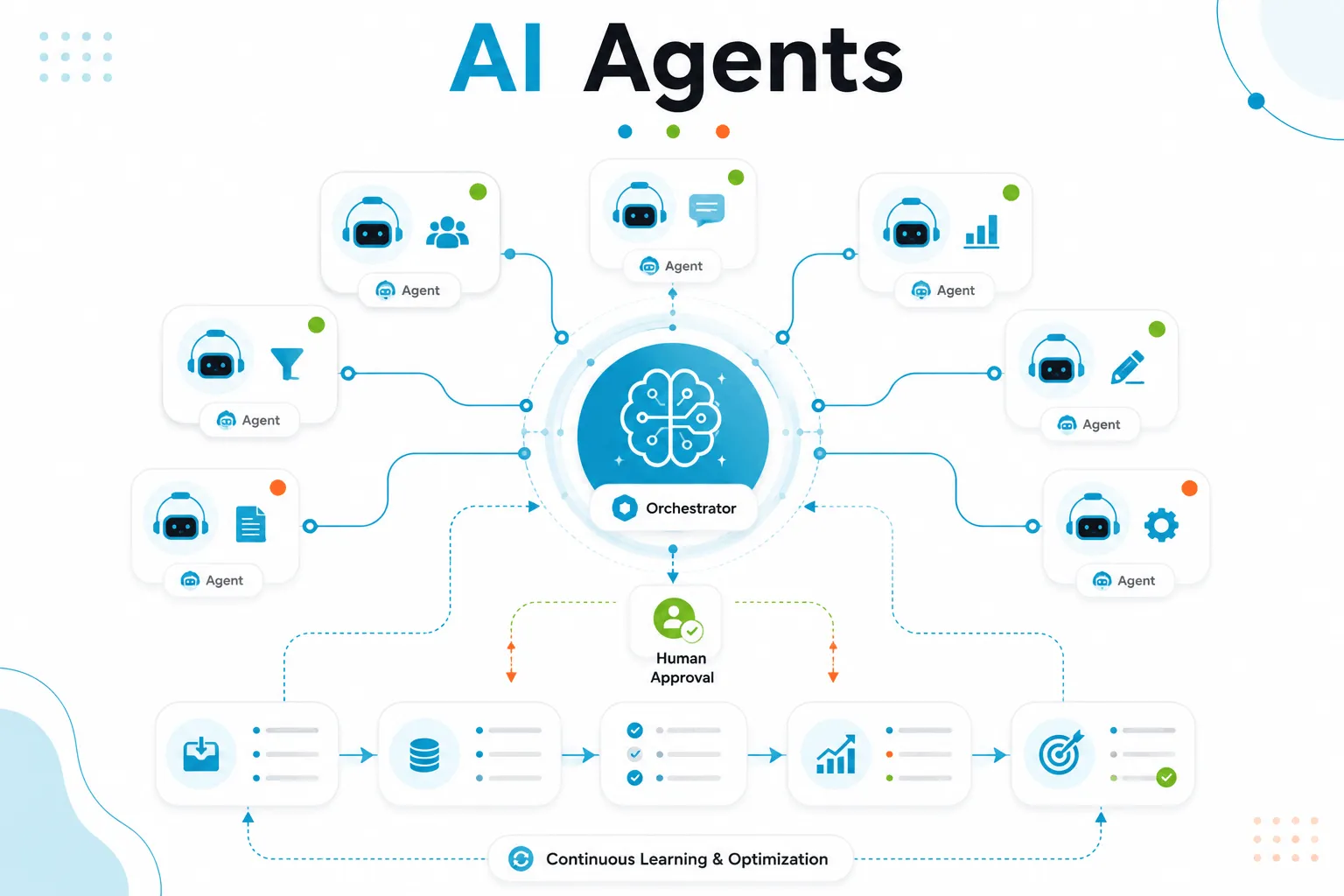
To scale efficiently, businesses should deploy AI agents to automate multi-step, high-impact workflows such as lead qualification, support resolution, and reporting. These systems reduce manual work, improve speed, and enable continuous optimization.
Start with High-Impact, Repeatable Processes
Focus on workflows that are:
- Repetitive (done daily/weekly)
- Rule-based (clear decision logic)
- Time-consuming for humans
Map the Workflow Before Automating
AI performs best when the process is clearly defined. This prevents building inefficient or fragile automations. Document:
- Inputs (data sources, triggers)
- Decision points (if/then logic)
- Outputs (actions taken)
Use Modular, Task-Specific Agents
Avoid building one all-in-one AI system. Instead:
- Break workflows into smaller agents (e.g., one for data retrieval, one for decision-making, one for execution)
- Connect them through orchestration tools
Deploy Where Your Data Lives
AI agents should operate close to your core systems (CRM, database, warehouse). Moving data across multiple tools increases latency, cost, and error risk.
Monitor Outputs and Iterate Weekly
AI systems degrade without oversight. Track:
- Error rates
- Completion rates
- Time saved
Then refine prompts, logic, or data inputs regularly.
Establish Guardrails and Escalation Paths
This prevents costly or reputational errors. Define when AI should:
- Proceed autonomously
- Request human approval
- Escalate to a human operator
Case Study: Simon AI
Simon AI addressed slow, manual marketing workflows by deploying AI agents that analyze customer behavior and trigger personalized campaigns in real time. This reduced audience-building time by 90%, uncovered over 100 high-value segments, and enabled faster, data-driven campaign execution.
3. Centralize Data for AI Accuracy and Performance
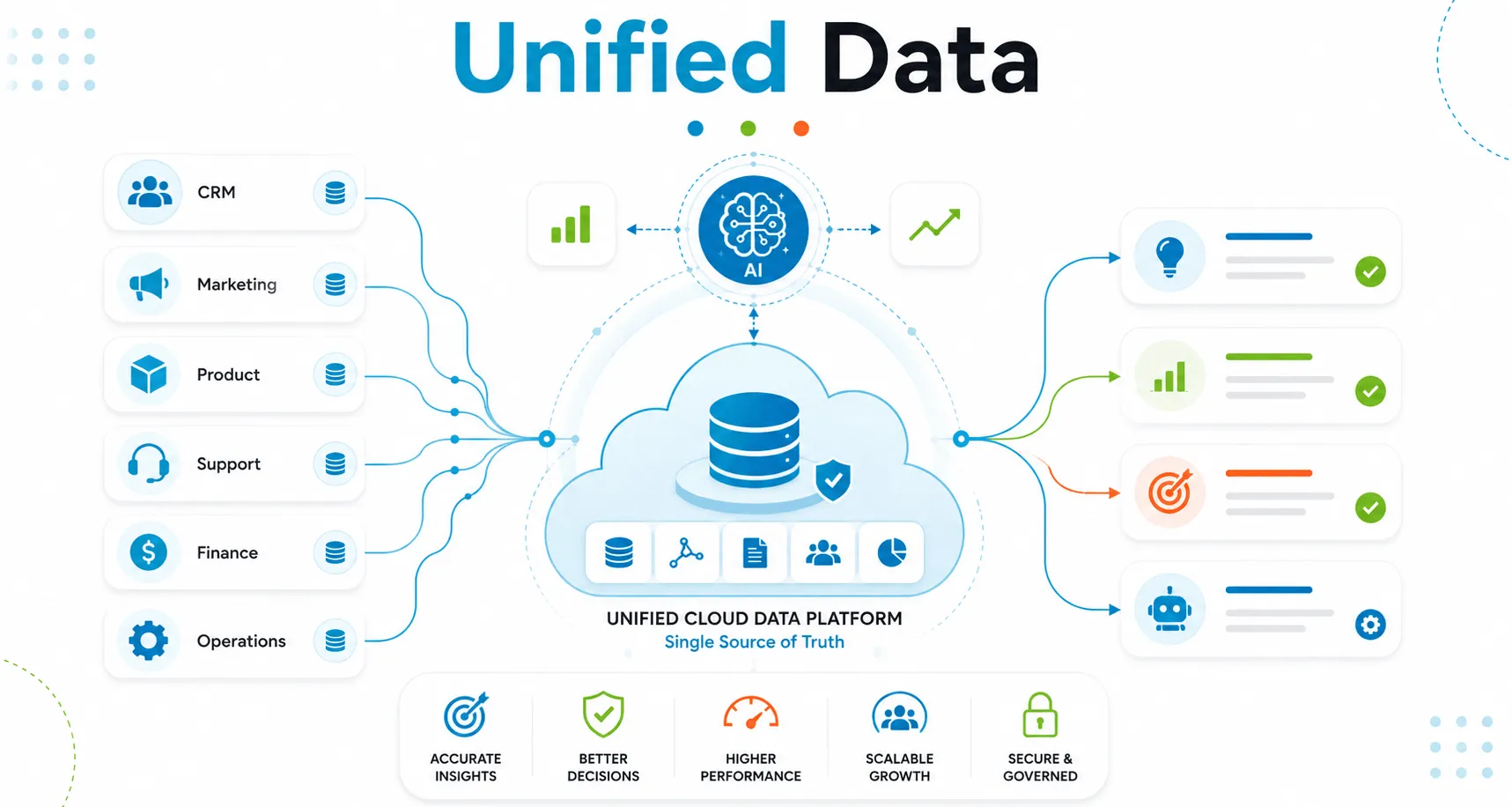
Information scattered across different apps prevents AI from functioning correctly. Future-proofing requires consolidating separate systems into a single source of truth to provide a reliable foundation for automated decision-making.
Consolidate Data into a Central Platform
Use a unified data layer (e.g., Snowflake, BigQuery, Databricks) to aggregate:
- Customer data (CRM)
- Marketing data (ads, email)
- Product usage data
This provides AI systems with consistent, reliable information.
Standardize Data Definitions and Naming
Inconsistent naming (e.g., “customer_id” vs “user_id”) creates confusion and errors. Establish:
- Shared schemas
- Naming conventions
- Documentation for all key fields
Implement Data Validation and Quality Checks
Poor data quality leads directly to poor AI outputs. Set up:
- Automated validation rules
- Duplicate detection
- Missing data alerts
Sync Systems in Near Real-Time
Outdated data reduces decision accuracy. Use pipelines (e.g., Fivetran, Airbyte) to keep systems updated frequently.
Build Privacy and Compliance Into AI Workflows
AI-first systems must be designed with privacy and regulatory requirements from the start, not added after deployment. Businesses should define how customer data is collected, stored, processed, and accessed across AI workflows.
For companies operating in or serving the European market, this includes GDPR obligations such as lawful basis, data minimization, consent management, retention limits, and data subject rights.
Additionally, not all teams or agents should access all data. Apply role-based access controls and audit logs to improve security and compliance.
Continuously Audit Data Health
Schedule regular audits to identify:
- Data drift
- Inconsistencies
- Broken pipelines
AI systems are only as reliable as the data they consume.
Case Study: IONOS
IONOS solved fragmented customer data by consolidating over 150 sources into Snowflake’s AI Data Cloud. This enabled a unified customer view and machine learning–driven recommendations, doubling upsell conversion rates and helping retain 30% of customers at risk of churn.
4. Reduce Technical Debt Before Scaling AI
To avoid long-term inefficiencies and system failures, businesses must address technical debt (outdated, messy, or poorly structured systems that accumulate from quick fixes and rapid development) before scaling AI. Clean, modular systems are more reliable, cost-efficient, and easier to maintain.
Audit Existing Systems and Workflows
Before adding AI, review current infrastructure:
- Where are workflows breaking?
- Which automations require frequent fixes?
- Where are delays or inefficiencies?
This identifies weak points that AI would amplify.
Refactor Large, Fragile Automations
A fragile automation is a workflow that breaks when one upstream field, tool, or rule changes. Before scaling AI agents, businesses should break this complex workflow into smaller modules: data validation, lead scoring, routing logic, and notification delivery. That makes failures easier to isolate and fix.
This improves:
- Debugging speed
- Scalability
- System resilience
Eliminate Redundant Tools and Logic
Many organizations accumulate overlapping tools and duplicate workflows. Consolidate where possible to reduce:
- Costs
- Integration complexity
- Maintenance overhead
Introduce Monitoring and Observability Tools
Use platforms like Datadog or New Relic to track:
- System performance
- Failures
- Latency
Visibility is essential for maintaining AI systems at scale.
Document Architecture and Processes
Undocumented systems create long-term risk. Maintain:
- Workflow diagrams
- Data flow maps
- Automation logic documentation
This enables faster onboarding and troubleshooting.
Adopt a Balanced Architecture Strategy
A sustainable system typically includes:
- Stable core logic (majority of operations)
- Scalable processing layers
- Flexible AI-driven interfaces
This prevents over-reliance on experimental components.
Case Study: Figma
Figma managed the complexity of scaling AI features by introducing a structured credit-based system tied to usage and model intensity. This approach kept costs predictable, improved transparency, and ensured scalable AI deployment without compromising system performance.
5. Balance Human Oversight and AI Automation
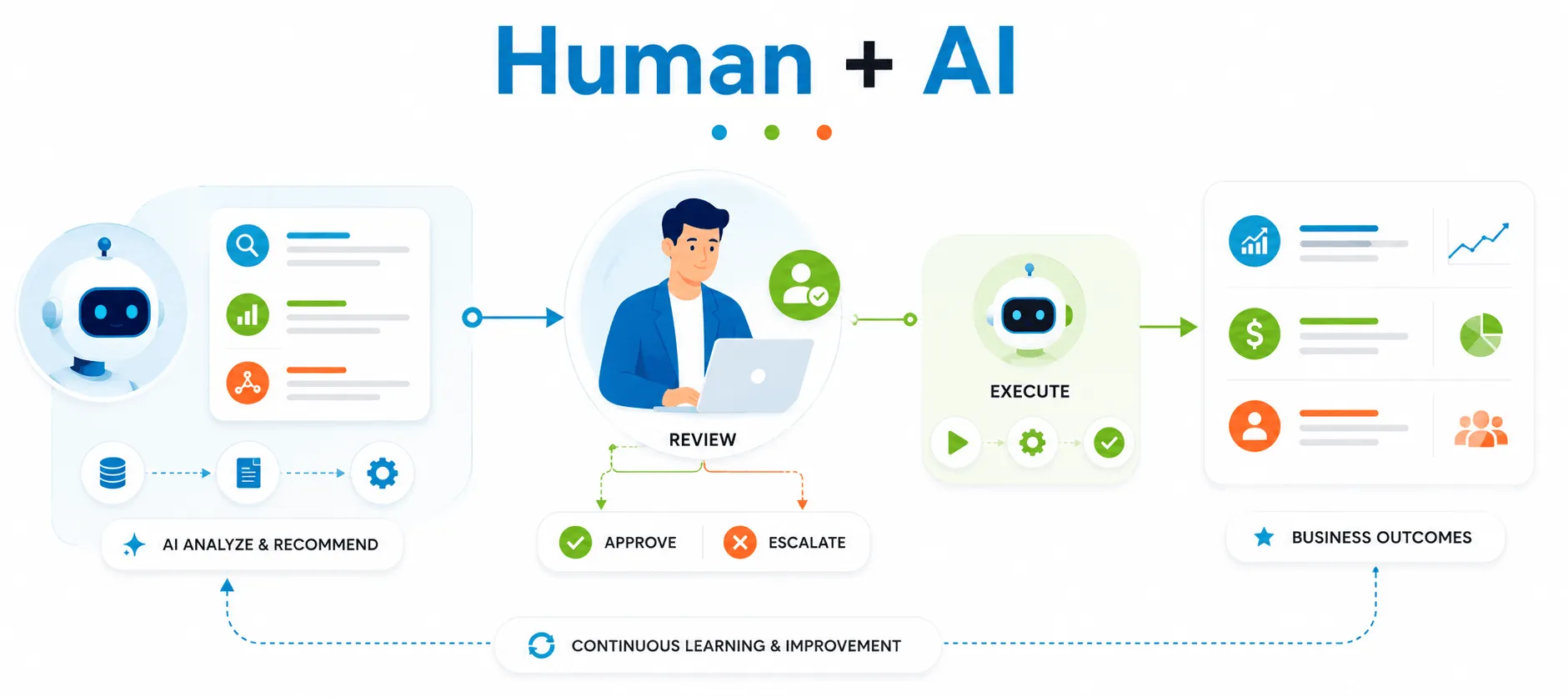
Human-in-the-Loop (HITL) ensures automated systems do not replace human judgment, instead redistributes human effort toward expert review, exception handling, ethical oversight, and accountability while AI handles repeatable execution at speed and scale.
Define Clear Human vs AI Responsibilities
Assign tasks based on strengths to avoid ambiguity and inefficiency.
- AI → speed, scale, pattern recognition
- Humans → judgment, ethics, strategy
Establish Approval Layers for Critical Actions
Reduces operational risk by requiring human review for:
- Financial decisions
- Legal or compliance outputs
- Customer-facing communications (high-risk cases)
Train Teams in AI System Management
Shifts roles from execution to oversight by ensuring employees understand:
- How AI tools work
- How to interpret outputs
- How to intervene when needed
Create Feedback Loops to Improve AI Systems
Continuous feedback improves system performance over time. Encourage teams to:
- Flag incorrect outputs
- Suggest improvements
- Refine prompts and workflows
Measure Human-AI Collaboration Performance
Ensure AI is delivering real value—not just automation for its own sake, by tracking metrics such as:
- Time saved
- Error reduction
- Output quality
Prioritize Ethical and Responsible AI Use
Trust is a long-term competitive advantage in AI adoption. Establishing guidelines is essential to nurture customer relationships, review for:
- Data usage
- Bias mitigation
- Transparency
Case Study: Datadog
Datadog combined product-led and sales-led growth by using product usage data to trigger human sales engagement for high-value accounts. This hybrid approach enabled efficient scaling, contributing to $886 million in Q3 2025 revenue and significant enterprise customer growth.
Future Trends: What to Expect Beyond 2026
The next phase of digital growth will move beyond simple task automation toward fully autonomous business ecosystems. Organizations must prepare for a shift where the user interface disappears, and AI systems interact directly with one another.
- Growth of Dark Social and Private Communities: As public search becomes saturated with AI-generated content, high-value discussions will shift to dark social — users evaluating brands through private channels like WhatsApp, Slack, and Discord.
- Inter-Agent Commerce: AI agents representing different companies will negotiate and execute transactions with each other without direct human intervention.
- Hyper-Personalized Content Generation: AI will move from assisting content creation to generating unique, real-time interfaces and product descriptions tailored to a single individual's immediate context.
- Trust by Design Security: As AI supply chains become more complex, security will shift toward autonomous threat detection that protects data at the inference level, securing information while the AI is actively thinking.
Final Thoughts
To move forward, businesses should focus on these immediate, actionable steps:
- Identify and refactor fragile automations and redundant tools to reduce technical debt before scaling.
- Transition to a GEO-focused model by using clear, extractable language and headings that mirror real user queries.
- Move toward a centralized platform to ensure all AI agents access the same high-quality information.
- Establish clear escalation paths where AI handles repetitive tasks but requests human approval for high-risk financial or legal decisions.
Frequently Asked Questions (FAQs)
What is Generative Engine Optimization (GEO)?
GEO is the practice of optimizing content so AI systems (like ChatGPT or Perplexity) cite your content when generating answers, rather than relying solely on traditional search rankings.
How is AI changing SEO?
AI is shifting SEO from ranking pages to becoming a trusted source for AI-generated answers. This means content must be clear, factual, and structured for extraction—not just keyword-optimized.
What tools are needed for an AI-first business?
Common tools include:
- Data platforms: Snowflake, BigQuery
- Automation: Zapier, Make
- AI models: OpenAI, Anthropic
- Monitoring: Datadog, New Relic
Related Content
Read These Next
E-commerce Marketing Automation: How to Increase Sales on Autopilot in 2026