.png)
.webp)
.webp)
Ecommerce Performance Marketing: A Complete Guide for Scaling Online Stores
.png)

.png)

Ecommerce Performance Marketing is a results-based digital strategy where advertisers pay for specific actions like sales or conversions. In 2026, the system relies on three core pillars: media buying through automated platforms, measurement using tracked and modeled data, and conversion systems designed to maximize first-party data capture.
INTRODUCTION
Performance marketing is often described as “paying for results.” That’s technically true—but incomplete.
In ecommerce, performance marketing is not just about running ads. It’s a system that connects:
- paid media (Meta, Google, TikTok, marketplaces)
- tracking and attribution
- conversion infrastructure (site, checkout, offers)
In 2026, that system is harder to operate than it was a few years ago.
Three shifts define the current landscape:
- AI-driven campaign automation (e.g., Advantage+, Performance Max) reduces manual control
- Privacy restrictions limit tracking accuracy and visibility
- Fragmented customer journeys make attribution less deterministic
These shifts are measurable. Privacy changes—especially on iOS—have reduced observable conversion data, with many advertisers seeing 30–50% signal loss.
Signal loss refers to the reduction in trackable user data due to privacy restrictions, device limitations, and cross-platform behavior, which results in incomplete or missing conversion data across marketing platforms.
At the same time, automated campaigns can improve results by around 10–20% when enough data is available.
Customer journeys have also become longer. Many ecommerce purchases now involve multiple interactions (often 6–10+) before conversion.
As a result, performance marketing is no longer just about campaign optimization—it’s about building a system that works despite incomplete information.
WHAT THIS GUIDE COVERS
This guide breaks down how ecommerce performance marketing works in 2026 and what it takes to build a system:
- What performance marketing actually means in ecommerce
- How the performance marketing system works end-to-end
- Key channels and their roles in the funnel
- Metrics that matter (and where they break)
- How to build a scalable performance marketing system
- The role of AI, automation, and signal loss
- Common failure points and how to address them
What Is Performance Marketing in Ecommerce?
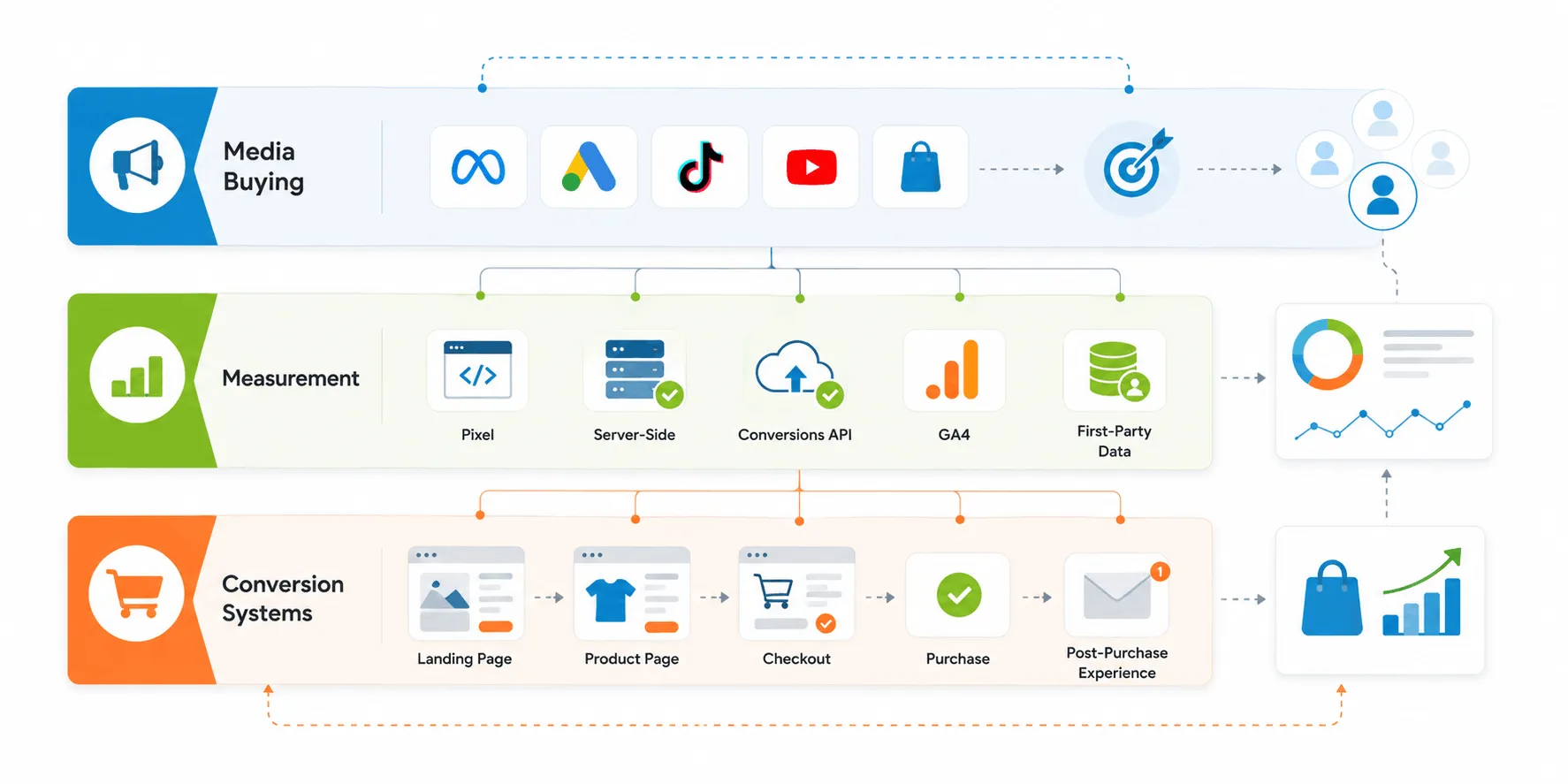
Performance marketing in ecommerce is a system for acquiring customers through paid channels where optimization is driven by measurable outcomes like conversions, revenue, or ROAS—but in practice, it relies on partial data, modeled attribution, and platform-reported signals.
At a surface level, it is defined by models like CPC, CPA, and ROAS. But performance is not created at the metric level—it comes from how systems interact.
Performance marketing sits across three connected layers:
- Media buying (how traffic is acquired)
- Measurement (how results are tracked and interpreted)
- Conversion systems (how traffic turns into revenue)
This matters because performance doesn’t come from ads alone. A strong campaign can still fail if conversion is weak or tracking is inaccurate.
In practice, most ecommerce brands operate within ranges:
- Paid social (new customer acquisition) typically lands around 1.5x–3x ROAS, depending on product margins and industry vertical (e.g., luxury vs. FMCG)
- Paid search (high intent) often performs at 2x–5x+ ROAS
- Conversion rates usually fall between 1%–3% for new visitors
These ranges are not fixed targets, but they help frame expectations. Performance is rarely exact—it sits within a band depending on channel and funnel stage.
A key shift in 2026 is that optimization is no longer based on complete visibility. You are working with signals that are partially tracked, partially modeled, and sometimes biased.
How Does Performance Marketing Actually Work?
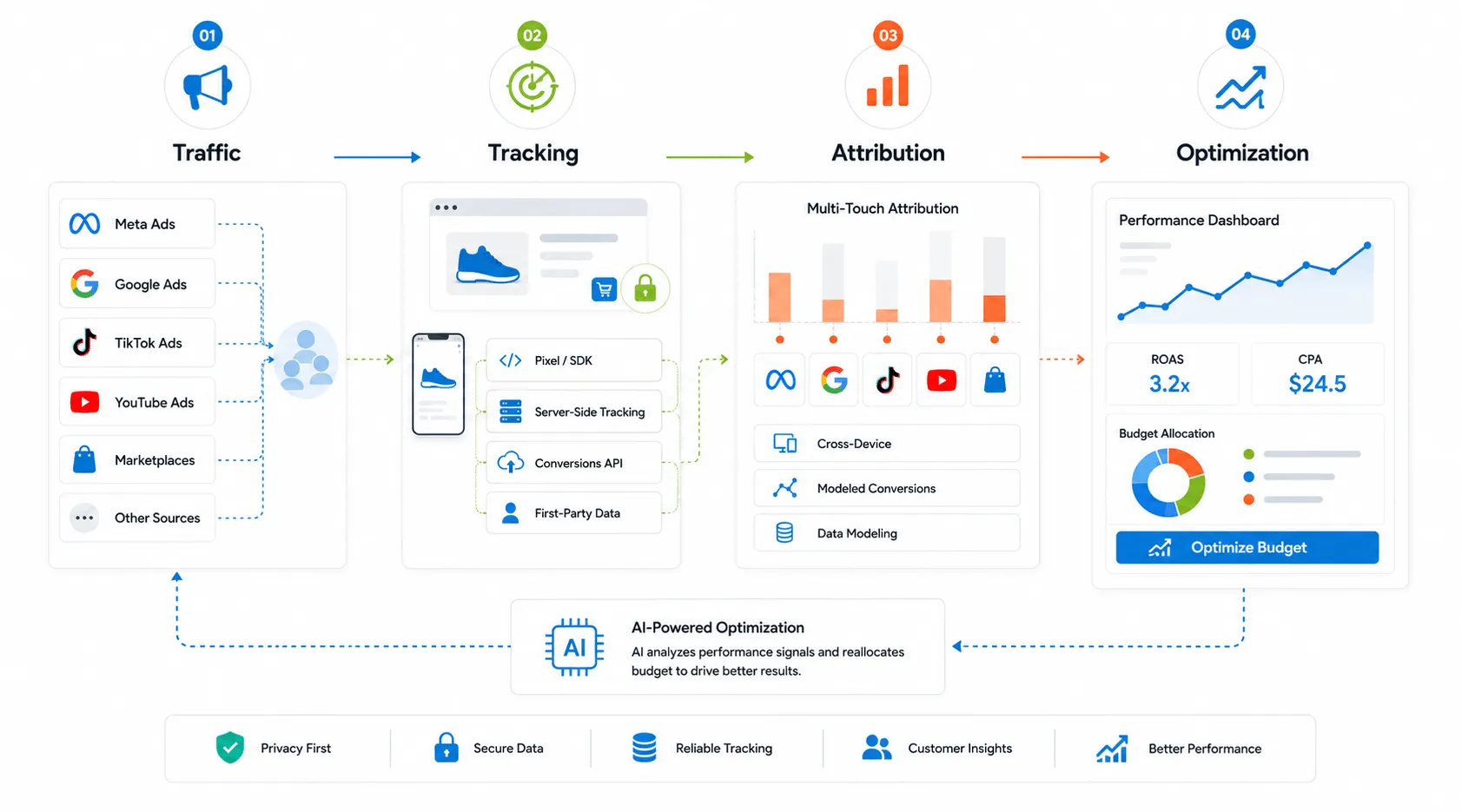
Performance marketing works by acquiring traffic through paid channels, tracking user behavior across touchpoints, and reallocating budget based on observed performance. However, the system relies on a mix of tracked and modeled data rather than complete visibility.
At a system level, it follows a consistent flow:
- Traffic acquisition through paid channels
- User interaction across sessions and devices
- Conversion tracking through pixels, APIs, and first-party data
- Attribution assigning credit to channels
- Optimization based on observed results
Modern tracking infrastructure increasingly relies on server-side tracking, Google Conversions API (CAPI), Meta Aggregated Event Measurement, and GA4 data modeling to compensate for signal loss and improve data reliability.
Where This Breaks in Practice
This system assumes clean data. In reality:
- Platforms use modeled conversions to fill tracking gaps
- Reported results can differ by 20–40%+ across tools
- Cross-device behavior fragments the journey
This is why the same campaign can show different performance across Meta, Google, and analytics tools.
Instead of trying to find a single “correct” number, performance marketing relies on consistency. If multiple data sources show the same trend, it is usually reliable—even if the exact numbers differ.
Which Channels Drive Ecommerce Performance Marketing?
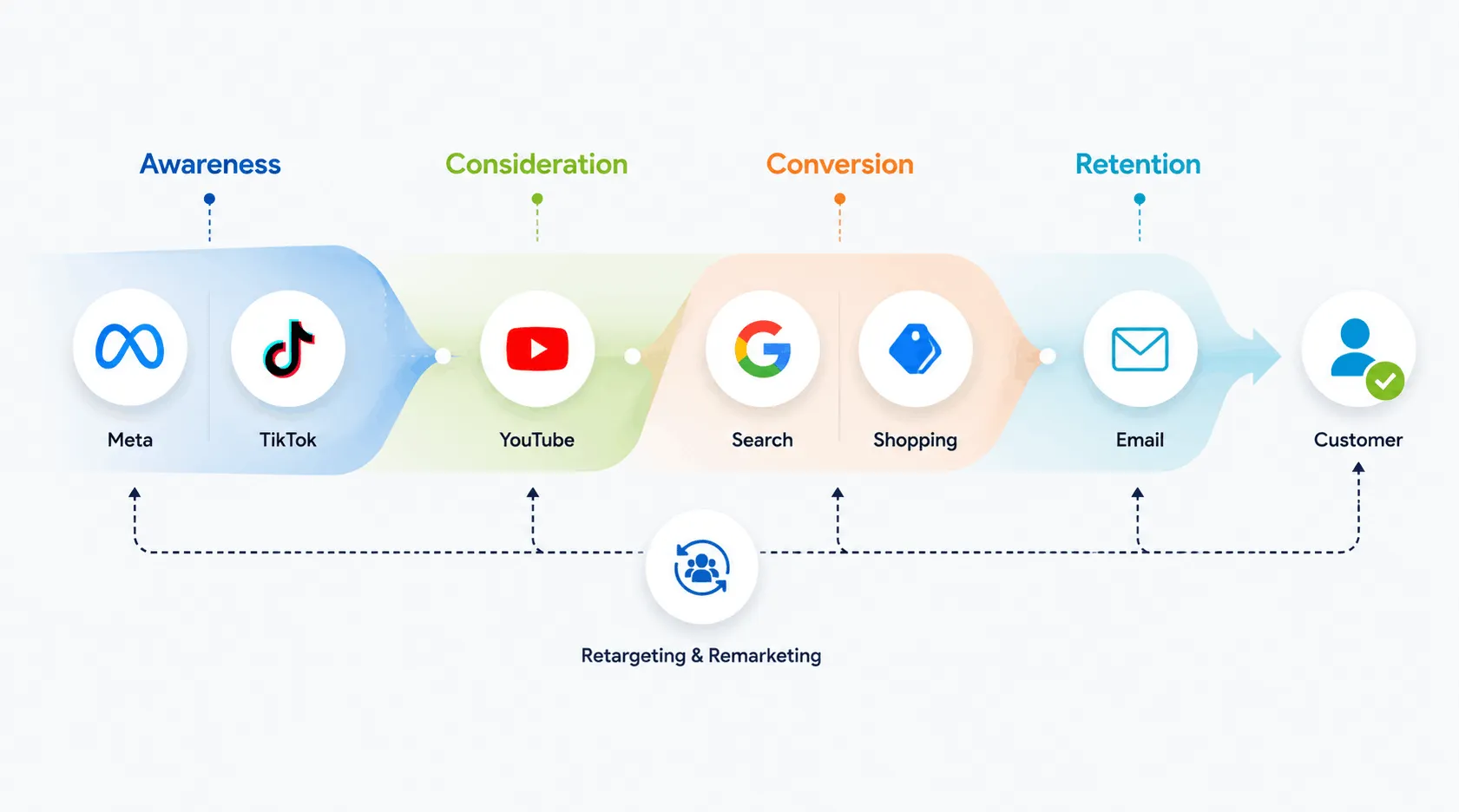
Ecommerce performance marketing uses multiple paid channels that operate at different stages of the funnel, but no single channel drives performance alone—results come from how channels work together.
Channel Roles by Funnel Stage
Key Insight
Customers rarely convert after a single interaction.
A typical journey:
- Discover a product on social media
- Search for the brand later
- Click a retargeting ad
- Convert through a direct visit or email
Research shows that a large share of influence happens before the final click, yet most tracking systems still credit that last interaction.
This creates a common bias:
- Search and retargeting appear more effective than they actually are
- Discovery channels appear less efficient than they actually are
Over time, this leads to underinvestment in demand generation and higher acquisition costs.
What Metrics Actually Matter in Performance Marketing?
Performance marketing relies on metrics like ROAS, CPA, and conversion rate, but in 2026 these are best treated as directional indicators rather than exact values.
Core Metrics
What Good Performance Looks Like
Good performance is not just high numbers. It usually means:
- ROAS is above breakeven and stable
- CPA fits within your margins
- Conversion rate is consistent
- Performance holds as you increase budget
A campaign with moderate ROAS that scales is often more valuable than one with high ROAS that cannot grow.
Platform-reported results can also overstate performance—sometimes by 20–50%—which is why comparing multiple data sources is important.
How Do You Build a Scalable Performance Marketing System?
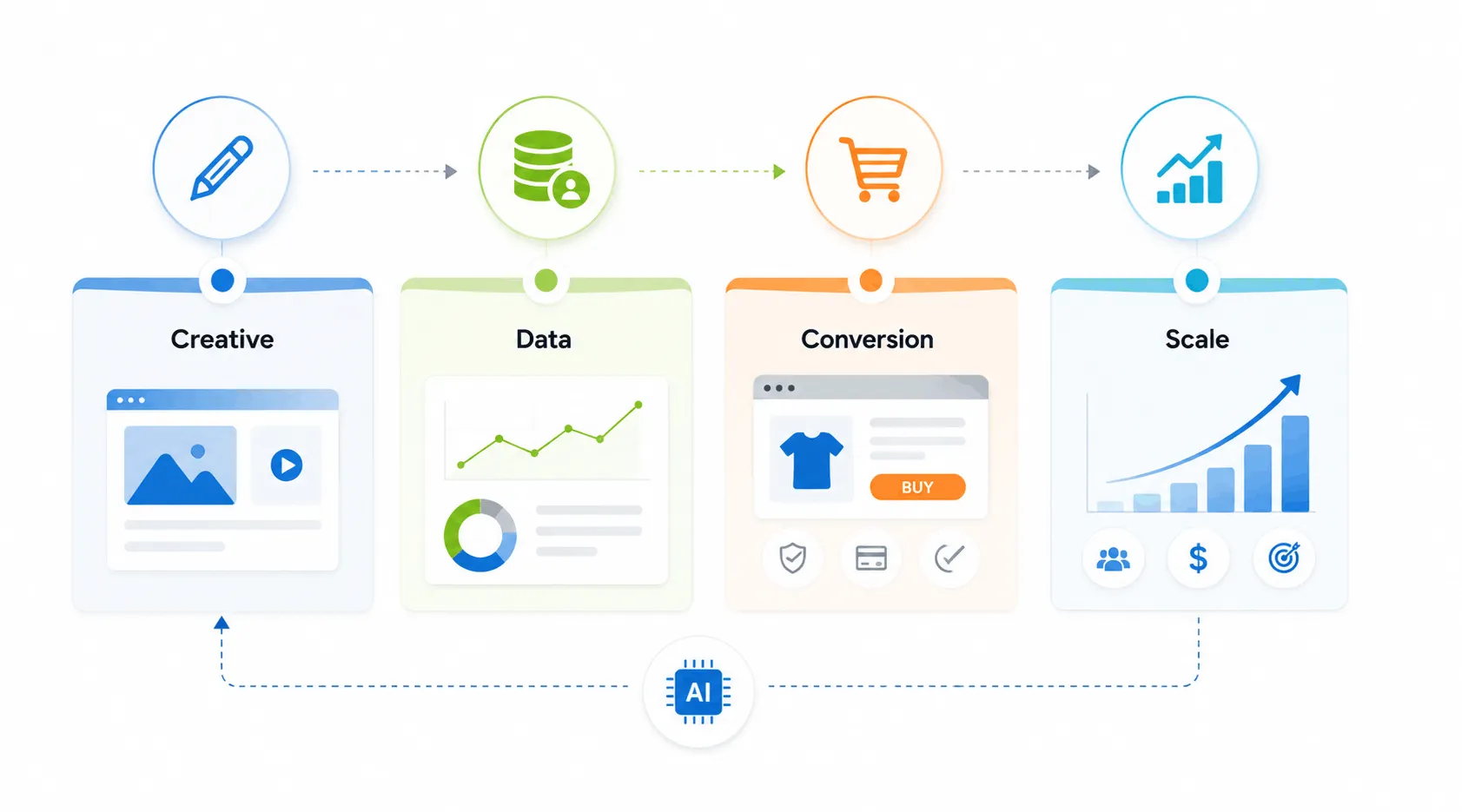
A scalable performance marketing system is built by aligning media buying, measurement, and conversion performance, then improving each over time.
The process starts by identifying the main constraint.
Common bottlenecks include:
- low conversion rate
- high acquisition cost
- limited traffic volume
If the constraint isn’t addressed, increasing ad spend usually leads to diminishing returns.
From there, channel strategy should balance demand generation and demand capture. Relying too heavily on one channel limits growth and increases risk.
Measurement also needs to be layered. Instead of relying on a single tool, most setups combine platform data, analytics, and attribution to form a more complete view.
First-party data plays a critical role in this system. In practice, this is collected and leveraged through:
- post-purchase surveys to identify true acquisition sources
- server-side tracking to improve data accuracy
- CRM integration to connect customer data across touchpoints
- email and retention flows to extend customer value
Testing is where improvement happens. This typically involves creatives, audiences, and offers—but changes should be isolated to understand what is actually driving results.
Creative Strategy in 2026
In 2026, creative is often considered the primary driver of performance, as platform targeting becomes increasingly automated.
Effective creative systems typically include:
- high-volume creative testing (multiple variations per concept)
- structured testing frameworks (hooks, formats, messaging angles)
- creative analytics to identify patterns in top-performing assets
This shift reflects a broader change: targeting is increasingly handled by platforms, while creative determines performance.
Decision Thresholds
Clear decision rules help avoid inconsistent optimization:
- Scale when performance is stable for several days and holds across different data sources
- Pause or adjust when acquisition costs consistently exceed targets or conversion rates drop
Finally, performance improves through iteration—new creatives, better landing pages, and refined offers.
In our experience managing high-spend ecommerce accounts, performance improvements are rarely driven by a single change, but by consistent iteration across creative, data, and conversion systems.
The key principle is simple: you are not scaling campaigns, you are scaling a system.
How Is AI Changing Performance Marketing in 2026?
AI is shifting performance marketing from manual optimization to automated systems where advertisers provide inputs while platforms control execution.
Performance is increasingly influenced by:
- creative quality
- conversion data
- budget structure
Most platforms need a consistent flow of conversion data to optimize effectively. When that data is limited, performance becomes less stable and harder to scale.
This creates a shift in focus. Instead of adjusting bids or targeting manually, marketers now focus on improving inputs—especially creative and data quality.
The trade-off is reduced transparency. Campaigns may perform well, but it is not always clear why, since optimization happens within platform algorithms.
What Are the Common Challenges in Performance Marketing?
Performance marketing operates under structural limitations that cannot be fully removed.
Data fragmentation is a core issue. Each platform reports its own version of performance, and those numbers rarely align perfectly.
Privacy restrictions reduce the amount of trackable data, which means a growing portion of performance is estimated rather than directly observed.
Other common challenges include:
- rising ad costs
- creative fatigue
- limited visibility in marketplace ecosystems
Advanced measurement approaches such as MMM (Marketing Mix Modeling), Incremental Lift testing, and Creative Analytics are increasingly used to understand performance beyond platform-reported metrics.
These are not temporary problems. They are part of how the ecosystem works. The goal is not to eliminate them, but to build systems that can operate effectively despite them.
FAQ
What is performance marketing in simple terms?
A strategy where businesses pay for measurable outcomes like clicks, leads, or sales.
What is a good ROAS for ecommerce?
Typically around 2x–4x, depending on margins, growth goals, and industry vertical.
Why don’t platform numbers match analytics?
Because platforms use modeled attribution and often overreport their own performance.
Is performance marketing still accurate in 2026?
It is less precise, but still useful for understanding trends and making decisions.
What is the biggest challenge today?
Incomplete data due to privacy restrictions and cross-device behavior.
CONCLUSION
Performance marketing in ecommerce is no longer just about running ads and measuring conversions. It is a system shaped by incomplete data, automated platforms, and multi-touch customer journeys.
Success comes from understanding how acquisition, measurement, and conversion work together—and making decisions based on consistent patterns rather than exact numbers.
In 2026, the advantage is not perfect accuracy. It is the ability to operate effectively despite its limitations and scale using directional insight.
Read These Next
Marketing Automation Workflow: How to Design High-Converting Sequences from Scratch