.png)
Growth Hacking Strategies: 7 High-Speed Tactics for Explosive Growth
.png)

.png)

Growth hacking in 2026 is an AI-native strategy that utilizes autonomous agents, Bayesian experimentation, and Generative Engine Optimization (GEO) to scale revenue. Unlike traditional marketing, it focuses on lowering Customer Acquisition Costs (CAC) through RAG-integrated workflows and automated lead generation, balancing high-speed execution with human-in-the-loop oversight to prevent technical and social debt.
Key Takeaways
- Growth hacking has evolved into an intelligence-driven process using AI agents and statistics to identify the most efficient paths to revenue.
- With rising costs per consumer, companies are shifting away from broad brand awareness toward low-cost, high-impact levers within the customer journey.
- Sustainable growth requires optimizing every stage of the funnel to maximize customer spend.
- Rapid, unmanaged automation can lead to fragile systems and a loss of brand trust. Placing human guardrails in automated systems is essential for long-term viability.
Article Overview
This article explores the 2026 growth hacking landscape, where AI-native strategies and rapid experimentation replace traditional, high-cost marketing. It outlines seven high-speed tactics to achieve explosive scale.
While prioritizing technical automation and data-driven efficiency, the text emphasizes balancing speed with human oversight to avoid the long-term pitfalls of technical and social debt.
How to Scale a Business in 2026: The New Rules of Growth
With Customer Acquisition Costs (CAC) (the cost to acquire one new customer) rising significantly by 40% to 60% (Data-Mania, 2026), companies have shifted toward an AI-native approach where scaling is a continuous, intelligence-driven evolution of the product itself.
Why Growth Hacking Outperforms Traditional Marketing
Traditional marketing relies on fixed annual budgets and broad messaging to build long-term brand equity. In contrast, growth hacking operates in short sprints, using technical experiments to optimize every stage of the funnel.
For example, Instatus in 2025 achieved a 1,500% increase in organic search traffic and 833% growth in monthly recurring revenue by treating SEO as a systematic growth engine rather than a one-off campaign.
In 2026, Privacy and Regulation laws demand privacy-by-design, forcing growth hackers to balance high-velocity automation with strict ethical guardrails to avoid massive regulatory fines. For instance, General Data Protection Regulation (GDPR) mandates explicit consent and AI transparency for EU data, while California Consumer Privacy Act (CCPA) grants users opt-out rights.
This led to data approaches such as zero-party data, where users willingly share information through owned collection methods (like lead magnets, quizzes, and chatbots)
How Data-Driven Strategies Prevent Marketing Waste
In 2026, successful expansion requires processing huge amounts of data in real-time. Companies now use AI models and advanced experimentation systems to ensure every marketing spend goes to the most effective channels. This is vital because the average B2B SaaS Customer Acquisition Cost (CAC) is now $536, and Fintech CAC can reach $1,450 (Data-Mania, Feb 2026).
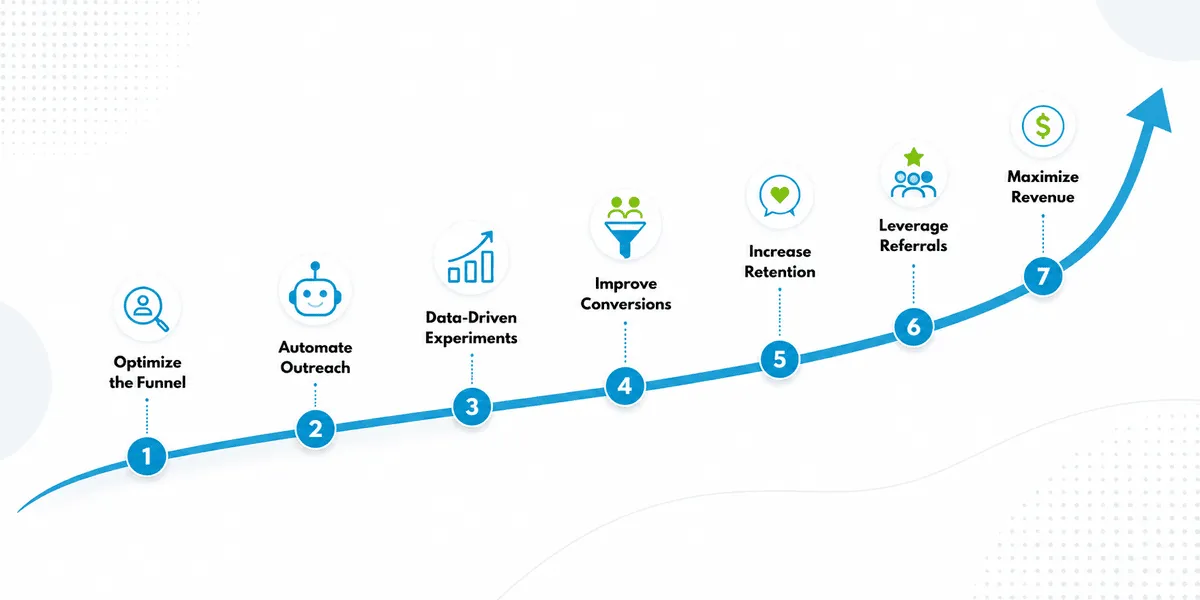
To be highly efficient, top organizations use specific, fast-paced methods that combine technical accuracy with creative insight. The following seven tactics are the most effective strategies for driving rapid growth while maintaining long-term profit.
7 High-Speed Tactics for Explosive Growth
1. Optimize the Entire Funnel to Maximize Revenue Efficiency
Sustainable growth requires looking at the entire customer journey through the AARRR framework (Acquisition, Activation, Retention, Referral, and Revenue). The AARRR framework, often called the "pirate metrics," is a model for tracking and optimizing the metrics that drive product growth.
It focuses on five key stages of the customer lifecycle:
- Acquisition: How do users find you? (e.g., website visits, downloads, ad clicks)
- Activation: Do users have a great first experience? This is typically measured by users achieving immediate value offers or completing a milestone (e.g., signing up, using a core feature).
- Retention: Do users come back? (e.g., daily/monthly active users, repeat purchases, reduced churn rate).
- Referral: Do users like the product enough to tell others? (e.g., shares, invitations sent).
- Revenue: How do you make money from users? (e.g., conversion rates to paid subscriptions).
For instance, Noble in 2026 built a 10% conversion rate engine by replacing fragmented tools with a single, centralized data system. By combining bulk enrichment APIs, waterfall enrichment for broader coverage, and AI-driven research, the system processes thousands of data points per hour, leading to qualifying and routing leads in seconds.
2. Use AI Agents to Automate B2B Outreach and Lead Generation
Deploy AI Sales Development Representatives (SDRs) (AI-powered sales representatives who seek potential customers) to revolutionize B2B outreach. These agents automate prospecting, personalize cold emails, and qualify leads at scale, ensuring an accelerated and highly efficient lead generation pipeline.
Autonomous AI SDRs now operate through agentic workflows, combining Retrieval-Augmented Generation (RAG) (providing AI with specific search and customized responses), vector database retrieval, and orchestration frameworks like LangGraph to research prospects and execute personalized outreach at scale.
Agentic automation improves marketing for:
- Speed-to-Lead: AI agents like Atlas can contact a lead immediately after a form fill, significantly increasing conversion rates.
- Scale: Outreach can be personalized for thousands of prospects simultaneously using CRM data and web research.
In 2026, Devlo successfully booked 120 qualified appointments through automated outreach for Monizze by targeting 7,000 decision-makers with a 62.3% email open rate.
3. Rank in AI Overviews Using Generative Engine Optimization (GEO)
Search has shifted from keyword matching to conversational intent. Generative Engine Optimization (GEO), is the process of structuring content to be easily digestible and directly quotable by AI models, significantly increasing a brand's likelihood of being featured in the highly visible AI Overview section of search results.
To remain visible, brands must:
- Structure content for quotability: Ensure key insights, data points, and answers are presented in concise, easily extractable formats (like bullet points or short, definitive paragraphs) that an AI model can directly quote.
- Prioritize informational authority: Become the definitive, cited source for specific questions in your niche.
- Optimize for Generative Engine Optimization (GEO): Actively tailor content so that it's highly digestible and frequently chosen by AI overviews.
LLMs (Large Language Models), such as GPT-5.1 and Gemini 3 Flash, power AI Overviews and determine which sources are cited in conversational search. LLMs are a class of AI programs trained on vast amounts of text data to understand, generate, and respond to human language.
Research by Ahrefs in 2025 shows that AI Overviews can reduce traditional search clicks by 34.5%, making it vital to be the cited authority.
4. Run High-Velocity Experiments to Identify Winning Tactics
Modern growth teams use Bayesian testing to quickly find the best asset version. This testing tracks performance in real-time, allowing you to stop the test and declare a top-performer sooner than with older A/B methods.
Speeding Up the Feedback Loop
- Real-Time Monitoring: Using observability tools (e.g., GPT-5.1 observability) to track how users interact with experiments
- Dynamic Customization: Automatically serving different website versions based on real-time user intent signals.
By automating these workflows with tools like n8n, companies like TMNZ in 2026 have delivered 400 hours of productivity gains per month, allowing more time for creative experimentation.
5. Build Viral Loops to Lower Your Customer Acquisition Costs (CAC)
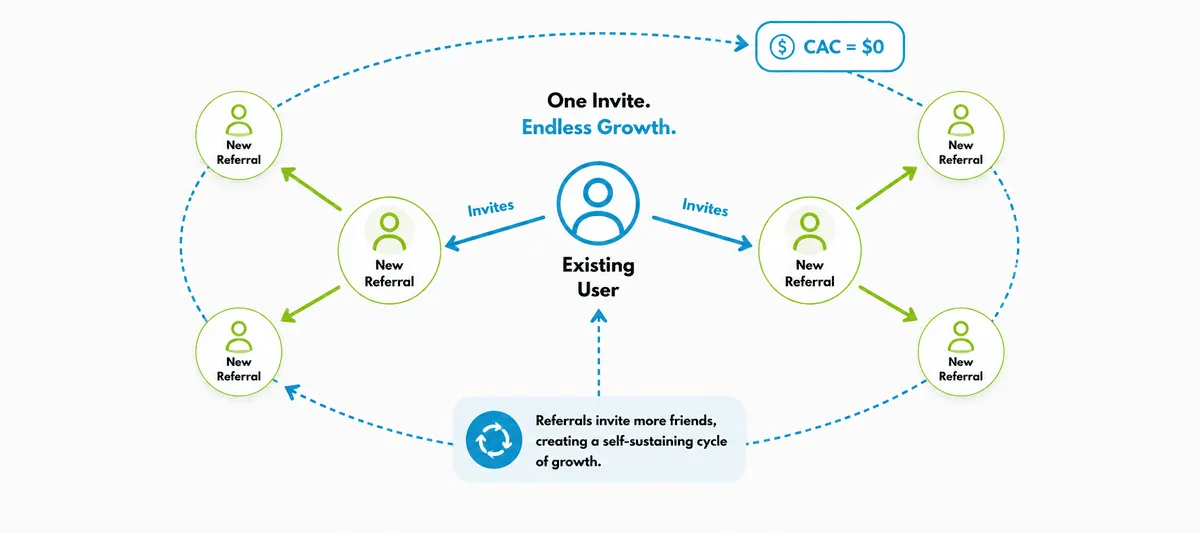
A viral loop is a growth mechanism where existing customers bring in new users, usually through referrals. This lowers CAC because organic customer invites, not paid marketing, drive new user sign-ups.
Create a self-propelled system that prompts user acquisition through:
- Native Sharing: Integrating referral prompts directly into the product workflow.
- Social Proof Integration: Using real-time notification tools like Senja to show live customer wins and build instant trust.
Dropbox famously used viral loops to achieve growth without ad spend. To leverage social sharing, they utilized a referral program which provided extra storage for every new user who signs up through a referral link.
6. Connect Disconnected Data to Remove Growth Bottlenecks
Growth plateaus often occur when marketing, sales, and product data are siloed. Integration and automation platforms like Zapier, Make, and n8n act as digital glue, connecting disparate software applications.
Zapier and Make are low-code, cloud-based tools for creating simple app workflows. n8n is an open-source, more powerful alternative often used for complex, self-hosted automation.
These tools are critical for growth hacking because they:
- Unify Siloed Data: They connect data from marketing, sales, and product systems to provide a single, complete view of the customer journey for accurate analysis.
- Enable High-Speed Automation: They automate repetitive tasks, which is essential for rapid experimentation and scalability.
- Improve Operational Efficiency: They reduce manual error and allow small teams to handle large volumes of data, making growth more capital-efficient.
In 2026, Musixmatch used n8n to access a complex data stack, reducing client request fulfillment time to just 15 seconds.
7. Prioritize Retention to Support Sustainable Scaling
Profitability in 2026 is governed by the LTV:CAC ratio, comparing how much profit a customer brings in over time (Lifetime Value, LTV) versus how much it cost to get that customer (Customer Acquisition Cost, CAC). Retention is the primary driver of this ratio, as keeping a customer is significantly cheaper than replacing one.
Scale sustainably by identifying benchmarks:
- Payback Periods: Top-performing companies target a CAC payback period of 12 months or less.
- Expansion Revenue: Up-selling existing customers to increase their lifetime value without additional acquisition costs.
Risks and Challenges of Modern Growth Hacking
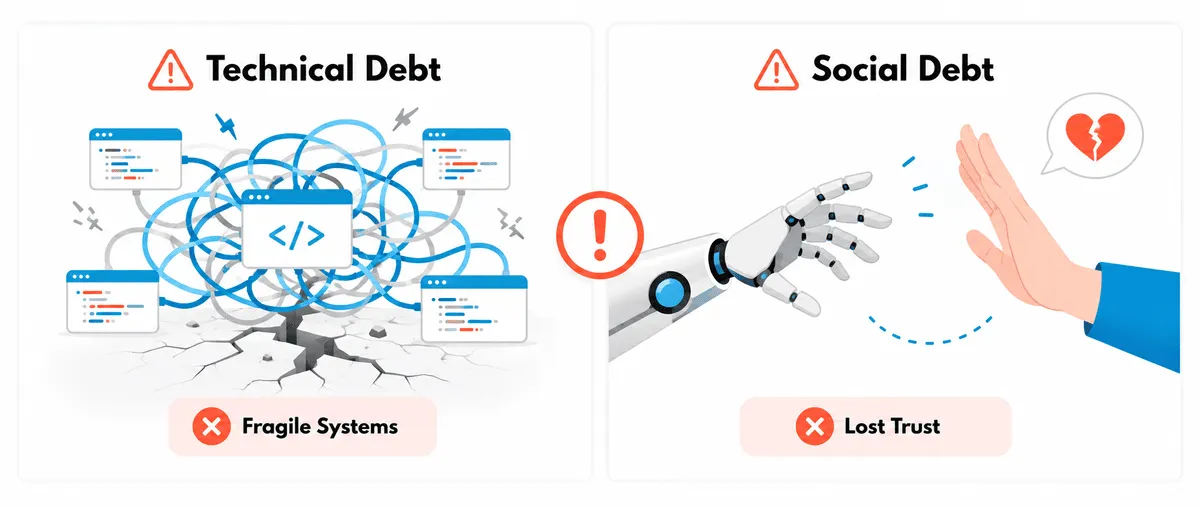
High-speed growth requires a balance between automated efficiency and human oversight. Too much automation leads to systems that break easily (Technical Debt) or push customers away with aggressive, impersonal tactics (Social Debt).
In 2026, successful growth hacking uses AI to boost human strategy, not replace it. Organizations must monitor both the technical and human costs of their hacks to ensure long-term viability.
Technical Debt: The Cost of Moving Too Fast
In 2026, technical debt is defined as unmanaged system complexity, often arising from vibe-coding (coding with AI via natural language prompts without formal architecture or governance).
While AI allows for rapid deployment, it can create a messy web of automation logic that no one fully remembers implementing. This debt results in slower release cycles, higher incident rates, and AI initiatives that eventually stall because the underlying data architecture is too brittle to scale.
Social Debt: The Risk of Impersonal Automation
Social debt is the cost of using aggressive, impersonal AI tactics that erode customer trust over time. For example, brands are getting flagged or blacklisted for being detected with automated comment spamming.
As organizations deploy autonomous agents at scale, they risk a loss of brand reputation if communication becomes repetitive, error-prone, or lacks empathy. Social debt accumulates when a company prioritizes short-term conversion volume over the long-term health of the customer relationship.
Technical Debt vs. Social Debt
The most resilient brands understand that technical and social debt are interconnected. A brittle technical system often produces poor customer experiences, while a focus on aggressive hacks inevitably leads to messy code and unorganized data.
Achieving explosive growth in 2026 requires a Human-in-the-Loop approach, where AI handles the high-volume execution while humans provide the ethical guardrails, creative direction, and strategic supervision necessary to keep the system healthy and the brand trustworthy.
Final Thoughts
To implement these strategies effectively, organizations should consider the following actionable steps:
- Identify and fix leaks in the AARRR framework to ensure marketing spend isn't wasted on a broken journey.
- Use automation tools like Zapier or n8n to connect marketing, sales, and product data for a 360-degree customer view.
- Restructure digital content into citable formats with original research to capture traffic from AI search engines.
- Implement human guardrails for AI workflows to prevent the accumulation of technical and social debt.
Frequently Asked Questions (FAQs)
What is the difference between growth hacking and traditional marketing?
Traditional marketing often relies on fixed annual budgets and broad messaging to build brand equity over time. In contrast, growth hacking uses short technical sprints and rapid experiments to optimize every stage of the sales funnel for immediate, measurable results.
How has AI changed lead generation in 2026?
Lead generation is now driven by autonomous AI agents that handle prospecting, research, and hyper-personalized outreach simultaneously. These tools can contact leads instantly and manage thousands of conversations at scale.
What is Generative Engine Optimization (GEO)?
As search shifts to conversational AI, GEO involves optimizing content so LLMs (like Gemini or GPT) cite the brand as an authority. This includes using direct answer formatting and technical schema to ensure visibility in AI-generated overviews.
What are the 7 core tactics for explosive growth in 2026?
The seven tactics include optimizing the entire AARRR funnel, using AI agents for B2B outreach, ranking in AI search through Generative Engine Optimization (GEO), running high-velocity experiments, building viral loops, unifying disconnected data, and prioritizing customer retention.
Related Content
Read These Next
E-commerce Marketing Automation: How to Increase Sales on Autopilot in 2026