.png)


10 Proven Growth Marketing Strategies to Scale Revenue in 2026
.png)

.png)

Growth marketing in 2026 shifts from chasing clicks to driving real business results. It focuses on first-party data, AI-driven efficiency, and performance metrics that measure actual impact. Growth marketing in 2026 will centre on data-driven experimentation across the full customer journey, using testing and performance analysis to guide decisions.
AI overviews, creator partnerships, and metrics like CAC, ROAS, and CLTV will drive more measurable and efficient growth strategies.
Key Takeaways:
- Shift to Business Impact: Growth marketing prioritizes total business impact over isolated metrics like clicks.
- Agentic AI Integration: Success relies on agentic AI that can independently reason, re-route user journeys in real-time, and automate the entire creative testing lifecycle.
- Zero-Party Data Mastery: With the decline of third-party cookies, brands must own the customer relationship by collecting data voluntarily shared through interactive tools.
- Metric Integrity: To bypass inaccurate platform attribution, organizations should use performance metrics to ensure ad spend correlates with capital.
- Unified Revenue Operations: Rapid scaling requires a RevOps structure that eliminates silos, ensuring data flows seamlessly between marketing, sales, and finance to reduce execution latency.
Article Overview
Marketing has moved past tracking clicks to focus on bottom-line results.
This guide provides a roadmap to move beyond slow, steady growth toward rapid scaling by turning data into action faster. Success rests on three fundamental pillars:
- Data Mastery: Shifting from tracking cookies to owning the customer relationship through direct data control. This uses information shared directly by customers to fuel real-time responses and predictive modeling.
- AI-Human Collaboration: Moving to AI integration, leveraging rapid systems while retaining human strategic oversight.
- Metric Integrity: Transitioning from vanity metrics and siloed data to a macro-view of business health, utilizing MER and unified frameworks for strategic clarity.
Below are 10 strategies businesses can implement to overcome rising ad costs and platform limitations, transforming marketing from a business expense into a high-speed revenue driver.
10 Growth Marketing Strategies To Scale Revenue In 2026
Pillar 1: Data Mastery
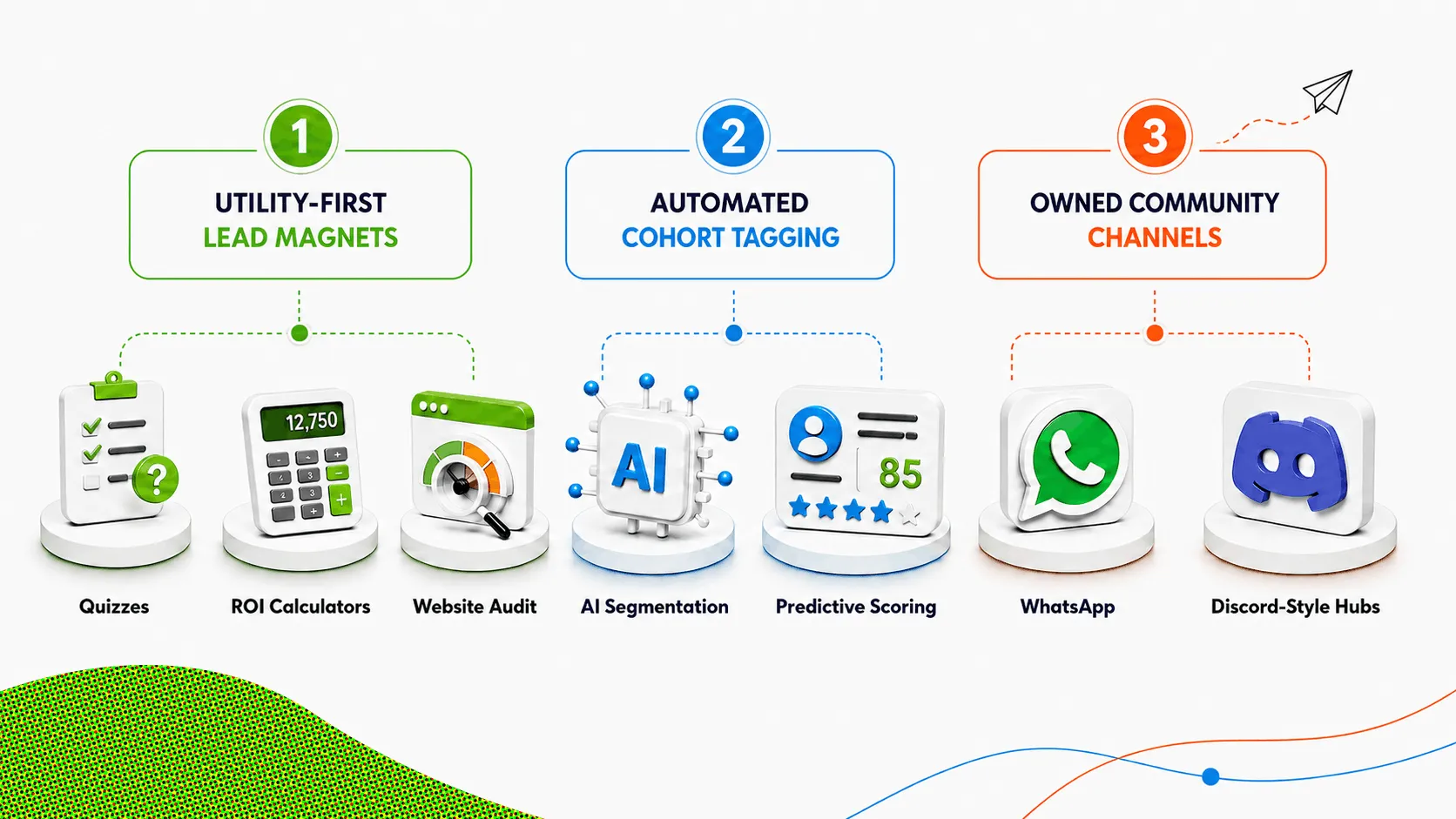
Shift from tracking cookies to owning the customer relationship through direct data control.
1. Deploy Utility-First Lead Magnets
Brands now face heightened user anonymity after privacy settings block third-party cookies, and AI browsers spoof user behavior. To solve this, there is a shift to collecting zero-party data—information voluntarily shared by consumers—for molding user personas to create personalized marketing campaigns.
For brands, replace passive contact forms with interactive tools forms, style quizzes, or technical auditors. These provide users with immediate value in exchange for their preferences, transforming a cold lead into a rich profile of their specific needs.
2. Automate High-Value Cohort Tagging
Ad platform automations in 2026 lead to prioritization of volume over value to hit their own internal numbers. This leads to AI finding cheap, lowest-quality customers who buy once on discount and never return.
Address this by implementing a high-value signal system that automatically tags users who account for the highest percentage of your direct sales. Sync these specific tags with your ad platform's conversion API to force the AI to bid only on prospects with high-profit potential.
3. Launch "Owned" Community Channels
Gatekeeping has moved from a consumer trend to a core business model, as social networks now intentionally hide external links to keep users trapped within their own platforms. If your growth strategy relies solely on social platforms to drive web traffic, your reach will inevitably plateau.
Migrate your audiences to owned platform channels, such as private WhatsApp broadcasts or a Discord server. By fostering a space for peer-to-peer interaction and original research, you create a self-sustaining ecosystem that drives organic retention and advocacy.
Pillar 2: Human-AI Collaborative Execution
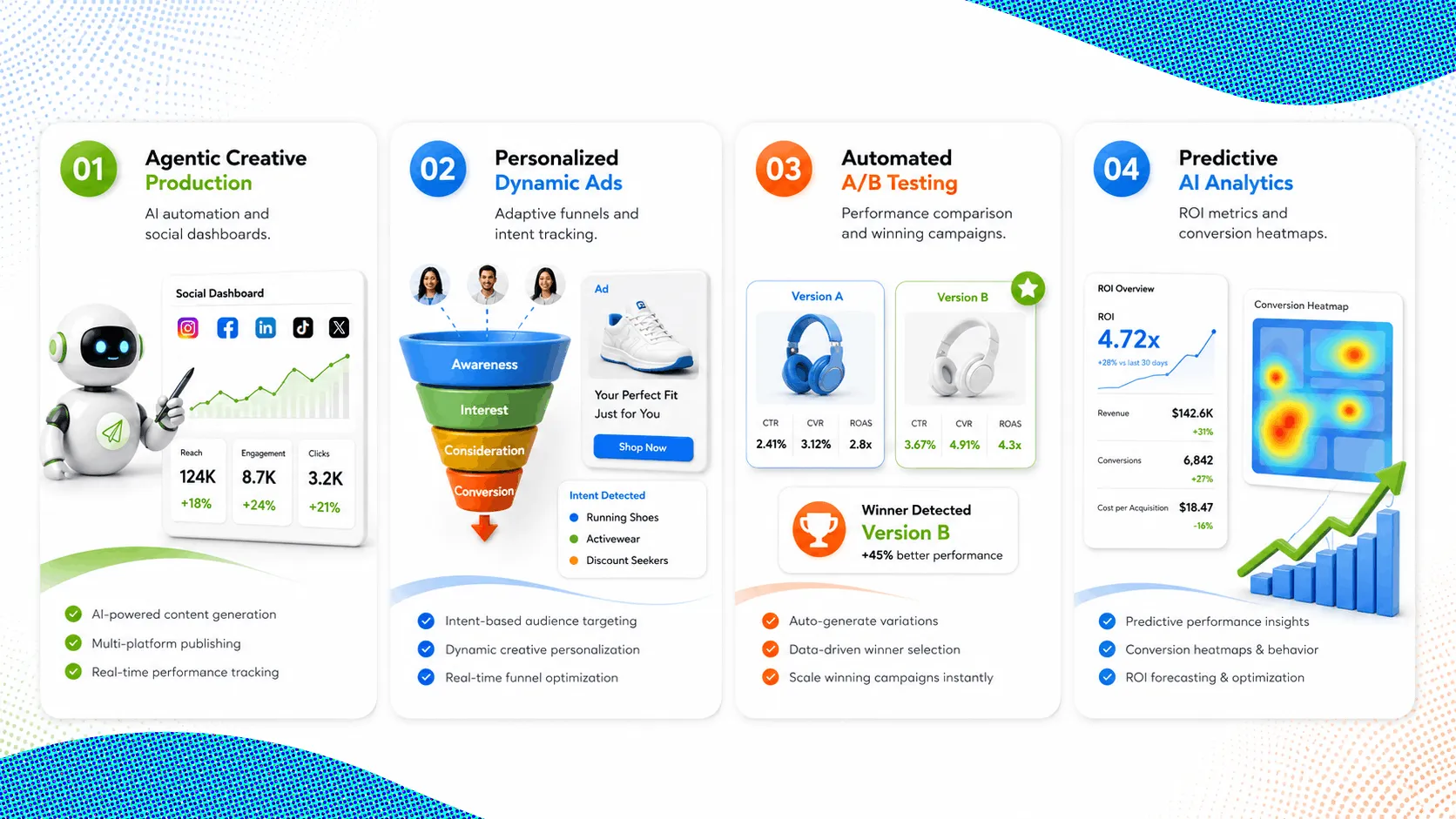
Scaling in 2026 calls for a strategic collaboration of AI-driven execution speed and human creative oversight.
4. Agentic Creative Production
Recent data from Graffius’ 2026 Lifespan of Social Media Posts shows that content engagement on TikTok and Snapchat now has a half-life (time it takes to reach half of its engagement) of effectively zero minutes. This means content on these platforms loses relevance almost instantly.
Scale effectively by delegating repetitive data processing and iterative testing to AI, while reserving human creatives for the storytelling and positioning that automation cannot replicate. This hybrid model facilitates rapid execution while maintaining the emotional resonance necessary to sustain long-term brand loyalty.
5. Personalized Dynamic Ads
Traditional marketing relies on static funnels—rigid, pre-set paths where every user receives the same sequence of ads regardless of their actions. Today’s consumers easily spot these canned experiences. If a user deep-dives into your technical specs but continues to receive generic ‘Welcome’ ads, it signals that your brand isn't paying attention, often leading them to opt out.
Instead of a fixed map, use agentic AI to monitor micro-moments and independently re-route users based on real-time intent.
6. Automate A/B Test Iterations
Manual A/B testing can no longer match the speed of modern markets; by the time a human team analyzes two images, the audience has already moved on. This human-driven execution drives a bottleneck where potentially winning ideas are delayed by manual cycles.
To resolve this, transition to agentic automation that manages the entire testing lifecycle. These AI agents analyze sentiment and visual cues that deploy tailored creative iterations simultaneously, identifying and funding high-performing assets in real-time while retiring underperforming ones.
7. Take advantage of AI Predictive Analytics tools
Predictive AI shifts marketing from reactive to proactive. By analyzing historical data through machine learning, organizations can forecast purchase likelihood, preferred channels, and specific product interests. This facilitates precision segmentation and personalized engagement based on future intent rather than past actions.
Real-world applications of this technology show a significant impact. Using the Insider One personalization platform, Adidas saw a 13% increase in conversion rates, while Pierre Cardin achieved a 445% uplift.
Systematically applying these predictive models across unified customer data optimizes marketing spend and maximizes customer lifetime value by focusing resources on the highest-probability buyers.
Pillar 3: Metric Integrity
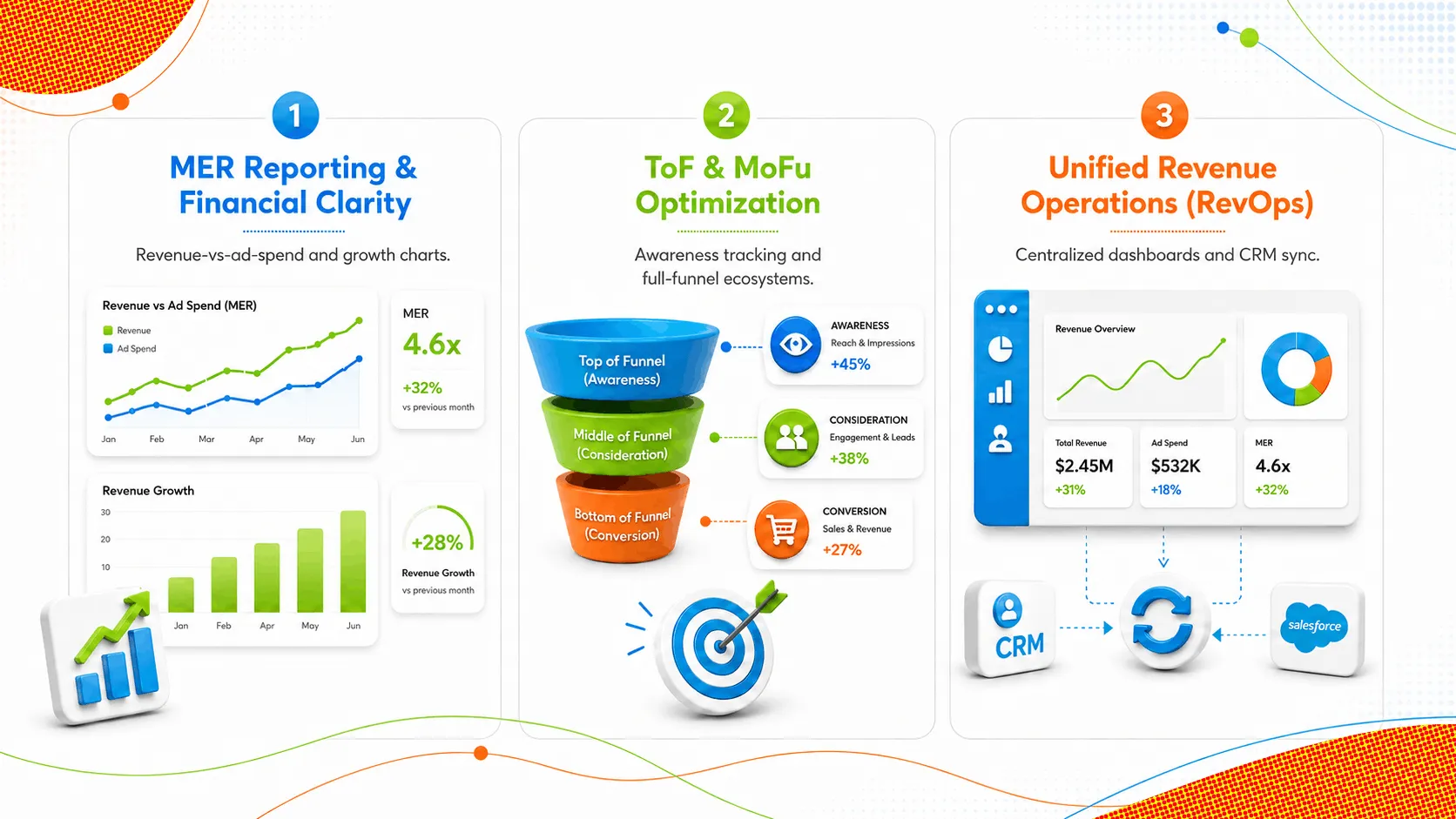
Transition from vanity metrics to a macro-view of business health.
8. Enforce MER Reporting
Modern ad platforms can no longer track the individual buyer’s journey with complete accuracy. Without a verifiable path to purchase, platform dashboards now rely on statistical modeling, which means reported conversions are often probabilistic estimates rather than confirmed facts.
To maintain financial clarity, transition from platform-specific metrics to the Marketing Efficiency Ratio (MER).
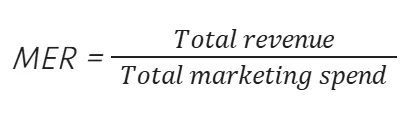
Establishing a target MER serves as a financial baseline to ensure advertising budgets scale only when the ratio remains stable. This bypasses the inherent guesswork of platform attribution, ensuring that increased capital allocation translates directly into measurable bottom-line growth.
9. Sustaining Top-of-Funnel (ToF) and Middle-of-Funnel (MoFu)
Investment in brand awareness is frequently deprioritized because these channels rarely yield a last-click attribution. However, in a fragmented digital market, top-of-funnel awareness serves as the primary driver for high-intent search traffic. Cutting these budgets to improve short-term margins often leads to a long-term decay in overall lead volume.
Increment Testing helps quantify the value of these indirect channels. By temporarily suspending a specific channel within a controlled geographic region, you can measure subsequent impact on total sales. This reveals the essential role that awareness channels play across full-funnel growth.
10. Unifying the Revenue Operations (RevOps) Structure
Scaling requires a unified data environment where CRM, marketing automation, and finance tools communicate without friction. Otherwise, growth will be stumped by lead decay. In an on-demand economy, even a brief delay with a high-intent lead is lost to a faster competitor.
Eliminate departmental silos by centering teams around a single RevOps dashboard. A mature RevOps structure eliminates departmental silos by centering all teams around a single source of truth—the customer’s lifecycle value. If a lead goes cold, the system must auto-escalate it.
When data flows seamlessly between sales and marketing, the decision-to-execution latency drops, allowing the organization to respond to market shifts in hours rather than weeks.
Common Growth Marketing Strategy Challenges & Solutions
Scaling a business in 2026 requires overcoming platform hurdles and data gaps. Below are the most common growth marketing challenges and the strategic tips to solve them.
Summary
To scale revenue in 2026, growth marketing must shift from tracking vanity clicks to driving total business that balances data mastery, agentic AI collaboration, and metric integrity. This framework discusses:
- Data Mastery
- Replacing dying third-party cookies with zero-party data collected via interactive utility-first tools
- Optimizing ad spend by syncing high-value cohort signals directly to conversion APIs
- Migrating audiences to owned community channels (e.g., Discord or WhatsApp) to bypass platform gatekeeping.
- Human-AI Collaboration
- Execution is supercharged by agentic AI, which automates the entire creative testing lifecycle and re-routes user journeys in real-time based on intent
- Metric Integrity
- Financial risk is managed through the Marketing Efficiency Ratio (MER) and unified RevOps structures that eliminate data silos.
- Success requires a full-funnel technical integration to ensure that scaling remains profitable relative to customer lifetime value.
Frequently Asked Questions (FAQs)
1. How do I track customers if third-party cookies are going away?
Switch to zero-party data, which is information customers voluntarily give through interactive tools owned by the brand.
Offer utility tools that provide immediate value to the user in exchange for their specific preferences, allowing you to build rich customer profiles without relying on private tracking.
2. How does Agentic AI differ from standard automation?
Standard automation follows a set path, but agentic AI can reason and act independently. For example, it can monitor a user's intent in real-time and automatically change their ad sequence or launch new creative tests without waiting for a human to analyze the data.
3. How does RevOps help me scale faster?
Revenue Operations (RevOps) unifies your marketing, sales, and finance teams with the same dashboard.
When these teams are connected, information flows instantly, preventing lead decay, where potential customers are lost to faster competitors.
Read These Next
Marketing Automation Workflow: How to Design High-Converting Sequences from Scratch