.png)

Growth Marketing vs Demand Generation: Breaking Down the Modern Marketing Funnel
.png)

.png)

In 2026, Demand Generation captures market interest by optimizing for AI search (AEO) and problem-aware intent. Growth Marketing acts as a logic layer, using predictive analytics and experimentation to optimize the customer lifecycle. While Demand Gen builds the pipeline, Growth Marketing maximizes lifetime value (LTV) through retention and viral loops.
Key Takeaways:
- Demand generation acts as a visibility layer to capture market interest, while growth marketing serves as a logic layer to optimize the entire customer lifecycle.
- Modern marketing in 2026 relies on technical ecosystems including Answer Engine Optimization (AEO) for visibility and predictive analytics for customer retention.
- Demand generation captures informational search intent from problem-aware prospects, whereas growth marketing optimizes solution-utility intent for existing users.
- The two frameworks are interdependent; demand generation provides the user cohorts necessary for growth experiments, while growth marketing creates the social proof and viral loops that lower acquisition costs.
What is the Modern Marketing Funnel in 2026?
The marketing funnel is no longer linear—it’s recursive, AI-mediated, and partially invisible.
Buyers now discover, evaluate, and validate solutions across AI search engines, private communities, and dark social channels where users evaluate brands through encrypted channels like Slack and WhatsApp. Much of this journey happens without direct attribution, forcing marketers to rethink how demand is captured and revenue is generated.
Modern marketing operates as a technical ecosystem built on:
- AI search visibility (Answer Engine Optimization / AEO)
- Intent signals (behavioral and predictive data)
- Machine learning attribution (cross-channel tracking)
- Experimentation loops (continuous optimization)
Within this system, two functions must work together:
- Demand Generation → Captures market interest and fills the pipeline
- Growth Marketing → Optimizes the customer lifecycle and maximizes value
Understanding the Difference Between Growth Marketing and Demand Generation
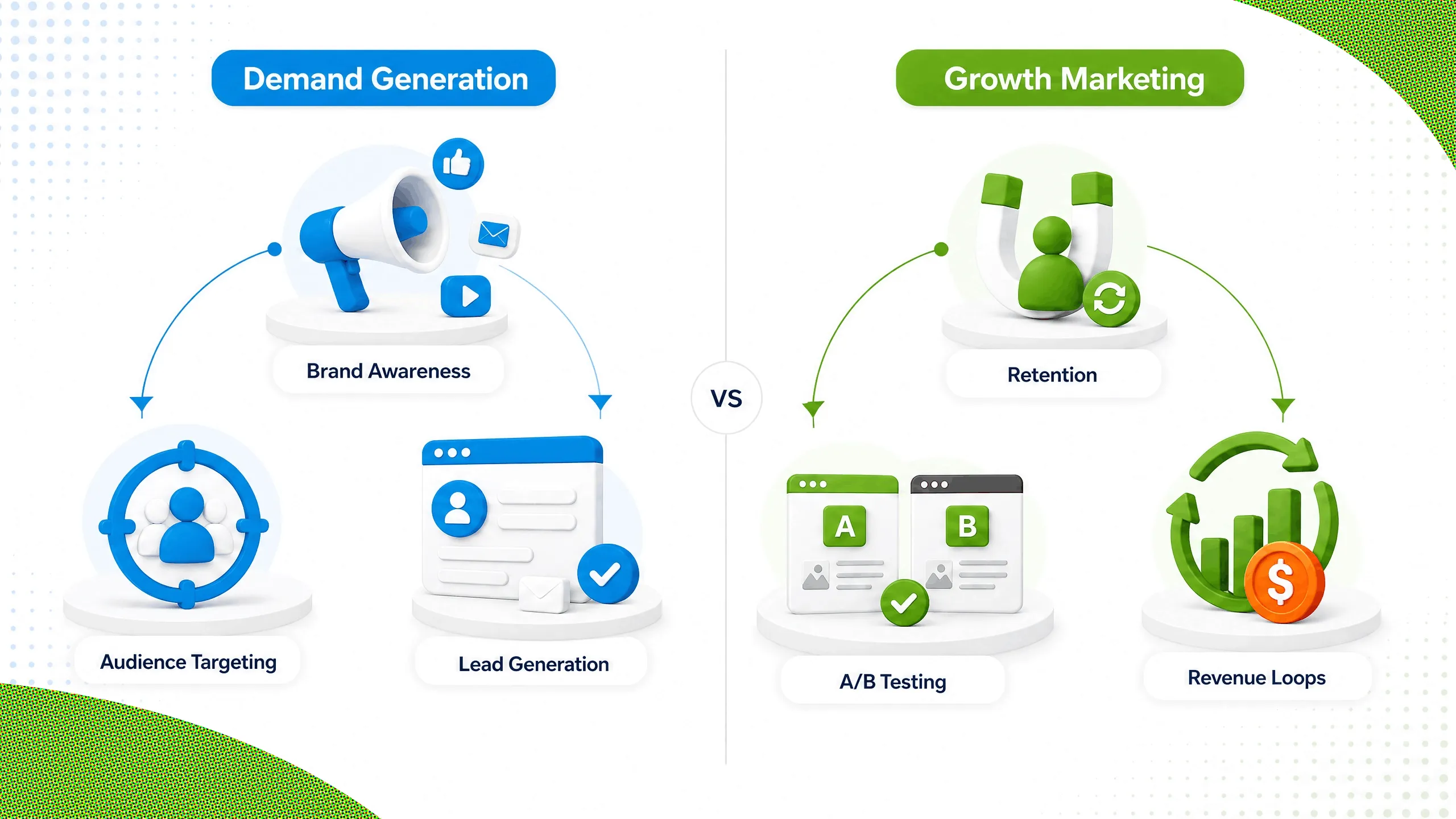
Demand generation acts as a visibility engine to capture initial market interest, while growth marketing serves as a logic layer to optimize the entire customer lifecycle through data-driven experimental loops.
- Growth Marketing functions as the logic layer, ensuring every interaction increases customer base value over time.
- Demand Generation acts as the visibility layer, designed to capture interest and guide prospects into a sales pipeline.
Key Differences: Growth Marketing versus Demand Generation
Demand Generation: Capturing Market Interest
Demand Generation focuses on creating brand authority and capturing early-stage buyer intent within AI-driven search environments to populate the sales pipeline.
Core Functions
- Capture problem-aware search intent
- Build authority and trust
- Generate qualified pipeline
Key Tactics in 2026
- Answer Engine Optimization (AEO): Structuring content so AI systems cite your brand directly
- Generative Engine Optimization (GEO): Ensuring your data is indexed and recommended by AI models
- Intent Signal Analysis: Using predictive models to identify in-market buyers early
- AI-Powered Outbound: Autonomous agents executing personalized outreach at scale
- Social Graph Analysis: Mapping influence patterns across private communities
- Synthetic Personas: AI-generated ICPs trained on real behavioral data
Growth Marketing: Optimizing the Entire Lifecycle
Growth marketing manages the post-acquisition experience, focusing on extracting maximum value from existing users through data-driven retention loops.
In practice, this operates across platforms like:
- Segment (data collection and unification)
- Amplitude (behavioral analysis)
- HubSpot (activation and workflows)
These systems trigger automated actions based on user behavior, turning insights into revenue outcomes.
Core Functions
- Improve activation and onboarding
- Increase retention and engagement
- Maximize LTV and referrals
Key Tactics in 2026
- Predictive Churn Modeling: Identify and retain at-risk users automatically
- Zero-Party Data Orchestration: Activate customer-declared data across the lifecycle
- Viral Loops: Build self-sustaining growth mechanisms into the product
- A/B Testing at Scale: Continuously optimize every touchpoint
- API-First Attribution: Flexible tracking across fragmented journeys
How Dark Social Impacts Demand Generation and Growth Marketing
Dark social refers to private, untrackable channels (such as Slack, WhatsApp, and direct messages) where buyers research, validate, and share recommendations outside traditional analytics.
In Demand Generation, it shapes how prospects discover and trust brands, often before any measurable touchpoint occurs. In Growth Marketing, it amplifies retention and referrals, as satisfied users share products within their networks, driving high-quality, low-cost acquisition.
While it cannot be directly attributed, its influence can be inferred through self-reported attribution, direct traffic patterns, and API-first attribution models; making it a critical, if invisible, layer across the entire funnel.
Where Humans Still Matter: Human-in-the-Loop
AI can optimize patterns, but it cannot define priorities, context, or meaning. This is where the human-in-the-loop becomes critical, a system where human judgment actively guides, validates, and overrides AI-driven decisions. This ensures outputs align with strategic goals, brand positioning, and real-world nuance.
Role of Human In Demand Generation
- Editorial judgment (what should be said vs what ranks)
- Brand positioning and narrative control
- E-E-A-T validation of AI-generated outputs
Role of Human In Growth Marketing
- Deciding which experiments actually matter
- Interpreting anomalies and edge cases
- Setting ethical boundaries in automation
While AI runs the system, humans decide what’s worth optimizing. In practice, AI handles scale, such as processing data, identifying patterns, and executing workflows. Meanwhile, humans define what matters: which problems to solve, which signals to trust, and which trade-offs to make.
The most effective teams don’t replace human decision-making with AI, but integrate it. AI becomes the execution layer, and humans remain the decision layer, working together to produce outcomes that are not just optimized, but meaningful and strategically sound.
How Growth Marketing and Demand Generation Target Different Buyer Mindsets
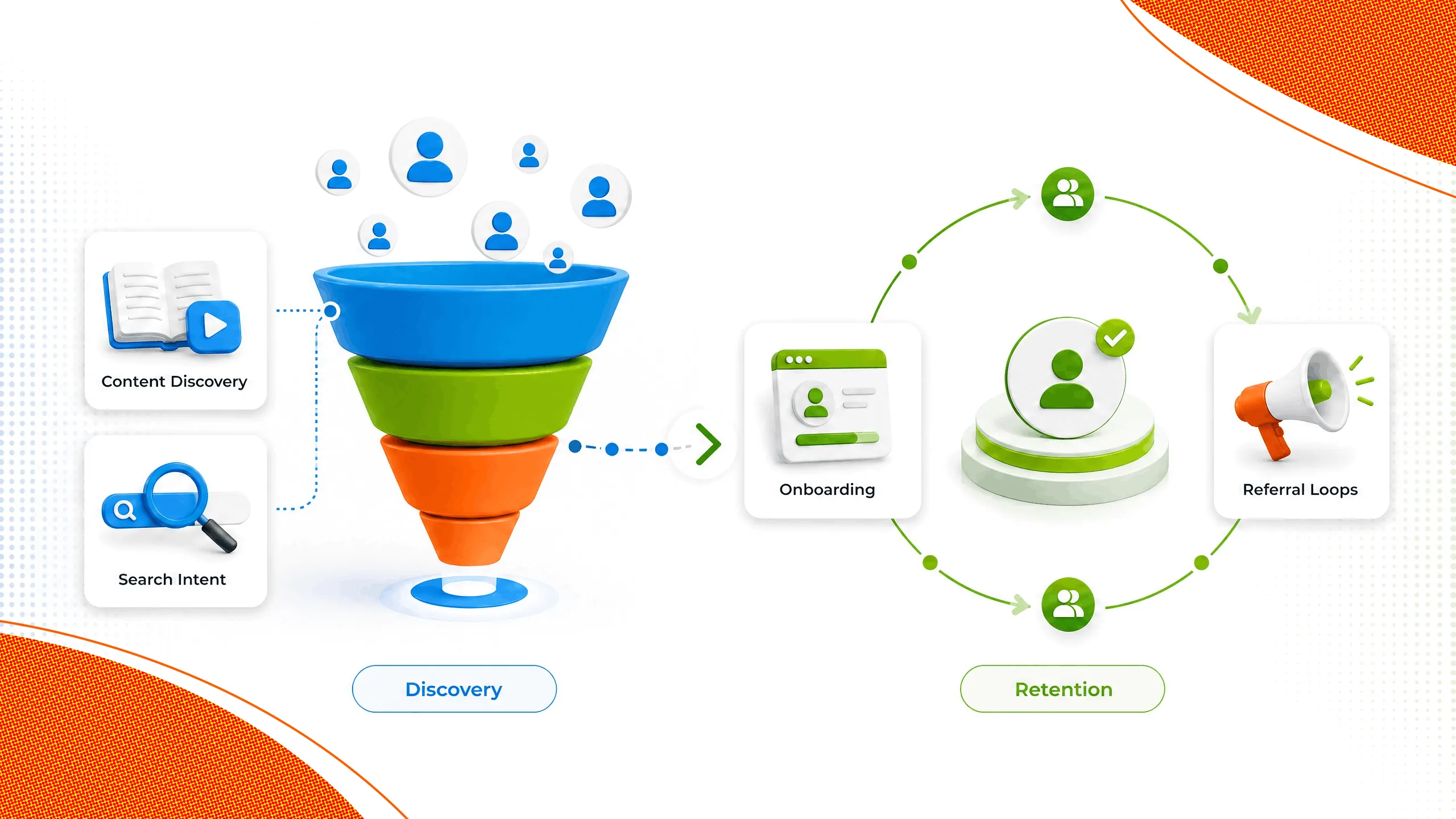
The primary distinction between these strategies in 2026 lies in how they address specific stages of natural user search intent. While Demand Generation captures problem-aware inquiries from prospects seeking new solutions, Growth Marketing optimizes solution-utility intent for users already within your ecosystem.
1. Problem Awareness vs Product Utility
The distinction begins with whether a user is searching for a new solution or attempting to extract more value from a tool they already own.
- Demand Generation for Problem Awareness: Users at this stage have a specific pain point but may not be familiar with your brand. Their search intent is often informational. For example, searching for the "best software for remote teams." This includes meeting users in dark social channels, where buyers often conduct private research and seek peer reviews before deciding for purchase.
Demand generation captures this intent by building brand authority and establishing trust before the user is ready to commit to a purchase. - Growth Marketing for Solution Utility: Once a user is acquired, their search intent shifts toward maximizing the product's value. Growth marketing addresses this by analyzing behavioral data to see where users succeed or get stuck.
The goal is to facilitate the transition from a one-time buyer to a loyal advocate who actively refers others.
2. Pipeline vs Lifecycle Value
Search intent also varies based on the user's timeframe and their position within the modern funnel.
- Demand Generation’s Focus on Active Seekers: This strategy targets users most likely to purchase immediately. By using intent data and AI analysis, demand generation identifies active seekers and guides them quickly into the sales pipeline to meet immediate revenue goals.
- Growth Marketing’s Focus on Compounding Results: Growth marketing prioritizes the long-term value of the entire customer lifecycle. Because keeping just more customers has a better chance of increasing profits, this strategy uses predictive analytics to identify at-risk users and trigger automated interventions to maintain the relationship.
3. Content Authority vs Experimentation
The methods used to satisfy user intent differ between providing expert answers and validating user behavior through experimentation.
- Demand Generation via Thought Leadership: To satisfy users who rely on AI assistants for research, demand generation focuses on being the primary answer. This involves distributing high-value guides, videos, and webinars that establish the brand as a technical authority.
- Growth Marketing via A/B Testing: Growth marketing moves beyond guessing user needs by utilizing A/B Testing (comparing two versions of a webpage) to see how users actually behave. By analyzing where users click or what they ignore, growth teams continuously optimize every digital touchpoint to improve the user experience.
Selecting the Strategy: Which Approach Fits Your Business?
Choosing between these frameworks requires an honest assessment of your business stage, product category, and current revenue bottlenecks.
When to Prioritize Demand Generation
This approach is essential for companies in the Market Entry or Category Creation phase. If your primary challenge is that not enough people know your brand exists or understands the problem you solve, Demand Generation is the priority.
It is for the business that needs to build a sales pipeline from scratch and establish immediate authority in AI-driven search results.
When to Prioritize Growth Marketing
This is the framework for businesses with Product-Market Fit (evidence that a product can satisfy a specific market) that are struggling with leaky funnels. If you have plenty of leads but they aren't converting into long-term users, or if your Customer Acquisition Cost (CAC) is too high, Growth Marketing is the solution.
It is for those looking to optimize existing traffic and turn current users into a referral engine.
Common Risks and Failure Points in Modern Marketing Funnels
Implementing modern marketing strategies without technical precision can lead to significant resource waste. To avoid failure in 2026, brands must address these common pitfalls:
- Low-Quality AI Content: Content without human expertise fails E-E-A-T (Experience, Expertise, Authoritativeness, Trustworthiness) standards required for AI indexing.
- Funnel Leaks: Focusing on demand without growth marketing leads to high churn, where customers leave faster than they are replaced.
- Activation Failure: If the initial experience is poor, users never reach the revenue stage, wasting acquisition costs.
Transitioning to a Full-Stack Marketing Model and Unified Revenue Engine
In 2026, the most successful brands integrate growth and demand strategies into a unified model where each engine feeds the other. This alignment ensures high-performing leads are leveraged and every customer provides maximum value.
How Demand Generation Fuels Growth Marketing:
Demand Generation provides the necessary data for growth experiments. It brings in the diverse cohort of users needed to run A/B Testing. Without the prospective leads generated by Answer Engine Optimization (AEO), growth teams would have no data to optimize.
How Growth Marketing Fuels Demand Generation:
Growth Marketing provides the social proof and data insights that make Demand Generation more effective. When growth teams build viral loops, it creates organic brand awareness that lowers the overall cost of Demand Generation.
Furthermore, insights from growth experiments tell demand gen teams exactly which features to highlight in their top-of-funnel content to attract higher-converting traffic.
How Demand Generation and Growth Marketing Fuel Each Other
Demand Generation and Growth Marketing must operate as a compounding system, not separate functions.
Demand Generation drives high-quality acquisition through AEO, video, and signal-based outreach. For instance, a B2B company reports a 300% increase in qualified leads after maximizing visibility through citation mapping, signalling tools, implementing schema markups and optimizing for AI crawlers.
Growth Marketing then amplifies this impact by optimizing onboarding, retention, and engagement. Insights from experimentation (what drives activation, reduces churn, and increases referrals) feed directly back into Demand Generation, improving targeting and messaging.
At the same time, growth-driven behaviors like referrals and product advocacy increase visibility in dark social, reinforcing demand at the top of the funnel.
By aligning these two under a unified revenue team, businesses ensure that the interest captured at the top of the funnel is never wasted at the bottom.
Final Thoughts
To successfully implement a modern marketing model, businesses should take the following actionable steps:
- Determine if the primary bottleneck is a lack of brand awareness (requiring demand generation) or high user turnover (requiring growth marketing).
- Transition content strategy toward AEO and GEO to ensure brand visibility in AI-driven search environments.
- Utilize a Customer Data Platform (CDP) to aggregate zero-party data and fuel predictive churn models.
- Align demand and growth functions under a single revenue engine to ensure insights from experimental loops inform top-of-funnel content.
Frequently Asked Questions (FAQs)
What is the main difference between growth marketing and demand generation?
Demand generation focuses on the short-term goal of building a sales pipeline by creating brand authority and capturing early-stage buyer intent. Growth marketing takes a long-haul approach, using rapid experimentation and data testing to maximize the lifetime value of existing customers.
How has AI changed demand generation in 2026?
It has shifted toward technical frameworks like Answer Engine Optimization (AEO) and Generative Engine Optimization (GEO). Instead of traditional SEO, brands now structure data specifically so AI agents and generative models cite them as the primary recommendation for user queries.
When should a business prioritize growth marketing over demand generation?
A company should prioritize growth marketing once it has achieved product-market fit but is struggling with high customer churn or "leaky funnels". It is the ideal framework for optimizing existing traffic and turning current users into a self-sustaining referral engine.
Related Content
Read These Next
B2C Marketing Automation: 7 Retail Workflows That Drive Immediate Impulse Sales