.png)
.webp)
International Growth Strategy: A Technical Framework for Integrating into Global Markets
.png)

.png)

What is an international growth strategy?
An international growth strategy is a plan that helps a business enter and grow in new countries. It focuses on choosing the right markets, adapting products and marketing to local needs, and building the systems needed to scale.
The goal is to grow revenue while managing risk and keeping operations efficient.
Key Takeaways
- Global growth is not just about translation, but also about adapting to each market
- Choose markets based on performance data, not just location
- Local payments, laws, and user experience matter for success
- Test smaller proxy markets before entering large ones
- Set clear limits to control spending and reduce risk
Article Overview
Expanding into international markets requires more than translation or basic market entry. This article explains how to build a structured international growth strategy, from choosing the right markets to adapting your messaging, systems, and operations. It also covers common mistakes and real-world examples to help you grow globally with less risk.
Why International Growth Matters in 2026
Most new consumer demand and revenue growth are now coming from emerging markets, while competition and costs continue to rise in mature markets. Expanding internationally allows businesses to reach new customers, grow faster, and reduce reliance on a single market.
As digital markets mature and competition increases, many businesses are finding it harder to grow within a single country. At the same time, new opportunities are emerging in faster-growing regions.
According to the International Monetary Fund in 2026, emerging markets are growing at around 4%, compared to 1.5% in advanced economies, which explains why brands are shifting focus to regions like Asia-Pacific and Latin America.
This shift is already visible in how large companies operate, highlighting the need for businesses to devise a smarter, more structured approach to global growth.
Global Expansion vs Local Market Growth
Understanding the difference between global expansion and local market growth helps you choose the right strategy for your business.
Quick takeaway:
- Choose local growth if you want quick wins with lower risk
- Choose global expansion if you want long-term scale and are ready to invest
Steps to Building an International Growth Strategy
Building an international growth strategy means entering new markets in a structured way. Start by choosing the right country, test before scaling, adapt your messaging, and make sure your product and systems work locally. The goal is to grow sustainably while managing cost and risk.
1. Choose the Right Market
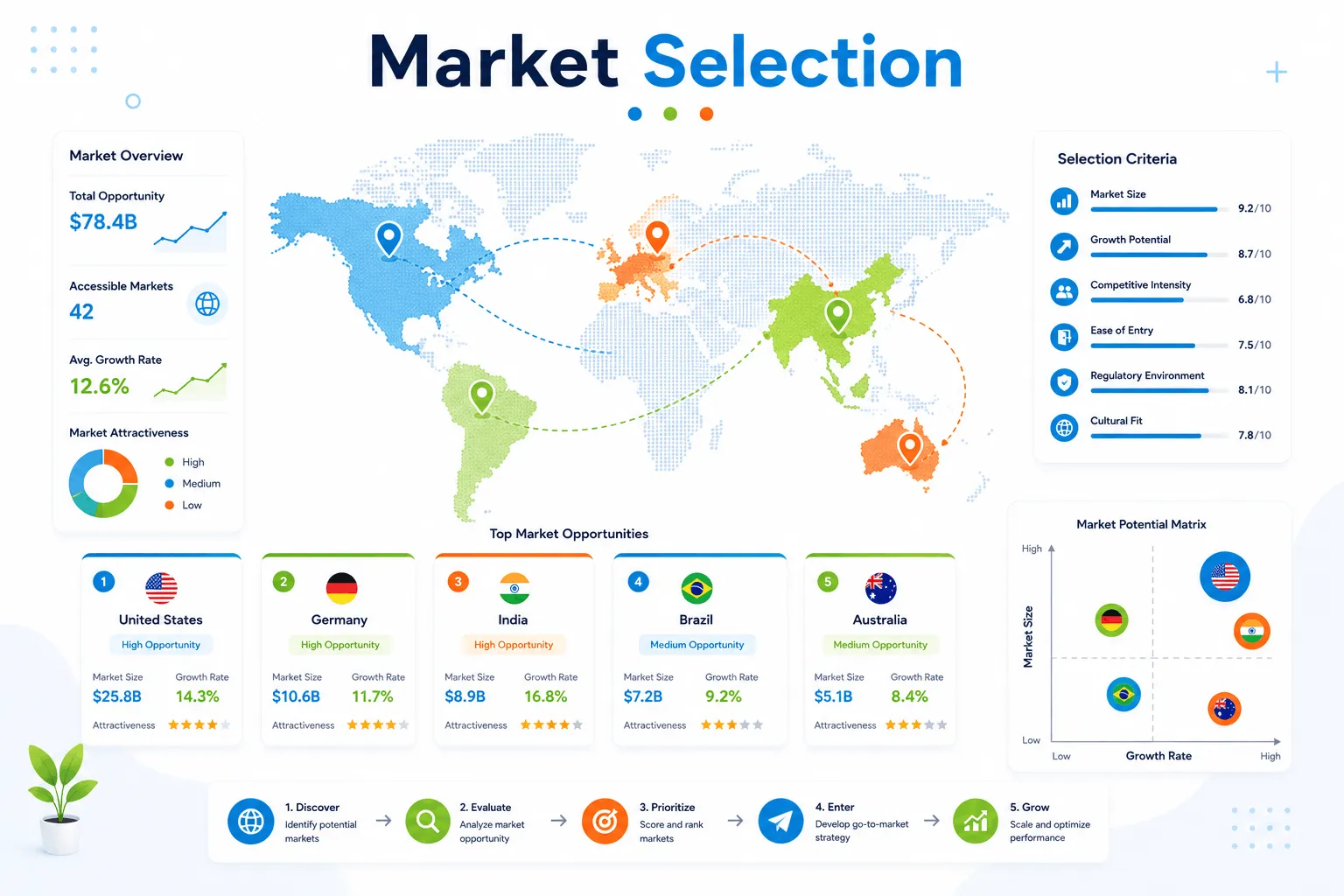
Start by selecting markets where your business has the highest chance of success.
Look at:
- Customer demand for your product
- Similar buying behavior to your current market
- Marketing costs and competition levels
As International Monetary Fund reports in 2026 that faster-growing economies are found in emerging markets, brands increasingly prioritize regions like Southeast Asia and Latin America over saturated markets.
2. Test with Smaller “Proxy” Markets
Before entering large markets, test in smaller ones with similar characteristics.
A proxy market is a smaller country used to test your strategy before scaling.
This helps you:
- Understand pricing and positioning
- Test marketing channels and messaging
- Identify operational challenges early
According to WorkMotion in 2026, 42% of startups fail international expansion due to poor product-market fit, often because they skip testing and enter large markets too quickly.
3. Adapt Your Message
Direct translation often fails because it does not reflect how people actually search or communicate in a new market.
Instead, use transcreation, which means adapting your brand messaging to fit the local language, culture, and expectations.
To do this well:
- Use local keywords and search terms people actually use
- Match tone, style, and cultural context
- Adjust your value proposition based on what matters in that market
Case Study: Nike’s 2022 Never Done Growing Euro campaign focused on women’s football during the UEFA Women’s Euro and used local publishers and influencers to match regional interest leading to 42% revenue growth. This strategy remains relevant in 2026, where brands increasingly rely on culturally aligned campaigns to stand out in competitive markets.
4. Localize the Full Customer Experience
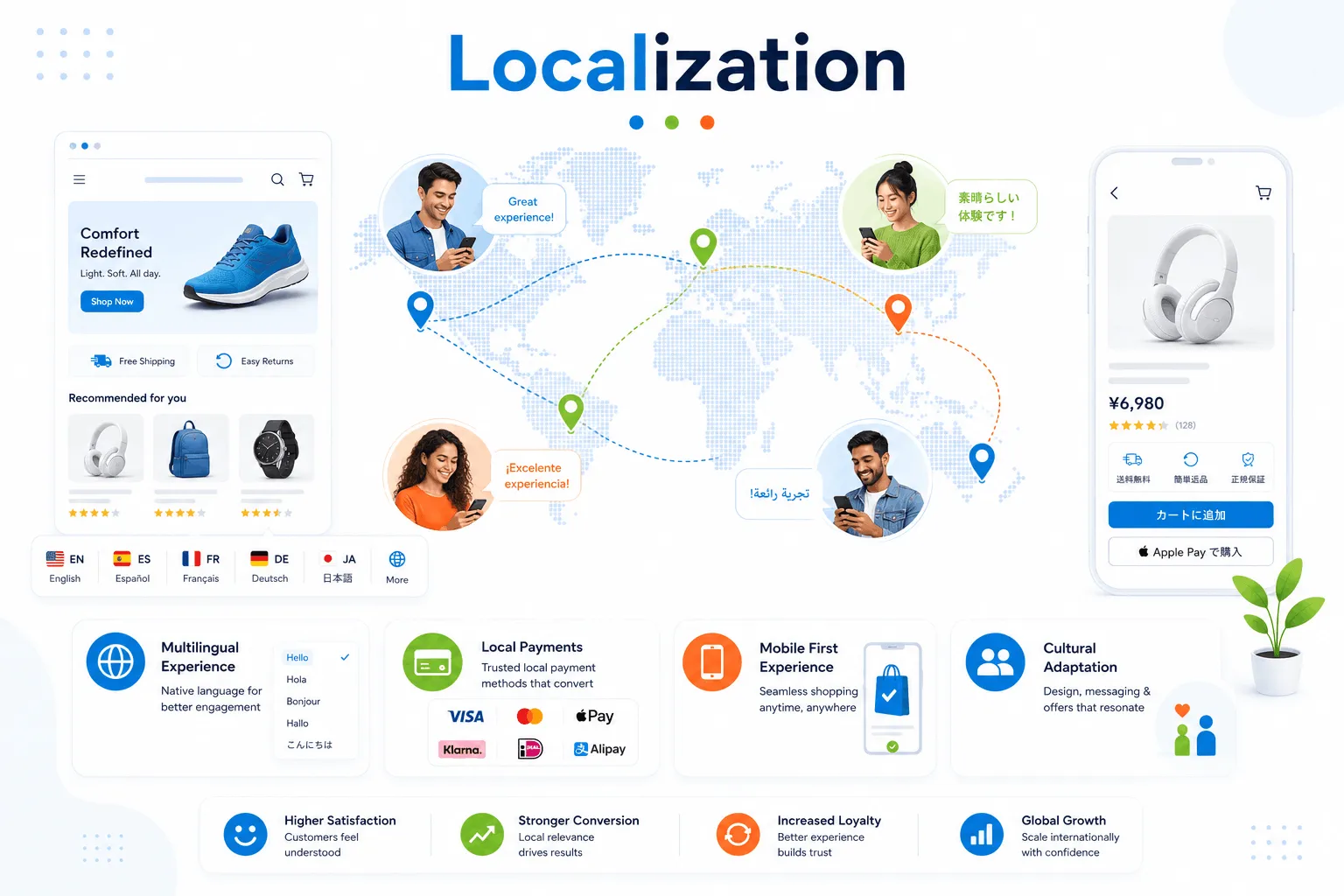
Customers expect a seamless experience that feels native to their region. If any part of the journey feels unfamiliar, conversion rates drop.
Localization should cover the entire funnel, not just the top layer.
Focus on:
- Offering local payment methods
- Meeting regional legal and privacy requirements
- Ensuring fast website performance through local hosting
Case Study: KFC’s digital transformation in China shows how localization goes beyond products, building its strategy around China’s mobile-first behavior through its app, loyalty system, and digital ordering. By 2022, 89% of its sales came from digital channels, and this model continues to define its operations in 2026, reflecting how brands must align with local habits to stay competitive today.
5. Build Scalable Infrastructure
To grow across multiple countries, you need systems that support both control and flexibility.
A strong setup includes:
- Centralized data and reporting for consistency
- Shared brand guidelines and strategy
- Local execution teams that adapt campaigns
Case Study: Airbnb’s expansion model allowed local hosts to define experiences instead of enforcing a single global standard in 2026. This contributed to 96% revenue growth and 74% booking growth in key markets, showing how local execution can scale when supported by centralized systems.
6. Manage Risk with Clear Limits
International expansion often involves a learning phase where performance is unpredictable. Without clear limits, costs can increase quickly.
Define:
- Acceptable customer acquisition cost (CAC) is the cost you spend to get one new customer
- Expected return timelines
- Conditions to pause or adjust investment
This helps you stay disciplined and protect your budget.
Case Study: Lululemon faced a major shift after US import rule changes, with a $240 million tariff impact in 2025 rising to $320 million in 2026. The company adjusted its supply chain and distribution strategy instead of continuing with rising costs, showing the importance of setting limits and adapting early.
7. Improve Data Tracking
Tracking performance across countries is harder due to privacy laws and platform limitations.
To maintain visibility:
- Use server-side tracking, which collects data directly from your server instead of relying on the user’s browser
- Combine available data with modeled insights
- Focus on trends rather than perfect accuracy
IAPP in 2026 reports that over 80% of the global population is now covered by privacy laws, and companies using server-side tracking can recover lost data, making it a key requirement for modern growth.
What Is Glocalization in International Growth?
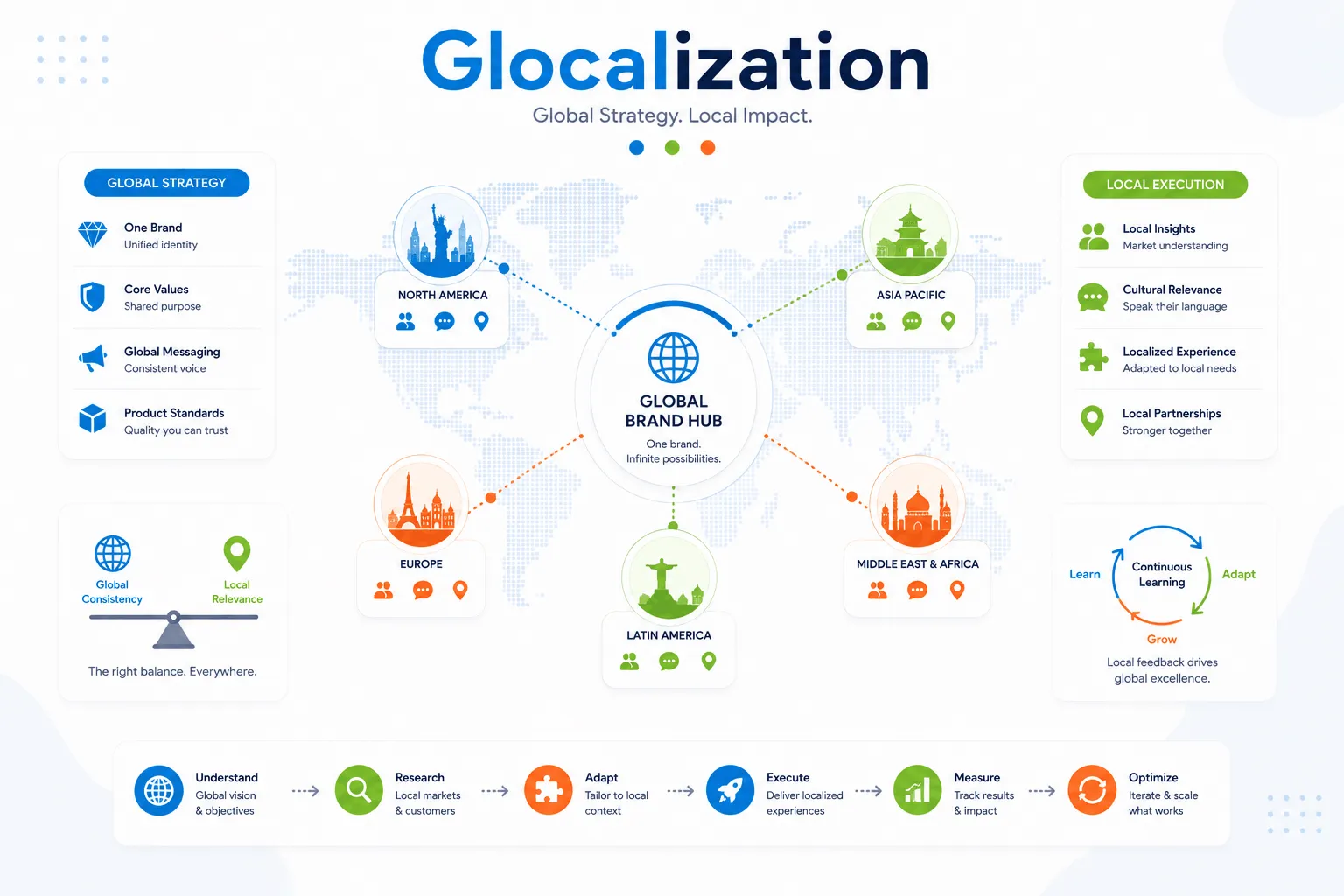
Glocalization means combining global strategy with local execution.
In simple terms:
- Keep your brand and data centralized
- Adapt marketing and experience for each country
This helps you stay consistent while still connecting with local users.
Common Mistakes to Avoid
Expanding into new markets can drive growth, but many businesses fail because they overlook key details. These are the most common mistakes to watch for:
- Expanding too quickly without testing
Entering multiple markets at once without proper testing often leads to wasted budget and poor results. Each market behaves differently, so it’s important to validate your approach before scaling. - Relying only on translation
Simply translating content does not make it effective. Without adapting messaging to local culture and search behavior, your content may not connect with the audience or drive conversions. - Ignoring local payment preferences
Customers are less likely to complete a purchase if their preferred payment method is not available. In many regions, credit cards are not the primary option, so offering local payment methods is essential. - Choosing markets based only on location
Nearby countries are not always the best choice. Differences in customer behavior, pricing expectations, and competition can make a distant market more suitable than a closer one. - Not setting clear cost limits
Without defined limits for spending, businesses can continue investing in a market that is not performing. Setting thresholds for metrics like customer acquisition cost helps control risk. - Underestimating legal and regulatory requirements
Each country has its own rules for data privacy, taxes, and business operations. Failing to comply can lead to delays, fines, or even being blocked from operating. - Overlooking operational readiness
Logistics, customer support, and delivery expectations vary by region. If operations are not prepared for local demand, it can damage customer experience and brand trust. - Expecting the same strategy to work everywhere
What works in one market may not work in another. Successful international growth requires continuous learning and adjustment based on local performance.
Final Thoughts
International growth in 2026 is no longer just an opportunity, but a requirement for long-term scale. Companies that succeed are not the ones that expand the fastest, but the ones that expand with structure. They test before scaling, adapt to local needs, and build systems that support growth across regions.
Next steps:
- Identify 1–2 high-potential markets based on demand and growth rates
- Test your product and messaging in a smaller or proxy market
- Review your customer experience for localization gaps (payments, legal, speed)
- Set clear performance benchmarks before scaling further
- Build tracking systems that work within privacy regulations
Taking a step-by-step approach reduces risk and improves your chances of long-term success.
Frequently Asked Questions (FAQs)
What is an international growth strategy?
An international growth strategy is a plan to expand a business into new countries by selecting the right markets, adapting to local customer needs, and building systems that support long-term growth.
What is a proxy market?
A proxy market is a smaller, similar market used to test your strategy before entering a larger one. It helps reduce risk by allowing you to validate pricing, messaging, and demand.
What is transcreation?
Transcreation is adapting your message so it keeps the same meaning but fits the local language and culture. It matters because simple translation often fails to connect with new audiences.
What are the biggest mistakes in international expansion?
Common mistakes include expanding too quickly, relying only on translation, ignoring local payment methods, choosing markets based only on location, and not setting clear cost limits.
Read These Next
Marketing Automation Workflow: How to Design High-Converting Sequences from Scratch