.png)
Organic vs Paid Social Media: Which Strategy Wins for Brand Loyalty in 2026?
.png)

.png)

Quick Answer
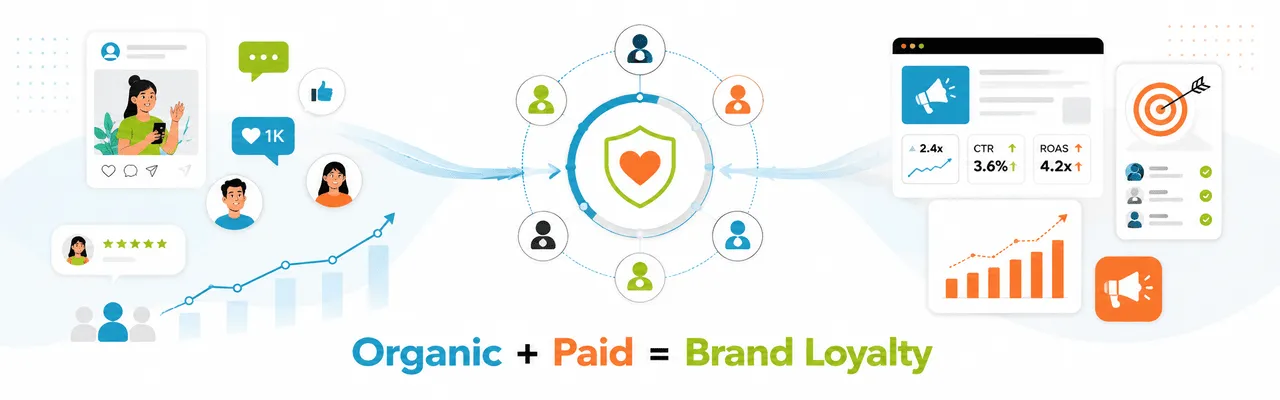
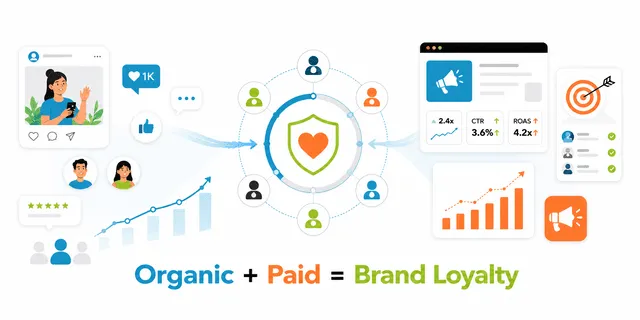
In 2026, Organic Social Media wins for brand loyalty by building trust and Zero-Party engagement, while Paid Social Media is essential for scalable reach and overcoming algorithmic throttling. The most successful brands employ a Hybrid Strategy, using organic content to establish credibility and platform-native AI (like Meta Advantage+) to amplify high-performing assets, resulting in lower CPAs and higher customer lifetime value.
Introduction
Many brands still ask the wrong question in 2026: should we focus on organic social media or paid ads?
In campaign audits, performance problems rarely come from budget alone. They usually come from relying too heavily on one strategy. Teams often expect organic content to grow without distribution, or they depend on paid ads without building trust first.
Organic social media builds familiarity and credibility over time, while paid social media creates reach quickly and predictably. Because feed algorithms now limit visibility, most successful campaigns use both. The 2025 Sprout Social Index (surveying over 4,000 consumers and 1,200 marketers) shows that consumers want brands to be thoughtful, responsive, and human on social — a standard that organic content is better positioned to meet, while paid campaigns remain necessary to scale reach.
What Is Organic Social Media?
Organic social media is content published without advertising spend. It includes posts, videos, stories, comments, and community interaction designed to build awareness, trust, and long-term loyalty. In 2026, this strategy has shifted toward Zero-Click Content — providing full value directly within the platform’s feed without requiring a link click. Platforms penalize posts that drive users off-platform, so organic success depends on on-platform satisfaction.
Used for:
- Brand awareness
- Community building
- Customer trust
- Long-term loyalty
- Engagement
Limits:
- Low reach due to algorithms — Facebook Pages now average 2–5% organic reach per post, down from over 15% in 2014
- Slower growth
- Requires consistent content
- Difficult to scale quickly
In testing across multiple brand accounts, organic content performs best when it feels natural rather than promotional. Meta’s October 2025 update confirms that its recommendation engine now surfaces 50% more Reels from creators who published that day, giving recent video content a clear visibility boost. Meta and TikTok documentation confirm that feed algorithms prioritize content based on watch time, interaction, and relevance. Because of this, organic growth depends more on content quality than posting frequency.
For most B2B and B2C sectors, organic social is strongest for trust and loyalty, but limited in speed and scale.
Creator-Led Organic and AI Content in 2026
Organic social in 2026 is no longer limited to brand-produced posts. Creator-led content, user-generated content (UGC), and AI-assisted production now play a major role in organic reach. 94% of organizations say influencer marketing delivers stronger ROI than traditional digital advertising, with a majority reporting at least 2x returns.
Platforms like TikTok, Instagram, and YouTube prioritize content that feels native to the feed. TikTok’s median engagement rate climbed to 3.70% in 2026, a 49% increase from the prior year, far above any other major platform. Creator-style videos often outperform polished brand ads because they generate longer watch time and more interaction.
AI tools are also used to generate variations of hooks, captions, and visuals, allowing brands to produce more content without increasing production cost. However, higher volume alone does not guarantee reach. Accounts that publish frequently but lack engagement signals still see limited distribution.
In most audits, the highest-performing accounts combine brand content, creator content, UGC, and AI-assisted variations. This mix produces more consistent organic reach than relying on one format.
What Is Paid Social Media?
Paid social media refers to advertising on platforms such as Facebook, Instagram, TikTok, LinkedIn, and YouTube using budget to reach targeted audiences.
Used for: fast reach, lead generation, ecommerce sales, campaign launches, and scaling content.
Advantages:
- Precise targeting
- Immediate traffic
- Predictable delivery
- Scalable campaigns
Limits:
- Requires budget
- Lower trust than organic
- Creative fatigue happens quickly — ad engagement typically drops after 7–10 exposures
- Rising cost due to data privacy rules and signal loss from tracking limitations
- Higher CPM in competitive markets — Meta CPMs rose 20% year-over-year in 2026
- Dependence on platform AI optimization
In campaign reviews, paid performance often declines when creative is not refreshed regularly. Platform AI systems such as Meta Advantage+ require continuous testing, and campaigns frequently re-enter learning phases when signals change.
Paid social wins in speed, but not always in loyalty.
Quick Comparison
Full-Funnel Roles: Organic vs Paid
Organic and paid social media perform best when used at different stages of the funnel.
In most audits, campaigns fail when brands try to use the same content for every stage. Organic content builds familiarity, but paid campaigns are usually required to move users toward action. The strongest accounts use organic for credibility and paid for distribution.
How Algorithms Changed Organic vs Paid Reach
Social platforms now use feed algorithms that limit organic visibility to keep users engaged and encourage advertising spend.
Changes seen in recent years:
- Organic reach declined
- Video prioritized
- Engagement required for delivery
- Ads receive more distribution
- Content volume increased across brands and creators
Facebook Pages now average 2–5% organic reach per post, down from over 15% in 2014. Instagram posts reach approximately 5–7.6% of followers, with Instagram’s organic reach dropping 12% from 2024 to 2025. Average organic reach on Facebook sits at 1.65% across the platform in 2026.
Content volume has also increased across platforms. AI-powered algorithms now drive more than 80% of content recommendations across social media platforms, making competition for feed visibility higher than ever. Because of these changes, the way performance is measured also changed.
What Metrics Matter for Organic vs Paid
Different strategies require different metrics.
Common mistakes in reports: judging organic by sales, judging paid by likes, ignoring funnel stage, or using only one KPI. Accurate evaluation usually requires looking at both engagement and revenue together.
How to Implement a Hybrid Social Media Strategy
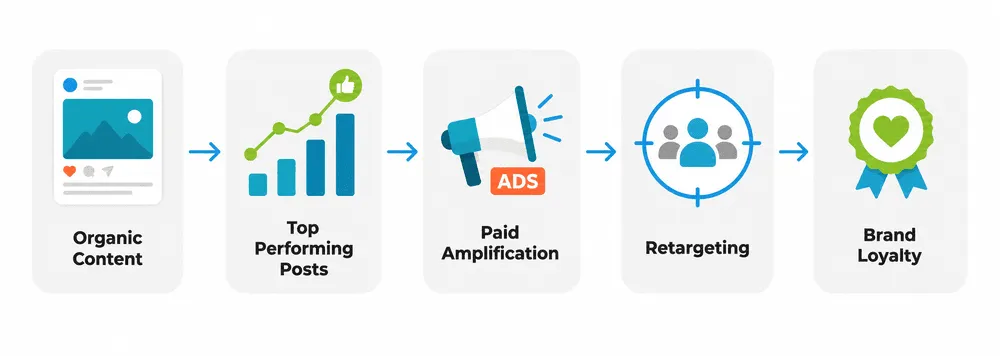
A hybrid strategy means using organic and paid for different roles instead of expecting one strategy to do everything.
In most high-performing accounts, the hybrid model follows a repeatable cycle:
- Organic content builds engagement
- High-performing posts are identified
- Paid ads amplify winning content
- Retargeting converts engaged users
- Organic maintains credibility between campaigns
Organic creates familiarity. Paid increases distribution. Retargeting drives conversion. Consistency builds loyalty. A study by Stackla found that 79% of consumers favor UGC when making purchasing decisions over branded content (13%) and influencer posts (8%), reinforcing why organic social proof makes paid ads more effective.
Pro Tip: Use your organic feed as a Creative Sandbox. Only put paid spend behind organic posts that achieve a top-tier engagement rate. This Post-Testing ensures you only put budget behind content that has already been human-verified by the algorithm.
Which Strategy Wins for Brand Loyalty in 2026?
Brand loyalty is built through repeated exposure, trust, and consistent interaction.
Organic social media usually produces stronger loyalty because users choose to follow and engage over time. 52% of Gen Z users say they trust brand or product information found on social media more than information from Google or AI chatbots, showing how powerful organic credibility has become.
However, organic alone is rarely enough in 2026. Algorithm limits reduce visibility, which makes paid campaigns necessary for distribution.
The question is no longer which strategy is better. The question is how to use both without weakening either. Organic builds trust. Paid creates scale. Hybrid builds brands that last.
FAQs
What is the difference between organic and paid social media?
Organic uses unpaid content to build trust and engagement, while paid uses advertising budget to reach targeted audiences faster.
Which is better for brand loyalty?
Organic usually builds stronger loyalty, but paid helps scale reach. Most brands need both.
Is organic social still effective in 2026?
Yes, but algorithm limits mean Facebook Pages reach just 2–5% of followers organically, making paid distribution necessary for most brands to maintain visibility.
Should brands use both organic and paid?
Yes. Organic builds credibility, paid drives reach, and hybrid strategies perform best.
Read These Next
Marketing Automation Workflow: How to Design High-Converting Sequences from Scratch