.png)

Paid Advertising Strategy: The Complete Multi-Channel Domination Guide
.png)

.png)

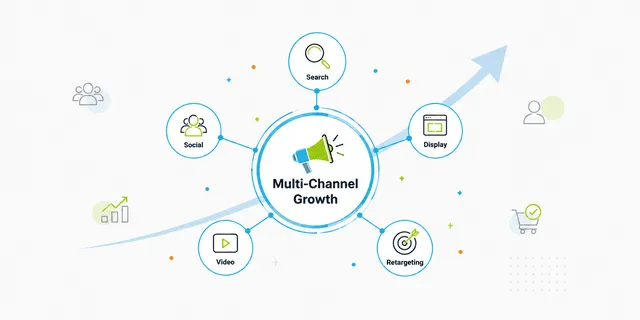
A multi-channel paid advertising strategy is a synchronized ecosystem where search, social, display, and video platforms function as interconnected touchpoints. By mapping channels to stages of the buyer journey and leveraging tools like Meta Advantage+, Google Ads PMax, and CAPI (Conversions API), advertisers improve CAC stability, increase conversion efficiency, and reduce platform dependency.
Multi-Channel Paid Strategy Overview
Introduction
Most paid advertising strategies rely heavily on a single platform. While this can generate results initially, it often becomes unstable as campaigns scale. Brands using 3+ channels achieve 287% higher purchase rates than single-channel approaches, and those deploying 5+ coordinated channels see 412% higher purchase rates. The cost-per-acquisition on isolated channels typically runs 40–60% higher than integrated multi-channel approaches.
In reality, users do not stay on one platform. According to Nielsen and Google, users typically engage with 6–8 touchpoints before making a purchase decision. A multi-channel paid advertising strategy reflects this behavior by creating multiple touchpoints across platforms, increasing the chances of engagement and conversion.
Instead of running isolated campaigns, multi-channel strategies connect platforms into a system. Search captures demand, social creates discovery, display reinforces messaging, and retargeting brings users back. Customer retention improves by up to 91% when customers interact across multiple channels, and multi-channel campaigns average 2x the performance of single-channel efforts.
Privacy-first tracking has also changed how campaigns operate. With the deprecation of third-party cookies and the rise of frameworks like Privacy Sandbox, platforms rely more on first-party signals, server-side tracking (CAPI), and modeled data. This introduces signal loss and requires marketers to focus on data quality rather than just targeting precision.
What This Guide Covers
- What a Multi-Channel Paid Advertising Strategy Means
- Core Components of Multi-Channel Domination
- The Role of Each Paid Channel
- How Multi-Channel Campaigns Work Together
- Budget Allocation and Scaling Across Channels
What Is a Multi-Channel Paid Advertising Strategy?
A multi-channel paid advertising strategy is a system where multiple platforms work together to influence a single conversion. Instead of relying on one channel to do everything, each platform is used for a specific role based on how users behave. In 2025, 47% of US brand and agency marketers said attribution and measurement were their top investment priorities — a signal of how central multi-channel coordination has become.
Most campaigns fail when they expect one platform to handle awareness, consideration, and conversion at the same time. This often leads to rising costs and inconsistent results because users are being pushed to convert before they are ready.
In practice, conversions are rarely driven by a single interaction. A user might:
- Search for a solution
- See an ad on social
- Revisit through retargeting
- Convert later after multiple touchpoints
A multi-channel strategy accounts for this behavior by creating a connected system instead of isolated campaigns.
Core Components of Multi-Channel Domination
A multi-channel strategy only works when the foundation is clear. Without it, campaigns become disconnected, messaging becomes inconsistent, and performance drops.
Define Target Audience Clearly
Campaigns perform better when targeting is specific. Instead of broad audiences, define segments based on behavior, intent, or role. Use CRM data or lookalike audiences from platforms like Meta or Google to reach the right users.
Maintain Unified Messaging
Users often see ads across multiple platforms. If messaging changes too much, it creates confusion. Effective campaigns keep the same core message while adapting the format per platform.
Choose Channels Based on Behavior
Trying to be present on every platform usually leads to weak performance. Instead:
- Use search for high-intent users
- Use social for discovery
- Use display or retargeting for follow-ups
Channel selection should match how the audience behaves, not what is popular.
Adapt Creatives Per Platform
One of the most common mistakes is using the same creative everywhere. This reduces performance because platforms work differently. For example:
- TikTok → short-form, native-style videos
- LinkedIn → professional, insight-driven content
- Meta → visual + conversion-focused creatives
The Role of Each Paid Channel
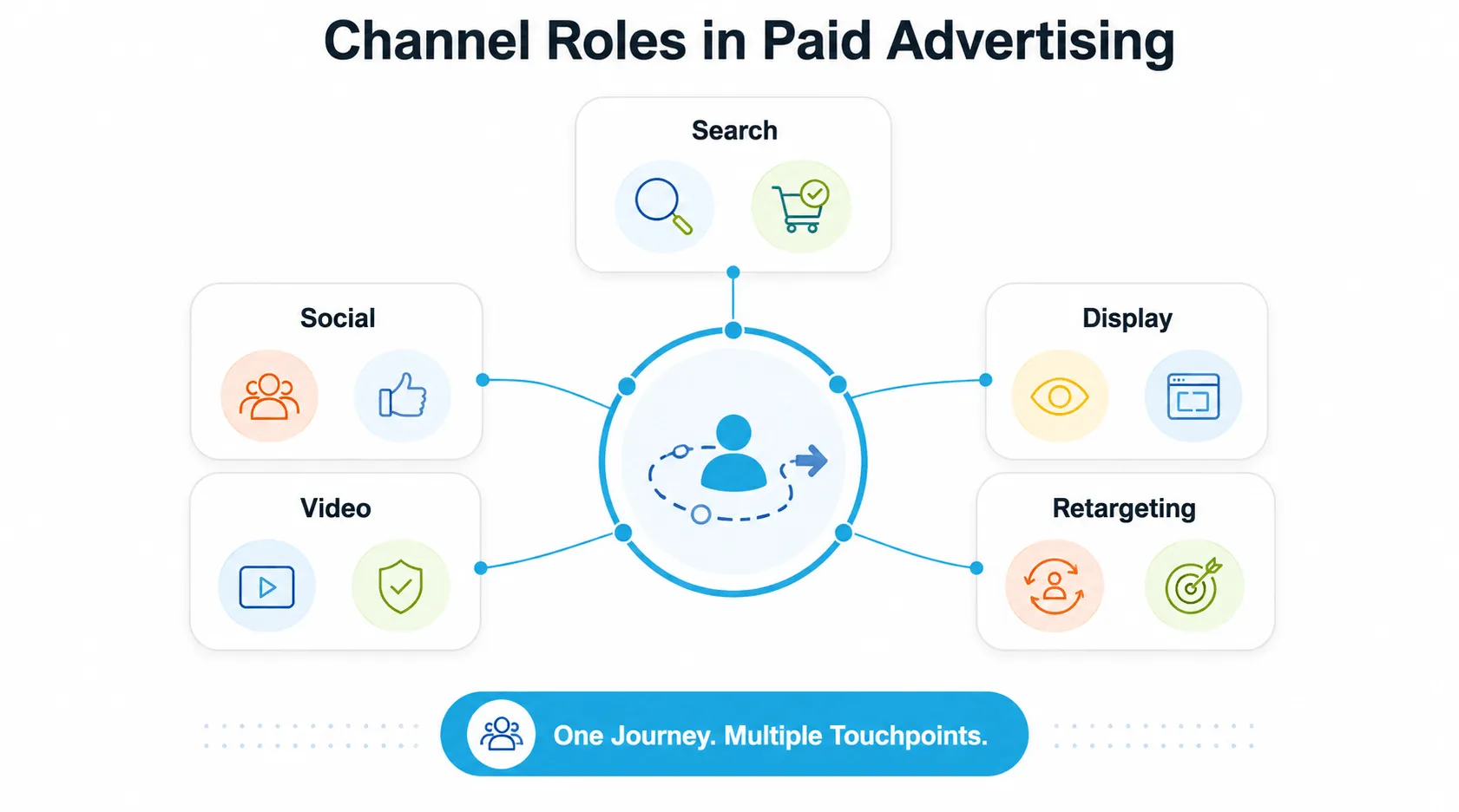
In a multi-channel strategy, each platform serves a specific role. Performance drops when the same approach is applied across all channels instead of using each one for what it does best.
Search (Google Ads)
Search captures existing demand. Users are already looking for a solution, which makes this channel highly conversion-driven. Google Ads is best for high-intent traffic with strong bottom-funnel conversions. Performance is typically evaluated using conversion rate, CPA, and impression share for high-intent queries.
Pro Tip: In our recent audits, campaigns using Google Ads with Performance Max (PMax) powered by Gemini-based asset optimization tend to improve conversion efficiency when paired with strong first-party signals, though visibility into exact placements is limited due to its black-box nature.
Social (Meta, TikTok, LinkedIn)
Social platforms create demand. Users are not actively searching, but they can be influenced through content, targeting, and repeated exposure.
Platform roles:
- Meta → conversions and retargeting (CPA, ROAS stability)
- TikTok → discovery and reach (CTR, engagement rate)
- LinkedIn → B2B targeting (lead quality, CPL)
Pro Tip: We’ve found that TikTok often drives lower CPM and higher engagement in early stages, while Meta stabilizes conversions once sufficient data signals are fed through CAPI and Advantage+ campaigns.
Display and Native Advertising
Display reinforces visibility. These ads appear across websites and help keep your brand present even when users are not actively engaging. Used for awareness and retargeting, repeated exposure across the web, and reinforcing previous interactions.
Pro Tip: Display campaigns typically perform best when evaluated on assisted conversions rather than last-click CPA, especially in multi-touch journeys.
Video (YouTube)
Video builds understanding and trust. It allows more time to communicate value, making it effective for products that require explanation. Best for education and storytelling, mid-to-top funnel campaigns, and reducing hesitation before conversion. LinkedIn video watch time surged 36% year-over-year in 2025, signaling that video continues to dominate engagement across platforms.
Pro Tip: Longer-form YouTube content often improves conversion rates downstream, even if direct CTR is lower, because it increases user intent before retargeting.
Influencer Marketing
Influencers add credibility. Instead of direct ads, they provide social proof through trusted voices. Best for building trust quickly and niche or community-driven audiences. 94% of organizations say influencer marketing delivers stronger ROI than traditional digital advertising, with a majority reporting at least 2x returns.
Pro Tip: Influencer-driven campaigns often improve branded search volume, which later increases conversion efficiency in search campaigns.
Retargeting (Across Channels)
Retargeting connects the system. It re-engages users who have already interacted with your brand and keeps them moving forward.
Key functions:
- Targets users based on behavior (visits, clicks, engagement)
- Reinforces messaging across platforms
- Increases conversion probability over time
Pro Tip: We often see retargeting reduce CPA by 15–30% when layered across multiple platforms instead of relying on a single channel.
How Multi-Channel Campaigns Work Together
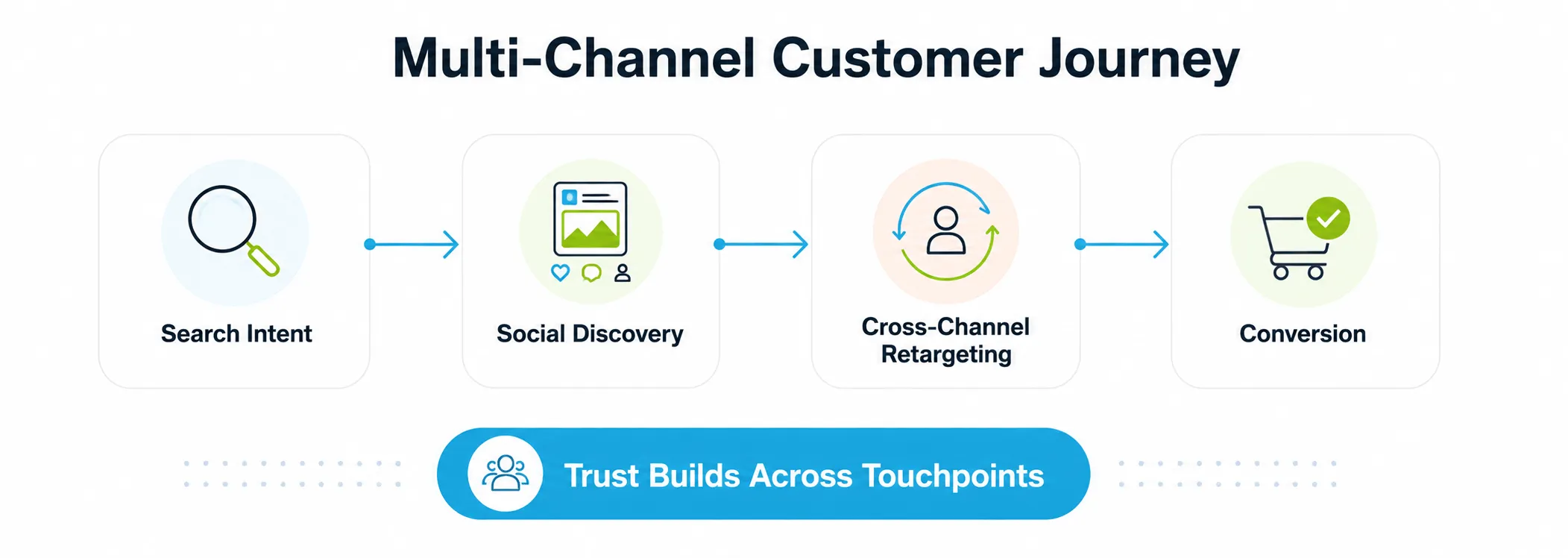
Multi-channel campaigns perform best when they are structured as a sequence, not isolated efforts. Each channel should build on the previous interaction instead of repeating the same message. Multi-channel marketing requires at least 18 touchpoints across 4–5 channels before conversion in many B2B environments.
A typical journey looks like this:
- A user searches and discovers a solution → captures intent but does not always lead to immediate conversion
- Sees a social ad that introduces the brand → reinforces awareness and builds familiarity through repeated exposure
- Encounters retargeting ads across platforms → reminds the user of the product and keeps the brand top-of-mind
- Converts after multiple touchpoints → decision happens after trust and familiarity are built over time
Each interaction increases confidence instead of forcing a quick decision.
Why Single-Channel Thinking Fails
When campaigns rely on one platform, users see limited touchpoints, trust is not built, and conversion becomes harder. What works better is multi-channel strategies that create layered interactions: awareness through social or video, intent through search, and reinforcement through retargeting. Each channel supports a different stage instead of overlapping roles.
Budget Allocation and Scaling Across Channels
Budget allocation should reflect each channel’s role, not be split evenly. Multi-channel performance improves when spend supports how users move through the system.
Allocate Budget Based on Role
Not all channels drive conversions directly. Search requires higher budget for conversions, while social and video support awareness and engagement. A common starting point is a 70/20/10 allocation:
- 70% → conversion-focused channels (search, retargeting)
- 20% → mid-funnel (social, video)
- 10% → testing new channels or creatives
Balance Testing and Scaling
Budgets should support both learning and growth. Use testing to identify winning creatives and audiences, then scale — increasing spend on what already performs.
Avoid Over-Reliance on One Channel
Putting most of the budget into one platform creates risk. CPC increased for 87% of industries in 2025, and Meta CPMs rose 20% year-over-year in 2026. Distributing spend across channels improves stability when any one platform experiences cost inflation.
Third-Party Tools and Measurement Layer
Multi-channel strategies often require tools beyond native ad platforms to unify data and improve decision-making. A third of marketing leaders are concerned about conflicting data and reliability in their measurement and reporting, which is why unified measurement infrastructure matters.
Common categories include:
- Attribution tools — track cross-channel performance (e.g., multi-touch attribution platforms)
- CRM systems — connect leads to revenue (e.g., HubSpot, Salesforce)
- Analytics tools — GA4 for behavior and engagement measurement
- Tag management / server-side tracking — CAPI implementations to improve signal accuracy
Automation and the “Black Box” Reality
Modern platforms rely heavily on automation systems such as Meta Advantage+ and Google PMax. While these systems improve efficiency, they also reduce visibility into how decisions are made. AI-powered bidding now drives 78% of all Google Ads spend in 2026, and 87% of marketers now use generative AI in at least one recurring workflow.
Marketers often cannot see exactly which placements, audiences, or combinations drive results. This “black box” nature means performance must be evaluated based on outcomes rather than granular control. As a result, success depends more on inputs (creative quality, data signals, budget structure) than on manual adjustments.
Daily monitoring is still required. Even automated systems need checks for budget pacing, creative fatigue, and performance anomalies. Automation reduces manual work, but it does not eliminate the need for oversight.
Data Privacy and Compliance
Automation relies heavily on data signals, which makes privacy compliance critical. Frameworks such as GDPR and CCPA regulate how user data is collected and used. In 2026, privacy-first tracking means greater reliance on first-party data, limited third-party tracking, and increased use of modeled data.
Signal loss is a direct result of these changes. Fewer trackable events mean platforms rely more on AI predictions. To adapt: implement server-side tracking (CAPI), prioritize consent-based data collection, and ensure compliance with regional privacy laws.
Conclusion
A multi-channel paid advertising strategy is not about being present on every platform. It is about building a system where each channel plays a specific role in moving users toward a decision.
When campaigns are structured this way, performance becomes more stable and scalable. Instead of relying on one platform to drive results, multiple touchpoints work together to build awareness, reinforce messaging, and increase conversions.
The key is coordination. Clear targeting, consistent messaging, and proper channel roles determine how effective the system becomes. When these are aligned, campaigns don’t just perform better — they become easier to scale.
FAQs
What is a multi-channel paid advertising strategy?
It is an approach where multiple platforms are used together to guide users through the buying journey instead of relying on a single channel.
Why not rely on one platform?
Because users interact across multiple platforms. Relying on one channel limits reach and the cost-per-acquisition runs 40–60% higher than integrated multi-channel approaches.
Which channels should be included?
Common channels include search, social, display, video, and retargeting. The right mix depends on where your audience is active.
How do you measure multi-channel performance?
By combining platform metrics with overall results such as conversions and revenue. Multi-touch attribution (MTA) models and Marketing Mix Modeling (MMM) are increasingly used alongside platform data to get an accurate view across channels.
How do you start a multi-channel strategy?
Start with two to three channels, assign clear roles, and expand once performance becomes consistent.
Related Content
Read These Next
E-commerce Marketing Automation: How to Increase Sales on Autopilot in 2026