.png)
.webp)
Paid Media Marketing Automation: How to Scale Your Campaigns Without the Manual Labor
.png)

.png)

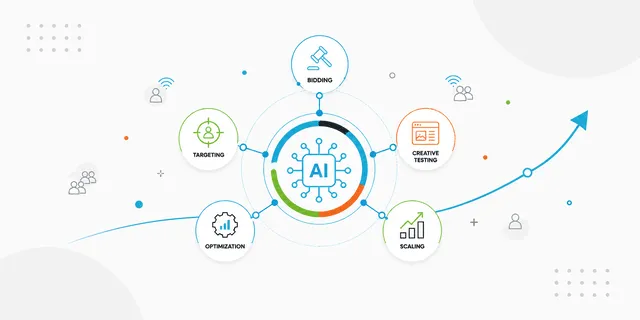
What is paid media marketing automation? Paid media marketing automation utilizes AI and rule-based software to execute bidding, targeting, and creative testing. By shifting from manual adjustments to real-time data signals — including pixel events, CRM data, and engagement patterns — marketers can scale campaigns across platforms like Meta and Google without proportional increases in labor, focusing instead on high-level strategy and creative direction.
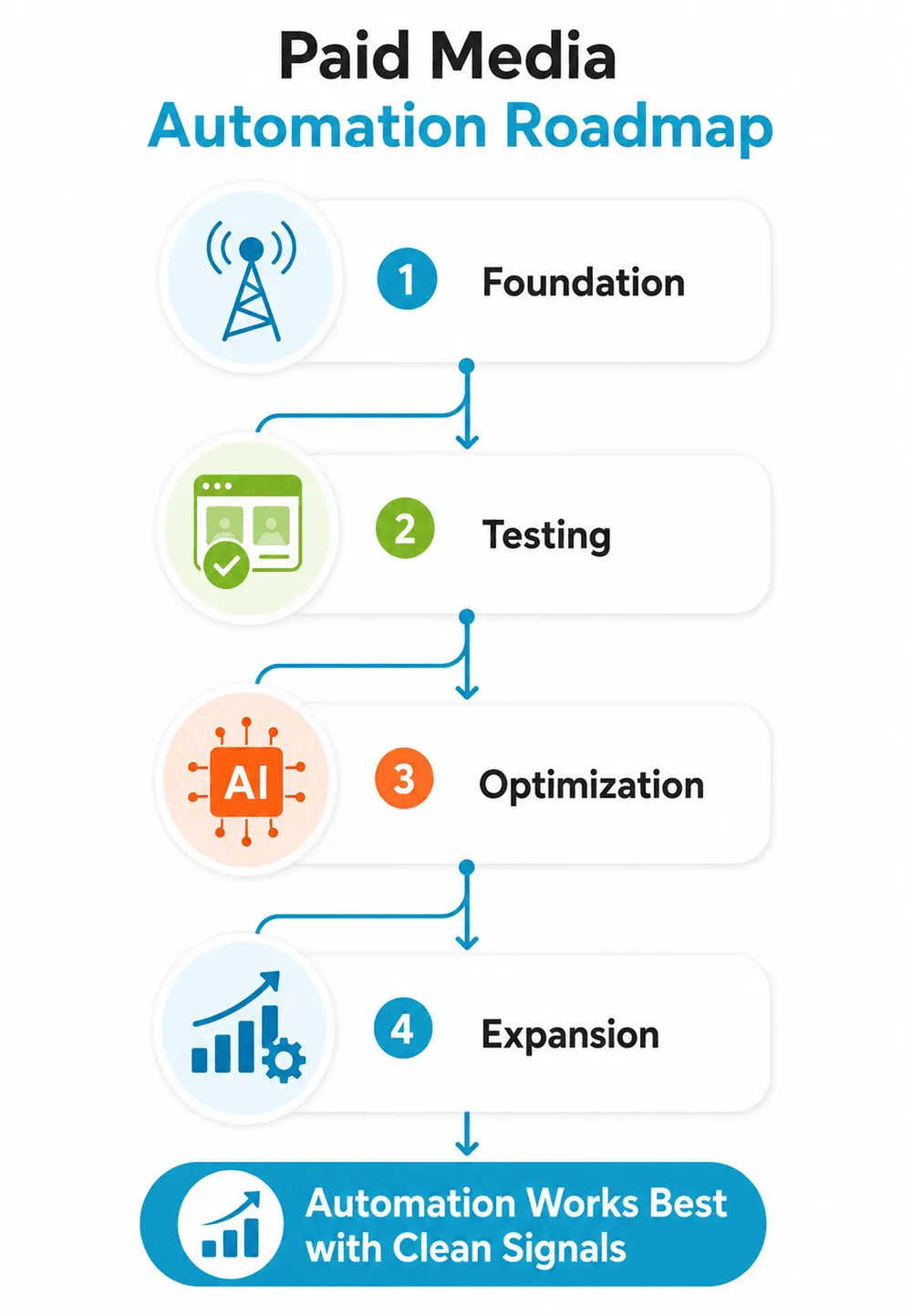
How Paid Media Automation Scales: A Strategic Roadmap
Each stage builds on the previous one — skipping stages is the most common reason automation underperforms.
Introduction
Managing paid media campaigns manually becomes increasingly difficult as scale grows. Each platform requires constant updates, testing, and optimization — which leads to time-consuming workflows and inconsistent results as campaigns expand across channels. Advantage+ Sales Campaigns deliver an average 22% lift in ROAS compared to manually configured campaigns, demonstrating the performance potential of automation when properly structured.
Paid media marketing automation addresses this by handling repetitive tasks such as bidding, audience selection, and performance optimization. Instead of making adjustments manually, automation systems continuously analyze data signals — pixel events, CRM conversions, engagement patterns — and make changes in real time.
Automation also changes the role of marketers. Instead of focusing on execution, teams shift toward strategy, creative direction, and performance analysis. With the right setup, campaigns can scale without requiring additional time or resources.
What This Guide Covers
- What paid media marketing automation means and how it works
- Key areas you can automate in paid media
- How to structure automated campaign workflows
- The black box problem with Google PMax and Meta Advantage+
- Data privacy, signal loss, and compliance in 2026
- Third-party automation tools and when to use them
- Common mistakes in paid media automation
What Is Paid Media Marketing Automation?
Paid media marketing automation is the use of AI and rule-based systems to manage campaign execution, testing, and optimization without constant manual input. PMax now drives approximately 45% of all Google Ads conversions, while Advantage+ grew 70% year-over-year in Q4 2024, surpassing a $20 billion annual revenue run rate. These are the primary implementations at scale in 2026.
The key difference from manual campaign management is how and when decisions are made:
- Manual: decisions happen after a human reviews data — which means hours or days of lag
- Automated: decisions happen in real time based on performance signals — pixel events, engagement data, CRM conversions
Targeting signals are the data inputs that tell automation systems where, when, and to whom to show ads. These include pixel events (e.g. page views, add-to-cart, purchases fired via Meta Pixel or Google Tag), CRM data (e.g. lead quality scores or closed-won revenue synced back via Conversion API), and engagement signals (e.g. video watch time, click-through rate by audience segment). Without clean signals, automation has nothing reliable to optimize against.
Key Areas You Can Automate in Paid Media
Automation is most effective when applied to the parts of a campaign that require constant adjustment. Not everything should be automated — especially not strategy or creative direction.
Bidding and Budget Allocation
Smart bidding systems in Google Ads (Target CPA, Target ROAS, Maximize Conversions) and Meta’s Advantage+ Budget use machine learning to adjust bids at auction level in real time. In 2026, Google’s Gemini-powered Performance Max (PMax) has further expanded this by dynamically generating ad assets and allocating budget across Search, Display, YouTube, and Shopping simultaneously — without separate campaigns for each.
Audience Targeting
Instead of manually building narrow audience segments, automation can expand or refine targeting based on behavioral signals. Meta’s Advantage+ Audience removes manual audience constraints entirely, allowing the system to find converters beyond your defined parameters. Lookalike audiences built from first-party CRM data — hashed emails uploaded via Custom Audiences — remain one of the highest-performing targeting inputs across both Meta and Google.
Creative Testing
Automation allows multiple creatives to run and be tested simultaneously. Meta Dynamic Creative Testing and TikTok’s Smart Creative rotate hooks, formats, and copy variations automatically, prioritizing combinations with higher engagement or conversion rates. This speeds up the testing cycle significantly compared to manual A/B testing.
Reporting and Data Aggregation
Automation consolidates performance data across platforms into unified dashboards. Tools like Supermetrics, Funnel.io, or native CRM integrations (HubSpot, Salesforce) pull campaign data from Meta, Google, TikTok, and LinkedIn into a single view — reducing the time spent reconciling conflicting numbers across separate platform dashboards.
How to Structure Automated Campaign Workflows
Automation only works when it’s structured correctly. Most campaigns underperform not because of the tool, but because the workflow is too vague or not connected to real business outcomes.
Note: even in a well-structured automated campaign, daily sanity checks are still necessary. Budget pacing, creative fatigue, and sudden CPA spikes require human review. Automation reduces daily workload significantly — it does not eliminate the need for oversight entirely.
The Black Box Problem: What Meta Advantage+ and Google PMax Don’t Tell You
One of the most important — and least discussed — trade-offs in paid media automation is reduced visibility. When you hand control to platform AI systems like Google Performance Max or Meta Advantage+, you gain optimization efficiency but lose granular insight into how that performance is being achieved.
With Google PMax, you cannot see which search terms are driving conversions, which placements are consuming budget, or how budget is being split across Search, YouTube, Display, and Shopping. Google’s Gemini-powered asset generation can create ad copy and imagery automatically — but marketers lose direct control over what messaging is being served.
Meta’s Lattice architecture (Meta’s unified AI model introduced in 2024–2025) operates similarly: Advantage+ removes audience constraints and lets the system find converters beyond your defined parameters. Multiple analyses report a 22–32% ROAS improvement from Advantage+ versus manual campaigns, but the trade-off is reduced ability to diagnose performance changes.
The practical approach: use automation for bidding and audience expansion, but maintain control over creative strategy and conversion signal quality. Review performance weekly at minimum, not monthly.
Data Privacy, Signal Loss, and Compliance in 2026
Paid media automation in 2026 operates in a significantly more constrained data environment. Apple’s App Tracking Transparency (ATT) requires explicit opt-in for cross-app tracking on iOS, with opt-in rates hovering between 15–25% globally. This has reduced observable conversion signal from mobile campaigns by 30–60% depending on vertical and audience.
Privacy Regulations
- GDPR (EU): requires lawful basis for processing personal data used in ad targeting; consent must be captured before behavioral data is used for retargeting or lookalike audiences
- CCPA / CPRA (California): gives users the right to opt out of data sale; affects third-party audience data used for targeting
- Apple’s App Tracking Transparency (ATT): requires explicit opt-in for cross-app tracking on iOS; has reduced observable conversion signal from mobile campaigns by 30–60%
Signal Loss and How to Compensate
Signal loss refers to the reduction in trackable user behaviour data caused by these privacy changes. When iOS limitations reduce conversion signal quality, algorithms try to optimize based on 60–70% of actual conversions instead of 95%+. The learning phase takes longer, optimization is less precise, and the performance ceiling drops.
The primary compensating strategies in 2026 are:
Conversion API (CAPI): server-side event tracking that bypasses browser-based signal loss. Meta CAPI and Google Enhanced Conversions send conversion data directly from your server to the platform, maintaining signal quality even when browser tracking is blocked.
First-party data activation: uploading hashed email lists (SHA-256) from your CRM as Custom Audiences for retargeting and lookalike seed audiences — not dependent on third-party cookies.
Offline conversion imports: sending CRM pipeline events (qualified leads, closed-won revenue) back to platforms so the AI optimizes toward business outcomes rather than proxy events like form fills.
Note: running paid media automation without addressing signal loss means the platform AI is optimizing against incomplete data. This is one of the most common reasons automated campaigns appear to perform well in the platform but show no corresponding revenue impact in the CRM.
Third-Party Automation Tools: When Platform-Native Isn’t Enough
Platform-native automation covers most use cases for single-platform or straightforward campaign structures. Third-party tools become valuable when you need cross-platform orchestration, more granular rule-based control, or deeper reporting.
In our experience reviewing mid-market paid media setups, most teams don’t need third-party tools until they are managing significant spend across three or more platforms simultaneously. Start with platform-native automation, get signal infrastructure right first, then layer in third-party tools where the native reporting or control is insufficient.
Common Mistakes in Paid Media Automation
Automation can improve performance, but only when set up correctly. Many campaigns underperform because automation is applied without proper structure, data, or oversight.
Over-automating too early: launching automated campaigns without enough conversion data for the AI to learn from. Most platform AI systems need a minimum of 30–50 conversion events per week per ad set to exit the learning phase reliably.
Poor input quality: weak creatives, unclear messaging, or wrong conversion events. If the conversion event being passed to the platform is a page view rather than a qualified lead, the system will optimize for page views — not pipeline.
Treating automation as set-and-forget: even highly automated campaigns require daily sanity checks for budget pacing, creative fatigue, and sudden CPA movements.
Not connecting real business data: relying only on platform metrics without validating against CRM revenue data. Platform attribution frequently over-credits conversions that would have happened without the ad.
Ignoring signal loss: running automation without Conversion API or first-party data infrastructure means the AI is optimizing on incomplete signals, which extends learning phases and reduces optimization accuracy.
Automation amplifies whatever you feed into it. Strong inputs and clean signals improve performance. Weak inputs scale the problem faster.
Conclusion
Paid media marketing automation is not just about saving time. It is about building systems that allow campaigns to scale without increasing manual effort.
In 2026, the effectiveness of automation is increasingly tied to first-party data quality and signal infrastructure. GDPR, CCPA, and Apple’s ATT framework have reduced the data available to platform AI systems. Teams that invest in Conversion API setup, CRM signal sync, and first-party audience activation will see meaningfully better automation performance than those relying on platform defaults alone.
The key is not to automate everything, but to automate the right parts. Strong inputs, clear goals, and connected data determine how well automation performs. When these are in place, automation becomes a multiplier for growth rather than just an efficiency tool.
FAQs
What is paid media marketing automation?
It is the use of AI and rule-based systems to manage campaign execution, testing, and optimization without constant manual input. Platforms like Meta Advantage+, Google Performance Max, and TikTok Smart Campaigns are the primary implementations at scale in 2026.
Does automation replace marketers?
No. Automation handles repetitive execution tasks — bidding, budget allocation, audience expansion — while marketers focus on strategy, creative direction, signal quality, and performance analysis.
What parts of paid media can be automated?
Bidding, budget allocation, audience targeting, creative testing, and reporting can all be automated. Signal infrastructure — Conversion API setup, CRM data sync, offline conversion imports — should be in place before automation is scaled.
Is automation only for large budgets?
No. Even smaller campaigns benefit from automation for creative testing and bid optimization. However, most platform AI systems require a minimum conversion volume of 30–50 events per week to exit the learning phase. Campaigns below that threshold may see limited benefit from AI-driven bidding strategies.
How do you start with paid media automation?
Start by getting signal infrastructure right: connect your Conversion API, confirm your conversion events reflect real business outcomes, and ensure your pixel is firing correctly. Then enable platform-native automation (Advantage+, Smart Bidding) with at least three to five creative variations per ad set.
Related Content
Read These Next
E-commerce Marketing Automation: How to Increase Sales on Autopilot in 2026