.png)
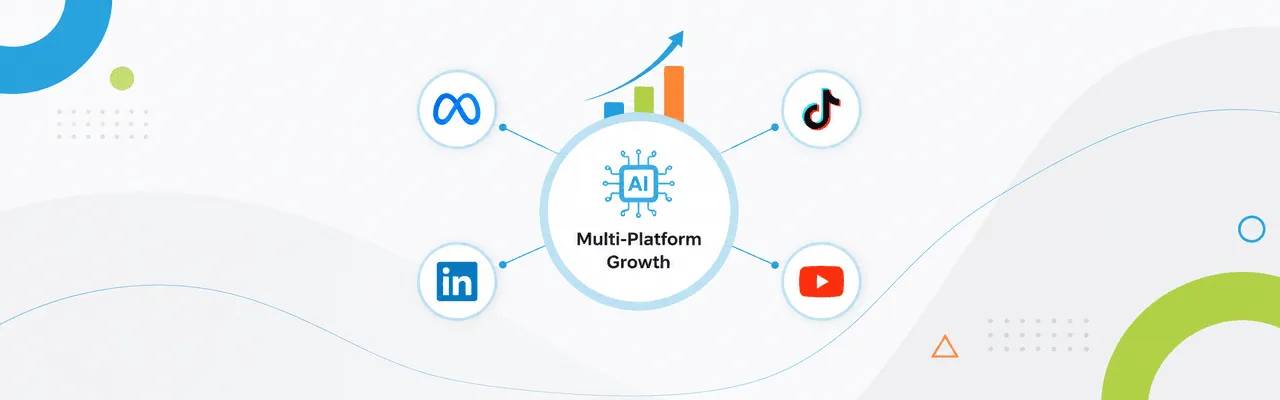
Paid Social Media Strategy: The Complete Multi-Platform Playbook
.png)

.png)

Quick Answer
A 2026 paid social media strategy is a multi-platform framework prioritizing creative-first testing and AI-driven optimization (like Meta Advantage+) over manual targeting. It uses a full-funnel approach—Meta for conversion, TikTok for discovery, and LinkedIn for B2B—to drive measurable business metrics like CAC and ROAS rather than just platform engagement.
Paid Social Platforms by Role
Sources: ICUC Social Benchmarks, 2026; Social Media Advertising Platform Guide 2026
Introduction
Paid social media has become more complex than simply running ads on one platform. In 2026, effective campaigns are built across multiple channels, where each platform serves a different role in the customer journey. Instead of relying on a single network, marketers now combine platforms such as Meta, TikTok, LinkedIn, and YouTube to improve reach, targeting, and conversions.
At the same time, rising competition and advertising costs have made strategy more important than execution alone. Running ads without a clear structure often leads to inconsistent results, even when creatives and targeting appear strong. A defined strategy helps connect audience targeting, creative messaging, and budget allocation into a system that produces measurable outcomes.
Privacy changes and platform automation have also shifted how campaigns are managed. The phase-out of third-party cookies and iOS tracking changes mean platforms now rely more on first-party signals, modeled data, and server-side tracking (Conversions API / CAPI). Many platforms now rely more on AI-driven optimization, broader targeting, and creative performance instead of manual audience selection.
What This Guide Covers
- What paid social media strategy means
- The role of each platform in paid social
- How to structure campaigns across the funnel
- How to build a paid social strategy step-by-step
- How to measure performance
- Key trends shaping paid social in 2026
What Is Paid Social Media Strategy?
Paid social media strategy is the process of using social platforms to generate measurable business outcomes, not just engagement. Instead of running ads randomly, campaigns are structured based on audience intent, creative messaging, and conversion goals.
The difference between campaigns that scale and those that don't is usually not the platform, but the structure behind it. Many campaigns fail because they rely on one platform to handle awareness, consideration, and conversion at the same time.
In practice, paid social works best when each campaign is tied to a specific outcome, such as lead generation or sales, and measured using metrics like CPA, ROAS, or CAC. Because targeting has become less precise due to privacy changes, performance now depends more on creative quality and campaign structure than on detailed targeting.
Key Trends in Paid Social (2026)
Paid social has changed significantly due to automation, privacy updates, and platform evolution. Data from multi-platform audits shows that performance differences are increasingly driven by creative quality and signal strength rather than manual targeting precision.
The Role of Each Platform in Paid Social
Each platform performs differently because user behavior is different. Campaigns become inefficient when the same strategy is applied across all platforms. Meta captures approximately 38% of global social ad revenue and generated $94 billion in 2025 alone, while 97% of B2B marketers incorporate LinkedIn into their marketing strategies.
Meta (Facebook & Instagram)
Meta performs best when the audience already has some level of awareness — either problem-aware (they recognize the need) or brand-aware (they have interacted through website visits, engagement, or past ads). It is commonly used for conversion and retargeting because its AI optimization (Advantage+) improves when there is enough data. Meta reported that its AI-driven ad improvements increased Instagram conversions by 5% in Q2 2025.
Use Meta when: you have traffic or past data, you want to convert or retarget, or you are scaling existing campaigns.
TikTok
TikTok performs best for reaching new audiences. Campaigns rely more on creative quality than targeting, making it effective for discovery. TikTok users now spend an average of 95 minutes daily on the app, and TikTok accounts grew 16.47% tier-to-tier between 2025 and 2026, outpacing every other platform. With the growth of TikTok Shop and improved attribution systems, it is increasingly effective for direct-response ecommerce as well.
Use TikTok when: you need new audience reach, you are testing creatives, or you want to generate awareness at scale.
LinkedIn is used when targeting matters more than volume. It allows advertisers to reach specific job roles or industries, which is useful for B2B campaigns. LinkedIn CPMs range from $33 to $65 for typical B2B targeting — significantly higher than other platforms, but justified when lead quality is the priority.
Use LinkedIn when: you need specific professional targeting, you are running B2B campaigns, or lead quality is more important than cost.
YouTube
YouTube works well for explaining products and building trust. Video content allows more time to communicate value, which makes it useful for higher-consideration purchases. LinkedIn video watch time surged 36% year-over-year in 2025 — a signal that video continues to dominate across platforms.
Use YouTube when: your product needs an explanation, you want to build trust, or you are targeting high-intent users.
How to Structure Paid Social Campaigns (Full Funnel)
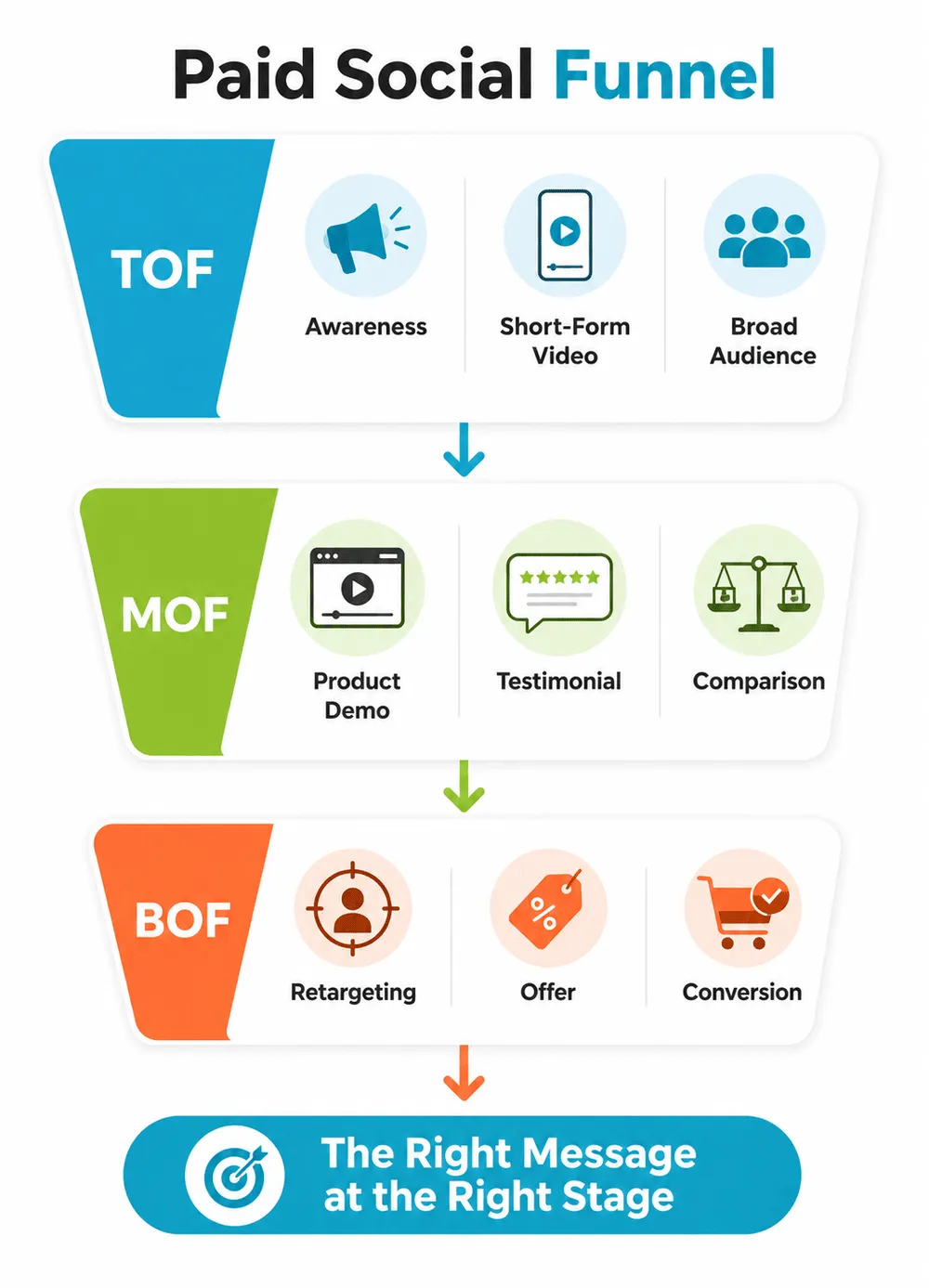
Paid social campaigns perform better when they follow how users make decisions. Instead of using one campaign for everything, effective strategies separate campaigns based on user intent.
Key Insight: TOF campaigns usually generate the lowest conversion rates but are necessary to bring new users into the funnel. MOF improves efficiency by qualifying users before conversion. BOF drives the highest conversions but depends on traffic from earlier stages. The most common mistake is skipping this structure — when campaigns try to push conversions without building awareness first, costs increase because the audience is not ready to act.
How to Build a Paid Social Strategy (Step-by-Step)
A paid social strategy is not built all at once. It develops over time based on what the data shows. Most campaigns fail because they try to scale too early or launch everything at once without knowing what works.
Step 1: Define Business Outcomes
Before launching anything, decide what the campaign is trying to achieve. Running campaigns for awareness, leads, and sales at the same time usually spreads the budget too thin. If the goal is lead generation, everything should support that: creatives focus on the offer, the landing page matches the message, and success is measured using cost per lead.
Step 2: Select the First Platform to Launch
Instead of running ads on multiple platforms immediately, start with one platform where your audience is most active. For ecommerce, start with Meta. For B2B services, start with LinkedIn. This allows you to test creatives faster, understand what messaging works, and avoid splitting budget too early.
Step 3: Creative Testing Framework Before Scaling
In most campaigns today, performance depends more on creative than targeting. Whitelisted creator content consistently outperforms brand-produced creative by 2–4x on CTR and CPA across Meta and TikTok. Start with multiple variations: different hooks (first 3 seconds), different visual styles (UGC vs polished), different formats (video, image), and different angles (problem vs benefit). A test isolates one variable at a time to clearly identify what drives performance.
Step 4: Use Early Performance Signals
Don’t wait only for conversions. Look at CTR (shows if the ad is interesting), video watch time (shows if people stay), and engagement (shows relevance). If a creative performs poorly here, it usually won’t convert later. Scaling it will only increase cost.
Step 5: Retargeting Based on Engagement Data
Retargeting works best when there is enough traffic or engagement. Target users who watched 50%+ of a video, users who clicked but didn’t convert, or website visitors. At this stage, messaging should shift from introducing to convincing, from broad to specific. Launching retargeting too early often leads to weak results because the audience is too small.
Step 6: Scale Campaigns Using Proven Signals
Once you find winning creatives, stable cost per result, and consistent performance, then scale. Instead of doubling the budget immediately, increase slowly, duplicate winning ads, and expand targeting step by step.
Step 7: Creative Iteration and Refresh Cycles
Performance drops over time, especially on social platforms. Ad fatigue sets in after 7–10 exposures on average, at which point engagement drops and platform algorithms penalize stale creative with higher delivery costs. To maintain performance, remove low-performing ads, introduce new variations regularly, and test new angles. Campaigns that scale long-term are not static — they evolve.
How to Measure Paid Social Performance
Measuring paid social performance requires looking beyond platform dashboards. Platform-reported conversions often don’t match CRM or backend data due to attribution gaps of 20–40%. The main difference is between platform metrics and business metrics.
Platform metrics include:
- CPC (cost per click) — how much you pay for traffic
- CPA (cost per acquisition) — cost per conversion inside the platform
- ROAS (return on ad spend) — revenue tracked by the platform
Business metrics include:
- CAC (customer acquisition cost) — total cost to acquire a real customer
- Revenue — actual sales, not just tracked conversions
- Pipeline or qualified leads — especially for B2B campaigns
Many companies now use Marketing Mix Modeling (MMM) and incrementality testing alongside platform data to get a more accurate view of which campaigns are driving real business results.
Conclusion
Paid social media strategy is no longer about running ads on one platform. Campaign performance now depends on how platforms, creatives, and data work together as a system.
Each platform plays a different role, and results improve when campaigns are structured around user intent instead of relying on a single channel. Strategy determines how efficiently the budget is used, especially as costs increase and tracking becomes less precise.
The most effective campaigns are not built by increasing spend, but by combining the right platforms, testing creatives consistently, and making decisions based on real performance data.
FAQs
What is paid social media strategy?
It is the structured approach to running ads on social platforms to generate measurable outcomes such as leads, sales, or revenue.
Which platform is best for paid social?
There is no single best platform. Meta is often used for conversions, TikTok for discovery, and LinkedIn for B2B. The right choice depends on the campaign goal.
How much budget is needed for paid social?
Budgets vary based on goals and industry, but campaigns usually start with testing budgets before scaling what works.
How should paid social performance be measured?
Use both platform metrics (CPA, ROAS) and business metrics (CAC, revenue). Comparing both gives a more accurate view of performance because platform-reported numbers can overstate results by 20–40%.
Why do paid social ads become expensive?
Costs increase when targeting is inefficient, creatives stop performing due to ad fatigue, or campaigns try to scale without proper structure. Meta CPMs rose 20% year-over-year in 2026, driven by creative fatigue and increased auction competition.
Read These Next
AI Marketing Automation: How to 10x Your Output with Machine Learning