.png)
Performance Marketing KPIs: The Only 7 Metrics That Actually Matter for ROI
.png)

.png)

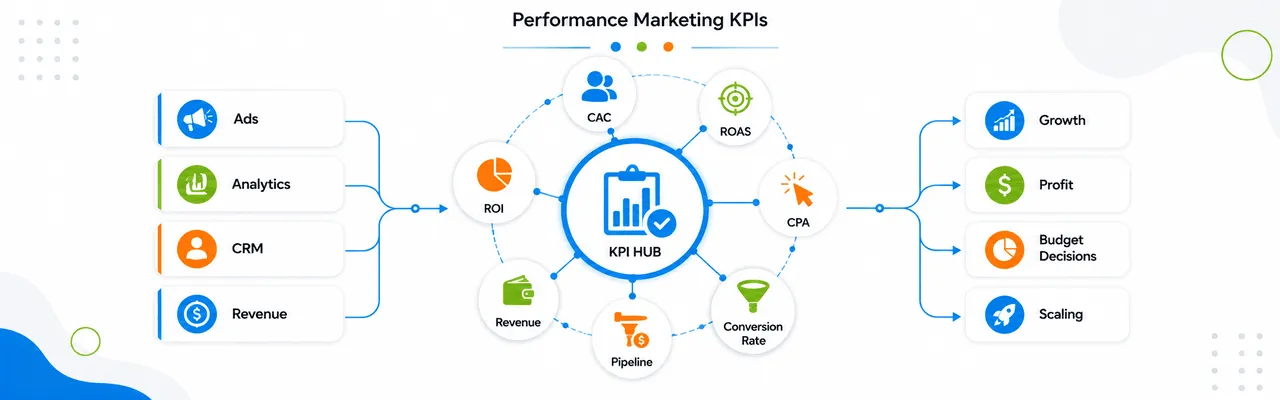
Performance marketing KPIs are the metrics used to evaluate whether marketing generates real business results such as revenue, pipeline, and profit. The most important KPIs are CAC, ROAS, Conversion Rate, CPA, Pipeline value, Revenue, and Marketing ROI, because these numbers measure cost efficiency and profitability instead of activity metrics like clicks or impressions.
Marketing reports often show strong numbers such as clicks, traffic, or leads, but these results do not always translate into revenue or profit. According to the HubSpot State of Marketing Report (2024), over 40% of marketers say proving ROI is their biggest challenge, even when campaigns generate large amounts of data. In many performance audits we review, the problem is rarely the lack of data, but the use of the wrong metrics to evaluate results.
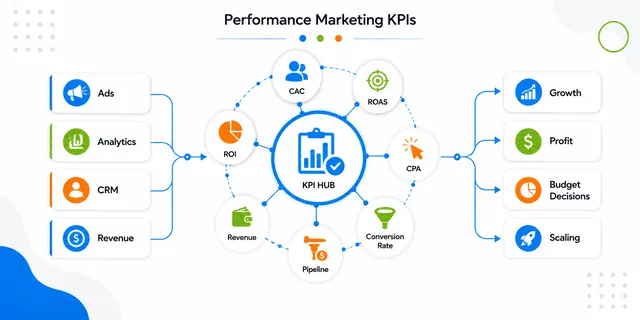
Modern marketing data comes from ad platforms, analytics tools, CRM systems, and backend reports, which makes attribution more complex than in the past. Google Ads attribution research (2023) shows that customers often interact with multiple channels before converting, which means no single metric can explain performance. Because of this, companies need to evaluate several KPIs together instead of relying on clicks, impressions, or leads alone.
What are the most important performance marketing KPIs?
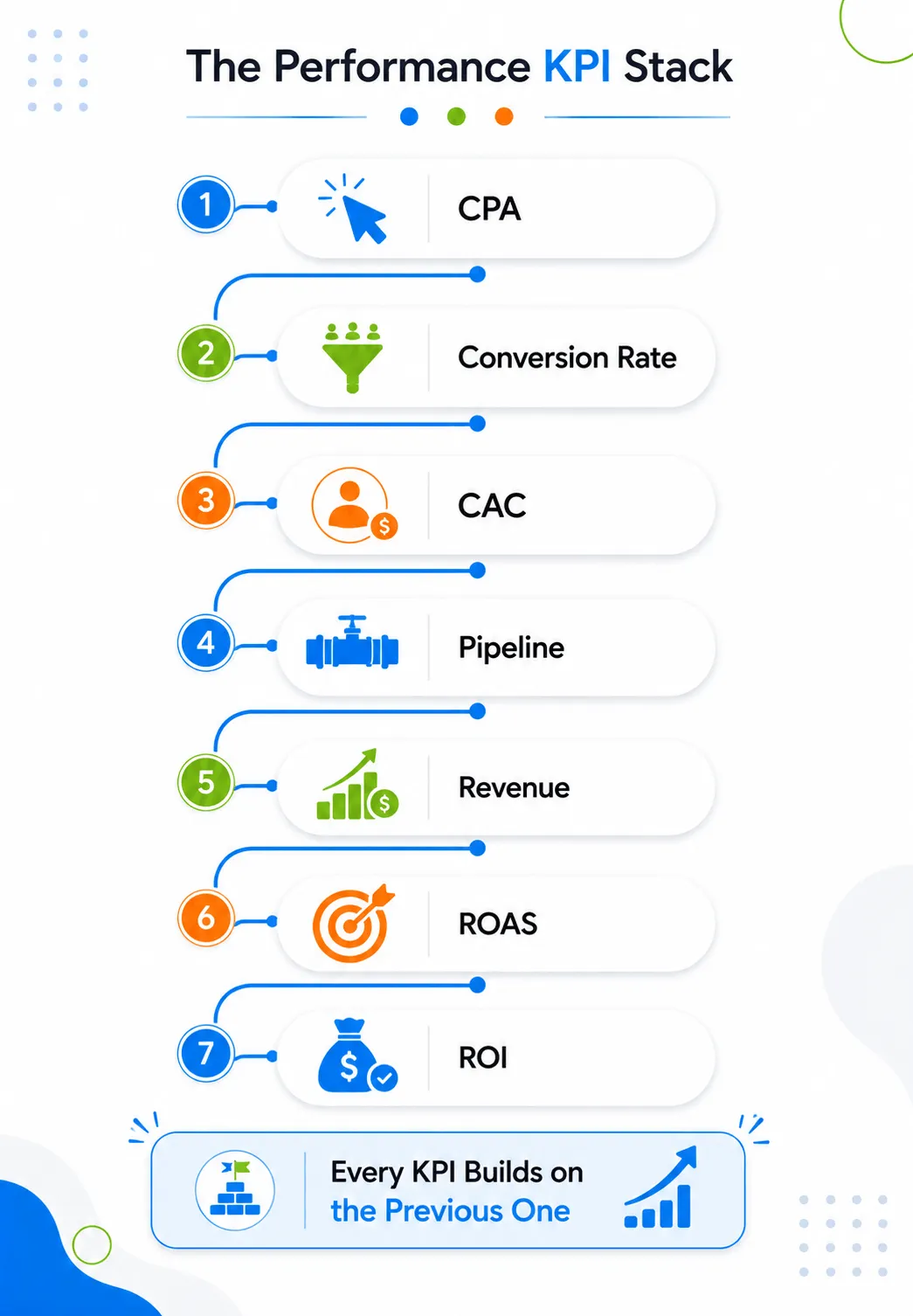
The 7 essential performance marketing KPIs are:
- CAC (Customer Acquisition Cost)
- ROAS (Return on Ad Spend)
- Conversion Rate
- CPA (Cost per Acquisition)
- Pipeline / SQL value
- Total Revenue
- Marketing ROI
Unlike vanity metrics such as clicks or impressions, these KPIs measure cost efficiency, lead quality, and bottom-line profitability. In most campaign audits we run, the accounts that scale successfully are the ones evaluated using revenue, pipeline, or acquisition cost instead of engagement metrics alone.
Quick Overview: The 7 KPIs That Actually Matter
Each KPI measures a different part of the marketing funnel. Looking at only one number can give a misleading picture of results, which is why decision makers usually review several metrics together when evaluating ROI.
These KPIs appear in most dashboards, but they should not be interpreted in isolation. A Nielsen Marketing ROI Report (2024) and McKinsey performance measurement research (2023) both show that campaigns can look profitable inside ad platforms while producing weak real returns when full costs are included.
Understanding how each KPI fits into the funnel is necessary to make correct decisions about budget, scaling, and strategy.
1. KPI #1 — Customer Acquisition Cost (CAC)
Customer Acquisition Cost (CAC) measures how much it costs to acquire one customer. It is calculated by dividing total marketing and sales cost by the number of new customers generated during a period. CAC is one of the most important KPIs for evaluating whether growth is profitable and sustainable.
Used for:
- budget planning
- scaling decisions
- profitability analysis
- forecasting growth
Difference from CPA:
- CPA = cost per conversion
- CAC = cost per actual customer
Limits:
- hard to track in multi-touch funnels
- offline sales may not be included
- B2B attribution is often incomplete
- CRM data may not match ad platforms
In our experience reviewing SaaS and ecommerce dashboards, CAC usually increases as campaigns scale, which is why it becomes one of the main limits to growth. Benchmark reports from ecommerce and SaaS studies (2023–2024) show that rising acquisition cost is one of the biggest challenges in performance marketing.
2. KPI #2 — Return on Ad Spend (ROAS)
Return on Ad Spend (ROAS) measures how much revenue is generated for every amount spent on advertising. It is calculated as revenue divided by ad cost and is one of the most common KPIs in paid media campaigns.
Used for:
- paid ads optimization
- ecommerce performance tracking
- budget allocation
- campaign comparison
Difference from other metrics:
- ROAS ≠ ROI
- ROAS ≠ profit
- ROAS only compares revenue vs ad cost
Limits:
- does not include product cost
- does not include salaries or overhead
- high ROAS can still lose money
- platform revenue tracking may be inaccurate
A Nielsen Marketing ROI Report (2024) shows that campaigns with strong ROAS can still produce weak profitability when product cost, discounts, and overhead are included. In many audits we run, ROAS looks strong in Ads Manager but does not match real profit in CRM or finance reports.
3. KPI #3 — Conversion Rate
Conversion Rate measures the percentage of users who complete a desired action after clicking an ad or visiting a page. It shows how efficiently traffic turns into leads, signups, or customers.
Used for:
- landing page optimization
- ad performance testing
- funnel improvement
- CRO (conversion rate optimization)
Why it matters:
- higher conversion rate lowers CAC
- higher conversion rate improves ROAS
- higher conversion rate allows scaling with less budget
Limits:
- high conversion does not always mean high revenue
- conversion quality may vary
- funnel stage affects expected rate
- platform conversions may not equal real customers
Google Ads benchmark studies (2023) show that small improvements in conversion rate can significantly reduce cost per acquisition. In our testing, improving landing page conversion often produces better results than increasing ad spend.
4. KPI #4 — Pipeline / SQL (Qualified Opportunities)
Pipeline or SQL measures the value of qualified leads that can realistically become customers. This KPI is commonly used in B2B, SaaS, and high-ticket sales where conversions do not happen immediately.
Used for:
- B2B marketing
- high-ticket funnels
- long sales cycles
- lead quality evaluation
Why it matters:
- leads ≠ customers
- pipeline shows real opportunity
- aligns marketing and sales
- used for forecasting
Limits:
- requires CRM tracking
- hard to connect to ads
- sales cycles take time
- attribution not exact
In many B2B audits we review, lead volume looks strong but pipeline value is weak, which means marketing is generating activity without producing real opportunities. Because of this, pipeline is often a more reliable KPI than leads alone.
5. KPI #5 — Cost per Acquisition (CPA)
Cost per Acquisition (CPA) measures how much it costs to generate one conversion, such as a lead, signup, or purchase. It is calculated by dividing ad spend by the number of conversions and is commonly used to evaluate campaign efficiency.
Used for:
- paid ads optimization
- lead generation campaigns
- ecommerce tracking
- comparing creatives and audiences
Difference from other metrics:
- CPA = cost per conversion
- CAC = cost per customer
- CPL = cost per lead
Limits:
- low CPA does not guarantee profit
- cheap leads may not become customers
- conversion tracking may be incomplete
- different funnels require different CPA targets
In many campaign audits we review, CPA looks strong inside ad platforms but does not match real performance in CRM or backend data. Cheap conversions often come from low-quality traffic, which is why CPA should always be reviewed together with CAC, pipeline, or revenue.
6. KPI #6 — Revenue (Real Performance)
Revenue tracking measures the actual sales generated from marketing campaigns using backend, CRM, or payment data instead of platform reports. It shows real business results and is often the most reliable way to evaluate performance.
Used for:
- measuring real campaign impact
- comparing marketing vs sales results
- validating ad platform reports
- understanding full-funnel performance
Common data sources:
- HubSpot / Salesforce — CRM pipeline and deals
- Shopify / Stripe — purchases and payments
- backend reports — real sales data
- BI dashboards — combined reporting
Limits:
- attribution across channels is not exact
- multi-touch journeys make tracking harder
- offline sales may not be connected
- platform reports may not match CRM
McKinsey marketing measurement research (2023) shows that many companies track dozens of marketing metrics but struggle to connect them to revenue. In our experience, the moment teams start comparing ad reports with CRM or payment data, performance often looks very different from what dashboards suggest.
7. KPI #7 — Marketing ROI / Profit
Marketing ROI measures the profit generated from marketing after all costs are included. It compares total revenue with total marketing and sales expenses to determine whether campaigns are truly profitable.
Used for:
- budget decisions
- scaling campaigns
- long-term planning
- evaluating overall strategy
Why it matters:
- shows real business performance
- includes costs beyond ads
- prevents scaling unprofitable campaigns
- used by decision makers, not only marketers
Limits:
- hardest KPI to calculate
- requires full cost data
- needs CRM, finance, and ad data combined
- often delayed compared to ad reports
A Gartner marketing analytics report (2024) notes that companies increasingly rely on first-party data and CRM reporting to evaluate real performance, because platform dashboards alone do not show full profitability. In many cases we review, campaigns that look profitable in Ads Manager turn negative after salaries, discounts, and product cost are included.
8. How Companies Choose the Right KPIs
Companies choose performance marketing KPIs based on business goals, funnel structure, and how data flows from campaigns to real sales. The correct KPI depends on what the company wants to measure, which usually requires connecting ad platforms, analytics, CRM, and reporting tools.
Different companies use different KPIs depending on the business model. Ecommerce often focuses on ROAS, B2B on pipeline, and SaaS on CAC or LTV. In most performance reviews we run, the most useful KPI is the one connected to real revenue, not the one shown in the ad platform.
FAQs
What is the most important KPI in performance marketing?
There is no single KPI for every business, but revenue, CAC, ROAS, and ROI are usually the most important because they show real financial performance.
What is a good ROAS in 2026?
A good ROAS depends on product cost, margins, and overhead. In many ecommerce campaigns, a ROAS between 2–4 may look strong in Ads Manager but still be unprofitable after expenses.
Why is CPA not enough to measure performance?
CPA only shows the cost of a conversion. It does not show whether the conversion becomes a paying customer or produces revenue.
Why do dashboards not match real revenue?
Ad platforms use attribution models that may not include offline sales, multi-touch journeys, or backend data. CRM and payment reports usually show more accurate performance.
Which KPI should B2B companies use?
Pipeline, SQL value, and CAC are often more useful than CPA or clicks, because sales cycles are longer and conversions do not happen immediately.
Read These Next
Marketing Automation Workflow: How to Design High-Converting Sequences from Scratch