.png)
.webp)
Performance Marketing vs Content Marketing: Choosing the Right Focus for Your Business
.png)

.png)

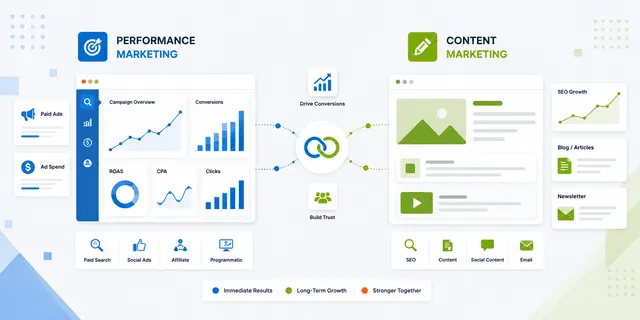
Performance marketing delivers immediate, measurable ROI through paid channels like Search and Social, making it effective for short-term sales. Content marketing builds long-term brand authority and organic traffic through valuable assets, reducing acquisition costs over time. In 2026, the most effective strategy integrates both to balance instant conversions with sustainable, privacy-resilient growth.
INTRODUCTION
Performance marketing and content marketing are often treated as competing strategies, but they serve different roles in driving business growth.
Performance marketing is designed to generate immediate, measurable results such as leads, sales, or conversions. Content marketing focuses on building awareness, trust, and long-term demand through consistent content creation.
In 2026, the distinction matters more due to:
- AI-driven campaign optimization (e.g., Meta Advantage+, Google Performance Max, LinkedIn Thought Leader Ads)
- privacy-first tracking reducing visibility into user behavior due to the phase-out of third-party cookies, stricter consent requirements, and limited cross-platform tracking
- longer, multi-touch customer journeys
Recent industry data indicates that 40–60% of conversions are now modeled rather than directly observed in some advertising platforms. This shift is driven by signal loss from privacy changes, making attribution less precise and more dependent on estimation.
Industry insights show that businesses using both performance and content strategies together tend to achieve more stable growth compared to relying on one channel alone (Breeze Development, 2024; LinkedIn Insights).
WHAT THIS GUIDE COVERS
This guide explains how performance marketing and content marketing differ and how to choose the right focus based on business goals, timeline, and resources.
It covers:
- What performance marketing is
- What content marketing is
- Key differences between both approaches
- When to prioritize performance marketing
- When to prioritize content marketing
- How both strategies work together
- How to choose the right strategy for your business
- How AI and privacy changes affect both approaches
- Advantages and limitations of each strategy
What Is Performance Marketing?
Performance marketing is a results-driven approach where advertisers pay based on measurable outcomes such as clicks, leads, or conversions. It focuses on short-term performance and continuous optimization using real-time data.
Performance marketing includes:
- paid search (Google Ads)
- social media advertising
- affiliate marketing
- programmatic advertising
The main characteristics:
- measurable ROI (e.g., CPA, ROAS)
- immediate traffic generation
- ongoing optimization through testing
Because results are trackable, performance marketing allows businesses to scale campaigns based on data rather than assumptions.
However, its effectiveness depends heavily on:
- accurate tracking systems
- strong creatives and targeting
- sufficient budget for testing and scaling
- conversion modeling systems that estimate performance when tracking is incomplete
What Is Content Marketing?
Content marketing is a long-term strategy focused on creating and distributing valuable content to attract, engage, and retain an audience. Instead of driving immediate conversions, it builds trust and brand authority over time.
Common formats include:
- blog articles
- videos
- social media content
- email newsletters
Key characteristics:
- long-term audience building
- organic traffic generation
- brand positioning and authority
Content marketing typically requires more time to produce results. However, once content ranks or gains traction, it can generate consistent traffic without ongoing ad spend.
Earlier studies suggested content marketing could cost significantly less than traditional outbound marketing. However, in 2026, this gap has narrowed. Due to AI-driven content saturation, the cost of producing high-quality, differentiated content has increased, especially when factoring in strategy, distribution, and ongoing optimization.
Content marketing also plays a key role in Top-of-Funnel (ToFu) nurturing, where users are introduced to a brand before they are ready to convert.
What Are the Key Differences Between Performance Marketing and Content Marketing?
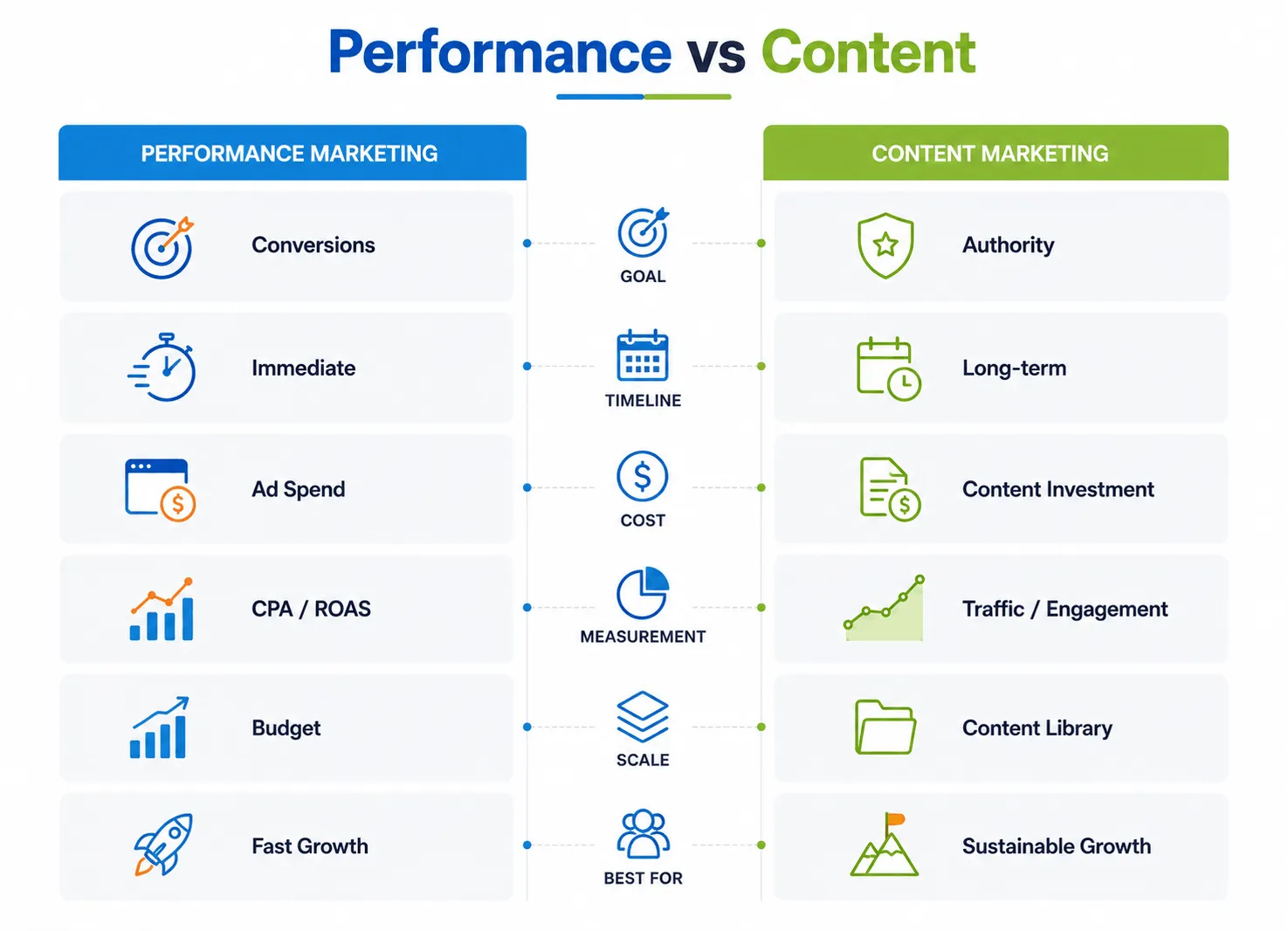
Performance marketing and content marketing differ in goals, timeline, cost structure, and measurement. Performance marketing prioritizes immediate results, while content marketing focuses on long-term growth and audience building.
Quick Comparison
Performance marketing delivers faster results but requires continuous spending. Content marketing takes longer but compounds over time.
When Should You Focus on Performance Marketing?
Performance marketing should be prioritized when the goal is to generate immediate results such as leads, sales, or traffic. It is most effective when campaigns require fast feedback and scalable outcomes.
Situations where performance marketing is more effective:
- new product launches
- short-term revenue targets
- testing offers or messaging
- entering new markets
Advantages:
- immediate data and feedback
- faster revenue generation
- clear attribution of results
However, relying only on performance marketing can increase costs over time. As competition increases, cost per acquisition (CPA) often rises, especially in saturated markets.
When Should You Focus on Content Marketing?
Content marketing is more effective when the goal is long-term growth, brand positioning, and organic traffic generation. It is best suited for businesses that want to reduce reliance on paid advertising over time.
Situations where content marketing is more effective:
- building brand authority
- improving SEO and organic visibility
- nurturing long sales cycles
- educating the market
Advantages:
- lower long-term acquisition cost
- compounding traffic over time
- stronger brand trust
However, content marketing requires:
- consistent production
- time to gain traction
- alignment with audience needs
Because of this, it is less suitable for immediate revenue needs.
How Do Performance and Content Marketing Work Together?
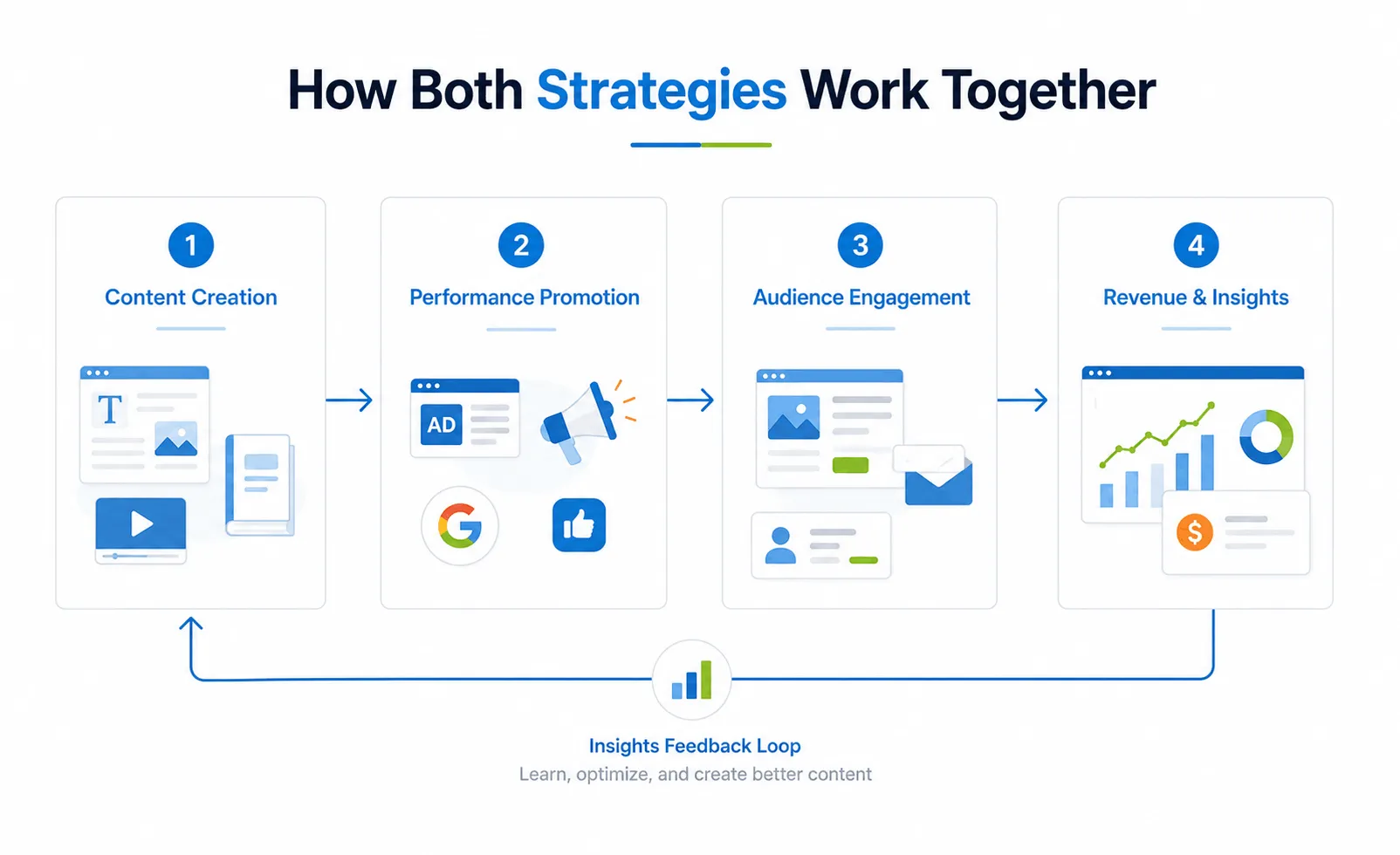
Combining performance marketing and content marketing allows businesses to generate immediate results while building long-term demand. Performance drives traffic and conversions, while content supports trust, engagement, and retention across the customer journey.
The two strategies work best when treated as one system rather than separate channels.
How they work together:
1. Content supports performance campaigns
Content improves ad performance by providing:
- landing pages that convert better
- educational material for retargeting
- stronger messaging alignment
Example:
- blog → used as landing page for paid ads
- video → repurposed into ad creatives
2. Performance marketing amplifies content
Paid campaigns can distribute content faster and reach targeted audiences.
Examples:
- promoting high-performing blog posts
- boosting videos with strong engagement
- running lead generation campaigns using content
This reduces the time it takes for content to gain traction.
3. Shared data improves both strategies
Performance marketing provides real-time data that can inform content creation.
Examples:
- high-converting keywords → used for SEO content
- winning ad messaging → used in blog headlines
- audience insights → used for content topics
This integration is increasingly supported by:
- Zero-party data (information users intentionally provide)
- CRM platforms such as HubSpot Content Hub
- AI tools like Jasper or Writer for content scaling
This creates a feedback loop between paid and organic efforts.
What Is the Best Strategy for Your Business Goals?
The best approach depends on business objectives, timeline, and available resources. Performance marketing is suited for immediate results, while content marketing supports long-term growth. Most businesses benefit from balancing both instead of choosing only one.
Decision Framework
Key consideration factors:
- Time horizon → short-term vs long-term
- Budget availability → ongoing ad spend vs upfront content investment
- Sales cycle length → immediate vs delayed conversions
- market competition → high competition increases paid costs
In practice, most businesses start with performance marketing to generate results, then invest in content marketing to reduce dependency on paid channels.
What Is Multi-Touch Attribution and Why Does It Matter?
Multi-touch attribution is a method of assigning value to multiple interactions a user has before converting, rather than giving full credit to a single click.
In most customer journeys, users interact with several touchpoints—such as ads, content, search, and email—before making a decision. Studies show that many conversions involve 6–10+ interactions, especially in higher-consideration purchases. Relying only on the final interaction creates a distorted view of performance, where channels that generate demand appear less effective than those that simply capture it.
This has direct impact on budget decisions. Channels closer to conversion—such as search or retargeting—often receive more credit, while discovery and Top-of-Funnel (ToFu) efforts are undervalued or reduced. Over time, this leads to weaker demand generation and slower growth.
Because tracking is now more limited due to privacy changes, platforms increasingly rely on conversion modeling to estimate how these touchpoints contribute to outcomes. In many cases, 40–60% of reported conversions are now modeled rather than directly observed, which reduces precision but still provides directional insight.
As a result, multi-touch attribution is no longer about exact accuracy. It is about understanding how different channels contribute to the overall system, and making decisions based on consistent patterns rather than isolated metrics.
How Do AI and Privacy Changes Affect Both Strategies in 2026?
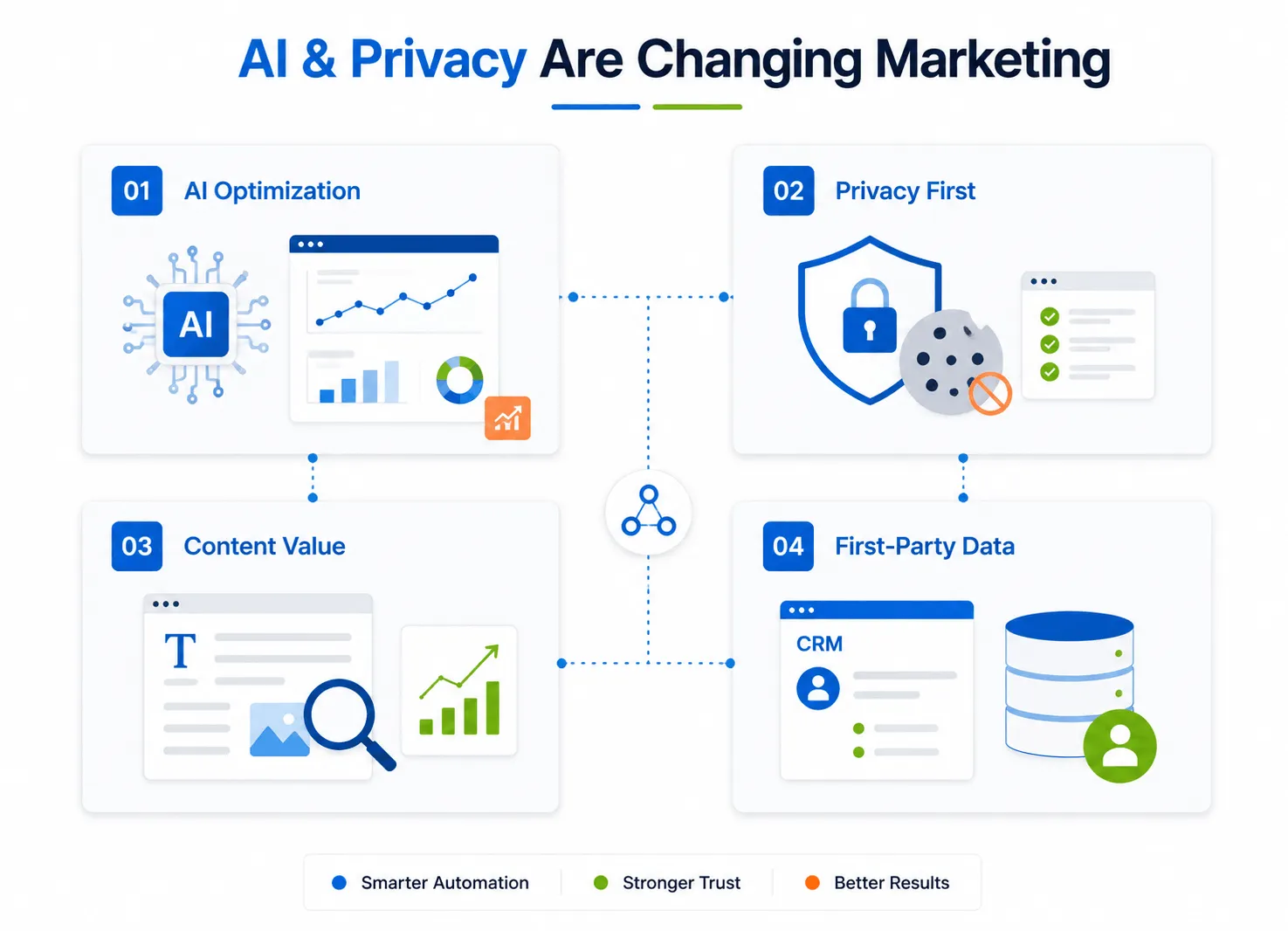
AI-driven systems and privacy-first tracking have changed how both performance marketing and content marketing operate. These changes affect targeting, measurement, and optimization across channels.
1. AI is reshaping performance marketing
Ad platforms now automate:
- bidding
- targeting
- budget allocation
This improves efficiency but reduces manual control.
As a result:
- performance depends more on data quality
- creatives and inputs matter more than settings
- testing becomes more important than manual optimization
2. Privacy changes limit tracking accuracy
With the end of third-party cookies and stricter privacy regulations:
- attribution becomes less precise
- user-level tracking is limited
- platforms rely more on modeled data
Many businesses are also shifting to GTM server-side tracking and first-party data collection to improve tracking reliability in privacy-first environments.
3. Content marketing becomes more valuable
Because tracking is limited, content plays a larger role in:
- building brand recall
- capturing organic traffic
- supporting multi-touch journeys
Users often interact with multiple pieces of content before converting, making content marketing essential in privacy-first environments.
4. First-party data connects both strategies
Both approaches now rely more on:
- CRM data
- email lists
- website behavior
First-party data improves:
- targeting accuracy in performance campaigns
- personalization in content marketing
What Are the Advantages and Limitations of Each Approach?
Performance marketing and content marketing offer different benefits and trade-offs. Performance marketing prioritizes speed and measurable results, while content marketing focuses on long-term growth. Understanding both helps businesses allocate budget and resources more effectively.
CONCLUSION
Performance marketing and content marketing serve different but complementary roles in business growth. Performance marketing delivers immediate, measurable results, while content marketing builds long-term demand and brand trust.
Choosing the right focus depends on:
- business goals
- timeline
- available resources
In 2026, relying on only one approach is less effective. Privacy limitations and AI-driven systems require a more integrated strategy.
Businesses that combine both approaches can:
- generate short-term revenue
- build long-term visibility
- reduce dependency on paid channels
A structured approach that aligns performance marketing with content marketing provides more stable and scalable results over time.
FAQs
What is the main difference between performance marketing and content marketing?
Performance marketing focuses on measurable short-term results, while content marketing builds long-term audience engagement and brand authority.
Which is better for small businesses?
Small businesses often start with performance marketing for quick results, then invest in content marketing for sustainable growth.
Can performance marketing work without content marketing?
Yes, but performance may decline over time due to rising costs and lack of brand support.
How long does content marketing take to show results?
Content marketing typically takes several months to generate consistent traffic and measurable impact.
Is it necessary to use both strategies?
In most cases, yes. Combining both improves efficiency, scalability, and long-term performance.
Read These Next
AI Marketing Automation: How to 10x Your Output with Machine Learning